Homemade Betta Fish Tank Decorations
As an Amazon Associate we earn from qualifying purchases. Details
People who search for homemade betta fish tank decorations usually want to make something themselves, save money, or give a tank a personal look. That is a good goal, but a home-made item goes into the water with a fish that has long, delicate fins. This guide covers which homemade ideas make sense, how to prepare them, and what to avoid. It is an informational guide, so it gives no product quota and no affiliate links. The only outside source I opened is the aquariuminfo.org betta care page, which I use for tank-size context. Anything else here is general practical guidance, and where a material’s safety is in question the guide says so instead of guessing.
Quick answer
- Make decor that is smooth, stable, and sized for the tank. Rough edges can catch fins. Loose pieces can tip over.
- Use only materials you can confirm are made for aquariums. If the label or the seller does not say the material is aquarium-safe, do not put it in the tank.
- Test-fit before the fish goes in. Place the item, watch the water for a day, and check that the item does not block the swimming space.
What the person searching wants
The person typing homemade betta fish tank decorations wants a DIY answer: what to build, what to use, and how to prepare it. They are not looking for a shopping list, so this guide does not rank products. Where a store-bought option is a sensible shortcut, the guide says so in one line and does not link to it.
The rules that apply to every homemade piece
Before you think about shape or color, check four things. Each one follows from how a betta uses its tank: it swims through the middle, rests near the surface and on the bottom, and has fins that can snag.
- Smooth edges. Sand, file, or polish any cut edge until it is smooth to the touch. A betta’s long fins can tear on a rough cut.
- Stable base. A piece that rolls or tips when the fish bumps it is a hazard. Set heavy pieces on the bottom, and keep tall pieces toward the back.
- Open swimming lane. Leave the front and middle of the tank clear. A decor piece that fills the whole tank makes the fish work harder to cross it.
- Known material. Use materials the seller or manufacturer describes as aquarium-safe, or natural stone and wood that you have checked and prepared. If you are not sure, leave it out.
Homemade ideas that work
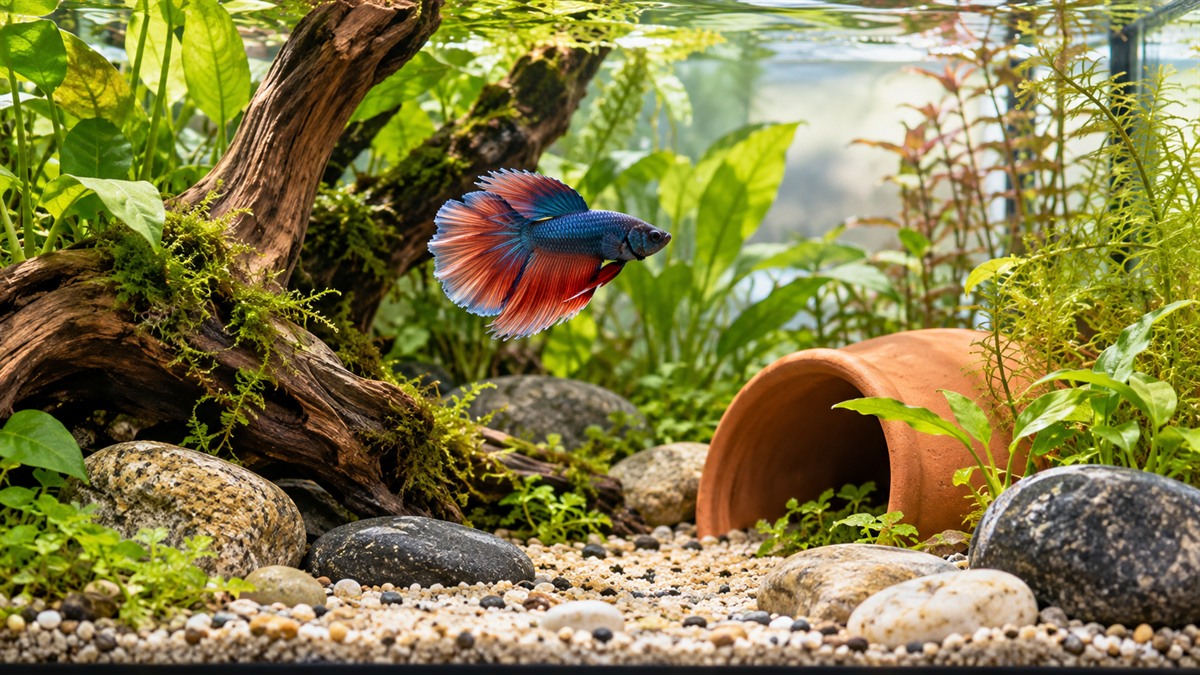
Stacked smooth stones
A small stack of smooth stones can make a cave-like hiding spot. Choose stones with no sharp points, rinse them well, and stack the larger ones first. Keep the stack low and wide so it does not tip. Before you stack anything, check that the stones are not a material you cannot confirm for aquarium use. Stones from a garden or a creek can carry dirt or unknown minerals, so rinse them thoroughly and do not use stones that crumble or fizz when a little vinegar is dropped on them. Those are simple checks, not a safety certification.
A leaf or bark hide
Many keepers use a leaf or a piece of bark as a resting spot near the surface. Use only leaves and bark that are sold as aquarium-ready, or prepare them yourself by soaking them until they sink and no longer shed debris. If you are not sure a leaf is safe, use a store-bought hammock instead. The Zoo Med betta bed leaf hammock guide covers the store-bought version.
A PVC or plastic pipe hide
A short length of pipe can work as a tube hide. Use new pipe that is sold for aquarium use or that the seller describes as safe for fish. Cut both ends, then sand every edge until it is smooth to the touch. Do not glue anything unless the glue label says it is aquarium-safe. Silicone sealant can be used for some builds, but only if the label says aquarium-safe, and cure it fully before the piece goes in the water.
Live or silk plants on a stone
A plant tied or glued to a stone can make a natural-looking base. Pick plants that will grow in your tank’s light, and check the plant care for the lighting it needs. Silk plants can be tied to a smooth stone with thread, but check that the thread is not a loop that could snag a fin. For plant ideas, see the live plants guide.
A sand or rock base
A layer of sand or a pile of rock can give the bottom of the tank a finished look, and some decor sits better on a base. Choose smooth sand, not sharp grit, and rinse it until the water runs clear. The sand or rocks guide explains the trade-offs.
What to avoid when you build
- Painted, varnished, or treated wood. Unless the seller says the finish is aquarium-safe, leave it out. This guide does not state which finishes are safe, because I have not opened a source that does.
- Metal and sharp scrap. Metal can rust and can have sharp edges. Leave it out.
- Anything that crumbles. A piece that breaks apart in the water can cloud the tank and can be hard to remove.
- Decor that blocks the surface. A betta rests and breathes near the top. A raft or hide that covers the whole surface leaves the fish no clear place to rest.
- Pieces too large for the tank. Measure before you build. A decor item that takes up a large part of a 5-gallon tank leaves little room for swimming.
A worked example with measurements
For example, take a 5-gallon tank. The aquariuminfo.org betta page says anything larger than 5 gallons suits a betta, and more water is better, so 5 gallons is a starting point rather than a maximum. Plan the decor like this:
- Put the tallest homemade piece, a stone stack, at the back corner of the tank.
- Put a flat, smooth hide against the side glass on the opposite side.
- Leave the front half of the floor clear so the fish can cross it without touching anything.
- Set a leaf hide near the surface on one side only, so the fish can rest without losing the open front.
Measure each piece against the tank’s floor and height before you place it, and do not use any figure you have not measured yourself. Then fill the tank, run the heater and filter, and check the water for a day before you add the fish. If a piece moves or tips, remove it and reset it on a wider base.
Sizes to compare against store-bought decor
If you are unsure how big a homemade piece should be, compare it with finished decor. The decor listings in my cache give sizes you can use as a reference. They are the seller’s figures, and I have not measured any of these pieces.
- A silk plant with a weighted base is listed at 6 x 4 x 3 inches (L x W x H). The listing also says it is suitable for tanks it describes as ranging from 2.5 to 30 gallons.
- A driftwood-style cave is listed at 6.3 x 2.8 x 3.9 inches (L x W x H). The listing says to soak it for 10 to 15 minutes before placing it in the tank.
- A plastic plant and rock cave set is listed at 5.4 x 5.4 x 3.4 inches and weighs 11.2 ounces, according to the listing.
- A stackable ceramic cave is listed as a small shelter for bottom-dwelling fish, with no size given in the excerpt I cached.
Use these figures as a sense of scale. A homemade piece about the same footprint as a listed cave leaves about the same amount of room in the tank. For a 5-gallon tank, which is the size the aquariuminfo.org page treats as a starting point, a piece near 6 inches wide is a reasonable check, but measure your own tank before you decide. A piece the size of the whole front of the tank is too large, whatever its material.
The soak instruction on the driftwood listing is useful for any wood you prepare yourself. Wood that has not been soaked can float, release tannins, or shed debris into the water. Soak homemade wood until it sinks and the water stays clear, and check the water before you add fish.
Checking a finished decor listing
When a store-bought piece is the easier choice, check the listing before you buy. Look for the size in inches, the material, whether the edges are described as smooth, and whether the listing says the item is for aquarium use. Be careful with phrases such as “fish safe” or “non-toxic”, since those are the seller’s wording. Compare the size with the tank you have, and leave a clear swimming lane in front of any cave or plant you add.
Mistakes to avoid
- Building a piece you have not tested for fit. A cave that looks fine on the table may block the swimming lane in the tank.
- Skipping the smoothing step. A rough cut that is not sanded can tear fins.
- Using a material because it looks natural. Natural does not mean safe for a tank. Check the source.
- Stacking too high. A tall, narrow stack can tip when the fish bumps it, and it can fall on the glass.
- Adding everything at once. Add one piece at a time and watch the fish for a few days, so you can see which piece causes trouble.
Who should skip homemade decor
If you have no time to prepare materials, or you cannot confirm that a material is made for aquariums, buy finished decor instead and check its listing for size and smooth edges. If you have a betta in a container smaller than 5 gallons, fix the tank first. Decor is the last step, not the first.
How to choose: a short rule
Build a homemade piece only when you can answer three questions: is the material known to be aquarium-safe, are all the edges smooth, and does the piece leave the fish a clear place to swim and rest? If you cannot answer yes to all three, leave the piece out and use a store-bought item with a clear listing.
Related guides
- Best live plants for a betta fish tank helps with the plant side of a homemade hide.
- Sand or rocks for a betta tank explains the base layer.
- Zoo Med betta bed leaf hammock covers a store-bought resting spot for comparison.
Source
The tank-size context in this guide comes from the aquariuminfo.org betta page: aquariuminfo.org betta care. Other points are general practical guidance. Where safety depends on a material, check the label or the manufacturer’s statement before you use it.
FAQ
Can I use stones from my garden?
You can if you rinse them well and they are smooth and do not crumble. Avoid stones that fizz when a little vinegar is dropped on them, and leave out any stone with sharp points.
Is a PVC pipe safe for a betta?
Only if the pipe is new, sold for aquarium use or described as safe for fish, and every cut edge is sanded smooth. Do not use glue unless its label says it is aquarium-safe.
Can I paint decor for my betta tank?
Not unless the paint or finish is described as aquarium-safe by the seller or manufacturer. This guide does not give a safety claim for paints.
How many homemade pieces should a 5-gallon tank hold?
Start with a few small pieces and leave the front open. Add more only if the fish uses the space well.
Is it better to buy decor?
Store-bought decor with a clear listing can save time and removes the guesswork about materials, as long as the listing gives the size and says the edges are smooth.