Best Internal Aquarium Pumps for a Betta Tank: Flow Math and Electrical Safety
As an Amazon Associate we earn from qualifying purchases. Details
The best internal aquarium pumps for a betta tank are the ones whose stated flow stays gentle enough for a betta to rest in, whose stated lift and size fit the tank, and whose cord can be kept well away from the water. An internal pump sits inside the tank under the water and moves water for an outlet or a filter. This guide compares the four in-tank pumps in the listing set, works through the flow figures each one states, and sets out the electrical rules for a pump that runs underwater.
Quick answer
- Pick by stated flow, then by tank size. Divide the stated gallons per hour by your tank volume to get turnovers per hour. A 317 GPH pump gives 63.4 turnovers an hour in a 5-gallon tank and 31.7 in a 10-gallon tank.
- Four of the twelve listings are in-tank pumps. The JAJALE 317 GPH, the LEDGLE, the FKSC 50 GPH and the ERAARK replacement pump are the picks. The other eight are air pumps, a sponge filter, a corner filter, a siphon and a kit.
- One listing gives two different flow figures. The LEDGLE title says 400 GPH, but its specifications give 1,800 liters per hour, which is about 475.5 GPH.
- Keep the cord and plug away from the water. CPSC guidance says cords should stay at least 5 feet from water, and a product that falls in should be unplugged before anyone reaches in.
What counts as an internal pump
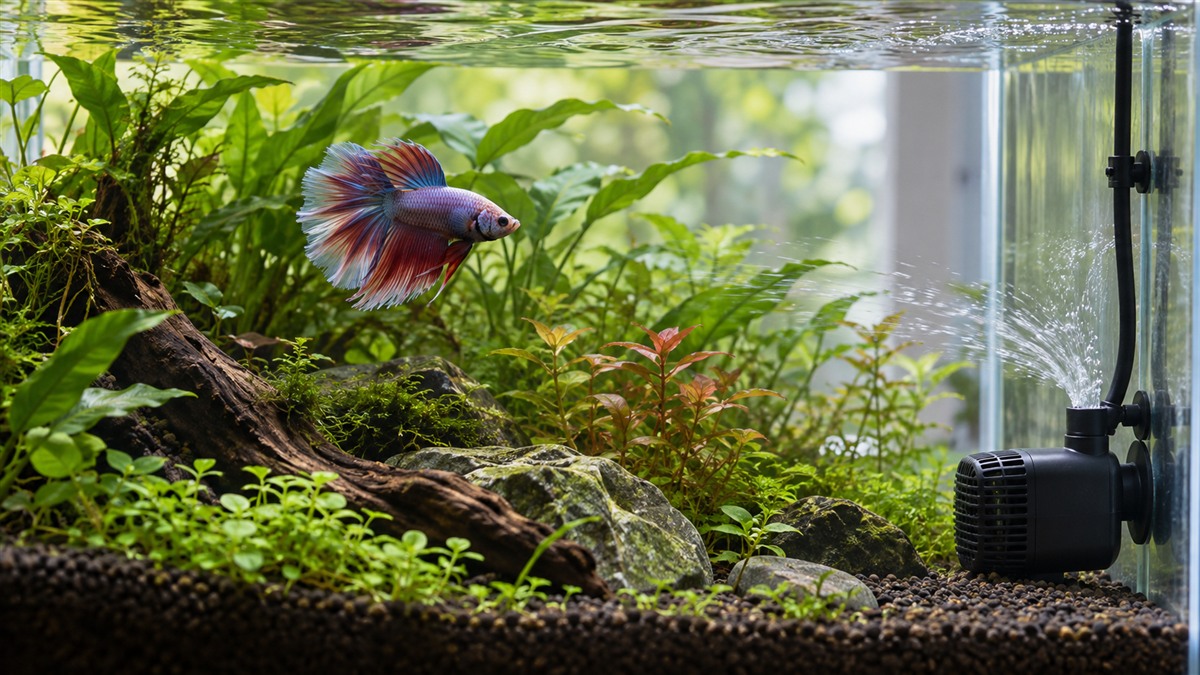
Internal is the word aquarium shops use for a pump that lives inside the tank. It is a different device from an air pump. An air pump usually sits outside the tank, pushes air down a tube, and drives an air stone or a sponge filter. An internal pump has its motor in the water, so its cord runs from the tank to a wall outlet, and its outlet creates the water movement you see in the tank.
That difference shapes the purchase. An air pump is judged by its airflow and how many air stones or sponge filters it can run. An internal pump is judged by its water flow in gallons or liters per hour, its maximum lift, and how it mounts. The listings in this set state those numbers in different places, which is why the tank-size arithmetic below is useful.
Twelve listings were in the source set for this keyword. Four are in-tank pumps by their own wording or by how they are mounted. The JAJALE 317 GPH and the FKSC 50 GPH name themselves submersible water pumps. The LEDGLE names itself a submersible pump. The ERAARK is a replacement water pump for one specific tank, and its listing says it uses four suction cups at the bottom. The other eight are four air pumps from Novique, HouseUp, Uniclife and Aqua Culture, a sponge filter from UPETTOOLS that needs an air pump to run, a hang-on-back corner filter from NIUZYRO, a hand siphon from AQUANEAT, and a 5-gallon kit from Rechale. None of those eight is an internal pump, so this post does not pick them. The listing set is unchanged; the picks are a subset of it.
The filtration rule a pump does not replace
The UF/IFAS aquarium setup guide (VM144) lists the main components of a simple home aquarium: the tank itself, a stand, a cover, lighting, a heater, an air pump and filtration. It also says every aquarium must have biological and mechanical filtration. That sentence matters for pump shopping, because the guide treats filtration as its own requirement. A pump moves water. It does not, by itself, supply the biological and mechanical filtration the guide describes.
For a betta tank, that means the pump should be chosen to work with the filter you already run or plan to run. If the tank has a filter, an internal pump adds flow on top of it, and the total movement is what the fish feels. If the tank has no filter, a pump alone leaves the filtration requirement open, and the sources we opened do not say that a pump can stand in for it.
The same guide says water must be dechlorinated before fish go in. That step is separate from anything a pump does, and a pump does not change the chemistry of tap water.
Calm water comes before maximum flow
The UF/IFAS betta publication (FA212) describes the species and its care. It says bettas prefer calm water, and it notes that research used flow as a stressor. It also warns that heavy filtration may harm a betta’s health and welfare. For a pump buyer, that is the central fact. The best internal pump for a betta is not the strongest one. It is the one whose flow you can keep low enough for the fish to rest while the tank still gets water movement.
This changes how the numbers should be read. A pump’s listed flow is usually its maximum. A pump rated at 317 gallons an hour is built to deliver up to that flow. The listing does not say the pump should run at that flow in a betta tank. The four listings in this set describe adjustment controls in different ways. The FKSC has a side-mounted valve. The LEDGLE listing says its knob adjusts flow from 0 to 1,800 liters per hour, but it does not give the flow at any particular setting. The JAJALE describes an adjustable flow, and it gives only the maximum. The ERAARK listing describes no adjustment at all.
Turnover arithmetic for each stated flow
Turnover per hour is a simple division. Take the stated flow in gallons per hour and divide it by the tank volume in gallons. Where a listing gives liters per hour, divide by 3.785 to get gallons per hour, because one US gallon is 3.785 liters. The result tells you how many times the full tank volume passes through the pump each hour, if the pump actually runs at the stated flow.
Two conversions are worth checking before you buy. The JAJALE specifications give 1,200 liters per hour, and 1,200 ÷ 3.785 = 317, which matches the 317 GPH in its title. The LEDGLE specifications give 1,800 liters per hour, and 1,800 ÷ 3.785 = 475.5, which does not match the 400GPH in its title. The table uses the specification figure for the LEDGLE, and it says so.
Table 1: Turnovers per hour at the stated maximum flow
| Pump | Stated maximum flow | 5-gallon tank | 10-gallon tank | 20-gallon tank |
|---|---|---|---|---|
| JAJALE 317 GPH | 317 GPH | 63.4 | 31.7 | 15.85 |
| LEDGLE (from 1,800 L/h) | 475.5 GPH | 95.1 | 47.55 | 23.78 |
| FKSC 50 GPH | 50 GPH | 10 | 5 | 2.5 |
| ERAARK replacement | not stated | not calculated | not calculated | not calculated |
Each cell is the stated flow divided by the tank volume. For the JAJALE, 317 ÷ 5 = 63.4, 317 ÷ 10 = 31.7 and 317 ÷ 20 = 15.85. For the LEDGLE, using the specification figure, 475.5 ÷ 5 = 95.1, 475.5 ÷ 10 = 47.55 and 475.5 ÷ 20 = 23.78. For the FKSC, 50 ÷ 5 = 10, 50 ÷ 10 = 5 and 50 ÷ 20 = 2.5.
The table shows the scale of each pump, not a rule for your fish. In a 5-gallon tank, the JAJALE and LEDGLE figures are ceilings that move the whole volume dozens of times an hour, while the FKSC gives 10 turnovers at its maximum. In a 10-gallon tank the FKSC gives 5 turnovers an hour, which is the gentlest result among the four picks. The ERAARK cannot be calculated, because its listing gives no flow figure at all.
Reading tank size and flow together
The tank size you have decides which numbers matter. A 5-gallon tank is small enough that even the FKSC reaches 10 turnovers an hour at its maximum. A 10-gallon tank gives the FKSC 5 turnovers an hour and the JAJALE 31.7. A 20-gallon tank brings the JAJALE to 15.85 and the LEDGLE to 23.78, while the FKSC drops to 2.5. Those figures are the ceilings. Any setting below the maximum gives a lower number, but the listings do not give the lower figures.
Lift is the other stated number. The JAJALE gives a maximum lift of 6.6 feet, and the LEDGLE gives a maximum lift of 2 meters. Lift matters when the outlet sits above the water line, for example when water is pushed up to a filter or a return. In a plain betta tank with the outlet under the surface, lift is usually a secondary figure. The FKSC and ERAARK listings state no lift at all, so for those two the lift cannot be compared with the others.
Power is the third number. The JAJALE lists a 22 W motor, the LEDGLE lists 25 W, and the FKSC lists 3 watts under a horsepower label. The ERAARK lists no wattage. Watts describe the electrical load on the outlet and the cord, not the flow in the tank, so do not read a higher wattage as a stronger flow for a betta.
How we chose
We set three rules before choosing picks, and each rule comes from the listing text rather than from outside data.
- The pump must sit in the tank. We used the listing’s own words, such as submersible or water pump, and its mounting. That is how the four picks were chosen, and how the eight other listings were excluded.
- The listing must state a flow, a lift or a power figure somewhere in its bullets or specifications. The ERAARK passes on mounting and compatibility, but it states no flow, so its missing figure is flagged rather than filled in.
- Each pick needs a limitation drawn from its own listing. The four limitations below are different from one another.
The arithmetic uses only the listing figures and the unit conversion. The biology uses the two UF/IFAS publications. The electrical rules use the CPSC guidance. The post adds no figure from a retailer page or a blog. We did not drop any listing from the set. We picked the four in-tank listings and named the other eight so you can see why they are not in the picks.
1. 317 GPH Submersible Water Pump – Adjustable Quite Aquariums, Fountains, Hydroponics, and Pond Pump (JAJALE 317 GPH submersible water pump)
Pros
- The listing states a maximum of 317 GPH, 1,200 liters per hour and a 6.6 ft lift, so the figures can be checked.
- The bullets describe an adjustable flow and tool-free installation and cleaning.
Cons
- At 317 GPH a 5-gallon tank turns over about 63 times an hour, which is a strong current for a betta.
- The bullet and the specifications give different nozzle sizes, so measure the outlet before buying tubing.
Best for: A tank of 10 gallons or more where a strong, adjustable outlet is wanted.
Skip if: Your tank holds 5 gallons or less, or your betta needs a very low flow to rest.
View on Amazon (affiliate link)
2. Submersible Pump with Adjustable Flow Rate, LEDGLE Aquarium Fountain Pump, Ultra Quiet Water Pump (LEDGLE 400GPH submersible fountain pump)
Pros
- The specifications list a maximum flow of 1,800 liters per hour, a 2 m lift and a 25 W motor.
- The listing gives a lowest working water level of 0.28 in, which suits a shallow setup.
Cons
- The title says 400 GPH but the specifications give 1,800 liters per hour, about 475.5 GPH, so the figures do not agree.
- The listing says not to use it below the minimum water level, so the tank must hold enough water.
Best for: A tank of 10 gallons or more that has room for a strong outlet and a flow knob.
Skip if: Your betta tank is 5 gallons or less, or the water level can fall below the stated minimum.
View on Amazon (affiliate link)
3. 50 GPH Submersible Water Pump – Fountain Pump for Aquarium & Fish Tank Mini, Adjustable Flow (FKSC 50 GPH mini submersible pump)
Pros
- The listing states 50 GPH, a body of 2.1 by 1.7 by 2.5 inches and a side valve for flow adjustment.
- Two interchangeable intake covers let you choose side or bottom intake before installation.
Cons
- Tubing is sold separately, and the outlets fit only 10.5 mm or 13.5 mm tubing.
- The listing gives the power as 3 watts under a horsepower label, so confirm the cord rating on the box.
Best for: A tank of 5 to 10 gallons where a gentle outlet is wanted.
Skip if: You need a strong current for a tank of 20 gallons or more.
View on Amazon (affiliate link)
4. ERAARK Replaced Water Pump for ERAARK 1.5 Gallon Aquarium Smart Betta Fish Tank (ERAARK replacement pump for the 1.5-gallon smart tank)
Pros
- The listing names one tank, the ERAARK 1.5 gallon smart betta tank, so compatibility is clear.
- The listing advises cleaning the pump regularly and replacing it about every six months.
Cons
- The listing gives no flow, lift, wattage or voltage, so its turnover cannot be worked out.
- It is tied to the one named tank and is not a general internal pump.
Best for: An owner who already has the ERAARK 1.5 gallon smart tank and needs a replacement pump.
Skip if: Your tank is any other size or brand, or you need a flow figure before you buy.
View on Amazon (affiliate link)
Electrical safety around a submersible pump
The CPSC electrical guidance, written for pools and spas, says to keep electrical cords, wires and products out of reach and at least 5 feet from the water. For a betta tank this is the most practical rule in the post. The cord should run from the pump to a wall outlet that is well away from the tank, rather than along the back of the stand or across the top of the hood where it can end up close to the water line.
The same guidance says that if an electrical product falls into the water, it should be unplugged before anyone touches it, and that nobody should reach into the water until it is unplugged. Apply that rule every time you clean a pump, move a decoration near the intake, or net a fish out. Unplug first, then reach in.
The CPSC guidance also warns that even submersible pumps, which are built to run underwater, may not be safe to use when a person is in the water. A betta tank is rarely a place where a person is immersed, but the warning is a reason to unplug the pump before any work inside the tank, not only when the pump has fallen in.
The guidance says that Ground Fault Circuit Interrupters (GFCIs) are the best protection against electrocution, and that permanently installed ones should be checked monthly. If the outlet you plan to use is not GFCI protected, a GFCI device is the safer choice for any pump in the tank. The post does not say which device to buy, and the listings do not mention GFCIs at all.
Each pick has its own electrical details, and they differ. The JAJALE listing says the motor meets UL voltage standards and gives a 6 ft plug. The LEDGLE specifications list 100 volts AC and 25 W, and its listing says the pump has an IP68 waterproof rating. The FKSC lists 3 watts and corded electric power. The ERAARK lists corded electric power and no voltage or wattage. Because the LEDGLE lists 100 volts AC and the JAJALE lists 110 volts AC, check the label on the pump before you plug it into your outlet. The listing does not state the voltage range the pump accepts.
Setup and cleaning checks
Install the pump with the intake and outlet fully underwater, and never run a pump that is above the water line. The LEDGLE listing says not to use it when the minimum water level is not reached, and it names a lowest working level of 0.7 cm (0.28 in). Set the water level so the pump is covered before you switch it on. If a pump stops running after setup, see fish tank pump not working before you assume the pump is faulty.
Choose the intake cover before installation. The FKSC listing describes two interchangeable covers, one for side intake and one for bottom intake. Pick the one that keeps the intake away from the betta’s usual resting spot, and check the outlet tubing size first. The listing says the outlets fit 10.5 mm or 13.5 mm tubing, and it says tubing is sold separately.
Check the tubing and nozzle sizes on the JAJALE before you buy. Its bullet lists 1/4 in, 3/4 in and three-fifths inch ID tubing, while its specifications list 1/2 in, three-fifths inch and 3/4 in nozzles. The two statements do not agree, so measure the outlet on the pump before you buy tubing.
The ERAARK listing recommends that you disassemble and clean the pump regularly, and it recommends replacing it about every six months. Those are the listing’s own instructions, and the sources we opened do not set a cleaning or replacement schedule for aquarium pumps. The JAJALE listing says installation, removal and cleaning are tool-free. Unplug the pump before you remove it for cleaning, whichever pump you use.
Mistakes to avoid
- Reading a maximum flow as a setting. The listed GPH is the ceiling. A betta tank usually needs less, and the listings do not say how much less at each setting.
- Trusting the LEDGLE title alone. The title says 400GPH and the specifications say 1,800 liters per hour, which is about 475.5 GPH. Use the number on the product page you buy from, and confirm it before you do the arithmetic.
- Treating the pump as the filter. The UF/IFAS guide asks for biological and mechanical filtration. A pump that only adds flow does not supply that by itself.
- Buying the ERAARK for a different tank. Its listing names one tank, the ERAARK 1.5 gallon smart betta tank. Any other tank needs a different pump.
- Reaching into the tank while the pump is plugged in. The CPSC guidance says to unplug first. Make that the first step of every cleaning session.
- Running the cord close to the water. Keep the cord and plug at least 5 feet from the water, and keep the outlet away from any splash zone.
FAQ
Is an internal pump better than an air pump for a betta?
The sources we opened do not rank the two. VM144 lists an air pump among the usual parts of a home aquarium, and FA212 says bettas prefer calm water. Which is better depends on the flow you need and on whether the tank already has a filter. The flow figures in this post apply only to in-tank pumps. If you are weighing the air option, read best betta fish need air pump before you choose.
How many turnovers per hour is right for a betta tank?
No source we opened gives a turnover target for bettas, so this post does not give one. The table gives the arithmetic, not the answer. Start with the lowest flow you can set, watch the betta and the water surface, and adjust from there. If a listing does not state a lowest setting, plan on a valve or a pump with a lower stated maximum.
Is a submersible pump safe to run in a betta tank?
The CPSC guidance says electrical cords and products should be kept out of reach and at least 5 feet from the water. It says a product that falls in should be unplugged before anyone touches it, and that GFCIs are the best protection against electrocution. It also warns that submersible pumps may not be safe to use when a person is in the water. Unplug the pump before you reach in, and before you clean it.
Which pick works in a 1.5 gallon tank?
Only the ERAARK replacement pump is named for a 1.5 gallon tank. Its listing ties it to the ERAARK 1.5 gallon smart betta tank, and it gives no flow, lift or wattage. You cannot work out its turnover from the listing. Check the tank label and the pump label before you buy.
Why does the LEDGLE listing show two flow figures?
The title says 400GPH, and the specifications say 1,800 liters per hour. Converted with 3.785 liters per gallon, 1,800 liters per hour is about 475.5 GPH. The listing does not explain the difference. This post uses the specification figure for the arithmetic and treats the title figure as unconfirmed until you can check it on the product page.
Bottom line
For a betta tank, choose the lowest stated flow that still moves water through your filter, and do the division before you buy. In a 5- or 10-gallon tank, the JAJALE and LEDGLE maximums give turnover numbers that are far above the FKSC figure, so the FKSC 50 GPH is the gentlest of the four picks. Keep every cord at least 5 feet from the water, and unplug a pump before you reach into the tank.
What we could not verify
- The LEDGLE listing gives 400GPH in its title and 1,800 liters per hour in its specifications. These figures do not match, and the listing does not explain why.
- The JAJALE listing gives nozzle sizes in one bullet and different nozzle sizes in its specifications. Measure the outlet before you buy tubing.
- The lowest-setting flow for the JAJALE and FKSC pumps is not stated. The LEDGLE states a range of 0 to 1,800 liters per hour, but not the flow at any particular setting.
- The ERAARK flow, lift, wattage and voltage are not stated in its listing, so its turnover cannot be calculated.
- Quiet running, the ultra-quiet and noise-dampening claims, the pure copper motor, the dry-running protection on the LEDGLE, and the UL statements are listing claims. The sources we opened do not check any of them.
- Only the JAJALE listing states a warranty, a one-year limited warranty in its specifications. The other three do not state one.
- No source we opened gives a lifespan for an aquarium pump. The six-month replacement advice for the ERAARK comes from its listing alone.
- No source we opened gives a turnover target for bettas. The arithmetic in this post shows scale, not a recommended number.
- The CPSC guidance is written for pools and spas. Applying it to a small aquarium is a reasonable precaution, not a rule written for aquarium equipment.
- Cord length is stated only for the JAJALE, where the 6 ft figure describes the plug and cord set. The other pick listings do not state a cord length.
Sources
- UF/IFAS, Aquarium Setup and Maintenance (VM144), archival copy of the EDIS PDF: https://journals.flvc.org/edis/article/download/109188/104367/152407 (opened 2026-10-20)
- UF/IFAS, Evolution, Culture, and Care for Betta splendens (FA212), PDF copy on EDIS: https://journals.flvc.org/edis/article/download/107912/117694/177282 (opened 2026-10-20)
- U.S. Consumer Product Safety Commission, Ways to Protect Yourself and Others From Shock or Electrocution (PDF): https://cpsc.gov/s3fs-public/WaysToProtectYourselfAndOthersFromShockOrElectrocutionuUpdated07312019.pdf (opened 2026-10-20)