Cryptocoryne Aquarium Plant Care Guide
As an Amazon Associate we earn from qualifying purchases.
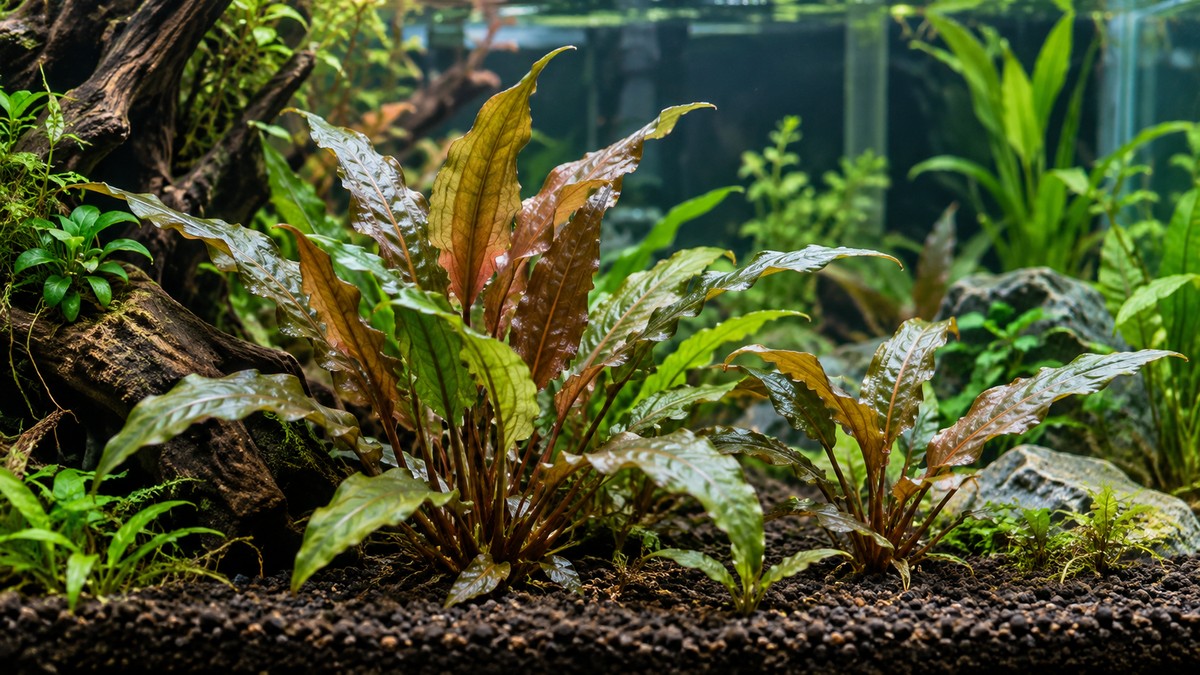
A crypt aquarium plant is a Cryptocoryne, a group of aquatic plants kept in freshwater tanks for their leaves and their tolerance of lower light. Crypts have a reputation for dropping every leaf soon after planting, so most of the advice about them is about patience. This guide uses the general botanical summary linked at the end of this page for the plant facts, and the product listings in our data for the four lights, so the care points stay general and the product points stay tied to what each page says.
Quick answer
- Crypts can lose all their leaves after planting; the source says plants may need about 30 days to establish and regrow leaves.
- Hardwater species tolerate low light but grow faster in brighter light.
- Rapid changes in the environment are suggested as a trigger for leaf loss, so keep conditions steady.
- The lights below are listed by their own stated sizes and features; none of the listings mentions Cryptocoryne.
What Cryptocoryne is
Cryptocoryne is a genus of water plants. The source describes two broad groups that matter to a keeper. Species from peat bogs need soft, acidic water and decomposing leaf litter. Species that grow on limestone are described as doing well in most aquaria and are generally easier to keep. If a plant label does not say which kind you have, ask the seller before you plant, because the water needs differ. The source gives a wide temperature tolerance of roughly 12 to 33 degrees C and a range from slightly alkaline to neutral pH for the easier species. Treat that as a general range for the group and not as a rule for one plant.
Crypt melt, explained
The behavior that surprises new keepers is leaf loss. The source says plants can lose all their leaves after planting, suggests rapid environmental change as a trigger, and says the plant may need about 30 days to establish and regrow leaves. It adds that experienced growers reportedly plant crypts in aquariums that have been established for at least three months. Moving a plant from emersed growth (grown in air at a nursery) to fully submerged conditions may also trigger the melt, which is why nurseries sometimes ship plants as bare rootstock without leaves. Some sources link the problem to nitrate buildup, so regular water changes are advised.
What this means in practice: do not throw the plant away when the leaves go. A bare rootstock can regrow. Keep the tank steady, do your regular water changes, and give it time. Our guide to aquarium plants for a betta tank lists other plants that suit similar tanks.
Light for crypts
The source says hardwater species tolerate low light, but grow faster in brighter light. The takeaway is flexibility: a crypt will live under modest lighting, and brighter light speeds growth. This is why a keeper with a small betta tank can use a modest light, while someone who wants quicker growth picks a stronger one. For more on planted-tank lighting, see our list of the best freshwater LED grow lights.
Planting and propagation notes
According to the source, submerged crypts reproduce vegetatively, which means new plants form from the existing one. Emersed plants may flower and reproduce sexually. For a keeper this means a healthy plant can slowly spread. The source does not give substrate or feeding directions, so this guide does not either. For sand-tank advice see plants that do well in sand, and for feeding, the guide to aquarium plant fertilizer. Shrimp keepers can browse plants for shrimp.
Steady conditions: a simple routine
- Plant into an established tank when you can; the source says experienced growers wait for at least three months of tank age.
- Change the water on a regular schedule, because buildup of nitrate is one suggested link to melt.
- Avoid moving the plant around, since changes appear to be a trigger.
- Light the tank with a source that matches the tank size, and leave it steady.
- Be patient for about a month before deciding the plant has failed.
If your fish look unwell, ask an aquarium-experienced vet. This guide does not cover illness.
Lights from our product data
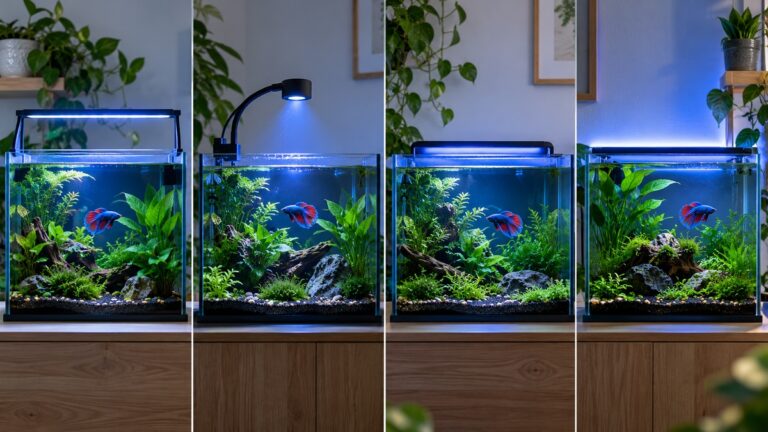
These four lights are in the data for this page. None of the listings names Cryptocoryne, so the notes below describe only what each listing says.
Fluval Plant 3.0 LED Planted Aquarium Lighting, 22 Watts
Listed for tanks 15 to 24 inches wide, with a programmable gradual 24-hour light cycle (sunrise, midday, sunset and night), six band waves for full-spectrum results, optional preset habitat configurations such as Lake Malawi, Tropical and Planted, 120 degree light dispersion and extendable mounting brackets. The product is 15 inches wide and weighs 0.55 kg. A steady, programmable cycle fits the advice to keep conditions steady. View on Amazon
HIRO AQUATICS Full Spectrum LED Light with Bamboo Board
Aimed at nano tanks. Full spectrum at 6000K, CRI above 80, 360 degree swivel, an 8.5 x 9 inch bamboo board with a maximum light height of 18 inches, 100 to 240 V and a one-year warranty. It suits a very small planted tank. View on Amazon
KZKR Upgraded Aquarium Light, 48 to 60 inch Foldable Hood Lamp
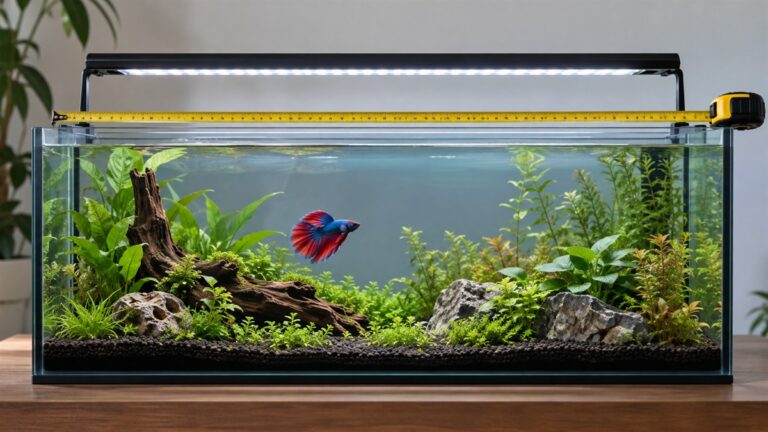
For long tanks. Two 22.5 inch lights join with retractable brackets to suit tank lengths of 120 cm (48 inch) to 150 cm (60 inch). The listing gives 5730 SMD LEDs, 5355 lumens, 33.5 to 34 W, three modes (all LEDs on, only blue LEDs, off), an aluminum case and 153 light sources. It says the light is not waterproof and must not go in the water. View on Amazon
iKefe 7.5 inch Color Changing LED Submersible Light
A colored decorative light, 7.52 inches long, with IP68 waterproofing for salt or fresh water, 12V low voltage, a wireless remote with memory, 16 colors and 4 transition effects. The listing calls it dimmable full spectrum RGB, good for plants and fish. It is more a decoration than a primary plant light, going by the listing’s focus on color effects. View on Amazon
FAQ
Why did my crypt lose its leaves?
The source says leaf loss after planting is common and may follow rapid environmental change or a move from emersed to submerged growth. It suggests about 30 days for the plant to establish and regrow.
Does a crypt need strong light?
Hardwater species tolerate low light, per the source, but grow faster in brighter light.
Is a crypt hard to keep?
The source says hardwater species are generally easier. Peat-bog species need soft, acidic water.
Which light is best for crypts?
None of the listings addresses Cryptocoryne. Match the light to tank size: nano lights for very small tanks, the KZKR for long 48 to 60 inch tanks.
Can crypts spread?
The source says submerged plants reproduce vegetatively.
Bottom line
Treat a crypt as a plant that needs a steady tank and a month of patience. Choose a light by tank size and keep it on a stable schedule; the Fluval Plant 3.0 listing is the one built around a programmable cycle. Check the species and the water it needs before buying.