Best Aquarium Cleaner Pumps
As an Amazon Associate we earn from qualifying purchases.
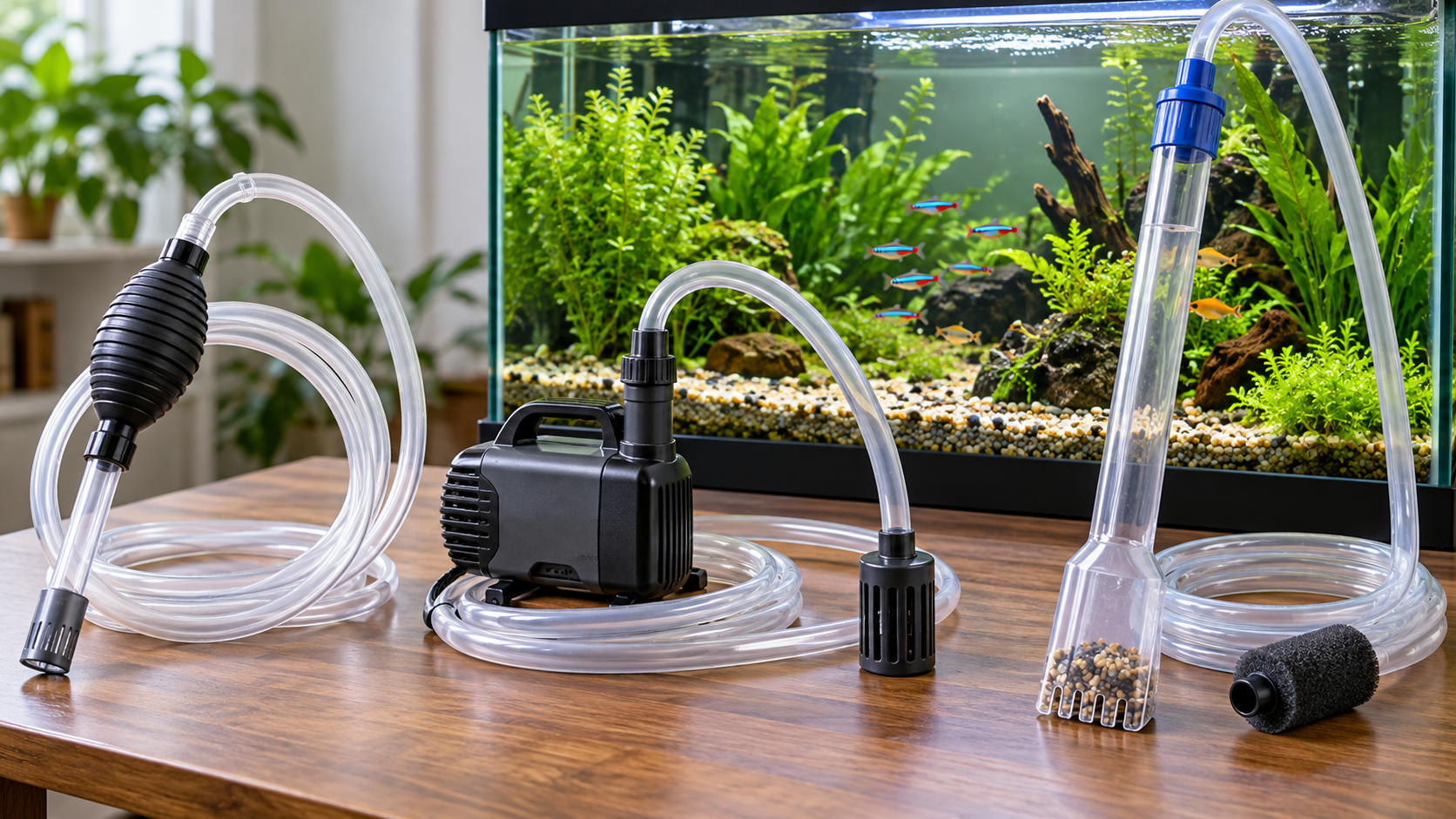
An aquarium cleaner pump is a hand-operated or faucet-driven device that starts a siphon and moves old water and loose debris out of a tank. For most home aquariums, the best aquarium cleaner pump is the one whose starting method matches your room: a faucet connection for a long run to a sink, or a squeeze bulb for a short, controlled drop into a nearby bucket. This guide compares five brands from our verified product data: enomol, Laifoo, Tetra, QZQ and AQUANEAT. None of them is a motorized pump, and that is deliberate, because a bulb or faucet-driven system is usually easier to control in a small tank.
Quick answer
- Across-the-room water changes: enomol connects to a compatible faucet and supplies a 30-foot hose.
- Simple short gravity run: Laifoo supplies a five-foot hose, a squeeze bulb, a hard gravel tube and a hose clip.
- Compact manual option: AQUANEAT states a hose of about 5.25 feet and a 1.5-inch water inlet.
- Largest accessory set: QZQ includes two pipe sections, a flow clip, a net and an algae scraper.
- Basic branded siphon: Tetra combines a priming bulb, a gravel siphon and a bucket clip.
Before you buy, read our guide to aquarium water test kits, which explains how to decide when a water change is needed, and our betta tank decor guide, which shows how hardscape and plants limit where a siphon intake can safely go.
Five aquarium cleaner pump systems at a glance
The word pump is used loosely in this category. A squeeze bulb displaces air so that water fills the hose, and gravity then keeps the siphon running while the outlet stays lower than the water surface. A faucet-driven changer uses the flow of tap water to create suction. The table compares the starting method, the stated reach and the listed details that matter for setup, so you can choose the mechanism before you compare accessories.
| Product | How flow begins | Hose or reach data | Other stated detail | Best setting |
|---|---|---|---|---|
| enomol 30 ft | Faucet-powered, two valves | 30-foot hose | 16.5-inch cleaning tube with a built-in screen; four adapter sizes | a medium or large tank near a compatible sink |
| Laifoo 5ft-S | Squeeze-bulb gravity siphon | 5-foot clear hose | hard gravel tube, detachable screen, hose clip | a small or medium tank with a bucket below |
| Tetra Water Cleaner | Priming-bulb gravel siphon | Not stated | 5.5 × 3.38 × 13.75 inches; listed up to 55 gallons | simple bucket-based gravel care |
| QZQ hand-press kit | Hand-press gravity siphon | Two pipe sections; total length not stated | flow clip, pipe clip, net, algae scraper | a buyer who wants several manual tools |
| AQUANEAT hand pump | Hand-pump gravity siphon | About 5.25 feet | 1.5-inch water inlet; recommended for tanks of at least 5 gallons | a compact setup with a lower drain container |
Reach can be compared directly because two products state their hose length. The enomol hose of 30 feet is about 5.7 times the AQUANEAT hose of 5.25 feet (30 ÷ 5.25 = 5.71), and six times the Laifoo hose of five feet. That ratio describes how far water can be routed. It does not mean enomol moves six times as much water. Gravity drop, faucet pressure, hose diameter, bends, tube depth and debris all affect the actual flow, and none of those is fully stated for every product.
Product picks in detail
1. enomol 30-foot water changer: the best faucet-powered reach
The enomol system works differently from a bulb siphon. Its listing says tap-water pressure starts drainage through two valves and a 30-foot hose, and reversing the valve arrangement supports refilling. The package includes a 3/4-inch garden-hose-thread adapter plus threaded faucet adapters in 15/16-inch, 55/64-inch and 13/16-inch sizes. That set improves your odds of a fit, but it does not cover every modern faucet.
The cleaning end is a 16.5-inch tube with a built-in screen. The main reason to choose this mechanism is that it removes the need to carry full buckets. It also creates a routing job: the line must avoid doorways, sharp bends, heaters and walkways. Never leave a faucet-driven system running unattended.
Limitation: the product details give neither the hose diameter nor a measured discharge rate, and the amount of water used at the faucet is not stated.
Skip if: your faucet is pull-out, sensor-operated or unthreaded, or the 30-foot hose cannot be routed securely.
2. Laifoo 5ft-S: the best complete short siphon
Laifoo uses a squeeze bulb to prime a gravity siphon. Its package includes a five-foot clear PC hose, a hard gravel tube, a hose clip, a siphon ball and a user manual. After priming, gravity should carry water to a container below the aquarium, so no motor or electrical part is involved. The listing describes the hose as anti-kinking, and the gravel tube is described as sinkable and as not disturbing fish or decor.
The detachable screen inside the gravel tube helps keep gravel out of the hose, but a screen is not a reason to stop watching the intake. Fine sand, plant roots, food and fish fins still need active control. The five-foot reach works best when the bucket can sit directly below or beside the stand. The hose clip matters because an unsecured outlet can turn a planned water change into a spill. The listing states a three-month warranty on quality issues.
Limitation: the product details give no tube diameter or flow figure, so its speed cannot be compared directly with the other manual systems.
Skip if: the receiving container cannot stay below the aquarium, or five feet does not leave a relaxed hose route without pulling.
3. Tetra Water Cleaner: a familiar bulb-and-clip layout
Tetra’s cleaner is a gravel siphon with a priming bulb and a bucket clip, and it is listed as compatible with aquariums up to 55 gallons. Its product dimensions are 5.5 by 3.38 by 13.75 inches. Those dimensions help with storage and handling expectations, but they do not predict suction.
The listing says the cleaner takes about 30 minutes to replace 30 percent of the water every 30 days. Read that as packaging guidance, not a universal husbandry schedule. A five-gallon betta tank and a lightly stocked 55-gallon community tank do not produce the same waste load. Test the water, account for feeding and filtration, and follow sound care guidance. The cleaner is only the tool for carrying out the change.
Limitation: the product details do not give a hose length or internal diameter, so you cannot calculate its routing reach or a comparable volume per minute.
Skip if: you cannot confirm that a bucket can sit at the required lower level because the hose length is not stated.
4. QZQ hand-press kit: the most accessories
The QZQ kit is built around a pressure-resistant hand bulb and the siphon principle. Its listing names two water-pipe sections, a joint, a press pump, a flow clip, a pipe clip, an extended outlet hose, a temperature sticker, a fishing net and a plastic algae scraper. It works as a broad maintenance bundle rather than a single precisely specified pump. The listing says it runs without electricity and without noise.
A flow clip can make a gravity siphon easier to slow while you move between substrate sections. The extra tools may save separate purchases, but every joint is another place for a loose fit or trapped debris. Assemble the kit dry, trace the water path before you start, and secure the outlet before priming. A long list of accessories does not prove stronger suction.
Limitation: the product details do not give total hose length, tube bore or flow, and the package dimensions are shipping dimensions rather than working dimensions.
Skip if: you want a minimal system with clearly stated reach, or several accessories would make the kit harder to check and store.
5. AQUANEAT hand pump: the clearest compact dimensions
AQUANEAT lists a hose of about 1.6 meters, or 5.25 feet, a 1.5-inch water inlet and a recommended tank size of at least five gallons. To use it, place the nozzle and hose in the tank, keep the water level above the discharge end, and squeeze the bulb until flow starts. The listing says the filter screen is intended to keep fish from being drawn in, and it names small fish such as betta among the suitable species.
The 1.5-inch inlet is the widest stated intake in this comparison, although the other products do not state bore sizes, so no full ranking is possible. In a planted or decorated betta tank, check that the intake fits between hardscape before you buy. A wide opening may move debris efficiently but can be awkward in tight spaces.
Limitation: no standardized flow value is given, and the listing’s statement that the product is safe for fish is a seller claim. It is not a reason to let the intake come near a betta.
Skip if: the 1.5-inch inlet is too large for your layout, or the drain container cannot stay below the aquarium for the whole siphon.
Use elevation before blaming the bulb
A gravity siphon needs a height difference. Set the waste container below the tank, remove upward loops from the hose, submerge the intake fully and make sure the outlet is open. The bulb’s job is to establish a water-filled path. If the hose rises above the aquarium surface or traps a large air pocket, repeated squeezing will not fix the layout. Practice the route with clean water before a real water change. That teaches you the path without risking a spill or startling a fish.
Hose length solves one problem and creates another
A longer hose reaches a sink, but it adds friction, storage bulk and more places for a kink. A short hose is easier to inspect and rinse, but it commits you to a nearby container. The 5.7 times reach ratio shows why enomol serves a different use from AQUANEAT. It does not show that enomol cleans better. Measure the actual route, including vertical drops and gentle bends, and then add modest slack. Extra hose coiled on the floor adds trip risk and no useful reach.
Faucet compatibility is a pass-or-fail test
Before you choose enomol, identify your faucet’s thread type and compare it with the listed adapters instead of assuming that most faucets will fit. Pull-down heads, recessed aerators, designer outlets and sensor fixtures are common failure points. Remove an aerator only if the fixture’s own instructions allow it. Also think about refill water. Tap water may contain chlorine or chloramine that must be treated before it goes into the tank. The EPA’s ammonia summary, which we also used for this article, explains why water quality needs care in aquatic systems. A reverse-flow valve does not condition water or match aquarium temperature.
Choose intake geometry for the substrate
Coarse gravel allows a rigid tube to enter the bed while lighter waste rises. Fine sand calls for a hovering technique so that grains settle before they reach the hose. In a planted tank, a narrower intake reaches between stems and hardscape with less disruption. The 1.5-inch AQUANEAT opening may work well in open gravel but can be cumbersome in a crowded layout. The product details do not give a complete set of bore and flow figures, so physical access to the substrate is a more reliable selection test than an assumed suction strength.
Control water volume, not just visible dirt
Decide the removal amount before you prime the siphon. Mark the target level temporarily or use a receiving bucket with a known volume. Gravel cleaning can absorb your attention while the water line falls faster than you expect. Stop at the planned level even if another patch of gravel looks untidy, because that section can wait for the next session. The nominal tank size also overstates the usable water when substrate, equipment, decor and the air gap below the rim take up space. A measured refill amount is more reliable than an estimated percentage.
Keep the betta away from the intake
Screens reduce risk but do not replace supervision. Guide the tube through small zones and pause if the fish comes close. Long fins can reach openings that the body cannot. Leave a calm refuge near the surface, and do not chase the fish around the tank with the siphon. If close control is hard, switch to a narrower tube or a slower arrangement. Any injury or unusual behavior calls for advice from an experienced fish keeper or aquatic veterinarian rather than improvised treatment.
Avoid over-cleaning the biological system
The goal is to remove accumulated debris and replace an appropriate amount of water, not to sterilize the aquarium. Beneficial microorganisms live on filter media, substrate and other wetted surfaces. Filter media and wetted surfaces host bacteria that process fish waste, so removing them all at once is a common way to upset a tank. Do not deep-clean every substrate section and replace all filter media in one session. Rinse equipment according to its instructions, and base water-care decisions on tests and your normal routine rather than on how the water looks.
Prepare replacement water before you drain
Know how the tank will be refilled before you squeeze the first bulb. Replacement water should be conditioned for your local supply and brought to a suitable temperature. The Merck Veterinary Manual states that new water should be dechlorinated before it is added to the aquarium, and that most city water is treated with chlorine or chloramine. Keep the heater submerged as its manual requires, disconnect equipment if the falling water line would expose it, and restore power only after the tank is safely refilled.
Prevent the three common spill paths
First, secure the discharge end with a clip or a stable sink placement. Second, make sure the receiving container holds more than the planned volume. Third, route the hose where it cannot be kicked, pinched or pulled. Stay present from priming through shutdown. To stop a gravity siphon, lift the intake out of the water or close the flow clip if your kit has one. Do not try to race a full bucket to a sink while water keeps flowing.
Clean and store the system as a water path
After use, drain every hose completely, rinse the parts according to the manufacturer’s directions, and inspect bulbs, screens, clips, threads and seals. A clear hose makes trapped debris easier to see. Let parts dry before closed storage unless the instructions say otherwise. Keep small adapters together and label the one that fits your faucet. A missing gasket or a stiff bulb found before the next water change is much easier to fix than a leak found after the siphon starts.
A simple selection sequence
Choose the drain destination first. If it is a sink across the room and the faucet fits, choose the faucet-driven system. If it is a bucket below the stand, measure the hose you need and choose a tube that suits your layout. Next compare the outlet controls and the number of joints. Finally, consider extra tools such as scrapers and nets. This order keeps the main water-moving job ahead of the accessory count.
How we chose
We limited this article to five brands in our verified product data whose listings describe aquarium water changing or gravel cleaning through a priming bulb or faucet pressure. We left out electric multi-function cleaners, which are covered in our separate electric-cleaner article. Selection favored a clearly stated starting method, measurable reach or dimensions, an outlet-control feature and a realistic situation in which the mechanism helps. We did not invent flow figures. The only derived figure is the reach ratio, which uses the two hose lengths that the products state.
What we could not verify
The product details do not provide comparable flow figures, internal hose diameters for every product, suction under loaded gravel, faucet water use, adapter compatibility with a particular fixture, or long-term durability of bulbs and seals. Tetra and QZQ do not state a usable hose length. Seller statements about fish safety are not independent certifications, and we cannot tell how product revisions change the included connectors. Check the exact package, dimensions and instructions before you order.
FAQ
Does a squeeze bulb keep pumping the water?
Usually not. It primes the hose, and gravity keeps the flow going while the outlet stays lower than the water surface in the tank.
Why won’t my gravel siphon start?
Check for a closed clip, air trapped in an upward loop, an outlet that is too high, a blocked screen or a loose joint that lets air in.
Can a faucet system refill the aquarium directly?
Some can reverse direction, but tap water still needs conditioning and a suitable temperature before it goes into the tank. Follow the product and conditioner instructions.
Is a longer hose always better?
No. Buy enough for a relaxed route. Extra length adds friction, kinking, storage bulk and trip risk.
Can I use a gravel siphon on sand?
Yes, with careful hovering and reduced flow, but fine grains lift easily. Do not push a wide intake deep into sand.
How do I stop the siphon quickly?
Use the flow clip if your kit has one, or lift the intake out of the water. Keep the outlet secured until the hose has finished draining.
Bottom line
Choose an aquarium cleaner pump by the route the water must travel. Use a faucet-driven system for a long run to a sink, or a squeeze-bulb gravity siphon for a controlled drop into a nearby bucket. Check the hose and tube against your layout before you buy, and plan the water volume before you start.
For related reading, see our aquarium water test kit guide, which helps you decide when a water change is needed, and our betta tank decor guide, which shows how hardscape limits where a siphon can reach.
Sources
- Merck Veterinary Manual, “Providing a Home for Fish,” https://www.merckvetmanual.com/all-other-pets/fish/providing-a-home-for-fish (opened October 27, 2026). Paraphrased: poor water quality is the most common cause of environmental-related disease in fish; most city water is treated with chlorine or chloramine.
- Merck Veterinary Manual, “Routine Health Care of Fish,” https://www.merckvetmanual.com/all-other-pets/fish/routine-health-care-of-fish (opened October 27, 2026). Paraphrased: new water should be dechlorinated before it is added to the aquarium; a pressurized water and vacuum system can remove solid waste from gravel during a water change.
- U.S. EPA, “Sources, Stressors & Responses: Ammonia,” https://www.epa.gov/caddis-vol2/caddis-volume-2-sources-stressors-and-responses-ammonia (opened October 27, 2026). Paraphrased: ammonia is a common toxicant derived from wastes, fertilizers and natural processes; unionized ammonia is very toxic to fish.