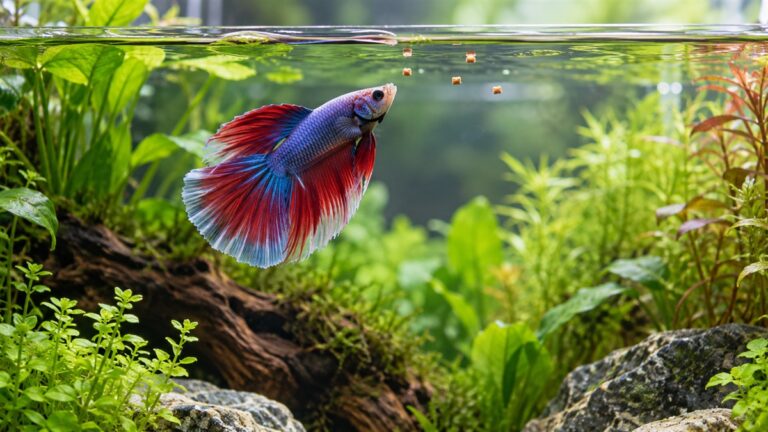
How Much And How Often To Feed Betta Fish
As an Amazon Associate we earn from qualifying purchases. Details
The sources checked for this guide do not give a betta-specific answer to how much and how often to feed betta fish. None of them gives a betta pellet count or a betta feeding frequency. What they do give is general fish feeding guidance and a clear warning about overfeeding, and this guide quotes both and labels which is which. The practical reading is to offer a small portion, watch whether it is eaten, and remove or avoid any food left behind. The numbers below are general fish figures, not betta rules.
Quick answer
- No source checked gives a betta-specific pellet count or feeding frequency.
- General fish guidance from UF/IFAS FA096 is to feed “based on a percentage of body weight,” and says “One feeding per day is plenty for most pet animals.”
- Merck’s general figure for maintenance diets is 1% to 2% of body weight per day. It is not stated for bettas.
- Overfeeding is the mistake the sources name most often, and it fouls the water. For the pellet-count question, see How Many Pellets to Feed a Betta.
What the general fish guidance says
UF/IFAS publication FA096, which covers fish feeding in general, says: “Fish should be fed based on a percentage of body weight. For maintenance, 0.5–1.0% body weight per day is adequate. Fish should probably be fed at least 5 days per week.” The same publication adds that “One feeding per day is plenty for most pet animals” and that “Rearing of young stock does require small meals fed more frequently.” Those statements describe fish in general. The publication does not name bettas.
The Merck Veterinary Manual page on providing a home for fish makes a similar general point: “Feeding methods and rates vary with species, age, system, and water temperature. In general, maintenance diets are fed at a rate of 1% to 2% of body weight per day, and growth diets at 3% to 5% of body weight per day.” This is general fish guidance. It is not a betta figure, and the page says rates depend on species, age, system and temperature.
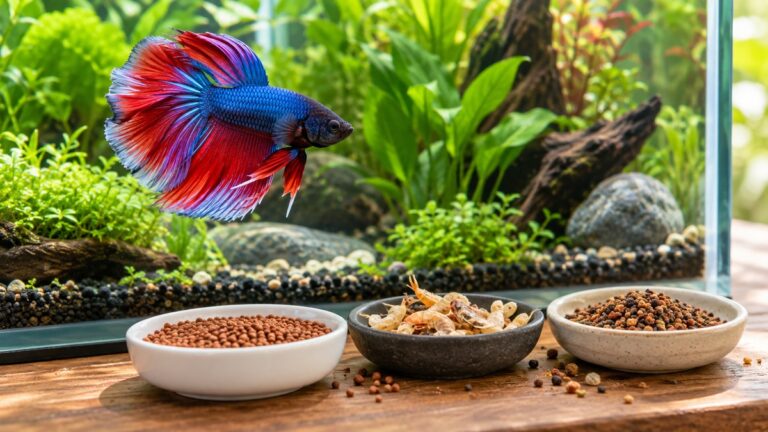
FA096 also covers the food itself. It says fish feeds “should be purchased frequently, ideally at least once a month,” and should be “stored in a cool, dry place.” Those are general storage points, not betta feeding amounts, but they bear on how fresh the pellets in a tank are.
The two general figures do not match. FA096 gives 0.5% to 1.0% of body weight per day for maintenance, and Merck gives 1% to 2%. A reader should not pick one and treat it as a betta rule. Both also depend on the fish’s body weight, and neither source gives a betta body weight. A percentage cannot be turned into a number of pellets without that weight and the energy content of the food, so this guide does not make that conversion.
Why overfeeding is the main risk
FA096 is direct on this point: “The most common mistake made by pet owners is over-feeding their fish, often with resulting degradation of water quality.” The publication also says that owners can underfeed as well, but overfeeding is the error it names first.
The betta-specific source is FA212, Evolution, Culture, and Care for Betta splendens. It describes “proper storage and feeding regimens—avoiding overfeeding and water fouling—as well as clean sources of live feeds” as “very important considerations.” On small tanks it says that aquariums “of limited volume and reduced filtration should be managed to include frequent water changes so that uneaten feed as well as ammonia and other dissolved wastes are not allowed to reach harmful levels.” That is the reason uneaten pellets matter: they add waste to a small tank.
Merck gives the health side of the same point: “Overfeeding can lead to health problems as well as a dirty tank.” The sources do not list specific symptoms of overfeeding in a betta. If your betta shows signs of illness, consult an experienced fish keeper or an aquatic vet.
A practical check on portion size
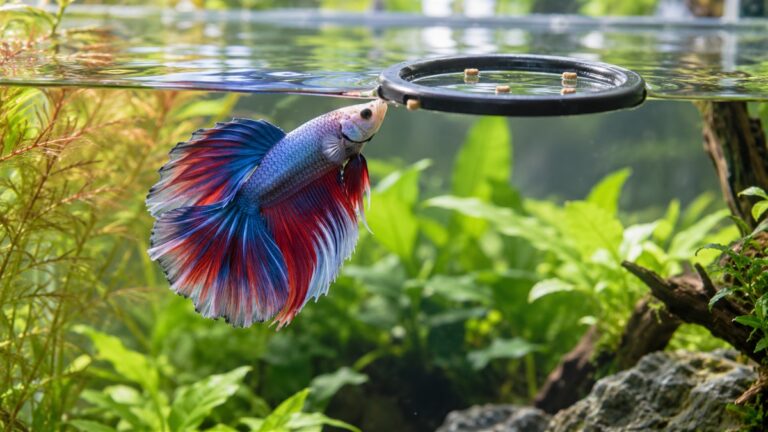
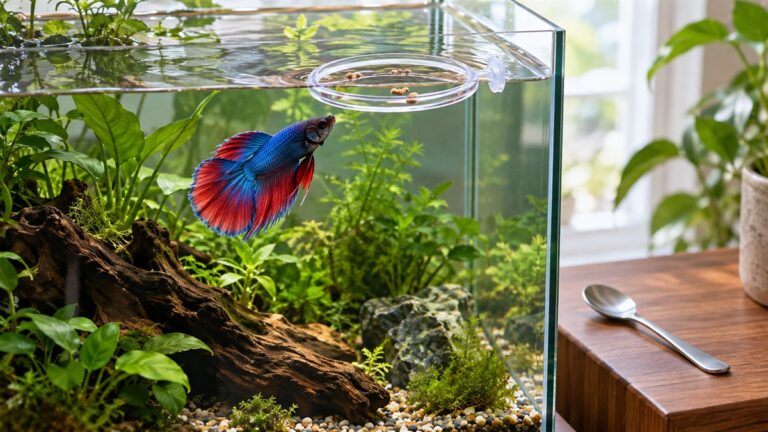
The sources do not give a portion method for bettas, so the steps below are a practical reading of the overfeeding warning, not a number from a source. Offer a small portion. Watch whether the betta eats it. Then check the tank the next day for food that has not been eaten. If food is still there, the portion was too large for that fish, and FA212 says uneaten feed should not be left to build up. Adjust the next portion down and check again. This method uses what you can see in the tank, so it does not depend on a number the sources do not give. FA212 ties the uneaten-food risk to limited volume, so tank size matters too. For the size question, see How Big of a Tank Do Betta Fish Need and What Size Tank Does a Betta Need.
How we chose
The sources were chosen from non-retail pages: two UF/IFAS extension publications (FA096 and FA212) and a Merck Veterinary Manual fish page. Retail product pages and listing text were not used for any feeding fact. Each source was opened with curl on 2026-10-23 and returned HTTP 200. Every quotation in this guide was checked against the downloaded text. Where a source covers fish in general, the guide says so. Where a source covers bettas, the guide says that too.
What we could not verify
This guide is limited by what the sources say. The points below are not covered by any source opened for it.
What the sources do not say
- A betta-specific pellet count per day, or per feeding.
- A betta-specific feeding frequency per day or per week.
- The body weight of an adult betta, so that a percentage cannot be converted into pellets.
- Whether the 0.5% to 2% general figures apply to bettas at all.
- The energy or pellet size of any specific food, or what the packaging directs.
Frequently asked questions
How many pellets should I feed my betta each day?
None of the sources checked gives a betta pellet count. For that question, see How Many Pellets to Feed a Betta. This guide does not repeat any count, because the sources it checked do not support one.
Is feeding once a day enough for a betta?
FA096 says “One feeding per day is plenty for most pet animals.” That is general fish guidance, not a betta rule. The same publication says young stock need “small meals fed more frequently,” which is about rearing, not adult fish.
How often should I feed a betta fish pellets?
The sources checked give no betta feeding frequency. FA096 says fish “should probably be fed at least 5 days per week,” which is a general figure for fish and is not stated for bettas.
What happens if I overfeed my betta?
The sources name two effects. FA096 says overfeeding causes “degradation of water quality,” and FA212 says uneaten feed adds to ammonia and other wastes in a small tank. Merck says “Overfeeding can lead to health problems as well as a dirty tank.” For any sign of illness, consult an experienced fish keeper or an aquatic vet.
Should I use the 1% to 2% rule for my betta?
No source checked says that rule applies to bettas. Merck gives 1% to 2% of body weight per day for maintenance diets in general and notes that rates vary with species, age, system and temperature. FA096 gives a lower general range of 0.5% to 1.0%. Neither figure was checked for bettas, and neither can be turned into a pellet count without a betta body weight.
Sources
- UF/IFAS Extension, FA096, fish feeding and nutrition publication: https://edis.ifas.ufl.edu/publication/FA096 (opened 2026-10-23)
- UF/IFAS Extension, FA212, Evolution, Culture, and Care for Betta splendens: https://edis.ifas.ufl.edu/publication/FA212 (opened 2026-10-23)
- Merck Veterinary Manual, Providing a Home for Fish: https://www.merckvetmanual.com/all-other-pets/fish/providing-a-home-for-fish (opened 2026-10-23)