Sand vs Gravel for Aquariums: 2 Substrate Listings Compared
As an Amazon Associate we earn from qualifying purchases.
Sand and gravel are the two substrates most aquarium keepers choose between, and the listings disagree on what each one is for. This comparison sets a 5 pound beige aquarium sand against a 2.2 pound polished glass sand and gravel mix, using only the grain sizes, weights and care lines each listing states.
Both store listings were read in the same set, and neither carries a check date in this listing set. The figures below are reported as listed.
Quick answer
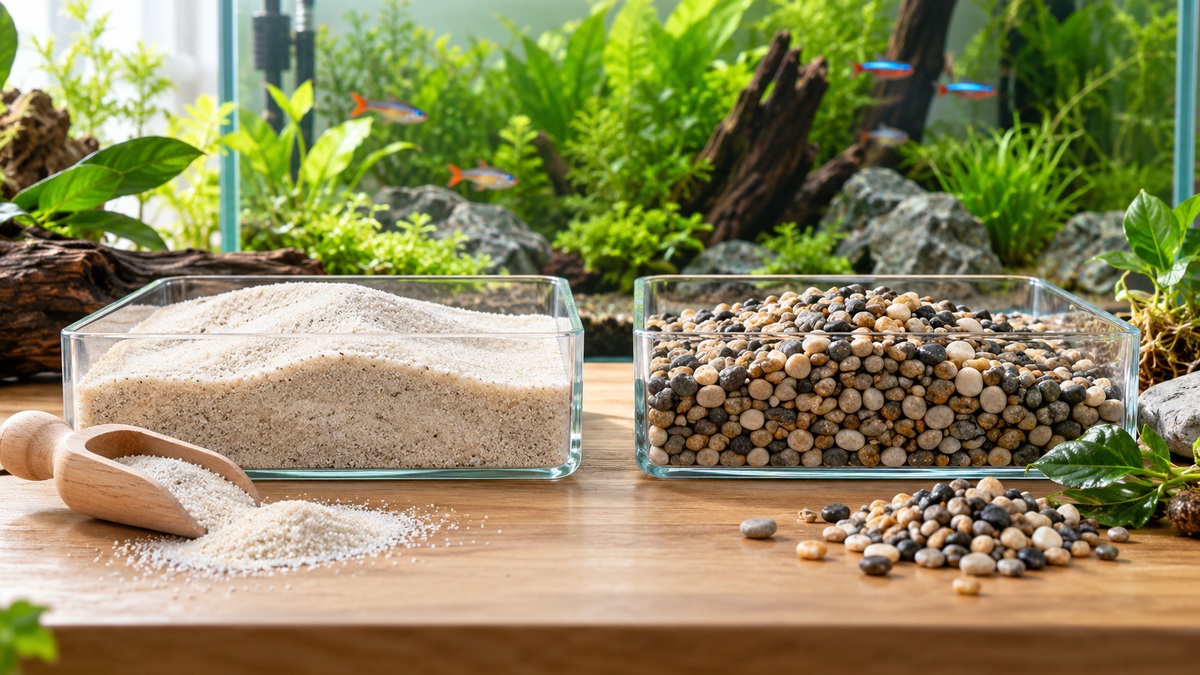
The two products are not the same size of material. The beige sand lists grains of 0.4 to 0.8 millimeters, and the BXI mix lists stones of 6 to 10 millimeters, which is several times larger. If you want a fine bed for bottom-dwelling fish to sift through, the beige sand listing is the one that describes that use. If you want a decorative, colorfast layer that sits still, the BXI listing describes that role instead.
Side-by-side listing data
| Feature | Beige aquarium sand (store) | BXI polished glass sand (store) |
|---|---|---|
| Grain or stone size | 0.4 to 0.8 millimeters | 6 to 10 millimeters (0.24 to 0.40 inches) |
| Weight options | 5, 10, 20 or 40 pounds, matched to tank size | 2.2 pounds, about 1000 grams |
| Volume | Not stated | 0.22 gallon |
| Color | Beige (white, black and brown also in bullets) | Oceanic Mix in specs, vibrant blue in bullets |
| Package size | 10 by 6 by 2 inches | 8.11 by 5.63 by 1.81 inches |
| Rinse before use | Pre-washed, quick rinse recommended | Rinse 3 to 4 times |
Beige aquarium sand, 5 pound pack (store)
The beige sand listing describes a fine, rounded grain of 0.4 to 0.8 millimeters. The bullets say the grains are smooth enough not to scratch fins, and they name corydoras and plecos as bottom fish that sift and burrow in it. The listing says the sand is dense and resists being stirred up by water flow.
The listing gives four weight options: 5 pounds for a 2 to 5 gallon tank, 10 pounds for 5 to 10 gallons, 20 pounds for 10 to 20 gallons and 40 pounds for tanks of 20 gallons or more. The bullets say the sand is non-toxic, will not cloud the water and settles almost at once. Its listing also describes uses outside the aquarium, such as terrariums and vase fillers.
View beige aquarium sand on Amazon
BXI polished glass sand and gravel mix (store)
The BXI listing is a polished glass sand with stones of 6 to 10 millimeters, sold as a 2.2 pound bag. The bullets call the stones colorfast, uncoated and non-toxic, and they say the glass will not change the water chemistry. The listing says the pieces have smooth edges and do not chip.
Its bullets also give a sizing rule: for a 1 inch layer, the pounds needed are length times width divided by 23. The bullets then give a worked case of 4.35 pounds for a 10 by 10 inch tank. The listing says to rinse three or four times before use, and it describes uses for betta tanks, terrariums and vases alike.
View BXI glass sand and gravel on Amazon
How we chose these listings
The two store listings are the only substrate products in this set, and both were kept. The research listings held eight other items: a test kit, aquarium salt, catappa leaves, a mineral supplement, mineral balls, a rock cave, a vitamin formula and a betta tank kit. None of these is a substrate, so they are not compared here and no card is given for them.
Worked example: a 20 by 10 inch tank
Take a tank with a 20 by 10 inch footprint. Using the BXI sizing rule for a 1 inch layer, the length times width is 200, divided by 23, which gives about 8.7 pounds of BXI stones.
The beige sand does not use the same rule. Its listing ties weight to gallons, with the 10 pound bag for a 5 to 10 gallon tank. A 20 by 10 inch footprint does not fix a gallon count, and the sand listing gives no layer depth, so the two products cannot be compared on one layer from the listings alone.
What the listings do not say
Neither listing states the depth of sand or gravel that suits a betta, or whether the grain size affects filtration or plant rooting. The beige sand listing describes benefits for bottom fish, but it does not test those claims. The BXI listing describes a glass material that stays colorfast, but it does not give a test result.
The BXI color conflicts between the specs and bullets, so the appearance in a tank should be checked on the product page or by a sample.
Frequently asked questions
Which substrate has the smaller grain?
The beige sand listing gives grains of 0.4 to 0.8 millimeters. The BXI listing gives stones of 6 to 10 millimeters, so the beige sand is the finer of the two.
How much sand does a 5 to 10 gallon tank need?
The beige sand listing gives a 10 pound option for tanks of 5 to 10 gallons. The 5 pound option is listed for 2 to 5 gallons.
How much BXI stone does a 10 by 10 inch tank need?
The BXI bullets give 4.35 pounds for a 1 inch layer, using length times width divided by 23.
Do these listings say they are safe for fish?
Both listings call their materials non-toxic. Neither listing gives a test report for fish, so the claim is the manufacturer’s statement.
Conclusion
For a fine bed that bottom fish can sift, the beige sand listing describes that job. For a colorful layer of larger stones, the BXI listing describes that job, though its color is stated two ways. The listings size their products on different rules, so compare the bag weight to your tank’s gallons and the layer depth to your footprint before buying.
For more on choosing a bed for a betta tank, see the guide to sand or gravel for bettas, the comparison of sand and gravel for a fish tank and the question of whether bettas prefer sand or gravel.
Bài viết liên quan: Aquarium Gravel Vacuums Compared: 4 Listings, Best Gravel and Sand Substrate Mix.