Best Betta Cave Ideas
As an Amazon Associate we earn from qualifying purchases. Details
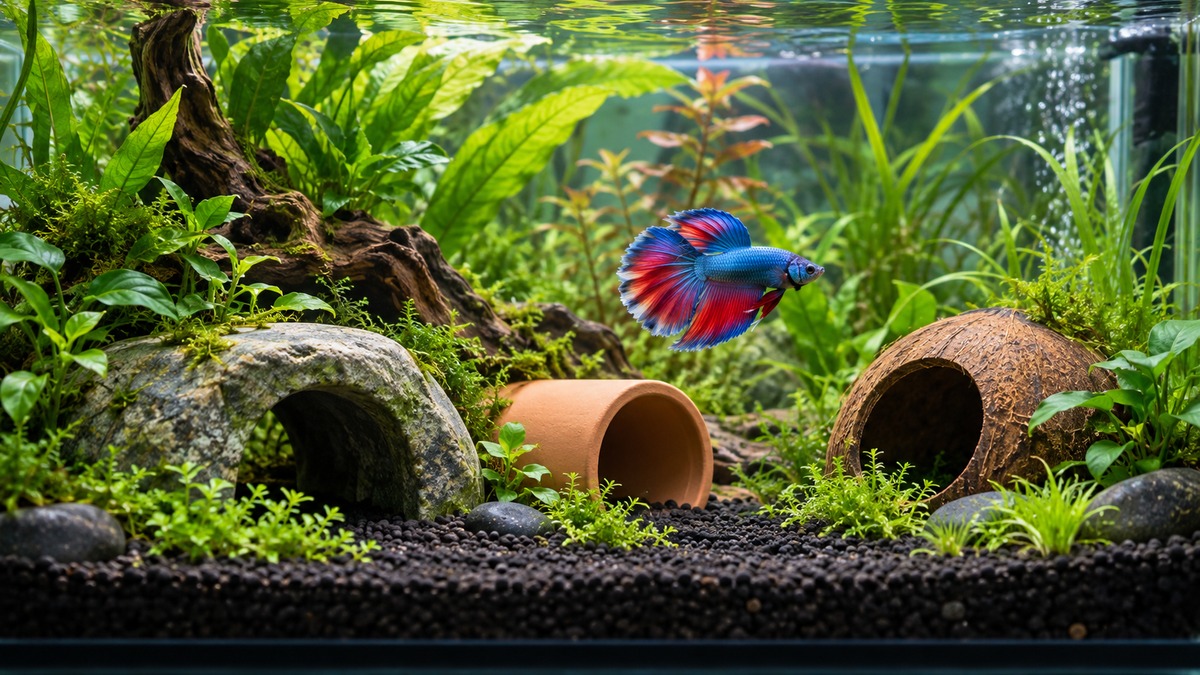
A cave is one of the simplest ways to give a betta somewhere to rest out of the open. But “cave” covers a lot of shapes, and each one suits a different tank. This guide goes through seven ideas that Amazon sells for betta tanks: a coconut shell, a strawberry, a conch shell, a silk-and-driftwood hideout, a floating cave, a corner cave and a buried tunnel. For each one it shows the listing numbers, where the listing disagrees with itself, and who should skip it. Plain stone-look caves are left out here. A cave never replaces a heated, filtered tank of the right size.
Quick answer
For most single-betta tanks, a smooth ceramic cave with a wide opening is the easiest idea to live with: the conch-shell cave lists a 3.52 x 2.22 inch entrance, the largest opening in this guide. Pick the coconut shell for a natural look, the floating cave when floor space is tight, and the buried tunnel when you want to watch the fish from the front glass. The listings give openings for only four of the seven, so measure before you buy.
Seven cave ideas at a glance
- Coconut shell: a natural dome with one opening (SunGrow).
- Strawberry ceramic: a small glazed cave that sits on the floor (Deapeey).
- Conch shell ceramic: a roomy white cave with a glazed interior (XuanFain).
- Silk plant and driftwood cave: a resin cave with soft silk leaves attached (UreverFins).
- Floating cave: a 3D-printed PLA hide that sits at the surface (HOZOE).
- Wood-look corner cave: a sculpted corner piece that can be stacked (FISHNOSH).
- Underground tunnel: a low ABS tunnel you bury under sand or gravel (CPLIKE).
What to check on any cave
The opening, not the outside size
A betta has to swim in and out without catching its fins. Outer dimensions tell you how much floor the cave uses; the opening tells you whether your fish fits. Only the strawberry, conch, silk-driftwood and floating caves state an opening in the listing. Measure your fish and the opening with a ruler before you order.
Surface and edges
Run a clean finger around the entrance when the cave arrives. Listings use phrases such as “smooth edges” or “fin-friendly”, and these are the seller’s words, not a test. If an edge feels rough or chipped, do not put it in the tank.
Material and prep
Ceramic, coconut shell, resin, PLA and ABS all appear here. The coconut-shell listing asks you to rinse the shell before use, even after boiling or soaking. Follow each listing’s own preparation note, and test the water after adding any new item.
Floor space and tank size
Caves take up floor area. Check the tank-size guidance in our betta tank size guide first, then choose a cave that leaves open swimming room.
The seven picks
1. SunGrow Betta Fish Cave, Coconut Shell (Best natural material)
Specs from the listing (checked 2026-10-17):
- Material: Coconut shell
- Product dimensions: 5 x 5 x 3 inches; 3.84 ounces
- Openings: one (the listing describes a single-opening dome)
Pros
- The listing says the edges are smooth and the shape gives no fin nipping.
- The listing describes a dome that leaves room to move around inside.
- The listing gives a clear preparation note: rinse before use.
Cons
- The listing gives no opening size.
- The listing claims bettas “thrive in a community aquarium better than alone”. That conflicts with the single-betta guidance on this site, so we do not follow it.
- It is a real shell, so the shape and size will vary a little from piece to piece.
Best for: A single betta in a heated, filtered tank where you want a natural look.
Skip if: You need a stated opening size before you buy.
View on Amazon (affiliate link)
2. Deapeey Pink Ceramic Strawberry Betta Cave (Best small ceramic cave)
Specs from the listing (checked 2026-10-17):
- Material: Ceramic
- Dimensions (spec table): 4.33 x 3.15 x 3.15 inches; 3.52 ounces
- Entrance (bullet): 1.58 x 1.97 inches
- Listing tank range: 2.5 to 5 gallon tanks
Pros
- The listing states an entrance size, so you can compare it with your fish.
- The listing says the surface is smooth and easy to rinse or brush clean.
- The listing says no assembly is needed.
Cons
- The listing contradicts itself on size: the spec table says 4.33 x 3.15 x 3.15 inches, while a bullet says about 3.93 x 3.19 x 3.19 inches.
- The listing also contradicts itself on weight: 3.52 ounces in the spec table, but a bullet says around 180 grams, which is about 6.3 ounces. We do not pick one figure.
- The 2.5 to 5 gallon range suits tanks smaller than this site recommends. Use it only in a tank of 5 gallons or more.
Best for: A small cave with a stated entrance for a heated tank.
Skip if: You want one clear set of dimensions in the listing.
View on Amazon (affiliate link)
3. XuanFain Ceramic Conch Shell Cave, White (Best roomy entrance)
Specs from the listing (checked 2026-10-17):
- Material: Ceramic with a matte white exterior and a glazed interior
- Dimensions: 5.91 x 3.74 x 3.35 inches (the size field says 3.5 inches high)
- Entrance: 3.52 x 2.22 inches
Pros
- The listing gives the widest entrance in this guide.
- The listing says the entrance is rounded and the interior is smooth glaze.
- The listing says the ceramic weight keeps it steady on the substrate.
Cons
- At 5.91 inches deep it takes the most floor space of the ceramic picks.
- The listing also names pleco and dwarf cichlids, so it is not betta-specific.
- The height differs slightly between fields (3.35 versus 3.5 inches).
Best for: A betta that needs a roomy, smooth shelter in a tank with spare floor.
Skip if: Floor space is tight.
View on Amazon (affiliate link)
4. UreverFins Silk Plant and Driftwood Cave (Best cave with soft plants)
Specs from the listing (checked 2026-10-17):
- Material field: Silk (the listing also describes a resin cave)
- Dimensions: 6 x 4 x 3 inches
- Opening: a rounded 2 inch swim-through opening
Pros
- The listing says the leaves are soft silk and the base is weighted so it will not float.
- The listing states the opening size.
- It adds plant cover and a hideout in one piece.
Cons
- The material field says silk, but the bullets describe a resin cave with silk leaves. The cave itself is resin.
- The listing recommends it for “2.5-30 gallons small fish bowl” tanks. Use it in a proper tank, not a bowl.
- Silk leaves can collect algae and debris over time.
Best for: A betta that likes cover at the back or side of the tank.
Skip if: You want a cave without fabric parts to clean.
View on Amazon (affiliate link)
5. HOZOE Floating Betta Cave and Hammock, Black (Best floating cave)
Specs from the listing (checked 2026-10-17):
- Material: PLA (3D printed)
- Dimensions: 3.94 x 3.94 x 1.97 inches (10 x 10 x 5 cm)
- Opening: about 4 x 4 cm
Pros
- It floats, so it uses no floor space.
- The listing says to compare the opening with your fish before you buy, and it gives the opening size.
- The listing says it can hold floating food in one place.
Cons
- The listing calls it a cave, a hammock and a feeder in one, so the use is broad.
- The 4 cm opening is about 1.6 inches, the smallest in this guide.
- The listing says it is safe for betta tanks and will not affect water quality, but gives no test, so test the water after adding it.
Best for: A tank where floor space is limited and the fish rests near the surface.
Skip if: Your betta is large for the 4 cm opening.
View on Amazon (affiliate link)
6. FISHNOSH Wood-Look Corner Cave (Best stackable cave)
Specs from the listing (checked 2026-10-17):
- Title and size field: 5.1 x 2 x 2.7 inches
- Spec table: 5.39 x 5.39 x 2.76 inches; 1.2 pounds
- Material field: Clay
Pros
- The listing says several units can be stacked or joined into a custom layout.
- The listing says it fits into the corner of a rectangular tank.
- The listing says no glue or tools are needed.
Cons
- The dimensions differ between the title (5.1 x 2 x 2.7 inches) and the spec table (5.39 x 5.39 x 2.76 inches), so the real footprint is unclear.
- The material field says clay, but a bullet says BPA-free, non-toxic plastic. We do not choose between them.
- No opening size is stated, so measure it yourself.
Best for: A rectangular tank where a corner is free and you want a modular layout.
Skip if: You need the material and size confirmed before you buy.
View on Amazon (affiliate link)
7. CPLIKE Underground Tunnel, 5 Inch (Best buried tunnel)
Specs from the listing (checked 2026-10-17):
- Material: ABS plastic
- Product dimensions: 5 x 5 x 2.3 inches; 2.82 ounces
- Openings: two (dual entrance)
Pros
- The listing says it sits flush against the glass so you can see the fish inside.
- The listing says the interior edges are rounded to reduce fin snagging.
- The listing says to keep both openings clear when you cover it with substrate.
Cons
- The opening is not measured in the listing, so check it before you buy.
- The listing names bottom dwellers such as loaches and corydoras alongside betta, so it is not made for betta alone.
- It needs enough sand or gravel on the floor to cover it.
Best for: A tank with a sand or gravel floor where you like to watch the fish.
Skip if: You use a bare-bottom tank or a thin substrate layer.
View on Amazon (affiliate link)
How to choose between them
- Small tank, little floor: the floating cave takes no floor space.
- Roomy entrance: the conch shell lists 3.52 x 2.22 inches.
- Natural look: the coconut shell.
- Planted look: the silk and driftwood cave. For real plants, see our live plants guide.
- Watch the fish from the front: the buried tunnel.
Worked example: how much floor a cave uses (our planning estimate)
Say your tank floor measures 20 x 10 inches, or 200 square inches. A conch cave at 5.91 x 3.74 inches covers about 22 square inches. A coconut shell at 5 x 5 inches covers 25. Together that is about 47 square inches, or roughly 24% of the floor. Outer dimensions overstate the footprint slightly for round shapes, so the real figure will be a little lower. If two caves would cover more than a quarter of the floor, pick one and add open swimming space instead.
Mistakes to avoid
- Buying on looks alone without comparing the opening to your fish.
- Trusting a “safe” claim without checking the edges yourself.
- Using a cave to justify a smaller tank. Caves add cover, not water volume.
- Placing a cave directly in front of the filter outflow.
- Skipping the water test after adding any new decoration.
Before you buy
- Is the tank heated, filtered and of the size our guide recommends?
- Have you measured your fish against the opening?
- Does the listing contradict itself on size or material? If so, ask the seller or choose another.
- Do you have free floor, or a surface spot for the floating option?
If you also want sleeping spots near the surface, see the leaf hammock guide.
FAQ
Do bettas need a cave?
A hiding place gives a betta somewhere to retreat, and many owners include one. It is optional decor, and it never replaces a heater, filter or water tests.
Which cave idea suits a small tank?
The floating cave uses no floor, and the strawberry cave is the smallest ceramic option at about 4.33 x 3.15 inches. Check the tank-size guide first.
Can a betta get stuck in a cave?
It is possible if the opening is too tight, which is why measuring matters. Only four of the seven listings give an opening, so measure the rest yourself.
Is a plastic or resin cave okay?
The tunnel listing says its ABS is made for freshwater or saltwater tanks, and the silk-driftwood listing calls its design fin-friendly, but no listing here cites a test. Check the edges and the water after adding one.
Do I need to prepare a coconut shell cave?
The SunGrow listing says to rinse it before use, even after boiling or soaking, and it mentions a post-boil soak in freshwater. Follow the listing.
Can I use more than one cave?
Yes, if there is floor space. Our planning example shows two caves using roughly 24% of a 20 x 10 inch floor.
Why are some listings marked as conflicting?
Where a listing gives two different sizes or materials, we show both rather than pick one. Check with the seller if it matters to you.