Best Filterless Betta Tank
As an Amazon Associate we earn from qualifying purchases. Details
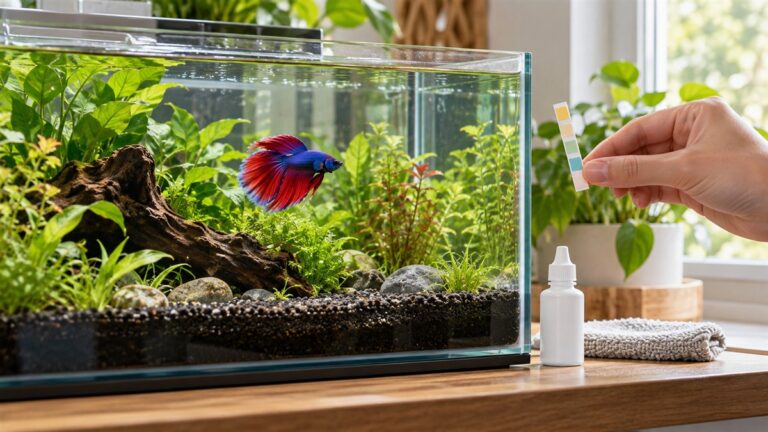
Quick answer: A betta can live in a tank with no filter, but only in a heated tank of at least 5 gallons that gets regular partial water changes and water tests. A filterless tank is the harder option, not the easier one. Removing the filter removes the water flow, but it hands the waste-removal job to you. Our default advice stays the same: a heated tank with a gentle, low-flow filter is easier to keep steady. A bowl with no filter is not a filterless tank, and the Illinois veterinary article we opened says bettas should not live in bowls.
What “filterless” means in this guide
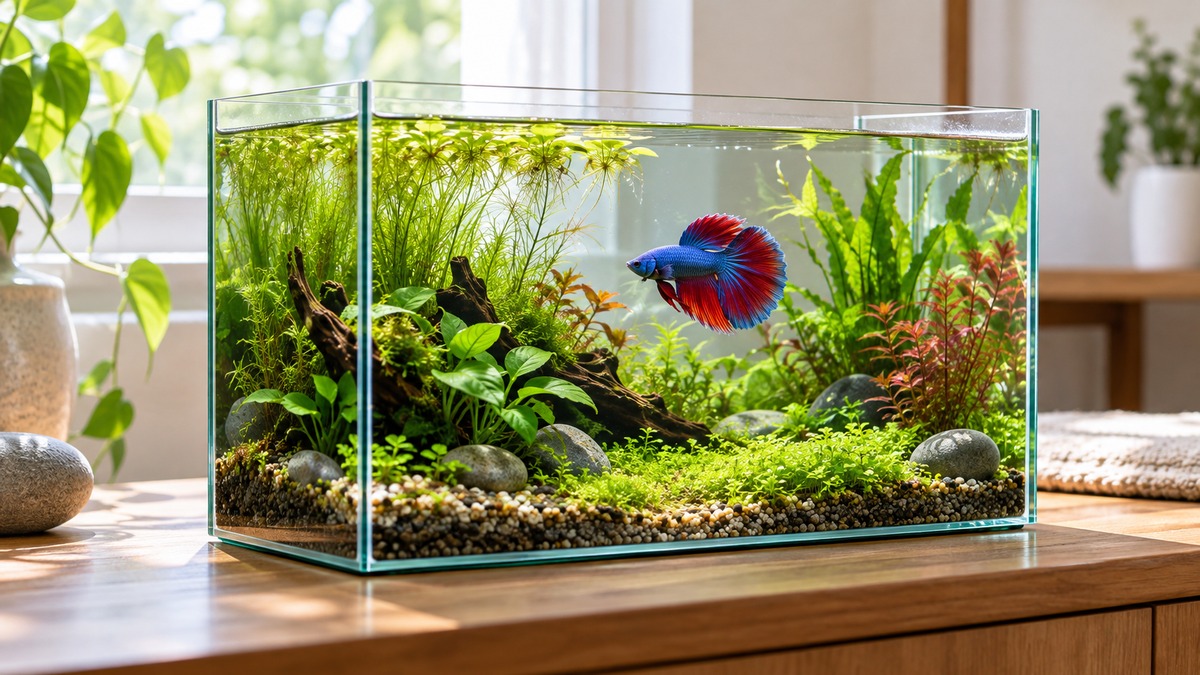
This guide covers a tank with no filter running in it. A gentle filter is a different setup, and the filter section below explains when one helps. The rest of this page is about what changes when the filter is gone: the waste, the water changes, and the temperature.
A bowl or vase is not a shortcut to a filterless tank. The University of Illinois article says bettas should not live in bowls. The UF/IFAS betta publication says small containers with reduced filtration need frequent water changes to keep waste from building up. A filterless setup needs at least the same care, plus more of the work done by hand.
Why a filter does a job you will now do
Fish release ammonia through their gills. The UF/IFAS ammonia publication says digestion of feed is the main source of ammonia in most hobby systems. Uneaten food and decaying matter add to it, and even a starved fish produces some ammonia. The more a fish is fed, the more ammonia it produces.
In a filtered tank, bacteria convert ammonia to nitrite and then to nitrate. In a filterless tank the same waste still appears. The water changes, the feeding routine, and the tests carry the load instead of the filter.
The thresholds that matter
The UF/IFAS ammonia publication gives these numbers:
- Un-ionized ammonia above 0.05 mg/L: damage to fish tissue can occur.
- Nitrite: toxic to fish at levels as low as 0.10 mg/L.
- Ammonia at 2.0 mg/L: sensitive fish will typically die.
- Nitrate: in closed systems with little or no water exchange, it can build up above 250 mg/L.
Two cautions apply. That publication is written for fish production systems, so read these numbers as the science behind water quality, not as a betta tank specification. Also, most home test kits measure total ammonia, not the more toxic un-ionized share, so the reading needs converting before you judge it.
Why warm water makes the same reading more dangerous
The UF/IFAS ammonia publication says the un-ionized share of ammonia rises as pH and temperature rise. Its worked example uses a pH of 8.0 at 26 degrees Celsius (78.8 degrees Fahrenheit), where the conversion factor is 0.0574.
For example, a total ammonia reading of 1.0 mg/L under those conditions gives about 0.057 mg/L of un-ionized ammonia. That is above the 0.05 mg/L level where tissue damage can occur. In a heated tank, the same test result is more dangerous than it would be in a cool one, so the heater and the test kit belong in the same plan. Our ammonia test kit guide covers the kit choice.
Water changes: the routine you take on
The Aqueon betta care page, a manufacturer page, says to change 1/3 of the water every 3 to 4 days in small unfiltered containers, and never to change all of it at one time. The UF/IFAS ammonia publication says a 25 to 50 percent water change will help remove some ammonia. The UF/IFAS betta publication gives no schedule.
No source we opened gives one fixed schedule for a filterless betta tank. Treat the Aqueon rule as a starting point and let your test readings decide how often you change the water. Our guide to cleaning a betta tank covers the cleaning steps.
Worked example, 5-gallon tank: these are estimates, because the listed capacity of a tank is not the water you have once gravel and decor are in.
| Share of water changed | Water removed from a 5-gallon tank |
|---|---|
| 25 percent | 1.25 gallons |
| One third (Aqueon’s figure) | 1.67 gallons |
| 50 percent | 2.5 gallons |
For example, a one-third change in a 5-gallon tank takes out about 1.67 gallons. Use a jug or a bucket with a mark on it, and count what you remove, rather than guessing from the tank’s label.
Tap water needs a dechlorinating product before it goes into the tank. The Illinois article also says to test tap water for heavy metals before use.
Testing: what to check and for how long
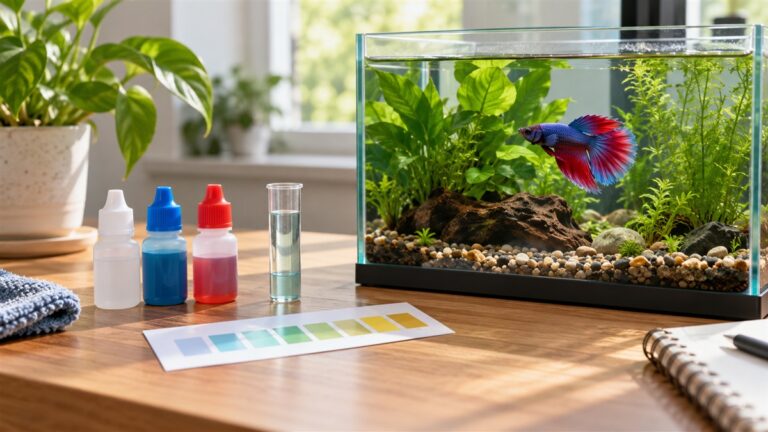
At minimum, test for ammonia and nitrite, and add nitrate and pH if you can. The UF/IFAS ammonia publication says a new biofilter needs six to eight weeks to build enough bacteria to reduce ammonia and nitrite. That describes a filter’s bacteria, not a filterless tank, and the publication does not say how long a filterless tank takes to settle. Keep testing through the first weeks, and keep testing until the readings stay steady.
The same publication says nitrifying bacteria slow down when dissolved oxygen falls below 5 mg/L, and when total alkalinity is below 20 mg/L. If your readings do not settle, check those two before you add more water changes. Our water quality test strip guide covers the quick option.
Heat: a heater is usually needed
The Illinois article says the tank needs to stay within 76 to 81 degrees Fahrenheit. It also says most homes run cooler than that, so an in-tank heater is usually necessary. The Aqueon page gives a wider range, 76 to 85 degrees Fahrenheit. The two sources disagree at the top end: 81 against 85 degrees Fahrenheit. We show both here and use the narrower Illinois range as the target, not 85 as a safe ceiling.
The UF/IFAS betta publication advises room air of no less than 71.6 degrees Fahrenheit for unfiltered, unheated containers. That is a floor for the room, not a water target, and it applies to containers without a heater. See our heater guide and the thermometer guide before you choose the equipment.
Does the tank still need a filter?
The sources give different emphasis. The Aqueon page says bettas “do not necessarily need a filter.” The Illinois article says a low-flow filter is vital so that a filter’s suction does not injure the fins. The UF/IFAS betta publication says bettas prefer calm water and that heavy filtration may be harmful to their health and welfare.
So the question is not only filter or no filter. A filter that makes too much current is a known problem, and a low-flow filter is the middle path if you want one. Our low-flow filter guide covers that choice, and the 10-gallon filter guide covers the size question.
Setup checklist for a filterless tank
- Start with at least 5 gallons. The Illinois article says bettas should ideally be in a 5-gallon tank or larger.
- Set a heater and a separate thermometer, and hold the water within 76 to 81 degrees Fahrenheit.
- Test your tap water, then dechlorinate every change.
- Check any decor for sharp edges before it goes in.
- Write the water-change routine down before the fish arrives: the jug, the bucket, the dechlorinator, and the day you will change water.
- Test through the first weeks and keep the readings in a log.
For the full tank build, see our setup guide. For tank size, see how big a tank a betta needs.
Mistakes to avoid
- Calling a bowl or vase a filterless tank. The Illinois article says bettas should not live in bowls.
- Changing all the water at once. Aqueon says never to do this.
- Feeding heavily. The more a fish is fed, the more ammonia it produces, according to the UF/IFAS ammonia publication.
- Heating without a thermometer. A heater’s own display is not enough to show what the water is doing over a day.
- Adding tap water without dechlorinating it. The Illinois article says tap water needs a dechlorinating product before use.
Who should skip a filterless tank
A filterless tank is a poor fit if you cannot commit to a water-change routine and regular tests, especially in the first weeks. It is also a poor fit if you are often away and cannot keep to a schedule. In those cases a heated tank with a gentle, low-flow filter is the more forgiving choice.
Frequently asked questions
Can a betta live in a tank with no filter?
Yes, if the tank is heated, holds at least 5 gallons, and gets regular partial water changes and water tests. The sources we opened do not describe it as easy care.
Is a bowl with no filter the same thing?
No. The Illinois veterinary article says bettas should not live in bowls, and a bowl without a filter is still a bowl.
How often should I change the water in a filterless betta tank?
The Aqueon care page suggests one third of the water every 3 to 4 days for small unfiltered containers. The UF/IFAS ammonia publication says a 25 to 50 percent change helps remove some ammonia. No source we opened gives one fixed schedule, so use your test results to adjust.
Does a filterless betta tank need a heater?
Usually, yes. The Illinois article says most homes run cooler than the 76 to 81 degrees Fahrenheit range that bettas need.
Why does temperature change how dangerous ammonia is?
The un-ionized share of ammonia rises with pH and temperature, according to the UF/IFAS ammonia publication. So a warm tank with a high pH can make the same test result more dangerous than a cool one.
Can I add a filter later?
Yes, and choose a low-flow model. The Illinois article says a low-flow filter protects delicate fins from suction, and the UF/IFAS betta publication says bettas prefer calm water.
Tanks and heaters in the research data
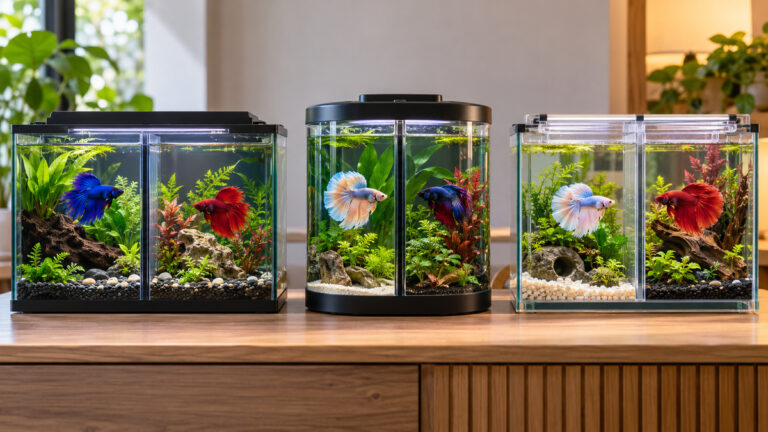
The research data lists the products below. Each one is at or above the 5-gallon minimum in this guide, or is a heater for the setup described above. Each listing states its own filter and heater details.
- Vimvins 5 Gallon Glass Small Fish Tank with Filter Light and Lid: a 5-gallon glass tank, listed with a filter and light.
- 6 Gallon Betta Fish Tank, 7 in 1 Aquarium Starter Kits: a 6-gallon kit, listed with a filter, air pump and light.
- 5.3 Gallon Fish Tank, Betta Fish Tank, Starter Kit: a 5.3-gallon kit, listed with a filter and light.
- hygger Small Aquarium Betta Heater: a submersible heater with an LED digital display, listed for tanks of 1 to 5 gallons.
Bottom line
A filterless betta tank can work, but it asks for more work from you than a filtered one. Keep the tank at least 5 gallons, heated within the 76 to 81 degrees Fahrenheit range, with dechlorinated water, a fixed water-change routine, and tests through the first weeks. If that routine is more than you can keep up, a gentle low-flow filter is the easier path.
Sources we opened
- UF/IFAS FA212, Evolution, Culture, and Care for Betta splendens (checked 2026-10-17; the page shows a 2024 copyright year and no publication date).
- UF/IFAS FA031, Ammonia in Aquatic Systems (checked 2026-10-17; no publication date shown).
- University of Illinois veterinary medicine column on betta fish (by Beth Mueller, dated April 15, 2019; checked 2026-10-17).
- Aqueon betta care guide (manufacturer page; checked 2026-10-17; no date shown).