How Many Pellets to Feed a Betta (Label Count and Schedule)
As an Amazon Associate we earn from qualifying purchases. Details
If you are asking how many pellets to feed a betta, you want a number you can use on the first day the fish is home. The honest answer is that the sources we opened do not agree on one universal count. They do agree on the method: feed a small amount, watch how much the fish eats in about a minute, and remove what it leaves. One widely used manufacturer label gives a specific count for a 1.5-inch betta, and this guide shows how to apply that label, how to read the frequency advice, and how to tell when a portion is too large. Figures below are from sources checked on 2026-10-18.
Quick answer
- Frequency: the Aquarium Co-Op betta care guide says to feed “once a day, as much as they can eat in one minute.” Treat that as the starting point.
- Count on one label: the Hikari Bio-Gold label gives 3 pellets per feeding for a 1.5-inch betta, with a maximum of 5 pellets at one feeding.
- Stop rule: remove any uneaten food after the feeding period, and do not add pellets to a fish that is still eating the last ones.
What the sources say about feeding amounts
Two sources give the most usable guidance, and they do not match in every detail.
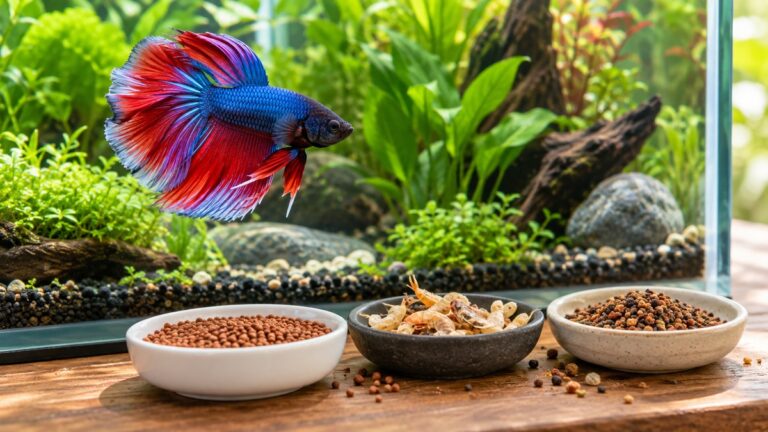
The Aquarium Co-Op care guide recommends a dedicated betta pellet as a staple, with freeze-dried bloodworms as a second food. It describes the pellets as small and floating and does not give a pellet count. Its feeding instruction is one meal a day, sized to what the fish finishes in about one minute. It also warns that “it’s very easy to overfeed betta fish” and tells keepers to check that the fish’s belly is not swollen with food.
The Hikari Bio-Gold product page gives a count. For a betta measured at 1.5 inches from nose tip to tail base, it says to “feed 3 (three) pellets of Betta Bio-Gold up to three (3) times daily.” It adds one pellet for each quarter inch of growth, never more than 5 pellets at one feeding. It also says to feed one pellet at a time, make sure the fish eats each one, and remove uneaten food after the feeding period.
The label and the care guide differ on frequency. The label says up to three times a day, while the care guide describes one feeding a day. Neither source says to give a full portion three times a day as a routine. For a new keeper, the lower frequency is the safer starting point, and the label’s three feedings should be read as a ceiling, not a target.
Start with the label, then adjust for fish size
The Hikari rule works by fish length, so it is the most practical way to set a count. Use your fish’s length as the starting point, then check the label on the bag you actually bought, because counts differ between brands.
| Betta length (Hikari method) | Pellets per feeding | Notes |
|---|---|---|
| 1.5 inches | 3 pellets | The label’s stated example |
| 1.75 inches | 4 pellets | One extra pellet for the next quarter inch, by the label’s rule |
| 2 inches or more | 5 pellets | The label caps one feeding at 5 pellets |
The table applies the label’s own rule and is not a separate standard. The label does not say how to measure a fish that is shaped differently, so measure from the nose tip to the base of the tail and round down if you are unsure.
For example, a betta that the label puts at three pellets can be offered one pellet, waited on, then offered the next, until the three are gone. If the fish stops after two, the three-pellet portion was too much for that day.
Building a simple daily schedule
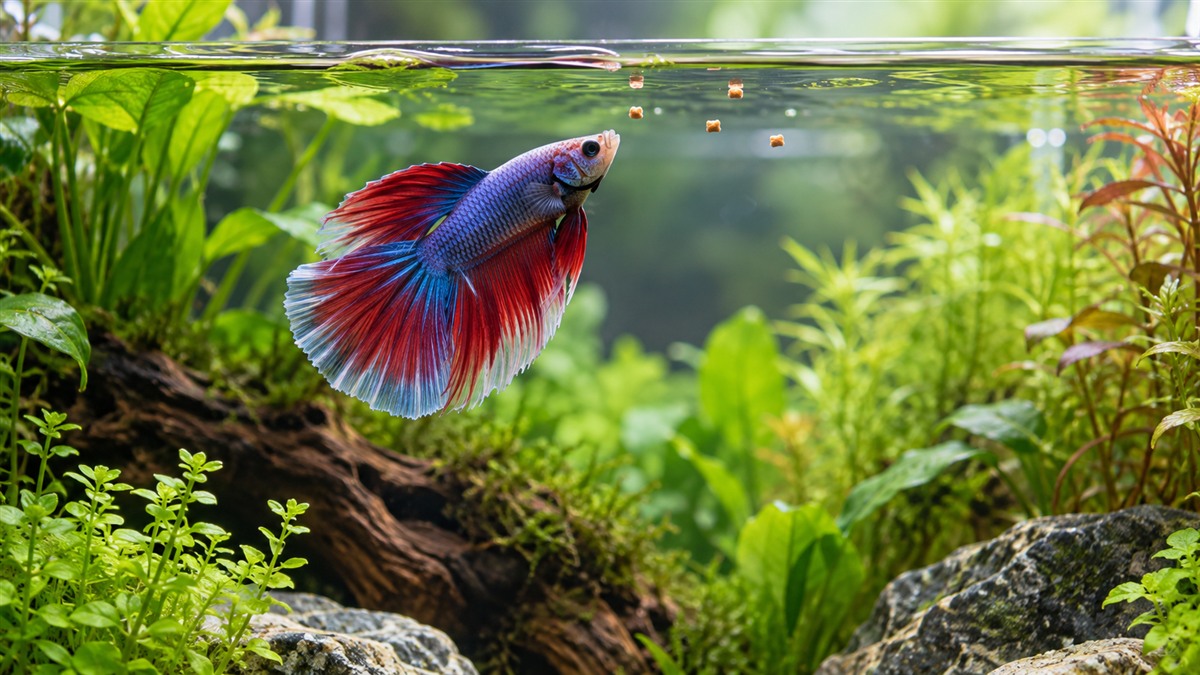
Most beginners need a schedule that is easy to repeat, not a complicated chart. The care guide’s one-minute rule gives a single daily check. Feed once in the morning, watch the fish for about a minute, and count what it eats. If it finishes quickly and looks for more, the portion may be right; if it ignores pellets that drift past, the portion is too large for that moment.
The label’s three-feeding maximum matters only if the fish is clearly active and finishes each portion. A betta that is sluggish, has a swollen belly, or leaves pellets on the bottom should be fed less, not more.
Because the sources do not give a fasting schedule, this guide does not recommend one. Keep the routine the same from day to day and adjust only when the fish’s behavior or body shape changes.
How to tell a portion is right
A portion is right when the fish eats each pellet in turn and no food is left after the feeding period. Use these checks at each feeding:
- Offer one pellet at a time and wait until the fish takes it before the next.
- Stop when the fish stops eating, even if pellets remain in the cup.
- Scoop out any food that is still on the surface or the bottom after the feeding period, as the Hikari label directs.
- Look at the belly from the side. The care guide says to make sure it is not swollen.
These checks are general feeding practice based on the label and care guide. They do not replace advice from an experienced fish keeper or an aquatic vet if the fish looks unwell.
Temperature and appetite
A fish that barely eats may be reacting to its surroundings rather than to the count. The Aquarium Co-Op care guide says bettas prefer temperatures around 80 degrees Fahrenheit. It also says that a betta kept without a heater in typical US room temperatures of 67 degrees Fahrenheit to 69 degrees Fahrenheit can become quite lethargic. A lethargic fish often leaves pellets behind, so check the heater and the thermometer before you reduce the count or switch brands.
The same guide recommends a tank of at least 5 gallons for a single betta, and it uses a 10-gallon tank as its example. Those figures come from the care guide, not from a feeding study, so read them as the care guide’s recommendation rather than a rule for how much food a tank can hold.
Pellet size and the label gap
The Hikari page does not state the physical size of the pellets, and the care guide only calls them small and floating. That means you cannot tell from our sources whether a given pellet will suit your fish’s mouth. Check the size on the package and compare it with the fish. If the fish repeatedly spits pellets back out, the sources we opened do not give a fix, so the safest step is to stop adding more and ask an experienced fish keeper for advice.
Adding other foods
The care guide suggests a dedicated betta pellet and freeze-dried bloodworms as a starting pair. Treats such as bloodworms are an add-on, not a replacement for the pellet count. The sources we opened do not give a portion for treats, so do not treat them as an unlimited extra. Count treat food as part of the day’s total and keep the pellet routine steady.
Mistakes to avoid
- Feeding by eye from a different brand. A count from one label does not carry over to another brand with different pellets.
- Treating the three-feeding maximum as a target. The care guide describes one meal a day, and the label is a limit, not a routine.
- Leaving uneaten pellets in the tank. The label says to remove them after the feeding period.
- Overfeeding a fish that looks full. The care guide warns that overfeeding is easy and asks keepers to check the belly.
- Changing the routine every day. Consistency makes it easier to notice when something is wrong.
What to check on a pellet label before you start
Use this checklist when you buy a new pellet. Each row names one label item and why it matters for the count.
| Label item | Why it matters | Hikari example |
|---|---|---|
| Pellets per feeding | Sets the starting count | 3 pellets for a 1.5-inch betta |
| Growth adjustment | Changes the count as the fish grows | 1 pellet per 1/4 inch of growth |
| Upper limit | Prevents large single feedings | Never more than 5 pellets at one feeding |
| Frequency | Sets how many feedings per day | Up to 3 times daily |
| Uneaten food rule | Keeps leftover food out of the water | Remove uneaten food after the feeding period |
If a pellet label does not state one of these items, do not guess. Use the one-minute rule from the care guide and start with a smaller portion.
Frequently asked questions
How many pellets should a betta eat?
It depends on the label and the fish’s length. The Hikari label gives 3 pellets per feeding for a 1.5-inch betta and never more than 5 at one feeding. Check the label on your own bag before you start.
Can I feed a betta once a day?
Yes. The Aquarium Co-Op betta care guide describes one daily feeding, sized to what the fish finishes in about one minute.
Does the label say to fast a betta?
The sources we opened do not give a fasting schedule, so this guide does not recommend one.
What if my betta spits pellets out?
The sources we opened do not cover this. Check the pellet size on the package, offer one pellet at a time, and stop adding more if the fish keeps spitting them out.
Does tank size change how much to feed?
The label bases its count on the fish’s length, not the tank. The care guide recommends a tank of at least 5 to 10 gallons for one betta, but it does not link tank size to a pellet count.
Related guides
- How big of a tank do betta fish need
- Best 10-gallon betta fish tank setup
- Keeping a betta fish in a bowl
Sources checked
- Aquarium Co-Op, Care Guide for Betta Fish (checked 2026-10-18)
- Hikari Bio-Gold Betta pellet product page with feeding directions (checked 2026-10-18)