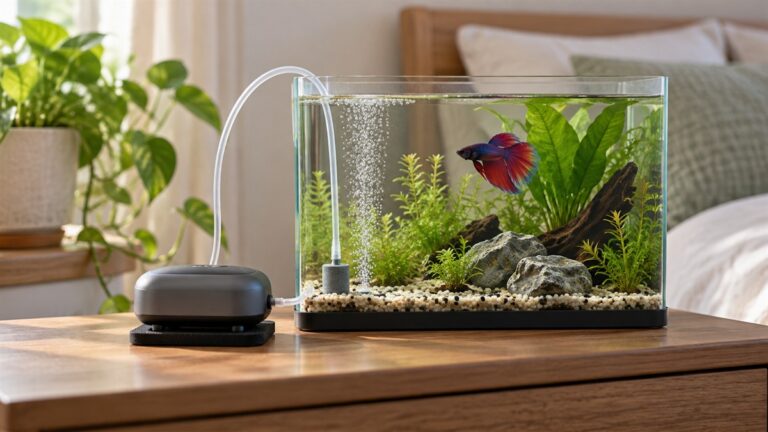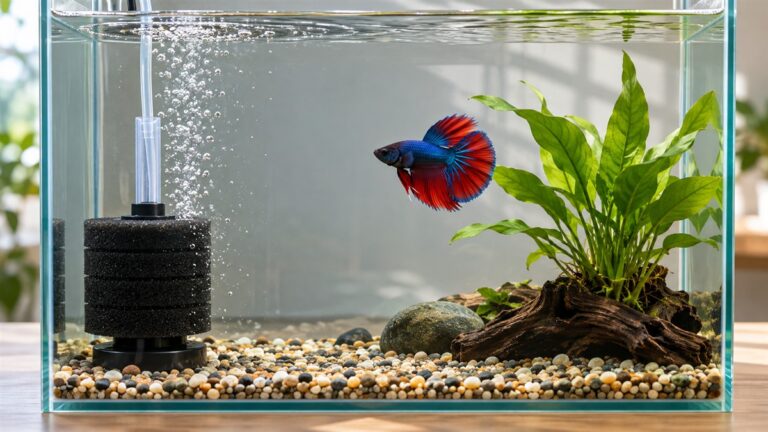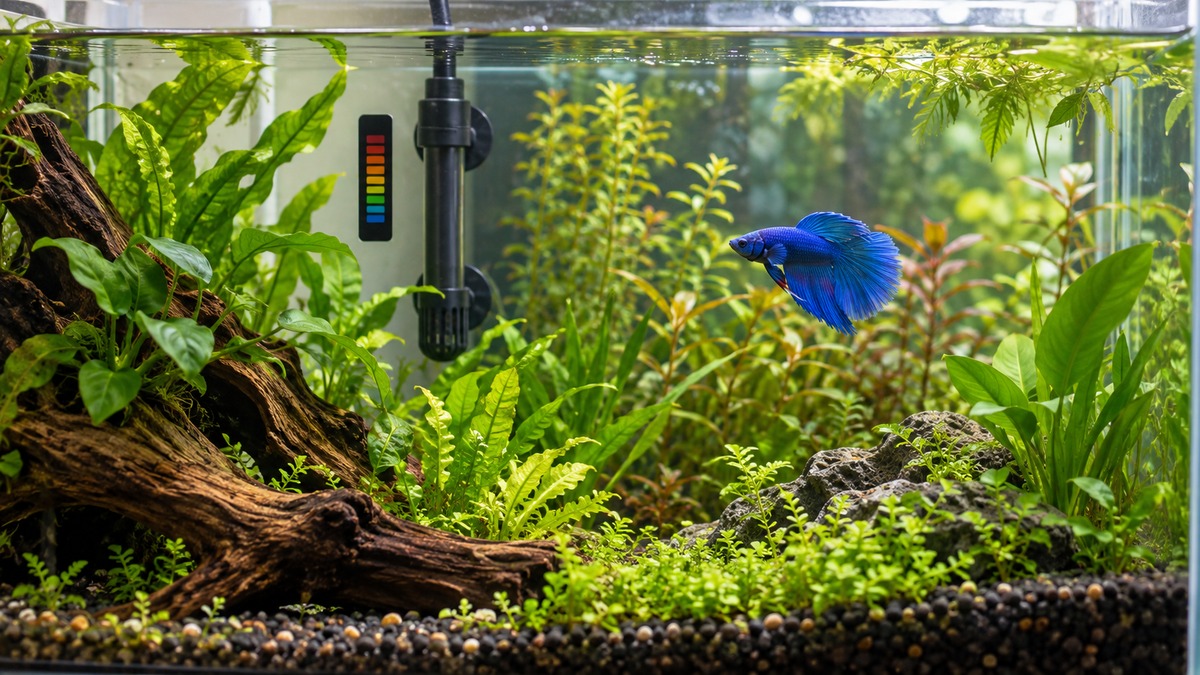
Do Betta Fish Need a Heater
As an Amazon Associate we earn from qualifying purchases. Details
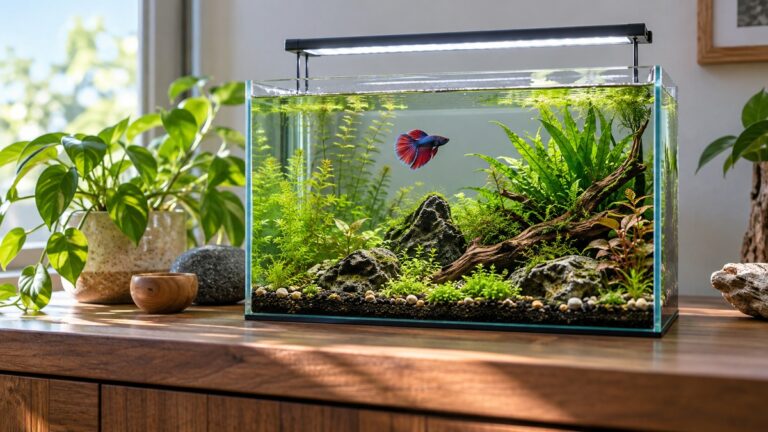
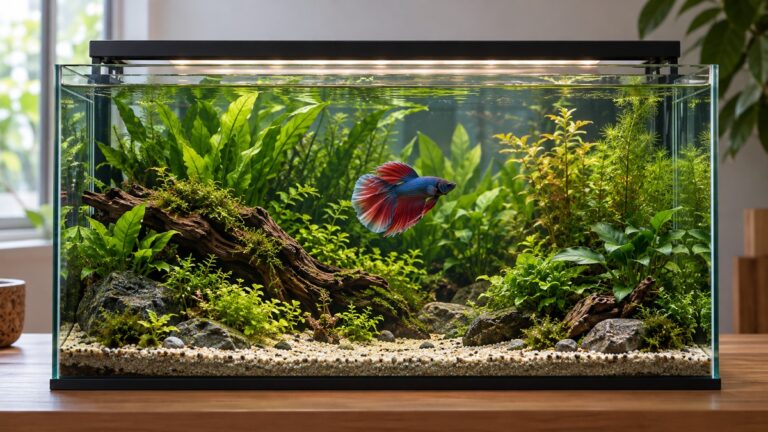
Quick answer: Most bettas kept in a home do better with a heater. Room temperature often drops below the mid-70s °F at night and in winter, and the water follows the room. If a thermometer shows the room holds steady in the mid-70s °F day and night, a heater may not be needed. If you cannot show that, use a small heater in a filtered tank of at least 5 gallons. A bowl or vase is not a substitute, heated or not.
Why the heater question comes up
Many first-time owners hear that bettas can live in a cup or a bowl, so they assume a heater is optional. A betta may survive a cool room for a while. The problem is what cool water does over time: the fish may eat less, move less and be more prone to illness. The goal is a steady temperature, not one reading taken on a single day.
Two sources we opened point the same way. A University of Florida IFAS extension publication on betta care says bettas thrive in warm water and do not do well in cold water. For an unheated, unfiltered container, it advises keeping room air at no less than 71.6 °F (22 °C) (UF/IFAS publication FA212, checked 2026-10-17).
A University of Illinois veterinary teaching hospital article (by Beth Mueller, dated April 15, 2019, quoting a board-certified zoological medicine veterinarian) gives a 76 to 81 °F range. It says most homes are cooler than that, so an in-tank heater is needed, and it advises against keeping a betta in a bowl (Illinois vet school article, checked 2026-10-17). Those are the only temperature figures in this post that come from a source we opened. The 78 °F preset on some heaters below is a manufacturer setting, not a betta requirement.
Two numbers to measure: room and swing
The heater question comes down to two numbers. The first is what the room holds. The second is how far the water moves between day and night. A thermometer answers both, and it does not need to be expensive. Read it at the same time each day for seven days before you decide.
Here is a worked example. Suppose the room reads 65 °F at night and 75 °F by afternoon. That is a 10-degree swing. An unheated tank will follow that swing, and the water will be coolest right when the room is coldest. If your week of readings looks like that, a heater is the safer choice. If the highest and lowest readings stay within a few degrees of the mid-70s °F, a heater may be optional. Keep checking after the seasons change, because a room that is fine in summer can drop in winter.
Quick check: do you need a heater?
- Probably yes if the room drops into the 60s °F at night, the tank sits near a window or an exterior wall, or the house runs cool in winter.
- Maybe not if the room stays steady in the mid-70s °F day and night and the water reading stays steady too. Keep checking.
- Never rely on a bowl, a vase or a small cup on a sunny windowsill. Sunlight heats the water unevenly and the swings are large.
What temperature do bettas need?
The two sources above give 76 to 81 °F (Illinois) and the warm-water guidance from UF/IFAS. Neither gives a single number to hit. Keep the reading steady inside the range rather than chasing one exact figure. If your betta is listless, is not eating, or shows signs of illness, consult an experienced fish keeper or an aquatic vet. This article does not give medical advice.
Heater basics in plain terms
A submersible heater has a heating element, a thermostat that switches it on and off, and a control that sets the target. Small heaters for betta tanks usually sit inside the water against the glass, held by suction cups. Three details matter for a betta tank:
- Size. A heater rated for a 1 to 6 gallon range is only correct for that range. A 25-watt heater and an 8-watt heater are different classes of product, and the listing’s gallon range is the basis for matching them to a tank.
- Protection. Two of the listings below say the heater shuts off above a set temperature or when the water level is too low. Check that the listing you buy says the same.
- A separate thermometer. Do not rely only on the heater’s own display. Keep a thermometer on the tank so you can see what the water is doing. Our thermometer guide covers the testing side.
Heater ranges at a glance
This table puts the five listings side by side using only what each listing states. The gallon column is the one to check first. Specs were read from the Amazon listing text, checked on 2026-10-10 for four listings and 2026-10-11 for the Marina listing. The listings do not give independent test results.
| Listing (ASIN) | Wattage | Gallon range the listing states | Display listed | Temperature setting or range |
|---|---|---|---|---|
| SEAOURA 25W (B0CMQD717F) | 25 W | 1 to 6 gal; bullets say suits a 5-gallon tank | Yes, LED external controller | Shuts off above 99 °F; sensor accuracy ±1 °F |
| DaToo 25W (B0893T67LX) | 25 W | 1 to 6 gal (bullets say 1 to 5) | None listed | Preset 78 °F |
| Orlushy 25W (B0BC6HLMY1) | 25 W | 1 to 6 gal | None listed | Preset 78 °F; accuracy ±3 °F |
| hygger 10W (B0BGG7Z3N9) | 10 W (this variant) | Title: up to 5/10/16/26 gal; bullets: 1 to 5 gal | Yes, LED digital | 59 to 93 °F |
| Marina 8W (B00AE23Z88) | 8 W | Up to 1.5 gal | None listed | Automatic thermostat with a set temperature |
The Marina listing’s 1.5-gallon ceiling is about one-third of the 5-gallon tank this post uses as its minimum. That gap is the reason the Marina listing is in the table as a warning, not a recommendation.
Heaters worth checking
These five listings are a starting point. The listings do not give independent test results, and the price on Amazon can change, so check the current price before you buy.
1. SEAOURA Small Aquarium Heater, 25W (B0CMQD717F)
Specs (from the listing, checked 2026-10-10): 25 W; listed for 1 to 6 gallon tanks, with a bullet saying it suits a 5-gallon tank; quartz heating tube; LED external controller with a stated sensor accuracy of ±1 °F; overheat protection that shows “HH” and shuts off above 99 °F; rated 110 to 120 V.
Pros: Clear external display; the listing states overheat protection. Cons: The title gives a 1 to 6 gallon range and a bullet gives a 5-gallon line, so check the tank you have. The controller is external, which means one more cable to route.
Best for: A 5-gallon betta tank you want to monitor on a display. Skip if: Your tank is under 5 gallons and you want the smallest possible heater.
View on Amazon (affiliate link)
2. DaToo Mini Aquarium Heater, 25W (B0893T67LX)
Specs (from the listing, checked 2026-10-10): 25 W; the listing says it suits 1 to 6 gallon tanks (bullets also say 1 to 5 gallons); preset to 78 °F; rubber sealing layer; quartz glass; one-year warranty; must be fully submerged.
Pros: A stated preset and a one-year warranty; a small body. Cons: The listing does not describe an adjustable thermostat, so you cannot set your own temperature. It has no display, so pair it with a separate thermometer.
Best for: A fixed-preset heater for a tank you already monitor with a thermometer. Skip if: You need a temperature other than the preset.
View on Amazon (affiliate link)
3. Orlushy Small Submersible Aquarium Heater, 25W (B0BC6HLMY1)
Specs (from the listing, checked 2026-10-10): 25 W; listed for 1 to 6 gallon tanks; preset 78 °F with accuracy stated as ±3 °F; ABS outer shell with a nickel-chromium heating rod; one-year warranty; the listing says to unplug and let the heater cool for 10 to 20 minutes before cleaning or taking it out of the water.
Pros: A small, fixed-preset heater with a clear cleaning instruction. Cons: The stated ±3 °F accuracy is wider than the ±1 °F stated for the SEAOURA. The listing does not describe a display.
Best for: A small tank where a fixed preset is enough. Skip if: You want a tight, visible temperature readout.
View on Amazon (affiliate link)
4. hygger Small Aquarium Betta Heater, 10W (B0BGG7Z3N9)
Specs (from the listing, checked 2026-10-10): 10 W in this variant (the title lists 10W, 25W, 50W and 100W models); the bullets say 1 to 5 gallons, while the title says up to 5/10/16/26 gallons, so check which range applies; temperature range 59 to 93 °F; 2 mm quartz glass; LED digital display with an external controller; overheat and dry-run protection with error codes shown on the display; body about 4.1 inches long.
Pros: A display and error codes; a compact body for small tanks. Cons: The title and bullets give different gallon ranges, so the listing is inconsistent on tank size. Read the specific model you buy.
Best for: A 1 to 5 gallon tank where you want to read the temperature on the heater. Skip if: Your tank is 5 gallons and you have not confirmed the wattage that suits it.
View on Amazon (affiliate link)
5. Marina Betta Fish 8W Submersible Heater (B00AE23Z88)
Specs (from the listing, checked 2026-10-11): 8 W; the listing’s highlight says it suits aquariums up to 1.5 US gallons (5 L); durable polymer body; suction cups; 110 V; automatic thermostat with a set temperature.
Pros: The listing names bettas and gives a small size range. Cons: The stated range stops at 1.5 gallons, well below the 5-gallon minimum this site uses. No display is listed.
Best for: A very small tank that the listing itself covers. Skip if: Your tank is 5 gallons or larger.
View on Amazon (affiliate link)
How we chose the heaters in this list
We kept listings that state a gallon range, a wattage and a thermostat or preset in the listing text, and we dropped listings where those details were missing. We did not rank them by price or by star rating. Where a listing contradicts itself, we say so. A listing is a seller’s description, so the buying decision should rest on the tank size you have and on a thermometer you trust.
Who should skip a heater
If your room holds a steady temperature and you have checked it with a thermometer over a full week, you may not need a heater. If you cannot keep the water in a stable range, a heater is the safer default. A bowl or vase is not a home for a betta either way. If you are considering one, read our bowl guide first, then plan a proper tank.
Common mistakes
- Buying a heater by wattage alone without checking the gallon range the listing gives.
- Placing the heater before it is fully submerged. Several listings warn about this.
- Setting the heater and never checking the thermometer again.
- Keeping a betta in a bowl with a heater clipped to the side. The site’s rule is a filtered tank of at least 5 gallons.
Related guides
Frequently asked questions
Does a betta fish need a heater in a home?
Often yes. If the room drops into the 60s °F, or the water reading moves a lot between day and night, a heater is the safer default. A room that stays steady in the mid-70s °F may not need one, but check it with a thermometer first.
Is a 25W heater too big for a 5-gallon betta tank?
The SEAOURA and DaToo listings state a 1 to 6 gallon range for their 25 W models, and the SEAOURA listing says it suits a 5-gallon tank. The listings do not give a wattage-per-gallon rule, so use the listed range and a thermometer to check the result.
Can I use an 8 W heater in a 5-gallon tank?
The Marina 8 W listing says it suits aquariums up to 1.5 gallons, so it does not match a 5-gallon tank by its own listing.
What temperature should I set?
The Illinois article gives 76 to 81 °F as the range, and several listings in this group preset to 78 °F. The preset is a manufacturer setting, not a verified betta requirement. Keep the water steady inside the range, check it with a thermometer, and ask an experienced fish keeper or an aquatic vet about your specific fish.
Do I still need a thermometer if the heater has a display?
Yes. A display shows the heater’s reading, and a separate thermometer lets you check it. Keep one on the tank.
Bài viết liên quan: Two Betta Fish in One Tank: Why You Need Two Tanks, How Many Gallons Do a Betta Fish Need? Setup Guide.