Aquarium Tester
As an Amazon Associate we earn from qualifying purchases. Details
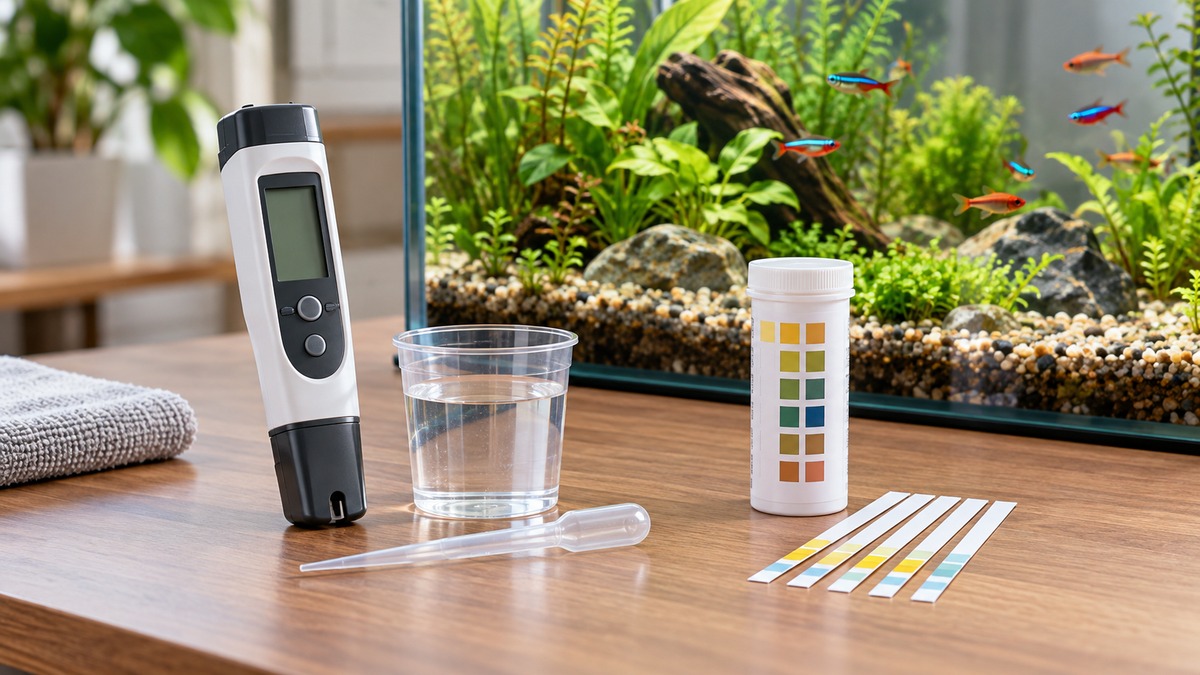
“Aquarium tester” covers four very different products: liquid test kits, paper test strips, a strip reader that gives a digital number, and probe-style meters. They do not measure the same things. A betta keeper mostly needs ammonia, nitrite, nitrate and pH, and two of the four types cannot read ammonia at all. This page sorts eight testers from Amazon by what each one actually measures, using only what the listings say. We read each listing in October 2026, and we did not buy or test any of them, so we cannot speak to accuracy.
Quick answer
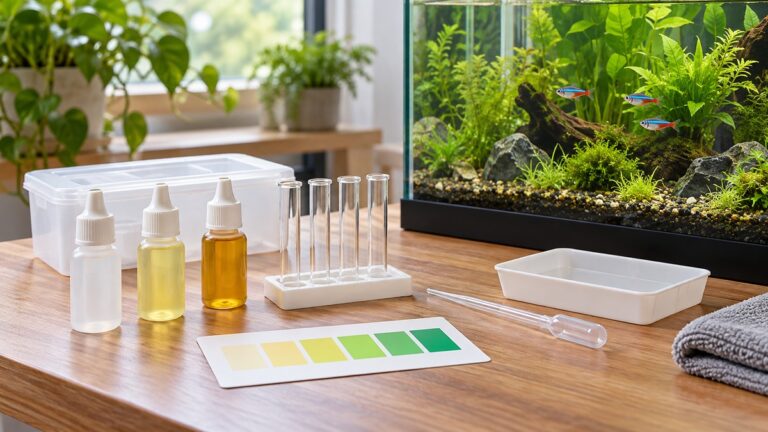
For a betta tank, pick a tester that reads ammonia, nitrite, nitrate and pH. The API Freshwater Master Test Kit covers exactly those five readings (pH, high-range pH, ammonia, nitrite, nitrate) with liquid reagents and a color card, and it is for freshwater only. If you would rather dip a strip, the AAwipes 8-in-1 and SJ WAVE 11-in-1 listings both name ammonia. The probe meters (Gain Express, Landtek) read pH, and the Landtek page says nothing about ammonia, nitrite or nitrate, so they cannot be your only tester. Our ammonia test kit guide goes deeper on that one reading.
The four types of aquarium tester
| Type | How you use it | Reads ammonia? | Example on this page |
|---|---|---|---|
| Liquid kit | Add drops to a water sample and match the color to a card | Yes in both kits here | API Master, Pawfly 5-in-1 |
| Test strips | Dip a strip and match the pads to a chart | Yes in all three listings | AAwipes, SJ WAVE, Droplytix |
| Strip reader | Dip a strip, then insert it for a digital readout | No; the listing names six other tests | Pawfly 6-in-1 digital |
| Probe or smart meter | Put a probe in the water for a number | No | Gain Express, Landtek |
The “reads ammonia” column comes from each listing’s text. If a listing does not name a test, we say so, which is not the same as proof that the device cannot do it.
Liquid kits
1. API Freshwater Master Test Kit
Specs (from the listing, checked 2026-10-18): model 34; 9.13 x 4.65 x 3.5 inches; 1.15 pounds; 7 bottles of test solutions, 1 color card and 4 tubes with caps; the title says 800 tests.
What the listing says: it monitors pH, high-range pH, ammonia, nitrite and nitrate, it is for freshwater aquariums only, and it is meant for weekly checks and for when water or fish problems appear.
Pros: every reading a betta keeper usually wants in one box. Cons: you match colors by eye, and the listing gives no accuracy figure.
Best for: a new tank that is still cycling. Skip if: you want a number on a screen. We have a longer API color chart guide if you use this kit.
View on Amazon (affiliate link)
2. Pawfly 5-in-1 Aquarium Water Master Test Kit
Specs (from the listing, checked 2026-10-13): model Pawfly-CW4952; 7.4 x 4.92 x 3.5 inches; 10.93 ounces; liquid reagents with color charts.
What the listing says: it tests pH, nitrite, nitrate, ammonia and phosphate, and it gives 265 measurements: 100 for pH, 45 for nitrite, 50 for nitrate, 30 for ammonia and 40 for phosphate. It is described as suitable for freshwater and marine tanks.
Pros: adds phosphate. Cons: only 30 ammonia tests, so a cycling tank that needs daily readings will use them up quickly. For example, a fishless cycle checked once a day would use 30 tests in a month, before you add the fish.
Best for: a stable tank checked weekly. Skip if: you expect to test ammonia often.
View on Amazon (affiliate link)
Test strips
3. AAwipes 8-in-1 Aquarium Test Strips (50 strips)
Specs (from the listing, checked 2026-10-18): model K02; 5.39 x 2.13 x 2.09 inches; 2.4 ounces; 50 strips.
What the listing says: it measures free chlorine, nitrate, nitrite, hardness, sodium chloride, total alkalinity, pH and ammonia nitrogen, and it is described as usable in freshwater and saltwater tanks and ponds. The directions give a 2 second dip for pads 1 to 7 and a separate step for pad 8, the ammonia pad.
Pros: eight readings in a small box and a named ammonia pad. Cons: strips are read by eye against a chart, and the listing gives no accuracy range.
Best for: quick checks of several readings. Skip if: you need finely graded ammonia numbers.
View on Amazon (affiliate link)
4. SJ WAVE 11-in-1 Aquarium Test Strips
Specs (from the listing, checked 2026-10-18): model “11 in 1 Aquarium Test Strips”; the title says 950 tests and 150 strips; the included-components line says 100 test strips (50 in a bag, 50 in a bottle), a color chart, an ebook and testing tubes.
Listing conflict: 150 strips in the title against 100 in the components line. The title also lists 50 ammonia strips, which may account for the gap, but the page does not say so.
What the listing says: it names pH, carbonate, total alkalinity, free chlorine, total hardness, nitrite, nitrate, copper, iron and ammonia, for freshwater and saltwater.
Best for: someone who wants copper and iron checks too. Skip if: a clear strip count matters to you.
View on Amazon (affiliate link)
5. Droplytix App-Enabled 10-in-1 Test Kit
Specs (from the listing, checked 2026-10-10): model “10-in-1 Aquarium Kit”; strips plus a mobile app; the listed pH range is 6.0 to 8.0.
What the listing says: a phone app scans the strip instead of you matching colors by eye, and the parameters named include ammonia, nitrite, nitrate, pH, GH, KH and chlorine. It is pitched at freshwater, saltwater, betta and shrimp tanks.
Listing gap: the title says 10-in-1, but the text we read names seven readings. The listing does not say how many strips come in a pack.
Best for: people who find color matching hard. Skip if: you do not want to depend on an app.
View on Amazon (affiliate link)
Strip reader
6. Pawfly 6-in-1 Digital Water Testing Kit
Specs (from the listing, checked 2026-10-13): model Pawfly-CW4992 (a sibling listing, B0H8SN41YR, carries the same text); 9.88 x 8.19 x 2.64 inches; 1.41 pounds; 3 AA batteries, not included; 50 strips; stores up to 100 records.
What the listing says: it measures pH 6.2 to 8.4, nitrate 0 to 250 ppm, nitrite 0 to 20 ppm, chlorine 0 to 10 ppm, GH 0 to 425 ppm and KH 40 to 180 ppm. You dip a strip for 2 seconds, press OK, wait for the countdown, and insert the strip for a digital readout. Out-of-range results show the maximum or minimum value.
Pros: no color matching, and it keeps a record. Cons: ammonia is not one of the six tests, and for a new betta tank that is the reading you most need.
Best for: a mature tank where you track nitrate and hardness. Skip if: your tank is still cycling.
View on Amazon (affiliate link)
Probe and smart meters
7. Gain Express Digital Combo pH and Temperature Meter
Specs (from the listing, checked 2026-10-18): pH range 0.0 to 14.0, accuracy plus or minus 0.1, resolution 0.01; a permanent temperature probe and a replaceable pH probe; up to 3-point calibration at pH 7.0, 4.01 and 10.01; automatic temperature compensation; backlit LCD; switchable between C and F.
Pros: a number to two decimals, and a replaceable pH probe. Cons: it reads pH and temperature only, and the accuracy figure is the seller’s. A pH probe needs calibration solutions and regular care, and the listing is aimed at labs and hydroponics as well as aquariums.
Best for: someone who wants to track pH closely. Skip if: you want one device for ammonia too.
View on Amazon (affiliate link)
8. Landtek Water Quality Tester with App Monitoring
Specs (from the listing, checked 2026-10-18): measures pH, TDS, EC, specific gravity, salinity and temperature; automatic temperature compensation; one-touch calibration of pH and EC; the app shows real-time data and a 30 day curve for each reading and sounds an alarm when a reading leaves a set range.
Listing gap: the listing does not name ammonia, nitrite or nitrate. It is filed under Industrial and Scientific and is pitched at aquariums and home laboratories.
Best for: trend tracking of pH and dissolved solids. Skip if: you have a new tank and need nitrogen readings.
View on Amazon (affiliate link)
How to choose for a betta tank
Start from the reading, not the gadget. In a new tank the readings people watch are ammonia, nitrite and nitrate, because they show whether the filter has built up beneficial bacteria. That is general aquarium guidance, not something we took from a source we opened, and our setup guide walks through the order of events. If the listing does not name ammonia, treat the device as a second tester, not a first one.
- New or recently changed tank: a liquid kit or a strip pack that names ammonia, nitrite and nitrate (picks 1 to 5).
- Stable tank, you like numbers: add a strip reader (pick 6) or a pH meter (pick 7) on top of a basic kit.
- pH only: our pH test kit guide compares options for that one reading.
Mistakes to avoid
- Buying a meter and assuming it covers ammonia. Probe meters read what the probe senses; the two meters here do not list ammonia.
- Trusting the title’s “in-1” count. The Droplytix title says 10 while the text names seven, and the SJ WAVE title and components line disagree on strip count.
- Ignoring expiry and storage. Neither strips nor reagents last forever; the SJ WAVE page lists “shelf life” as its warranty, so check the date on the pack.
- Testing once and stopping. The API listing frames its kit for weekly monitoring, which is a use pattern, not a guarantee of results.
Frequently asked questions
What is the best aquarium tester for a betta?
One that names ammonia, nitrite, nitrate and pH. Of the eight here, the two liquid kits and the three strip packs name ammonia, nitrite and nitrate, and the API Master kit adds high-range pH, according to their listings.
Are digital aquarium testers more accurate than strips or liquid kits?
The listings do not compare them. Only the Gain Express page gives an accuracy figure, plus or minus 0.1 pH, and that is the seller’s claim.
Can a digital tester measure ammonia?
The two digital devices here do not list it. The Pawfly 6-in-1 names six other tests and the Landtek names pH, TDS, EC, specific gravity, salinity and temperature.
How often should I test the water?
The API listing says weekly monitoring and whenever water or fish problems appear. We have not found a source we opened that sets a schedule for bettas.
Do I need a tester for a cycled tank?
Many keepers keep one for when something looks wrong. If a fish looks ill, ask an experienced fish keeper or an aquatic vet; a tester only tells you the water numbers.
Bottom line
If you buy one tester for a betta tank, buy one that names ammonia, nitrite, nitrate and pH. The API Master kit does that with liquids and a color card. Add a digital strip reader or pH meter later only if you want trend numbers, and read each title against the text underneath it.