Can I Feed Goldfish Betta Food
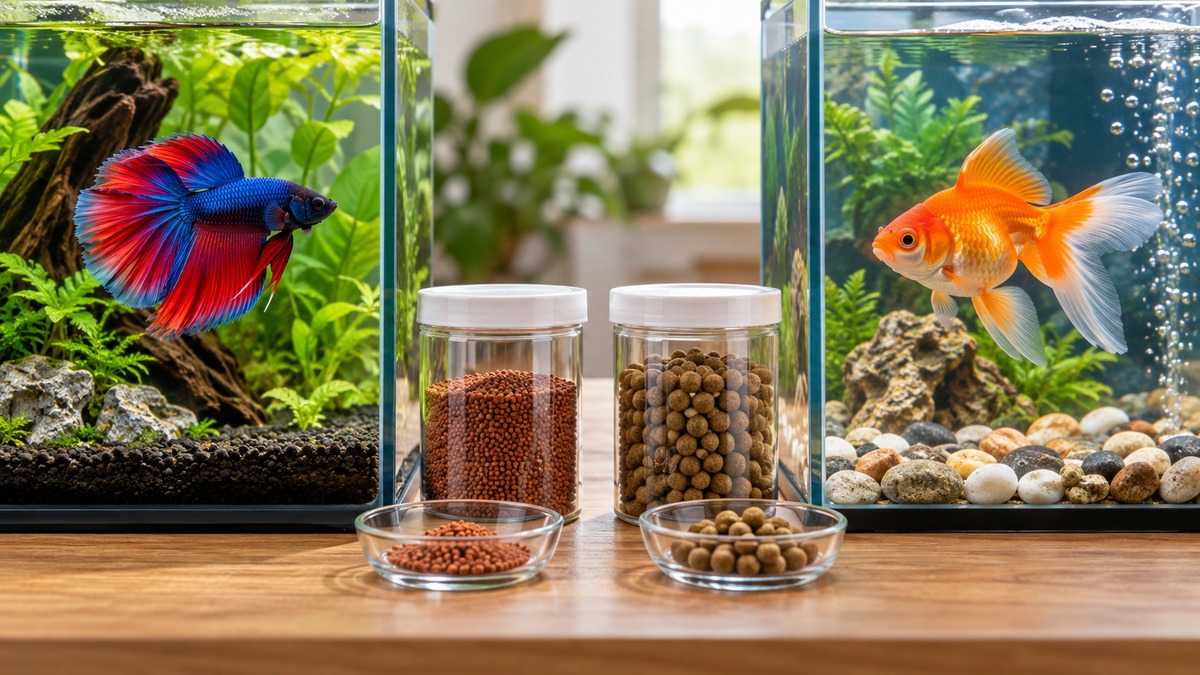
Short answer: the sources we opened do not test this exact swap, so none of them clears or condemns a goldfish eating betta food. What they do show is that goldfish and bettas are different kinds of feeders, with different natural diets and different protein and carbohydrate norms. That is the reason to treat betta food as the wrong staple for a goldfish, and to read the label before you scoop any into a goldfish tank. Below you will find the protein figures from four opened sources, a worked label comparison, and what a stray pellet does and does not tell you.
What goldfish eat, according to university sources
Oregon Sea Grant, part of Oregon State University, describes goldfish as opportunistic feeders. Its page says their diet may include plant matter, algae, small invertebrates, fish eggs and commercial fish food pellets, and it warns that overfeeding leads to obesity and other health problems. In other words, a goldfish in the wild eats both plants and animals, and a goldfish in a tank is expected to get a mixed diet, not a meat-only one.
What bettas eat
A 2016 paper in the Brazilian journal Boletim do Instituto de Pesca, written by a team from the Federal University of Vicosa and colleagues, calls Betta splendens a carnivorous species. It says bettas feed in their natural habitat on live foods such as tubifex worms, Daphnia, small aquatic insects and mosquito and Chironomus larvae. Betta food is built around that insect and worm diet, which is why the labels lean toward animal protein.
The protein numbers side by side
Two Southern Regional Aquaculture Center (SRAC) publications give the numbers. They are research on farmed fish and juveniles, not feeding charts for pets, so use them to compare diets rather than to set a portion.
- Omnivores and herbivores: SRAC Publication 5003 (Gatlin, 2010) says most herbivorous and omnivorous fish evaluated to date need a diet with 25 to 35% crude protein, while carnivorous species may need 40 to 50%.
- Goldfish: SRAC Publication 124 reports that the minimum dietary protein for goldfish in aquaria trials was 29%, based on weight gain. It also reports that goldfish gained the most weight on diets with 4.5 to 7% lipid, and that the goldfish on 4.5% lipid survived less well than those on 7 to 13%.
- Bettas: The 2016 paper tested six protein levels, from 27 to 47%, in juvenile bettas over 30 days and concluded that the requirement is between 30 and 33% crude protein. It reports that levels above 29.55% reduced the specific growth rate and levels above 33.13% reduced weight gain.
- Carbohydrate: SRAC 5003 says prepared feeds for carnivorous fish usually contain less than 20% soluble carbohydrate, while feeds for omnivorous species usually contain 25 to 45%.
The surprise in these numbers is that the trial minimums for goldfish (29%) and juvenile bettas (30 to 33%) sit close together. The gap shows up in the general ranges: 25 to 35% for omnivores against 40 to 50% for carnivores, and less than 20% soluble carbohydrate in carnivore feeds against 25 to 45% in omnivore feeds. A betta food is therefore likely to differ from a goldfish food on carbohydrate and on total protein, but you need to check the label of the specific food, because none of these papers measured a commercial betta food.
Worked example: reading two labels
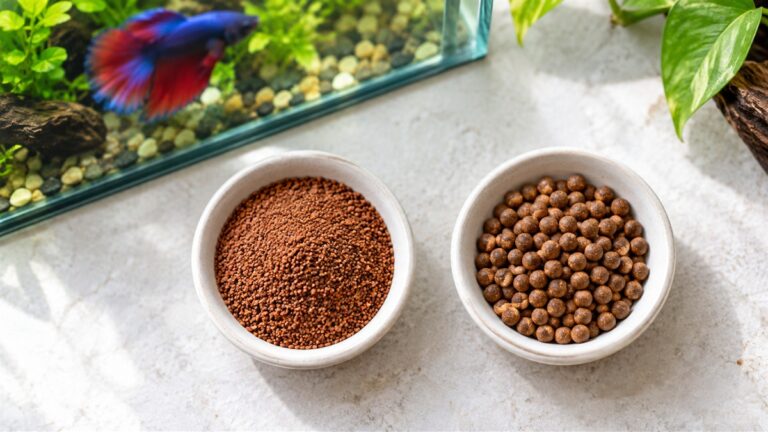
Suppose a 0.8 oz tub of betta food lists 40% minimum crude protein and a 3 oz tub of goldfish food lists 30%. This is a made-up example, not a product. By weight, the betta tub holds at least 0.32 oz of crude protein (0.8 oz x 40%) and the goldfish tub at least 0.9 oz (3 oz x 30%), so the bigger tub holds more protein in total even though its percentage is lower. Compare percentages, not tub sizes. The same sum works for any pair: a 1.2 oz betta tub at 45% holds 0.54 oz of protein, and a 2 oz goldfish tub at 32% holds 0.64 oz, so again the percentage, not the tub, tells you which food sits in the carnivore range. Against the SRAC ranges above, the betta label sits at the bottom of the 40 to 50% carnivore range, and the goldfish label sits inside the 25 to 35% omnivore range. The gap is 10%age points. If the betta label also showed no plant ingredients near the top of the list, that would fit the carnivore pattern in the sources. Compare the same lines on your own two labels: crude protein, crude fat, and the first five ingredients.
What this means for a one-off pellet
We found no study that fed betta food to goldfish, so we cannot say that a single stray pellet is safe or unsafe. What the sources support is narrower:
- A goldfish is an omnivore with a plant and animal diet, so a food designed for a carnivore is the wrong match for its regular meals.
- Overfeeding any goldfish, with any food, is linked to obesity and other health problems by Oregon Sea Grant.
- Food and waste affect your water. The SRAC publication notes that excess protein increases the excretion of nitrogenous waste, so extra rich food can add to the ammonia load in the tank.
If your goldfish has eaten betta food and you are worried, test the water for ammonia, remove any uneaten food, and ask an aquatic vet or an experienced fish keeper. The sources do not give a timeline, warning signs or a treatment for this case, and we are not offering any.
If you keep both fish
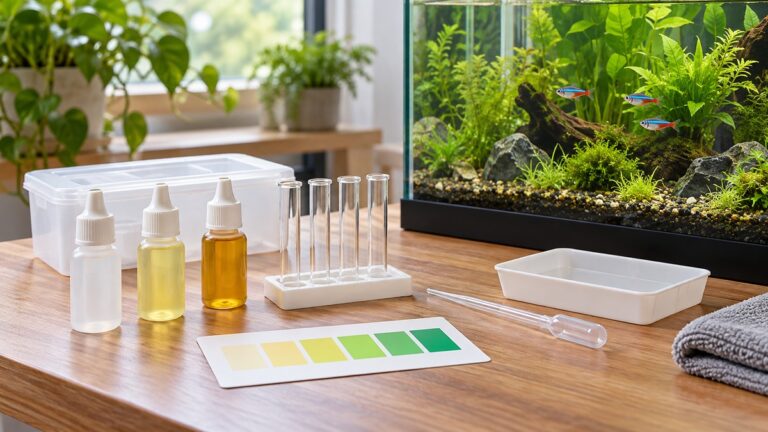
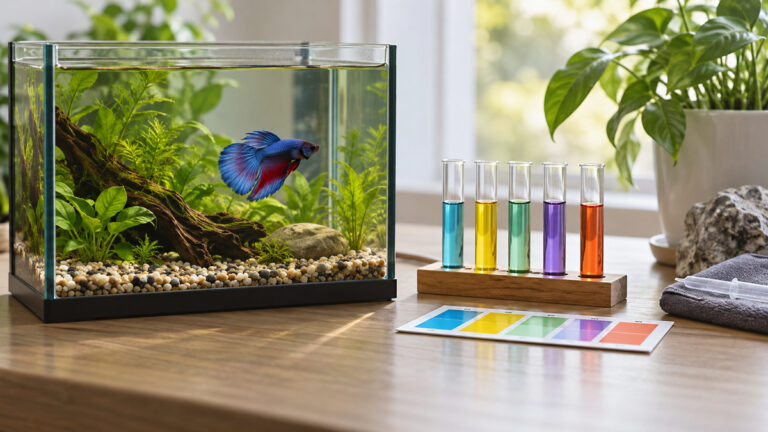
Feeding is the smaller question when the two species share space. Two of our other guides cover the practical side: the tank mate guide for a male betta and the betta tank cleaning guide, since leftover food is the main reason a tank needs cleaning. Because the tank water is shared, the water quality test strip roundup helps you keep an eye on ammonia after any feeding mistake.
Mistakes to avoid
- Using betta food as the daily food for a goldfish because the package is already open.
- Assuming a label that says “for all tropical fish” matches a goldfish. Read the protein and carbohydrate lines.
- Treating the SRAC numbers as a portion guide. They describe diet composition in research trials.
- Adding extra food to see if the other fish will eat it. Overfeeding is the one risk both fish share.
FAQ
Can goldfish eat betta food?
The sources we opened do not test it. They show goldfish are omnivores and bettas are carnivores, so betta food should not be the main food for a goldfish.
Why do the labels differ?
SRAC 5003 gives 40 to 50% crude protein for some carnivores against 25 to 35% for most omnivores, and less than 20% soluble carbohydrate in carnivore feeds against 25 to 45% in omnivore feeds.
Can bettas eat goldfish food?
The sources do not test that either. The betta paper describes a carnivore that eats live worms and insect larvae, and it found a requirement of 30 to 33% crude protein in juveniles, so check that a goldfish food reaches that protein range and whether it lists animal ingredients first.
Sources we opened (checked 2026-10-18)
- Goldfish, Oregon Sea Grant, Oregon State University
- Principles of Fish Nutrition, SRAC Publication No. 5003, Gatlin, July 2010
- Dietary Protein and Lipid Requirements of Golden Shiners and Goldfish, SRAC Publication No. 124, 1998
- Dietary crude protein levels for juvenile Betta splendens, Zuanon et al., Boletim do Instituto de Pesca 42(3), 2016