How Big Can a Betta Fish Get? Adult Size and Tank Needs
As an Amazon Associate we earn from qualifying purchases. Details
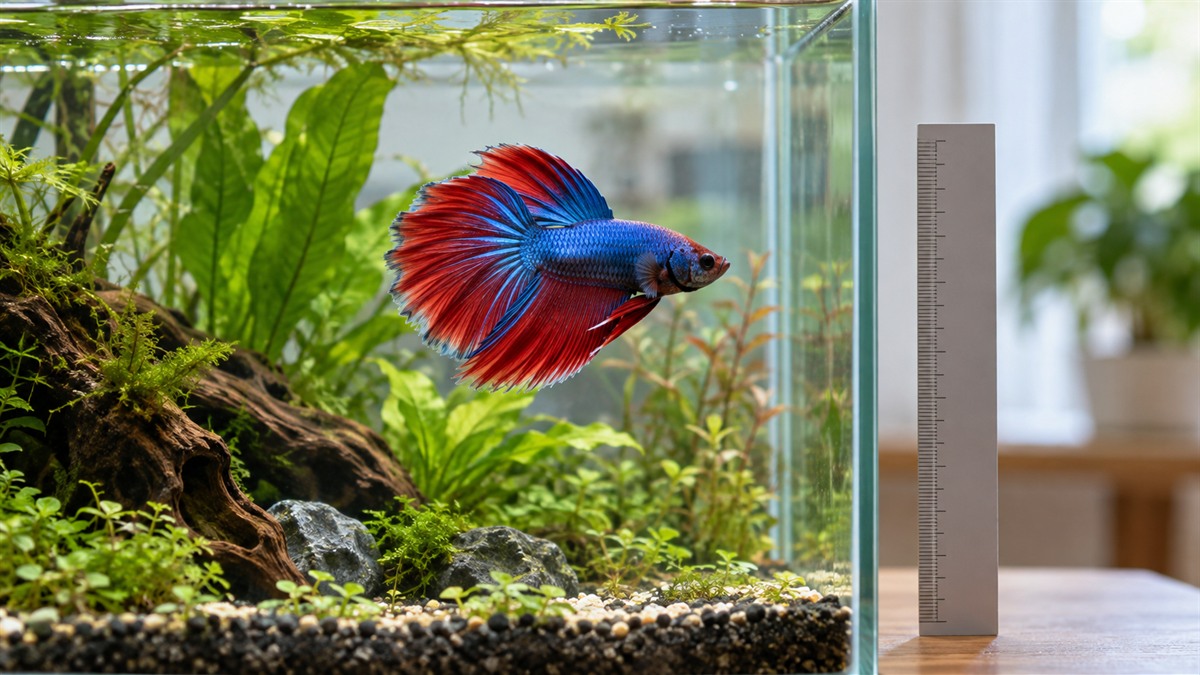
How big can a betta fish get? The sources we opened put an adult Betta splendens, the Siamese fighting fish, at about 2 to 3 inches (5 to 7.6 cm) long. National Geographic gives a size of 2 to 3 inches, and Animal Diversity Web, a University of Michigan database, gives an average of 7.5 centimeters, which is about 2.95 inches. Length alone does not set the tank you need. A betta of this size still needs warm water, calm flow and enough room to swim, and that is where most beginner mistakes happen.
Quick answer
- An adult betta is about 2 to 3 inches (5.1 to 7.6 cm) long, according to National Geographic. Animal Diversity Web gives an average of 7.5 cm, or about 2.95 inches.
- The sources we opened do not cover how long a betta takes to reach its full length. Animal Diversity Web only gives the age of sexual maturity, around five months.
- The Illinois veterinary column says bettas should “ideally be in a 5-gallon glass or plastic tank or larger.” For one fish, that is 18.9 liters.
- Keep the tank between 76°F and 81°F with a heater, and choose a low-flow filter. The Illinois column gives both points.
What size is an adult betta fish?
National Geographic gives the simplest figure: “Size : 2 to 3 inches long”. Animal Diversity Web gives a single average: “The Betta, on average, is 7.5 centimeters in length.” The two figures agree once the units match. Table 1 converts each one and shows the calculation, using 1 inch = 2.54 cm.
| Source | What the source states | Converted | Calculation |
|---|---|---|---|
| National Geographic | 2 to 3 inches long | 5.1 to 7.6 cm | 2 x 2.54 = 5.08 and 3 x 2.54 = 7.62 |
| Animal Diversity Web | average of 7.5 cm | 2.95 inches | 7.5 ÷ 2.54 = 2.95 |
Two things follow from the table. The average from Animal Diversity Web sits inside the National Geographic range. And even at the top of the range, the fish is under 8 cm long, so a large tank is not needed for the fish’s body. The tank question is about water, heat and swimming room, which the rest of this guide covers.
Why the two numbers are not identical
An average and a range answer different questions. Animal Diversity Web gives one average value. National Geographic gives a range, which allows for fish that are smaller or larger than the typical one. The sources we opened do not cover how length was measured, whether the body or the full fin span was counted, or how many fish were measured. For planning a container, round up to the top of the range, 3 inches or 7.6 cm, so that the tank is not sized for the smallest fish only.
What a length figure does and does not tell you
A length figure tells you how much room the fish needs to turn and swim at its largest. It does not tell you how much water the fish needs to stay healthy. Volume, temperature and flow are separate questions. The Illinois column treats them separately, and so does this guide.
How long does a betta take to reach adult size?
Animal Diversity Web says, “The fish reaches sexual maturity around five months.” It also says, “The young Bettas don’t begin to show very much color or fin shape until they are about three months old.” Those are timing points for maturity and color. They are not a date for full adult length, and the sources we opened do not give that date.
Lifespan is a separate figure, and the sources we opened give a wide range. National Geographic lists “Average Life Span In Captivity : 2 to 5 years” and “Average Life Span In The Wild : 2 years”. Animal Diversity Web lists 2 years for captivity. Table 2 sets out the figures side by side.
| Source | Figure | Setting |
|---|---|---|
| National Geographic | 2 to 5 years | captivity |
| National Geographic | 2 years | wild |
| Animal Diversity Web | 2 years | captivity |
A 2 to 5 year range is wide. The sources we opened do not explain what causes the spread, so this guide does not guess at a cause.
Do male and female bettas grow to different sizes?
Animal Diversity Web says that “the males are usually more brightly colored and have longer fins than the females.” That difference is in color and fin length. The sources we opened do not give separate body-length figures for males and females. The figures in Table 1 are not split by sex, so they are the only size figures this guide can state for both.
Tank size for a full-grown betta
The sources we opened do not give a separate tank size for a full-grown betta. They do give a figure for home keeping. The Illinois column says, “They should not live in bowls.” It adds, “Instead, they should ideally be in a 5-gallon glass or plastic tank or larger.” It also explains that “Betta fish are often seen living in bowls that are too small to allow for normal swimming and hiding behavior.”
This site uses that 5-gallon figure as the minimum for one betta. Table 3 converts it into liters and compares it with the two tank sizes in the Clark-Shen study, which is a peer-reviewed paper in the journal Animal Welfare.
| Tank | Liters | US gallons | Calculation | Source |
|---|---|---|---|---|
| Medium tank in the Clark-Shen study | 5.6 L | 1.48 | 5.6 ÷ 3.785 = 1.48 | Clark-Shen et al. 2024 |
| Large tank in the Clark-Shen study | 19.3 L | 5.10 | 19.3 ÷ 3.785 = 5.10 | Clark-Shen et al. 2024 |
| Illinois column minimum | 18.9 L | 5 | 5 x 3.785 = 18.9 | Illinois column |
The conversion uses 1 US gallon = 3.785 liters. The two sizes in the study do not match each other, and the difference matters. The study says, “For fish on display for sale, a minimum tank size of 5.6 L” is recommended. That is about 1.5 US gallons, and it is a minimum for fish on display for sale. It is not a home-keeping figure, and this site does not use it as one.
The large tank is the more useful comparison for a home. The study found that “Fish were significantly more active and spent significantly less time resting” in the large tank compared with the smaller tanks. Over each 600-second trial, “individuals in the large tank swam 92 s [CI: 46, 138] more than in the jar.” Using 600 seconds as the trial length, 92 ÷ 600 = 0.153, so the extra swimming was about 15.3 percent of the trial. The study also says that tanks “should not be barren” when kept as pets, which is why this guide also recommends plants and hiding places.
The study had limits. It used 13 Betta splendens, moved between five housing conditions, and ran short trials. Its results describe activity and resting in those trials. The sources we opened do not show what happens over months.
For more on choosing a volume, read how big of a tank do betta fish need and what size tank does a betta need.
Does a bigger tank make a betta bigger?
The sources we opened do not say that tank size changes a betta’s adult length. The Clark-Shen study measured activity and resting, not growth. A related point comes from the UF/IFAS FA212 page, which covers commercial breeding and says that “male bettas thrive in small containers as long as water quality, nutrition, and other health management considerations are properly managed.” The same page adds that “water quality is not dependent on the size of the container, but rather on management and husbandry.”
Those lines describe commercial fish farming, not a home aquarium. This site follows the 5-gallon standard for home keeping, based on the Illinois column. The two positions are in tension, and this guide says so rather than leaving it out.
Heat and flow for a full-size betta
Heat is the first thing to check. The Illinois column says, “Their tank needs to be kept within a distinct range of 76°F to 81°F.” It adds that “Because most homes are kept at a lower temperature, an in-tank water heater will be needed to maintain the temperature.” Converting to Celsius: (76 – 32) x 5 = 220, and 220 ÷ 9 = 24.4, so 76°F is about 24.4°C. For the top of the range, (81 – 32) x 5 = 245, and 245 ÷ 9 = 27.2, so 81°F is about 27.2°C.
Flow matters as much as heat. The Illinois column says, “A low-flow filter is vital to ensure that the fish’s delicate fins are not injured by the suction of a filter.” The UF/IFAS FA212 page makes a related point: “Bettas prefer calm water as shown by research using flow as a stressor, so heavy filtration may actually be harmful to a betta’s health and welfare.” On water changes, the same page says, “Aquariums of limited volume and reduced filtration should be managed to include frequent water changes”.
The sources we opened do not give a heater wattage or a filter flow rate for a specific tank size. Those numbers have to come from the product listing or the manufacturer, not from this guide.
Feeding and body size
The sources we opened do not link feeding to adult length. They do cover overfeeding and food amounts. The Illinois column says that “every day a betta fish should be given the amount of food it can eat within 3 to 5 minutes”. It warns that “Just like cats and dogs, betta fish can be overfed, leading to obesity and other health issues.”
The same column also makes a point about plants: “Plants can provide enrichment for the fish to hide and explore, but plants are not a food source.” Plants give a betta room to rest and explore. They do not replace a food schedule.
If a fish’s shape changes, or it stops eating, ask a vet. This guide does not give treatment or dosing advice. Feeding and welfare do not change the tank rule: the 5-gallon minimum still applies, whatever the fish’s length.
How we chose
The question is about the adult length of Betta splendens and what that length means for a home tank. We looked for sources that state a length, a lifespan or a tank volume in their own text, and we checked each quoted sentence against the saved page before using it.
We used five source types. The Illinois column is a university veterinary article quoting a board-certified zoological medicine specialist. The UF/IFAS FA212 page is a University of Florida publication, but it is written for commercial aquaculture, so we read it for water-quality and flow points only. Animal Diversity Web is a University of Michigan database. National Geographic is a general-audience source, and we used it only for its size and lifespan figures. The Clark-Shen study is a peer-reviewed paper in Animal Welfare.
We did not use retailers, product pages, blogs or Wikipedia for any size or care claim. Each figure is shown in its original unit, with the conversion and calculation written out. The 5-gallon minimum comes from the site’s welfare rule, and the Illinois column is the only opened source that gives the same figure. This guide names no products, because the question is about the fish, not a product.
What we could not verify
- The sources we opened do not cover how length was measured or how many fish were measured.
- The sources we opened do not cover the age at which a betta reaches full length. They give sexual maturity at about five months and color at about three months, and nothing more.
- The sources we opened do not cover separate body-length figures for males and females.
- The sources we opened do not cover whether tank size changes adult length.
- The sources we opened do not cover a maximum length for a single fish, or how often unusually large fish occur.
- The sources we opened do not cover heater wattage, filter flow rates for a given tank size, or the tap-water treatment steps that go with a new tank.
- The sources we opened do not cover disease, treatment or dosing. For any health concern, ask a vet or an experienced fish keeper.
FAQ
How big do betta fish get?
Most sources we opened put an adult betta at about 2 to 3 inches, or 5.1 to 7.6 cm. National Geographic gives “Size : 2 to 3 inches long.” Animal Diversity Web gives an average of 7.5 cm, which is about 2.95 inches. For planning a container, use 3 inches as the upper figure.
Do male bettas grow bigger than females?
Animal Diversity Web says that males are usually more brightly colored and have longer fins. Those are differences in color and fin length, not a measured size gap.
How long does a betta take to reach full size?
The sources we opened do not give that date. Animal Diversity Web says the fish reaches sexual maturity around five months, and that young bettas do not show much color or fin shape until about three months old. Sexual maturity and full length are not the same thing, so do not use the maturity age as a growth schedule.
Will a bigger tank make my betta grow bigger?
The sources we opened do not say that. The Clark-Shen study measured swimming and resting in tanks of different sizes, not growth. For a home tank, the reasons to choose 5 gallons or more are swimming room, warm water and calm flow, as the Illinois column explains.
How big a tank does one adult betta need?
The Illinois column says a 5-gallon tank or larger, which is 18.9 liters (5 x 3.785 = 18.9). This site uses that figure as its minimum. The sources we opened do not give a larger number for a full-grown betta, so 5 gallons is a minimum, not a ceiling.
How long do betta fish live?
National Geographic gives “Average Life Span In Captivity : 2 to 5 years” and “Average Life Span In The Wild : 2 years”. The sources we opened do not explain why the captive range is so wide.
Bottom line
Choose a heated tank of at least 5 gallons (18.9 liters) for one betta, with a low-flow filter and a water temperature held between 76°F and 81°F. Decision rule: if a container is smaller than 5 gallons, do not buy it for one betta; choose a 5-gallon tank or larger instead.
Sources
- Animal Diversity Web, Betta splendens account (University of Michigan): average length 7.5 cm, sexual maturity and color timing, captive lifespan. Opened 2026-10-19.
- National Geographic, Betta fish facts: size 2 to 3 inches, captive and wild lifespan. Opened 2026-10-19.
- UF/IFAS, Evolution, Culture, and Care for Betta splendens (FA212): calm water, filtration and container points in an aquaculture context. Opened 2026-10-19.
- Veterinary Medicine at Illinois, Your Betta Needs More Than a Bowl: bowls, 5-gallon tank, 76 to 81 F range, heater, low-flow filter, feeding. Opened 2026-10-19.
- Clark-Shen et al. 2024, Life beyond a jar, Animal Welfare: tank volumes of 5.6 L and 19.3 L, activity over 600-second trials. Opened 2026-10-19.