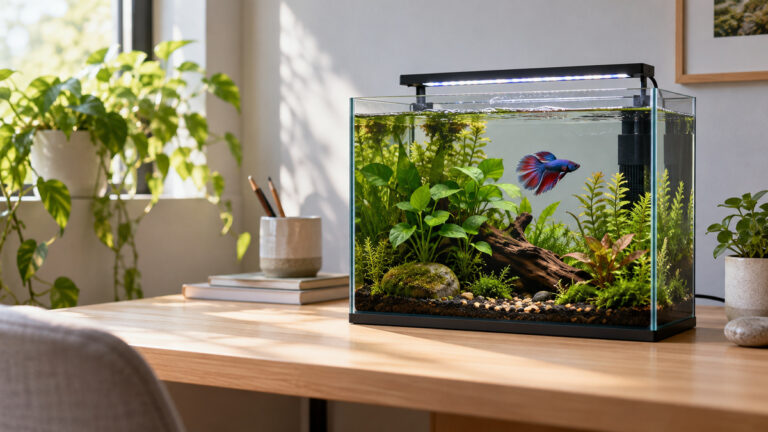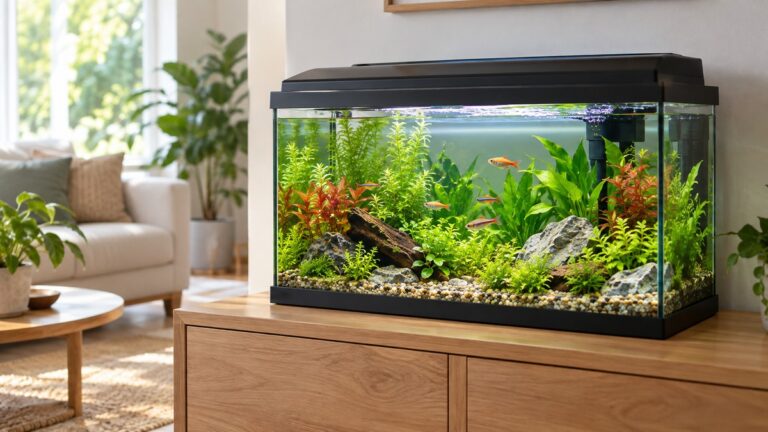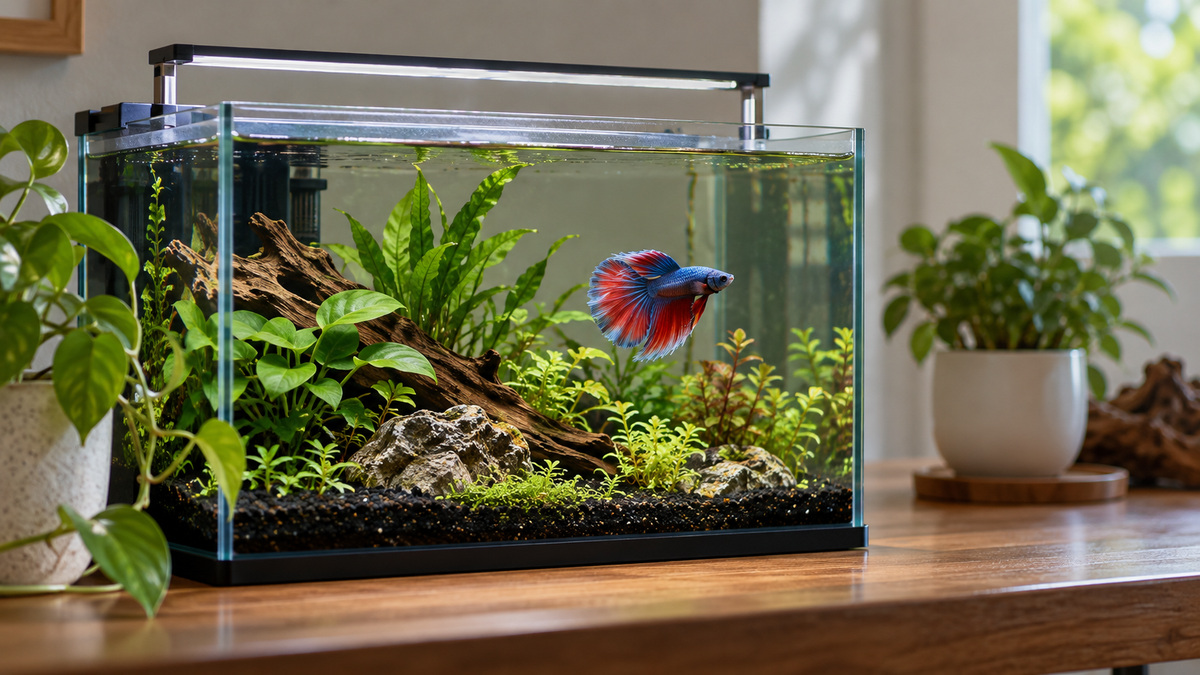
Best Lights for Small Aquarium: What to Check Before You Buy
As an Amazon Associate we earn from qualifying purchases. Details
The best lights for small aquarium setups are the ones that fit the lid opening, run on a timer, and give any live plants enough light. The pages we opened do not rank brands, so no product is named here. They do give two daily run times that differ: Aqueon suggests 6 to 8 hours for a tank without live plants, and Tetra says 10 to 12 hours is enough for animals and plants. Start from those numbers and choose a fixture that fits your tank.
Quick answer
- Fit comes first. Measure the lid or hood opening before you compare fixtures, because the light has to sit where that opening is.
- No live plants: plan on 6 to 8 hours a day, the range Aqueon gives for tanks without live plants.
- Live plants: plan on 10 to 12 hours a day, the range Tetra gives for animals and plants.
- Use a timer. Both manufacturer guides point to timers, and setting the same clock times every day keeps the schedule steady.
Why a small tank still needs a planned light
UF/IFAS puts the case for lighting in one line: “Proper lighting is essential for the health of all animals, plant life, and also for aesthetic reasons.” That sentence covers three jobs: keeping the animals healthy, supporting plants, and letting you see the tank. Those jobs do not shrink because the tank is small. What changes is the room for guesswork. Small tanks leave little space for an approximate schedule, so a fixed timer is usually a simpler fix than adjusting the light by hand each day.
Aqueon gives a reference point for the schedule: “Since most aquarium fish originate from tropical environments that receive 12 hours of daylight and 12 hours of darkness, you want to emulate that cycle with your lighting.” Read together with the rest of the same guide, that statement gives a reference and a working range. The 12-hour day is the natural model, and the 6 to 8 hour range is the practical schedule for a tank without live plants. This article uses the range, not the single reference, because a reference is not a daily setting.
The UF/IFAS 4-H marine aquarium project guide defines the term that matters for the timer: “Photoperiod: The amount of time each day that the aquarium lights are turned on.” That guide is written for marine tanks, but the definition works for a freshwater light too. The photoperiod is the number you set on the timer, so decide it first and then pick the fixture.
Working out the weekly hours
Each run time is a daily number, so multiply it by seven to see the weekly total. This is a planning check, not a biological threshold. It helps you confirm that a timer is set as you intended and lets you compare schedules side by side.
| Tank situation | Daily light, from the pages we opened | Weekly total (daily x 7) |
|---|---|---|
| Fish only, no live plants | 6 to 8 hours (Aqueon) | 42 to 56 hours |
| Fish with live plants | 10 to 12 hours (Tetra) | 70 to 84 hours |
| Tropical daylight reference | 12 hours (Aqueon) | 84 hours |
Worked check: 6 x 7 = 42 and 8 x 7 = 56, so a 6 to 8 hour day gives 42 to 56 hours a week. Likewise 10 x 7 = 70 and 12 x 7 = 84, so a 10 to 12 hour day gives 70 to 84 hours a week. If your timer reads a different weekly total than this, check the timer’s on-time settings before you change the fixture.
The pages we opened do not describe sunrise or sunset ramps, dimmers or split schedules, so this guide does not recommend any of them. A plain on-off timer is the setup the sources actually describe.
Matching the fixture to a small tank
Work through this checklist before you compare models:
- Measure the opening, not the glass. The light sits on top of the tank, so the lid opening or hood is what it has to fit. Write down the length and width of the opening, then compare fixtures against those two numbers.
- Check the mounting style. Some fixtures replace a hood, some clip to the rim, and some hang on a bracket. Pick the style your tank already supports. The pages we opened do not compare mounting styles, so check the product manual for your tank.
- Look for timer control. Tetra notes that installing a timer, or buying a unit with integrated timing, can make lighting easier. Aqueon says a simple timer can be used with the fixture to control the light. If the fixture has no timer, a plug-in outlet timer can control its power.
- Confirm the light can go fully dark. The daylight-and-darkness cycle from Aqueon includes 12 hours of darkness, so a fixture that stays partly lit all night does not match that cycle. Check that the switch or timer turns the light fully off.
None of these steps depends on which brand you pick. They work the same way for a clip-on bar, a hood replacement or a stand-alone fixture, because they describe the tank you already own.
Power, cords and the cover
A light is only part of the top of the tank. UF/IFAS says plainly: “Aquariums should be covered to prevent fish from jumping out.” A light that sits in the hood position does not remove that need. If the fixture replaces the lid, check that it still covers the opening, or keep a separate cover in place.
For power, the UF/IFAS 4-H marine guide defines ballast in one short line: “Ballast: A power source is required for aquarium lights.” The guide is for marine tanks, but the point is general. Plan the outlet, the cord and the timer before you buy, so the cord does not have to cross the wet top of the tank. Keep the plug, the timer and the power adapter away from splashes. The pages we opened do not give a full electrical checklist, so read the product manual for the power rating and any warning about water contact.
Plants: what light does and what algae does
FA251 is a UF/IFAS publication on commercial freshwater plant production. It says: “Most freshwater ornamental aquatic plants are tropical and require a warm climate and significant amounts of light.” That sentence is written for growers, but it describes the plants a hobbyist buys too. If your tank has live plants, the light has to be enough for them, which points the daily run time toward the 10 to 12 hour range in Tetra’s guide.
The same publication explains the other side of the balance: “Algae reduces plant growth by blocking available light for photosynthesis and by absorbing available nutrients.” Aqueon ties the shorter 6 to 8 hour range to less unwanted algae in a tank without live plants. Put together, a longer day is not automatically better. If algae takes over, change the schedule before you change the fixture, and do it in small steps. That order is a planning choice; the pages we opened do not give a step size.
Plants that need more light do not change the basic checklist. They make the timer more important, because a missed hour or an extra hour is harder to see when the plants are the reason for the light.
Choosing a light for your situation
Use the tank you have to pick the starting point:
- A fish-only tank with a simple lid: choose a fixture that fits the opening and has timer control, then set 6 to 8 hours a day, following Aqueon’s range for tanks without live plants.
- A tank with live plants: choose a fixture that fits the opening and plugs into a timer, then start within Tetra’s 10 to 12 hour range and watch for algae.
- A tank that needs a cover: choose a fixture that works with a lid or cover, because UF/IFAS says aquariums should be covered.
If you want a closer look at waterproof models for a fish tank, read best waterproof led light for fish tank. For planted tanks, see how to pick the best light for freshwater planted aquariums. Both guides are on this site, and they help when the question moves from size to fixture type.
Common mistakes
- Running the longest schedule by default. Aqueon’s range for tanks without live plants is shorter than Tetra’s range for animals and plants, so one number does not fit every tank.
- Skipping the dark period. The daylight-and-darkness cycle in Aqueon’s guide has 12 hours of darkness, so a light left on around the clock does not match it.
- Switching the light by hand. Both manufacturer guides point to a timer, which keeps the schedule the same from day to day.
- Buying by tank name rather than by opening. The fixture sits on the lid, so measure the opening first.
- Assuming plants will grow under any light. FA251 says plants need significant light, so a weak fixture is a poor match for a planted tank.
How we chose
We started from the question a small-tank owner asks: which light, and how long to run it. We kept to pages we could open and quote in this session. Those were three UF/IFAS publications (a general fish-trade guide, a marine project guide used only for definitions, and a freshwater plant production publication) and two manufacturer guides for the daily run times. We did not rank fixtures, did not name any product, and did not use prices or ratings. Where the pages disagree, we show both numbers and leave the choice to the reader. Search results returned many hobby blogs and retailer articles; we did not use them, because a search snippet is not proof of what a page says.
What we could not verify
- The pages we opened do not give a light output for small tanks. This guide has no PAR, PPFD or lumen figure, so it does not recommend an intensity.
- They do not state how a particular fixture fits a particular lid or hood. Measure your own opening.
- They do not compare colors or spectrums for fish or plants, so this guide does not say which color is better.
- They do not state heat output, power use, lifespan or warranty for any fixture.
- Both daily ranges come from manufacturers. We did not find an independent university source that gives a run time for a small tank, so treat the ranges as starting points.
FAQ
How many hours a day should a small aquarium light run?
Aqueon gives 6 to 8 hours for a tank without live plants, and Tetra gives 10 to 12 hours for a tank that holds animals and plants. Begin with the range that matches your tank, set the timer to the same clock times every day, and change the schedule only if you see a clear problem, such as algae.
Do I need a light if my small tank has no live plants?
Yes, for viewing and for the animals. UF/IFAS says proper lighting is essential for the health of all animals, plant life, and aesthetic reasons. A tank without plants still needs a fixed schedule, and Aqueon’s 6 to 8 hour range is the shorter starting point.
Should I buy a light with a built-in timer?
A built-in timer is convenient. Tetra says a timer, or a unit with integrated timing, can make lighting easier. If your fixture has no timer, a plug-in outlet timer can control its power. That is a practical choice rather than a rule from the pages we opened.
Can a light on top replace the tank cover?
Not by itself. UF/IFAS says aquariums should be covered to prevent fish from jumping out. Check whether the fixture is designed to cover the opening, or whether you still need a separate lid.
Does light color matter for plants or fish?
The pages we opened do not give color or spectrum guidance for small tanks, so this guide does not make a claim about it. Check the spectrum the product manual lists, and compare it with the plants you plan to keep.
Bottom line
Choose a light that fits the lid opening and runs on a timer. Set 6 to 8 hours a day for a tank without live plants and 10 to 12 hours for a tank with plants, then change the schedule in small steps if algae appears. Choose the shorter range without plants, the longer range with plants, and a timer either way.
Sources
- UF/IFAS FA124, The Ornamental Fish Trade: proper lighting is essential for the health of animals and plants, and tanks should be covered
- UF/IFAS 4-H Marine Aquarium Project Book (4H433): the photoperiod definition and the power-source point for aquarium lights (marine guide)
- UF/IFAS FA251, Freshwater Ornamental Aquatic Plant Production in Florida: freshwater plants need significant light, and algae blocks light for plants
- Aqueon, Why is a light schedule important for my aquarium?: 6 to 8 hours without live plants, the 12-hour day and darkness cycle, and a simple timer
- Tetra, Aquarium Lighting Basics: 10 to 12 hours for animals and plants, and timer control