Do Betta Fish Need an Air Pump? When One Helps
As an Amazon Associate we earn from qualifying purchases. Details
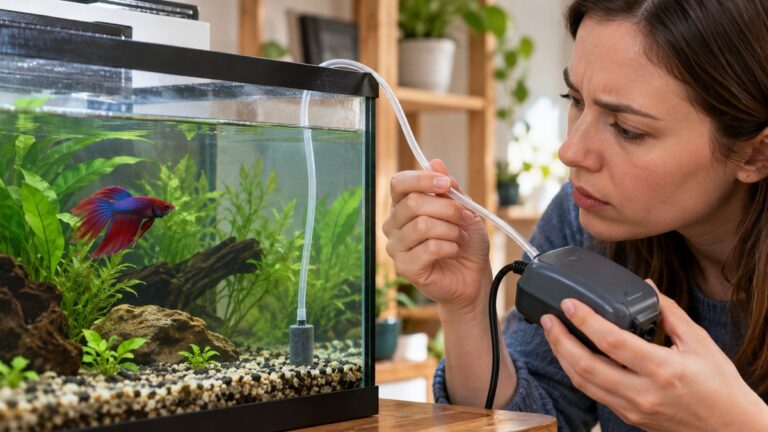
Fish that don t need air pump usually means one fish: the betta. Do betta fish need an air pump? Often not. Bettas have a labyrinth organ that lets them take air from the surface, so a pump is not automatically required. What matters is whether the surface moves. If your filter ripples or breaks the surface gently, it is doing the job. If the surface stays flat, an air stone is the recommended fix, according to the RSPCA care guide for Siamese fighting fish. Keep any surface movement gentle, because strong currents can damage a betta’s fragile fins.
Quick answer
- Bettas have a labyrinth organ, so they can take air from the surface. A pump is not automatically required.
- If the filter does not create bubbles or stir the surface, the RSPCA guide recommends an air stone to keep the water well oxygenated.
- Check whether your filter already breaks the surface gently. If it does, an extra pump may add nothing for the fish.
- Keep surface movement gentle. Strong currents can damage a betta’s fins.
- A betta needs a heated, filtered tank of 5 gallons or more. Bowls are not suitable.
What the labyrinth organ does
Bettas are labyrinth fish. The manufacturer’s betta guide describes the labyrinth organ as a structure that lets the fish process air from the surface when the water is less than ideal. The RSPCA guide says the species needs occasional surface air even where the water holds plenty of oxygen. A betta is built to reach the top of the tank, so a still surface does not by itself mean the fish is in trouble.
The same guide says the tank needs space between the water and the lid, so the fish can come up for air. A lid that touches the water removes that option, whatever the pump is doing. Bettas are also strong jumpers, so a lid is still needed. The answer is a lid that stops jumps but leaves an air gap above the water.
When an air stone is needed
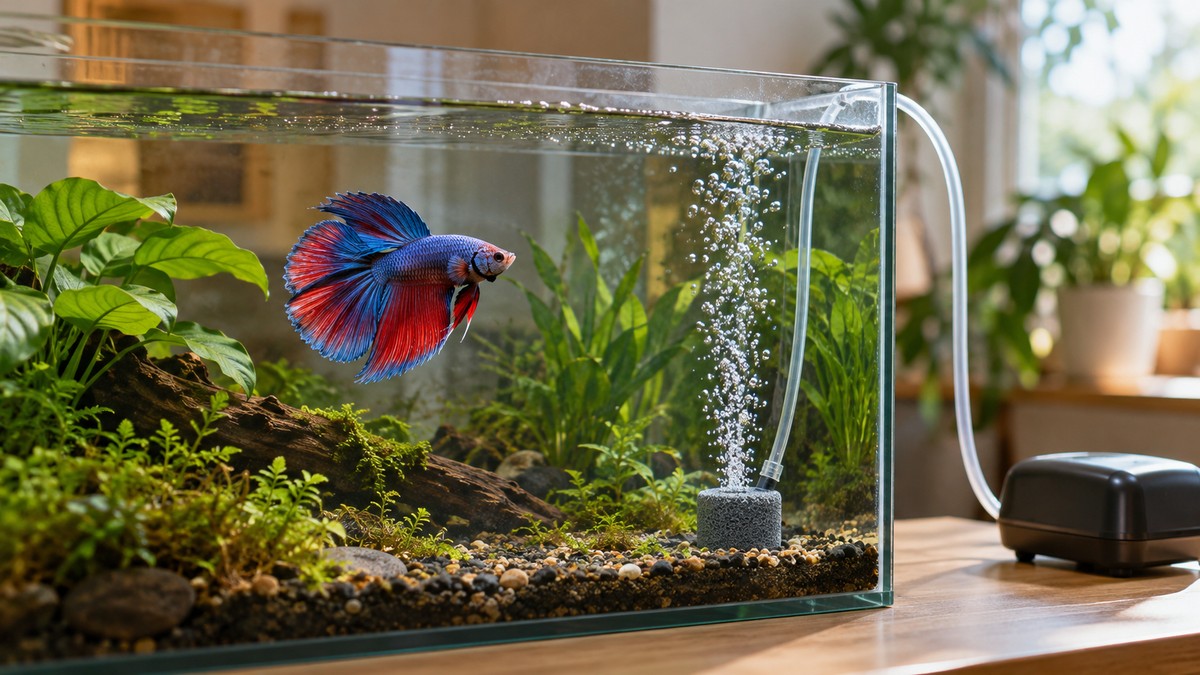
The RSPCA guide gives a clear threshold. If the filter does not create bubbles or stir the surface water, aeration with an air stone is needed to make sure the water is well oxygenated. The first test is visual. Look at the surface. If the filter outlet ripples it, or bubbles break the surface, the filter is already doing the job. If the surface stays flat and the water looks dull or still, an air stone is the fix.
An air stone is a diffuser on a tube, driven by an air pump. It adds bubbles, and the bubbles move water at the surface. It does not need to be strong. Exact flow rates and pump sizes for a given tank are not covered by the sources, so choose a gentle setting and check the surface after you install it.
Why the filter often matters more
A filter does two jobs. It moves the water, and it houses the beneficial bacteria that break down waste. The manufacturer’s nitrogen cycle guide explains that nitrifying bacteria live in the filter, the gravel and on solid surfaces, and that they convert ammonia to nitrite and then nitrate. Sponge filters give those bacteria a surface to grow on while trapping solids. A pump that only adds bubbles does not provide that bacterial surface.
The RSPCA guide says a filter of appropriate size for the tank, with adjustable flow, is needed. Adjustable flow matters for bettas. The manufacturer’s betta guide recommends a low-flow filter so the current does not damage the fish’s delicate fins. A strong filter and a strong air stone together can make a small tank too busy for a betta, so match the flow to the fish.
Checking whether you need a pump
- Look at the surface when the filter is running. Note whether it ripples or breaks gently.
- Check that the lid leaves an air gap above the water.
- Watch the fish near the top for a few minutes. Note whether it rises to the surface normally.
- If the surface stays still and the water seems dull, add an air stone.
- Keep the flow low, because bettas have fragile fins.
Maintenance that affects oxygen
Waste and uneaten food use up oxygen as they break down, so the tank’s cleanliness affects its oxygen supply. The RSPCA guide says overfeeding is common in this species and that uneaten food pollutes the tank. Offer only what the fish eats in a short time and remove the rest. The guide recommends partial water changes of 10 to 25 percent weekly, and a gravel clean. Adelphi University’s betta care page recommends changing the water at least once a week and treating new water with a dechlorinating agent.
Clean the filter in tank water, not tap water, because chlorine or chloramine can kill the beneficial bacteria. Rinse the filter lightly in tank water when it clogs, and avoid over-cleaning. Warm water holds less oxygen, so keep the temperature in the betta range as well.
Watching the fish after setup
The first week is the time to check how the fish uses the surface. A betta does not stay at the top; it comes up for air at intervals, so a brief visit to the surface is normal. The useful check is whether the fish can reach the surface without bumping into the lid and whether it looks settled between trips. A fish that repeatedly gasps at the surface, or that stays pressed against the lid, is telling you something about the setup. Check the temperature, the air gap and the water chemistry first. If the signs continue, consult an experienced fish keeper or an aquatic veterinarian.
Other species
The guidance here is about bettas. Many aquarium fish do not have a labyrinth organ, and their needs for dissolved oxygen differ. If a tank holds more than one species, check each species’ needs before deciding that no pump is required.
Resting near the surface
The RSPCA guide says Siamese fighting fish are better close to the surface when resting, and that tall plants with large leaves, on which fish can rest at night, can help. The manufacturer’s betta guide describes betta hammocks, which are soft artificial leaves that attach to the tank wall with suction cups, as rest stops. Soft live plants such as Hornwort or Naja grass are named as safe choices, and Anubias is named as a good option. Artificial plants should be betta-safe silk. These choices help the fish reach the top without strain.
Signs that the water needs attention
The manufacturer’s water quality article says fish with nitrite toxicity often breathe rapidly and gasp at the surface, and that their gill filaments can turn from bright red to dull brown or grey, although other causes exist. The RSPCA guide lists fish that sink or bob to the surface, that have clamped fins, or that stay in a corner for a prolonged period as signs of poor health. If you see these signs, test the water first. A pump does not remove ammonia or nitrite. The manufacturer’s article says the only safe level of either is zero.
The RSPCA guide gives ideal readings of ammonia below 0.1 ppm, nitrite below 0.2 ppm and nitrate below 50 ppm, with pH between 6.5 and 7.5.
Cycling and the air stone decision
The manufacturer’s nitrogen cycle article says ammonia usually begins to rise by the third day after fish are added, nitrite rises by the second week, and the cycle is complete when nitrates appear and ammonia and nitrite read zero. During cycling, test every two to three days and change about 10 to 25 percent of the water every few days. An air stone is a separate question from the cycle. The RSPCA threshold for one is about surface movement, not about test results.
Water movement and enrichment
The RSPCA guide says Siamese fighting fish prefer low flow because it mimics their natural habitat, and it suggests periodically changing the direction of the water flow as enrichment. Those points match the betta guide, which asks for a low-flow filter because strong currents can damage fragile fins. A gentle surface ripple is the target, whether it comes from the filter or an air stone.
Cleaning without stressing the fish
The manufacturer’s betta guide says that removing the fish for a deep clean causes more stress than leaving it in the tank. Its deep-clean steps remove about 50 percent of the water, starting with about 10 percent to avoid sloshing, and clean the decorations separately. The RSPCA guide recommends a dedicated, labelled bucket for the gravel siphon, and rinsing the filter in tank water rather than tap water.
Light and algae
The RSPCA guide says aquarium lights should be on for no more than 10 hours a day, and that the fish need at least eight hours of darkness. Keep the tank away from direct sunlight or windows to limit algae. The manufacturer’s water quality article says phosphate from fish food and other sources is a major contributor to algae blooms, so feeding sparingly also helps.
Bubbles at the surface
Not every bubble comes from the pump or the filter. The RSPCA guide says male Siamese fighting fish sometimes build bubble nests as a sign they are ready to breed. These appear as a cluster of small bubbles of various sizes on the surface, often in a corner with some cover, and the guide describes this as normal behaviour. Surface bubbles are therefore not proof that the water is well oxygenated, so judge the surface movement from the filter and the fish’s behaviour together.
Decor, gravel and fin safety
The RSPCA guide says gravel should be smooth, and that silk or live plants should not have rough edges, because fins tear easily. Male fish with long fins are particularly prone to fin tears. Sharp edges and points on decor and driftwood can be sanded gently to make them safe.
Where the facts come from
The advice here comes from the RSPCA care guide, two manufacturer care articles, a university veterinary guide on betta tanks, and a 2024 journal article on tank size and welfare. Each point is one a source states.
What is not covered
The sources do not give an air pump size for a given tank, an air stone flow rate, a dissolved oxygen level a betta needs, or a rule for other species. If you need those figures, check the product label or ask an experienced fish keeper.
FAQ
Do betta fish need an air pump?
Often not, because bettas take air from the surface. The RSPCA guide says an air stone is needed if the filter does not create bubbles or stir the surface.
Can a betta breathe with a still surface?
It can reach surface air through its labyrinth organ, as long as there is a gap under the lid. A flat surface with poor water quality is still a concern.
Will an air stone hurt my betta?
Not if the flow is gentle. Strong currents can damage the fins, so keep the movement low.
Is a filter enough?
If it creates bubbles or stirs the surface gently, the RSPCA guide’s threshold is met. Check it visually.
How big a pump do I need?
The sources do not give a size. Choose a gentle setting and check the surface.
Bottom line
A betta can breathe surface air, so a pump is not always required. Check the surface first. If the filter does not stir it, add a gentle air stone, keep the lid’s air gap, keep the water clean, and keep the tank heated and filtered at 5 gallons or more.
For more on the related questions, read the air pump guide for betta tanks and the guide to setting up an air pump.
- RSPCA Knowledgebase: How should I care for my Siamese fighting fish?, updated 1 May 2024, opened 30 October 2026.
- the manufacturer: The Ultimate Guide to Betta Fish, manufacturer care guide, opened 30 October 2026.
- the manufacturer: The Nitrogen Cycle, manufacturer guide, opened 30 October 2026.
- the manufacturer: Freshwater Aquarium Water Quality, manufacturer guide, opened 30 October 2026.
- Illinois College of Veterinary Medicine, “Bettas Need More Than Bowls” (April 15, 2019), opened 30 October 2026.
- Adelphi University, “Betta Fish Care” (author not stated), opened 30 October 2026.
- Clark-Shen (2024), Life beyond a jar, Animal Welfare, doi:10.1017/awf.2024.67, opened 30 October 2026.
Sources
- RSPCA Knowledgebase: How should I care for my Siamese fighting fish?: opened 30 Oct 2026; air stone threshold, surface air, filter flow.
- Aqueon: The Ultimate Guide to Betta Fish: opened 30 Oct 2026; labyrinth organ, low-flow filter.
- Aqueon: The Nitrogen Cycle: opened 30 Oct 2026; biological filtration.
- Aqueon: Freshwater Aquarium Water Quality: opened 30 Oct 2026; water quality.
- Illinois College of Veterinary Medicine: 5-gallon minimum, heated tank, no bowls (opened 2026-10-30)
- Adelphi University Betta Fish Care: labyrinth breathing at surface, weekly water change with dechlorinated water (opened 2026-10-30)
- Clark-Shen (2024), Life beyond a jar: opened 30 Oct 2026; tank size and welfare.