Fish Tank Air Pump Not Making Bubbles: What to Check First
As an Amazon Associate we earn from qualifying purchases. Details
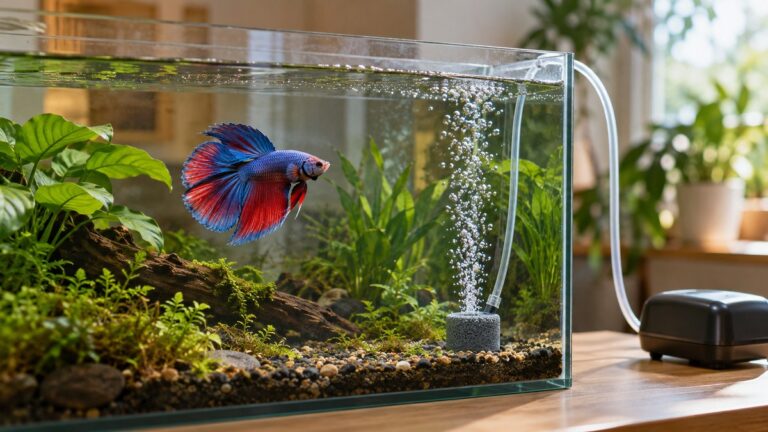
A fish tank air pump not making bubbles is a symptom, not always the cause. Before you replace the pump, check the water, the fish and the tank as a whole. Dissolved oxygen keeps the bacteria that break down fish waste working, and fish need it in the water to stay healthy. A pump that has stopped is one reason oxygen can fall, but the pump is only one part of the system. The RSPCA Australia care page for Siamese fighting fish, which is the betta, says these fish need occasional access to surface air even when water oxygen is plentiful.
Quick answer
- Check the fish first. Gasping at the surface or staying near the top means act on the water now.
- Test for ammonia if you have a kit. Ammonia should not build up in a healthy tank, and an ammonia test strip guide explains what a reading means.
- Check power, the plug and the tubing before you buy a new pump. These are general mechanical checks, not claims from a source.
- Keep a betta in a heated, filtered tank of 5 gallons or more. A pump is not a substitute for water management.
Start with the fish and the water
If a fish is gasping at the surface, breathing fast or crowding the top of the tank, treat that as urgent. The first step is the water, not the pump. Measure the temperature with a thermometer, and compare it with the betta temperature guide. The Illinois College of Veterinary Medicine gives a range of 76 to 81 degrees Fahrenheit for bettas and says an in-tank heater is needed in most homes. The Adelphi University betta page gives 75 to 80 degrees and says the temperature should be maintained with a heater.
Warm water holds less dissolved oxygen than cold water. The NMSU circular on aquaponics water quality says oxygen levels are strongly tied to temperature, which means a heater that has failed in a warm room, or a heater that is running too hot, can both change the oxygen picture. The NRAC fact sheet from the University of Massachusetts Aquaculture Center notes that oxygen solubility rises as temperature falls. Both sources are about aquaculture and aquaponics, so their figures are a guide to principle rather than a home-tank target.
Next, test for ammonia. The NMSU circular explains that the ammonia fish excrete will soon kill them if it accumulates, and that toxic ammonia increases as pH increases. A kit that shows any ammonia in a tank that is supposed to be established is a reason to make a water change and check the filter, not a reason to blame the pump alone.
Check the pump and its power
These are general mechanical checks. Neither source covers pumps or their parts, so none of the steps below is sourced.
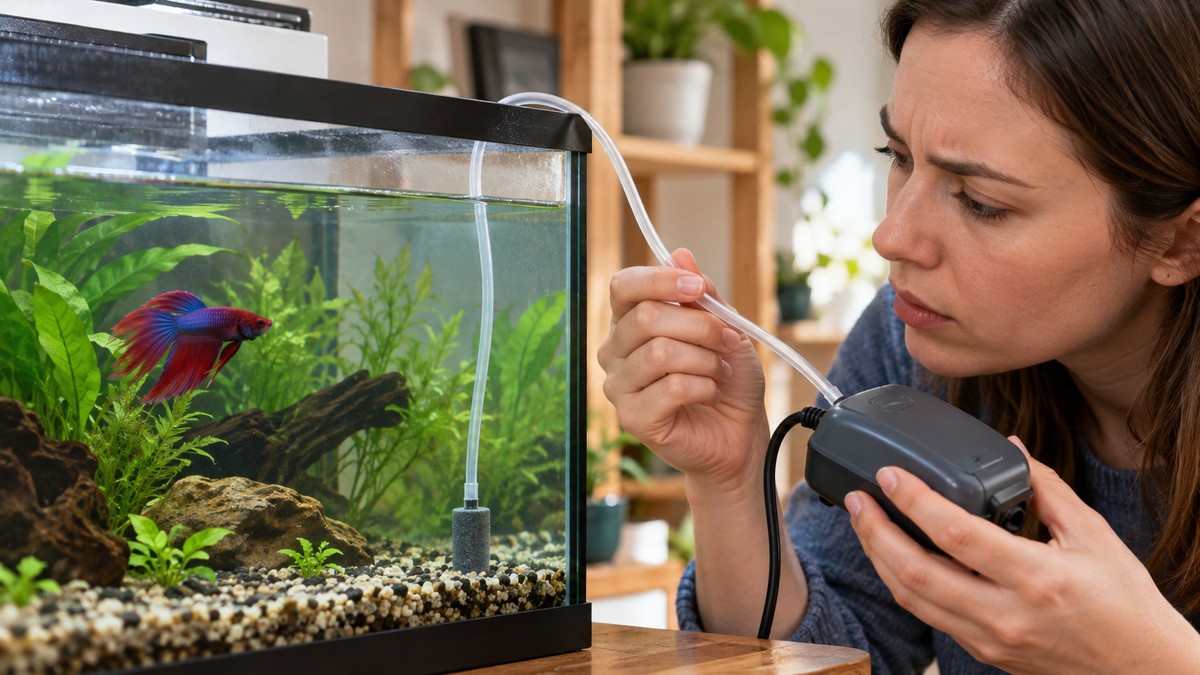
- Confirm the outlet has power. Try another device in the same outlet, or plug the pump into a known working outlet.
- Check the plug and the cord for damage. Do not run a damaged cord near water.
- Check the switch and any dial. Some pumps have a control that lowers output, and a turned-down dial can look like a dead pump.
- Listen. A pump that hums but moves no air may be blocked or have a failed diaphragm, and the sources do not describe the internal parts.
- Look at the tubing. Kinks, a disconnected end or water inside the line will stop air from reaching the stone.
If the pump runs but no bubbles reach the water, follow the air path. Check each joint, then the air stone itself.
Check the air stone and the tubing
An air stone can clog with algae, mineral deposits or debris. A stone that has been in use for a long time may slow the flow even when the pump is working. Remove the stone, rinse it in clean water that has been treated, and look at whether bubbles come out more freely. Do not use soap or household cleaners on the stone, because residue can harm the fish.
Tubing that sags below the pump can let water flow back toward the pump. Keep the pump above the water line and fit the tubing so that water cannot drain into the housing. The sources we opened do not describe a check valve, so if you use one, follow its own label.
When the pump is not the problem
A tank can lose its bubbles without a pump failure. The NRAC fact sheet notes that oxygen levels are lowest just before dawn and highest in the late afternoon, so a tank that looks fine at midday can be at its weakest overnight. If the water is warm and crowded, the surface may already be limited in oxygen exchange, and a loud pump will not solve a dirty tank. The NRAC fact sheet says oxygen must be kept above levels that stress fish, and it describes aeration or oxygenation as the means of doing that in culture systems. For a betta in a heated, filtered tank, the simplest fix is often water management: a partial water change, a check of the filter and a steady temperature.
The Adelphi page says bettas can breathe directly from the water surface because they are labyrinth fish. A betta that is at the surface and looking well is not necessarily in trouble because the pump has stopped. A betta at the surface that is gasping, has clamped fins or is hiding at the bottom needs a closer look at the whole tank.
Keep the filter gentle and the lid clear
The RSPCA page advises that a filter should be lightly rinsed in tank water when it starts to clog or at least monthly, and that tap water should not be used to clean it, because chlorine can kill the beneficial bacteria that break down ammonia. The same page says there must be space between the water and the tank lid so the fish can reach air. A lid that sits tight on the tank can cut off that access, so check the gap when the bubbles stop.
The Illinois College of Veterinary Medicine says a low-flow filter is preferred for bettas, because a strong current can injure delicate fins. If you replace a pump, do not assume a stronger pump is better. The sources support gentle water movement for a betta and do not describe any benefit from a forceful bubble stream.
Water changes and testing
The Adelphi page recommends water changes at least once a week and says new water should be treated with a dechlorinating agent. Those two habits do more for a tank’s oxygen and ammonia balance than most equipment fixes. Test the water when you change it, record the readings, and look for patterns. A tank with rising ammonia between changes needs more frequent water changes, a check of the filter and a review of how much food is left in the tank.
What to do if a fish is in distress
If a betta is gasping, lying on the bottom or showing clamped fins, do not wait for the pump to be repaired. Check the temperature, test for ammonia, and make a partial water change with treated water at a similar temperature. Then contact an experienced fish keeper or an aquatic veterinarian. This guide does not give medical advice or dosing instructions.
How we chose
The criteria were simple. We used pages we could open and read in full, and kept only the claims they state. Where a source covers aquaculture, aquaponics or pond culture rather than a home betta tank, we say so next to the claim. We did not use unopened publications, retailer pages or summaries as proof of a quote, and we left out any point that only a product label could settle.
What we could not verify
- The internal parts of an air pump, including the diaphragm, valve or motor, and how each one fails. No opened source covers pump mechanics.
- Check valves, air stone designs and tubing sizes. The sources do not describe them, so this guide does not say which one to buy.
- The noise, airflow or power draw of any pump. These are product facts that belong on the label.
- A dissolved oxygen figure for a home betta tank. A threshold of 5 mg/L appears in a UF/IFAS publication that we could not open, so it is not used here.
- Whether a betta needs a pump at all. The sources describe the labyrinth organ and gentle flow, but do not state a pump requirement.
Symptoms and the first check to make
The table below sorts the most common symptoms by the first check to make. It is a working order, not a diagnosis. Each row starts with the cheapest check, and each check rules something out before you move to the next one.
| What you see | First check | What it rules out |
|---|---|---|
| Bubbles have stopped and the pump is silent | Outlet, plug, switch and any dial | The pump is not receiving power or is turned down |
| Pump hums but no air reaches the water | Tubing for kinks and joints for leaks | The air path is blocked or disconnected |
| Bubbles are weak and the stone looks dirty | Remove the stone and rinse it in treated water | The stone is clogged with algae or debris |
| Water is cloudy or smells of waste | Ammonia reading and a partial water change | The filter or water quality is the cause |
| Fish at the surface, gasping or clamped fins | Temperature, ammonia and the lid gap | The problem is the water, not only the pump |
| Fish hiding at the bottom and not eating | Temperature and ammonia, then the fish | A sick or stressed fish that needs an expert |
Read the table from the top. If the first check finds the fault, you can stop there. If it does not, move down a row, and treat any fish that is gasping as the highest priority, whatever the table says about the pump.
A worked example for a 5-gallon tank
Take a 5-gallon betta tank that is changed once a week. A 25 percent change removes 5 x 0.25 = 1.25 US gallons, which is about 4.7 litres at 3.785 litres per gallon. A 10-gallon tank at the same percentage removes 2.5 gallons, about 9.5 litres. These are plain conversions, not figures from a source, but they tell you how much treated water to prepare before you start.
The same sum shows why a stopped pump should not push you into a large or sudden change. A bucket that holds only part of the change means two fills, and each fill must be dechlorinated and brought close to the tank temperature before it goes in. The Adelphi page recommends weekly changes and treated water, so the arithmetic is only the means of doing that calmly.
Keep a note of the volume you changed and the date. If the bubbles stop again within a few weeks, the note tells you whether the water has been drifting or whether the fault is mechanical.
FAQ
Why did my air pump stop making bubbles?
The cause can be power, a blocked air stone, kinked tubing, a dial set low, or a worn pump. Check the simplest causes first, then the water, because a fish in trouble is the priority.
Can a clogged air stone stop bubbles?
Yes, a stone clogged with algae or debris can slow the flow. Remove it, rinse it in treated water and check the flow again. Do not use soap.
Does a betta need an air pump to breathe?
The Adelphi page says bettas can breathe from the water surface because they are labyrinth fish. The sources do not say a pump is required, so the decision depends on the tank and its water quality.
Should I replace the pump right away?
Not until you have checked the power, the tubing, the air stone and the water. A pump replacement does not fix a dirty or overheated tank.
What is the first thing to check in an emergency?
Check the fish, then the temperature and ammonia. Make a partial water change with treated water if the tank is dirty. Seek help from an experienced fish keeper or an aquatic veterinarian for a sick fish.
Bottom line
When the bubbles stop, check the fish and the water first, then the power, tubing and air stone. Keep the tank heated, filtered and changed regularly, and keep the water gentle for a betta. A pump is one piece of the system, and the sources support water management before equipment.
Source list
- Illinois College of Veterinary Medicine, “Bettas Need More Than Bowls” (April 15, 2019), https://vetmed.illinois.edu/pet-health-columns/betta-fish/ , opened 2026-10-30
- Adelphi University, “Betta Fish Care” (author not stated), https://home.adelphi.edu/~ve21375/Betta%20Fish%20Care.html , opened 2026-10-30
- RSPCA Australia, “How should I care for my Siamese fighting fish?” (knowledge base), https://kb.rspca.org.au/knowledge-base/how-should-i-care-for-my-siamese-fighting-fish/ , opened 2026-10-30
- NMSU Cooperative Extension Circular 680, “Important Water Quality Parameters in Aquaponics Systems”, https://pubs.nmsu.edu/_circulars/CR680.pdf , opened 2026-10-30
- University of Massachusetts Aquaculture Center, NRAC Fact Sheet No. 170-1993, https://southcenters.osu.edu/sites/southc/files/site-library/site-images/WaterChemistryInAquacultureNCRAC.pdf , opened 2026-10-30
Sources
- Illinois College of Veterinary Medicine: temperature range 76 to 81 F, heater need, low-flow filter (opened 2026-10-30)
- Adelphi University Betta Fish Care: labyrinth breathing at surface, 75 to 80 F, heater, weekly water change (opened 2026-10-30)
- RSPCA Australia Siamese fighting fish care: surface air access, filter cleaning, no tap water on filter (opened 2026-10-30)
- NMSU Circular 680: oxygen tied to temperature; ammonia accumulation (aquaponics context) (opened 2026-10-30)
- UMass NRAC Fact Sheet 170-1993: oxygen solubility and aeration in culture systems (opened 2026-10-30)