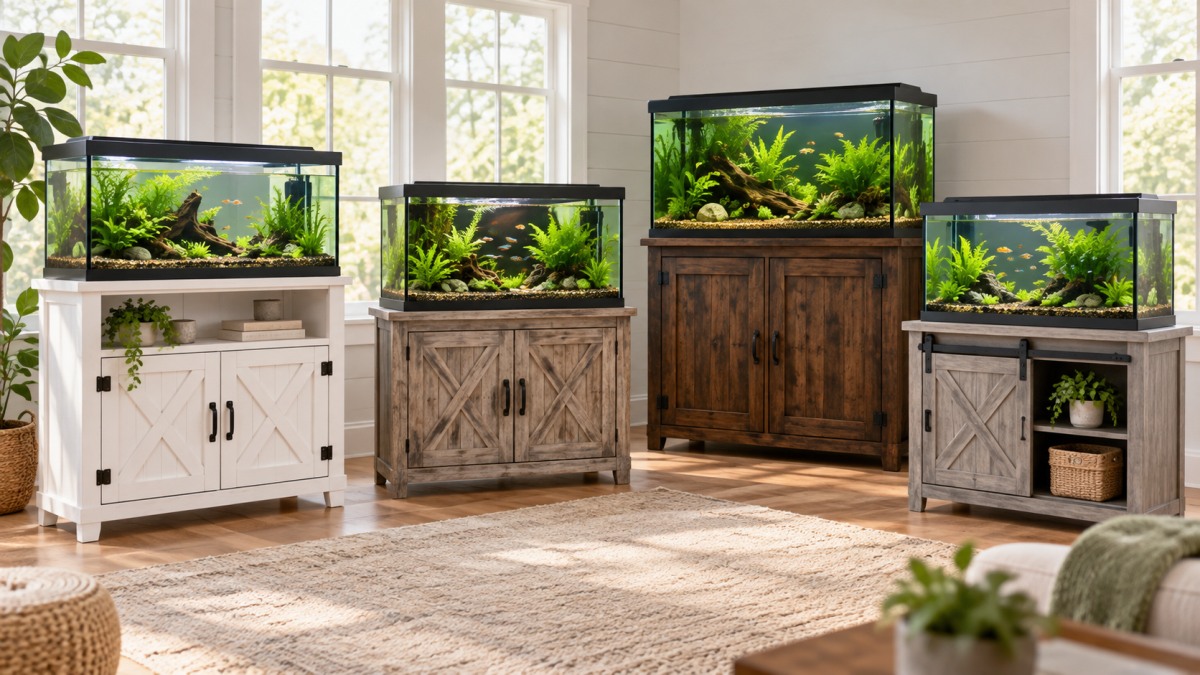
Hlivelood 55-75 Gallon Aquarium Stand Review
As an Amazon Associate we earn from qualifying purchases. Details
The Hlivelood farmhouse stand is a large enclosed cabinet for a 55 to 75 gallon aquarium, with barn-style sliding doors, adjustable shelves, two power outlets and two USB ports. It suits owners who want closed storage for tank supplies and a built-in power option in one piece of furniture. The first checks are the footprint against your tank base, since the spec field says 52 inches long while the bullets say 52 inches deep, and the electrical ratings, which the listing does not give. This guide works through each point using only the listing’s figures.
Introduction
The Hlivelood farmhouse stand is a large enclosed cabinet built to hold a 55 to 75 gallon aquarium. the product information presents it for owners who want closed storage for tank supplies and a built-in power option in one piece of furniture. It has barn-style sliding doors, adjustable shelves, two power outlets, two USB ports, and openings at the back for cords. the product information also describes it as a heavy-duty reptile tank stand, so the product is aimed at both fish and reptile setups.
Because the stand carries a tank of that size, the decision is mostly about fit and load. A buyer needs to know whether the stand’s footprint matches the bottom of the aquarium, whether the outlets can carry the equipment, and whether the listed load capacity is the right figure to rely on. This review works through those questions using the product specifications and the product information text, and it notes where the product information’s labels or figures are unclear.
One detail is worth noting at the start. The specification field gives the dimensions as 52 inches long, while the product information bullets describe the same 52-inch measurement as the depth. Those labels describe the same side of the stand, and the difference matters when you compare the stand with the aquarium’s base. The sections below use the product information’s depth language and flag the label issue where it affects the fit.
You can view the Hlivelood farmhouse aquarium stand on Amazon to check the current listing, the options, and the included parts before ordering.
Product snapshot
The specification fields and bullets together describe the following stand:
| Attribute | Listed value |
|---|---|
| Product dimensions | 52 inches long (specification field) / 52 inches deep (bullets) x 19.7 inches wide x 31.4 inches high |
| Tank volume (specification field) | 75 gallons |
| Tank range (listing title and bullets) | 55 to 75 gallons |
| Stated load capacity | Up to 1000 pounds (manufacturer claim) |
| Storage | 2 open and 4 hidden spaces, each set with 3-level adjustable shelves |
| Lower space | 20 inches deep and 13 inches high (listing), for 10 to 20 gallon terrariums or fish tank kits |
| Power | 2 power outlets and 2 USB ports |
| Cord management | Openings at the back of the stand |
| Material | High-density, thickened MDF (listing) |
| Doors | Farmhouse sliding barn doors with metal handles |
| Assembly | Instructions, tools, and labeled parts included |
| Weather resistance | Listed in the specification field as a special feature, without detail |
| Warranty | None listed in the published product specifications |
The table keeps the specification fields and the product information descriptions apart. The dimensions, tank volume, and load figure have a clear source in the product information. The power description, the cord openings, and the material are described in the bullets, and the electrical ratings are not given at all.
Who this stand suits
The stand suits owners of large freshwater or reptile tanks who need closed storage for supplies and want outlets close to the equipment. the product information names fish food, fishing nets, gravel cleaners, hoses, oxygen concentrators, and cleaning tools as the kinds of items to store. It also names filters, air pumps, and heater rods as the devices you might plug in.
The open spaces are useful for items you reach for often, and the hidden spaces suit items you want out of sight, such as spare hoses, cleaning supplies, and feed containers. the product information’s own examples point to a practical arrangement: the open spaces hold daily items, and the hidden spaces hold bulk or less attractive supplies.
The stand is not a fit for every setup. If your tank is much larger or heavier than The product information says, or if you need a stand with a different footprint or a built-in base for equipment that is not in the product information, check the specifications before ordering. The 55 to 75 gallon range is the product information’s intended range, and a tank outside that range should be compared carefully with the stand’s dimensions and load claim.
A buyer who needs a stand for smaller tanks should use the lower space described in the product information rather than the main compartment. The lower space is described as suitable for 10 to 20 gallon terrariums or fish tank kits, and it sits below the main cabinet.
Footprint and tank base
The stand measures 52 inches in the direction the product information calls depth, and 19.7 inches wide. Compare those numbers with the bottom of your aquarium, including any frame or base that extends past the glass. The aquarium’s base dimensions are the deciding measure, since a tank that overhangs the stand top can cause a poor fit and an unstable load.
the product information does not say how much overhang is acceptable, and it does not describe how the tank should be centered on the stand. Use the aquarium’s base dimensions as the deciding measure. This is the caveat the product information does not spell out, and it is the one most likely to cause a bad fit.
The label issue matters here. The specification field gives 52 inches as the length, and the bullets call the same 52-inch dimension the depth. Whichever label you use, measure the stand’s top surface in the direction the tank will run, and compare it with the tank’s base in that direction. A buyer who uses the wrong dimension may find that the tank overhangs the front or back edge of the top.
The width of 19.7 inches is the second dimension to check. A tank whose base is wider than the stand top will overhang the sides. Measure the aquarium base in both directions and compare each one with the stand’s top surface before the tank arrives.
Measure the room as well. Sliding doors avoid a hinged swing, but they still need clear space to move, and the clearance behind the stand needs room for outlets and cords. The door movement and the cord route should both be checked before the stand is placed.
Storage layout
The product information says two open storage spaces and four hidden ones. Each set includes 3-level adjustable shelves, so the shelf heights can be changed to suit cans, bottles, tubing, or cleaning tools. The doors are described as farmhouse sliding barn doors with metal handles.
Plan the shelf heights before you fill the stand. the product information does not describe the shelf load per level, so the buyer does not have a shelf-specific weight figure for any of the three levels in each set. The general 1000-pound claim is for the stand as a whole, not for an individual shelf. Keep heavier items on the lower shelves, and avoid overloading the adjustable shelves.
The open spaces are useful for items you reach for often, such as fish food, nets, and cleaning tools. The hidden spaces suit spare hoses, cleaning supplies, and feed containers. Arrange the items so that the heaviest and most frequently used items are the easiest to reach, and so that the cords and hoses do not block the sliding doors.
The lower space is described as 20 inches deep and 13 inches high. The product information says it can hold smaller 10 to 20 gallon terrariums or fish tank kits. Measure the height of that space against the equipment you plan to store there. Remember that the lower space’s height is the clear space available, so check it against the tallest piece of equipment, including any lid or lamp.
Sliding barn doors and handles
The doors are described as farmhouse sliding barn doors with metal handles. A sliding door reduces the swing room needed in front of the stand, but it still needs a clear track and clear space to slide. Check the sliding doors after assembly to confirm that they run smoothly and align with the frame.
the product information does not describe the door track in detail, so check how the doors seat in the track and how they stop at the ends of the run. A door that jumps off its track or rubs the frame will be a problem every time the stand is used. Test the doors several times after assembly, both opening and closing.
The metal handles are part of the door’s operation. Check that each handle is secure after assembly, and recheck it after the first weeks of use, since handles on a door that slides often are handled more than handles on a fixed door.
Power outlets and cord management
The stand includes two power outlets and two USB ports. The product information says these let you power filters, aeration pumps, heater rods, and other devices. It also mentions openings at the back and cord management.
does not list the outlets’ amperage, their total load limit, or the wattage of any equipment. That is the most important gap for an aquarium stand, because the outlets are the connection point for the equipment that keeps the tank running. Check the equipment’s power draw and the outlet’s load limit before you connect anything, and confirm the total draw of all the devices you plan to plug in.
Keep cords away from water and from any moving parts, and follow the equipment manufacturer’s guidance on placement near water. the product information does not describe a drip guard, a water barrier, or a sealed electrical compartment, so the placement of the outlets and the cords should keep them clear of the tank and any splash zone.
the product information’s cord management is described only as convenient openings and a set of back openings. Plan the routing of cables before you place the tank, because the back of the stand may be hard to reach once the aquarium is on top. Route the cords through the back openings before the tank is in place, and leave enough slack to move the stand or the equipment for cleaning.
Keep the outlets and USB ports in mind during placement. A stand that puts the outlets behind the tank, or at the back where the wall is, may make it difficult to plug in equipment later. Check the position of each outlet relative to the equipment you plan to run.
Plan the power route for the equipment that runs continuously, such as filters and air pumps. the product information does not give electrical ratings for the stand itself, so the buyer should confirm the power plan with the product documentation and the equipment’s documentation.
Build and load
The stand is described as made from high-density, thickened MDF. The product information says the material supports up to 1000 pounds and that the design is stable enough to place two of these cabinets side by side. does not include a load test, a method for the 1000-pound figure, or a test of the side-by-side stability claim.
Treat the 1000-pound figure with the same caution as any manufacturer claim for furniture. A tank that is full of water, plus gravel, decor, and equipment, is heavy, and the buyer should plan the load with the full setup in mind. the product information does not describe the weight of a full 75 gallon tank with its contents, so calculate the weight of the tank and its contents separately before placing it on the stand.
The product information says the cabinet’s stability and durability, but a stand that is level on a solid floor will perform better than one placed on an uneven surface. Level the stand before the tank goes on top. the product information does not give a leveling method, so use a spirit level and adjust the feet or shims on your floor until the top is level.
The stand’s weather resistance is listed in the specification field, but does not describe how that feature was tested or what conditions it covers. Treat weather resistance as a listed feature without detail. If the stand will be used in a damp room, check the surface and the edges regularly, and wipe spills promptly.
Assembly
The product information says the stand has a simple structure, includes all the tools needed for assembly, and labels every part. It also says the instructions are detailed and that the assembly process is convenient. Plan for a two-person build if your shelves or doors are heavy. Keep the packaging nearby until all parts are accounted for. Count the labeled parts against the instruction sheet before you begin, so that a missing part is noticed before the assembly is half finished.
Once assembled, test that the doors run smoothly and line up with the frame. Confirm that the shelves are set at the heights you want before the tank is placed. Tighten the hardware after the frame is square, and recheck it after a short period of use.
Level the floor before assembly and before adding the tank. Assembling on an uneven floor can leave the frame out of square, and a frame out of square will put the doors out of line and the top out of level.
Purchase decision: where this product fits
Hlivelood Farmhouse 55-75 Gallon Fish Tank Stand with Power Outlet is easiest to evaluate as a fit decision, not as a universal recommendation. Its stated design can be useful when the dimensions, included parts, and intended use described above match your exact setup. It is a weaker choice when you need a capability the product information does not explicitly provide.
Buy it when
- The stated size and configuration fit the space or equipment you already have.
- The included components replace separate purchases you would otherwise need.
- The limitations described in this review do not interfere with your main use case.
Avoid it when
- A missing compatibility measurement would determine whether it works at all.
- You need proof of performance beyond the manufacturer’s stated specifications.
- A simpler product would solve the same problem without unused features.
Before ordering, verify the two or three measurements that control fit. This single check is more useful than relying on a broad “works for most” description.
Limitations and caveats
Several limitations come directly from the supplied information:
- The dimension labels differ between the specification field (52 inches long) and the bullets (52 inches deep). Compare the stand’s top with the aquarium base in both directions before ordering.
- The 1000-pound load claim is a manufacturer statement. the product information does not describe a shelf-by-shelf load figure or a test method.
- The electrical ratings for the outlets and USB ports are not given. The amperage, the total load, and the wattage of the equipment must be checked by the buyer.
- The weather resistance is listed in the specification field without detail.
- the product information does not describe a leveling method, a drip guard, or a sealed electrical compartment.
- No warranty is listed in the published product specifications.
- The stability claim for placing two cabinets side by side is not supported by a test.
These limitations do not make the stand a poor choice. They do mean the buyer should verify the footprint, the outlet load, and the level of the floor before relying on the stand with a full tank.
Questions to put to the seller before ordering
the product information leaves several gaps. The questions below follow from them, and the written answers give the buyer more information than the bullets do.
- Which dimension is the length, and which is the depth, in the specification field and in the bullets?
- What is the amperage of each outlet, and what is the total load limit for the two outlets and two USB ports?
- What is the load capacity for each shelf level, and how was the 1000-pound figure determined?
- Is the stand designed to carry a full 75 gallon tank with its water, gravel, and equipment, and is that load included in the 1000-pound claim?
- What does the weather resistance feature cover, and under what conditions was it described?
- Is a warranty offered, and what does it cover?
- Are the sliding doors designed to stop at the ends of the track, and does the track include any stops or guides?
Keep the answers with the proof of purchase, and check the stand in hand against them when it arrives.
Buyer scenarios
The stand can suit different setups in different ways. The scenarios below apply the product information’s figures to common situations. Each one reasons from the stated numbers rather than predicting how a particular stand will perform.
A 75 gallon freshwater tank with a filter and an air pump. The stand’s 55 to 75 gallon range matches the tank, and the two outlets can power a filter and an air pump. The buyer should check the amperage of the two devices against the outlet rating, which the product information does not give. The open spaces can hold daily supplies, and the hidden spaces can hold spare equipment.
A reptile enclosure on the main top. the product information calls the stand a heavy-duty reptile tank stand, so reptile use is within its described range. The buyer should check the enclosure’s base dimensions against the stand’s top, and check the heater rod or lamp outlets against the outlet ratings. The stand’s power described in the product information is for devices such as heater rods, so the buyer should confirm the load with the equipment’s documentation.
A smaller tank in the lower space. The lower space is 20 inches deep and 13 inches high, described for 10 to 20 gallon terrariums or fish tank kits. The buyer should measure the smaller tank’s base and its height against that space, and confirm that the tank can be reached for maintenance from the front.
A tank with a large footprint. A tank whose base is wider or deeper than the stand top will overhang. The buyer should compare the base dimensions in both directions before ordering, since the product information does not describe the acceptable overhang.
A room with an uneven floor. the product information does not describe a leveling system beyond the feet and shims the buyer may use. The buyer should level the floor and the stand before adding the tank, since an uneven stand can affect the door alignment and the tank’s stability.
Buyer checklist
- Compare the stand’s top with the aquarium base in both directions, and note the label difference between the specification field and the bullets.
- Measure the room, the sliding door track, and the clearance behind the stand for outlets and cords.
- Confirm the amperage of each outlet and the total draw of the equipment you plan to run.
- Plan the shelf heights and the load on each level, keeping heavy items on the lower shelves.
- Level the floor and the stand before the tank is placed.
- Count the labeled parts before assembly, and check the sliding doors after assembly.
- Route the cords through the back openings before the tank goes on top.
- Confirm the warranty and the weather resistance details with the seller in writing.
Conclusion
The Hlivelood farmhouse stand is a large, enclosed option for owners who want storage and outlets built into the stand. Its listed features are a 52-inch length or depth, two open and four hidden storage spaces, adjustable shelves, two outlets, two USB ports, and a 1000-pound load claim. Its main gaps are the electrical ratings, the shelf-by-shelf load figures, the label difference in the dimensions, and the absence of a warranty in the supplied information.
the stand is a practical match for large tanks, provided you verify the footprint and the power plan first. Measure the aquarium base in both directions, confirm the outlet load against your equipment, level the floor before the tank goes on top, and get the open questions answered in writing before you rely on the stand.
FAQ
How big a tank does this stand fit?
The stand is listed for a 55 to 75 gallon aquarium. Compare its 52-inch measurement with the base of your tank, because the listing labels that measurement as both length and depth.
Does the stand include power outlets?
Yes. It includes two power outlets and two USB ports, which the product information says can power filters, aeration pumps and heater rods.
What load rating does the stand claim?
The product information says the high-density MDF supports up to 1000 pounds. That is a manufacturer statement, and the listing does not describe a load test.
Is assembly difficult?
The product information describes a simple structure, includes the tools needed and labels every part. Plan for two people if the shelves or doors are heavy.
What should I ask the seller before ordering?
Ask which dimension is the length, the amperage of each outlet, the total load limit, and the wattage of the equipment you plan to plug in.
Sources
- – https://www.amazon.com/dp/B0DGXTCBWG/?tag=bettafishhome-20