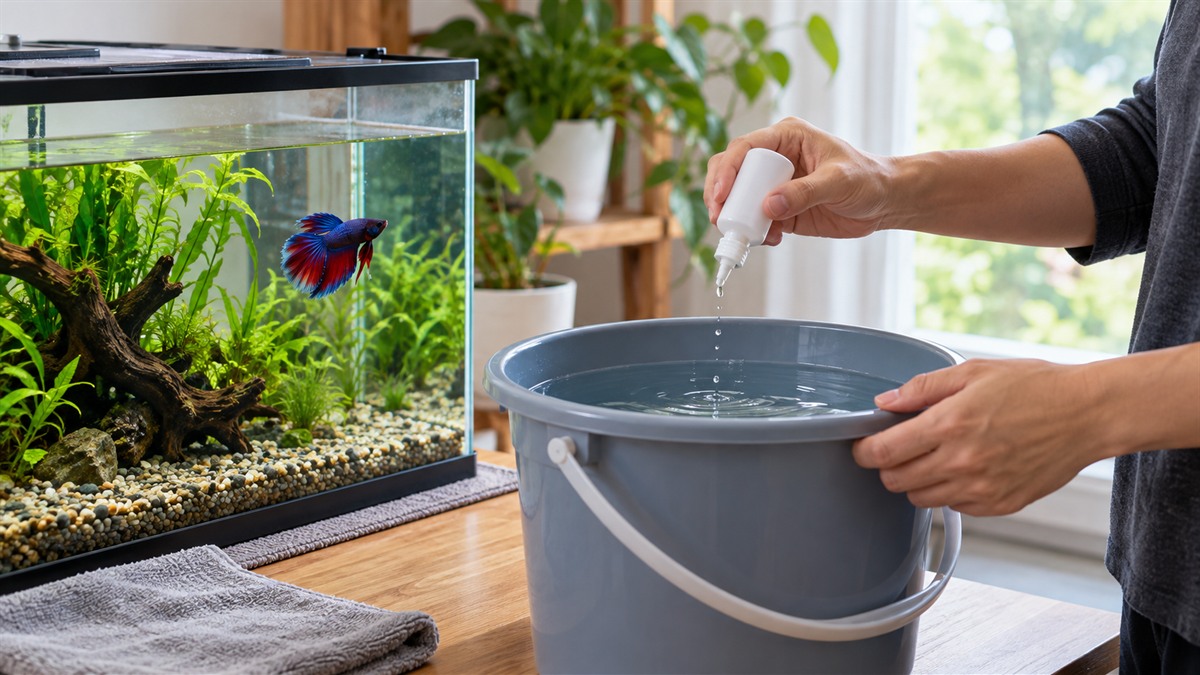
Best Betta Water Conditioner How To Use
As an Amazon Associate, this site earns from qualifying purchases.
Everything in this guide comes from the product names, specification fields and seller descriptions on the 12 Amazon listings below. Nothing here has been checked against the bottles or a test tank, so read each dosing figure as the seller’s published instruction and confirm it on the label. Twelve bottles, and most of them promise the same three things: removing chlorine, neutralizing chloramines, and handling ammonia. The differences that matter for a betta are the dosing unit, the bottle size, whether the product names bettas at all, and whether the dose is stated clearly enough to use without guesswork.
Who this guide is for
This guide is for betta keepers who fill or top up a tank with tap water and want a conditioner that matches how they dose. It is also for buyers who keep more than one kind of aquarium, such as a betta tank and a community tank, and want to know which bottles are written for fish in general and which are written for bettas specifically.
It is not a ranking. The listings cover a wide range of bottle sizes and dosing units. Some are labeled for bettas, some for freshwater and saltwater, and two are written mainly for houseplants. The sections below help you match a bottle to your setup.
Quick answer: the three groups in this set
The 12 listings fall into three groups.
Betta-labeled products (5 listings). The Aqueon Betta Bowl Plus, Tetra BettaSafe, Zoo Med Betta H2O, Fluval Betta Plus, and Crystalpro Betta Water Conditioner all name bettas in the title or the specification fields.
General aquarium products (5 listings). The API Stress Coat, TLC Products DeChlor and Conditioner, TankFirst Complete, Fritz Complete, and MICROBE-LIFT Xtreme are written for freshwater, saltwater, or both. They do not name bettas as the target fish.
Plant-first products (2 listings). The Southside Plants and Cute Farms conditioners are written mainly for houseplants and hydroponics. Both mention fish or aquariums as a secondary use. They are included here because they are in the set, but they are not the natural first choice for a betta tank.
Comparison table
The table lists the main fields for each bottle. A dash means the listing does not state the figure. “Not confirmed” means the listing gives figures that disagree, and the reason is given in the product notes.
| Listing | Bottle | Group | Dose stated | Warranty field |
|---|---|---|---|---|
| Aqueon Betta Bowl Plus | 4 fl oz | Betta | 5 mL per gallon | Satisfaction guarantee |
| Tetra BettaSafe | 1.69 fl oz | Betta | Not stated in the listing | See label |
| API Stress Coat | 16 fl oz | General | 5 mL per 10 gallons | Not stated in the listing |
| Zoo Med Betta H2O | 0.5 fl oz | Betta | Not stated in the listing | Manufacturer warranty |
| Southside Plants Tap Water Conditioner | 8 fl oz | Plant-first | 1/4 capful per gallon | No warranty |
| TLC Products DeChlor and Conditioner | 16 fl oz | General | Not stated in the listing | Satisfaction guaranteed |
| TankFirst Complete | 500 mL (16.9 fl oz) | General | 1 capful or 1 tsp per 10 gallons | No warranty |
| Fritz Complete | 2 fl oz | General | 1 tsp (5 mL) per 50 gallons | Not stated in the listing |
| Fluval Betta Plus | 2 fl oz | Betta | Not stated in the listing | Not stated in the listing |
| MICROBE-LIFT Xtreme | 64 fl oz | General | Not stated in the listing | Conditional-limited manufacturer |
| Crystalpro Betta Water Conditioner | 4.2 fl oz | Betta | 4 drops per gallon | 8-year manufacturer |
| Cute Farms Tap Water Conditioner | 16 fl oz | Plant-first | 1/4 capful per gallon | Not stated in the listing |
Three things stand out in the table. Seven listings give a dose a buyer can measure at home, whether per gallon, per 10 gallons, or by drops. Five give no dose for the water you treat, and three of those five are betta-labeled. The bottle sizes range from 0.5 ounces to 64 ounces, so the number of water changes each bottle covers will vary widely.
What the listings say a conditioner removes
Most of the 12 listings name the same targets, and the list is worth reading as a checklist.
- Chlorine and chloramines. Eleven of the 12 listings name chlorine, and ten name chloramines. API describes removing “chemicals” without naming either, and TLC names chlorine but not chloramines.
- Ammonia and nitrite. Aqueon, Tetra, TankFirst, Fritz, Crystalpro, and MICROBE-LIFT name ammonia. Zoo Med, Fritz, and MICROBE-LIFT name nitrite, and Fritz names nitrates as well. The Fluval, Zoo Med, TLC, API, Southside, and Cute Farms listings do not name ammonia.
- Heavy metals. Several listings name heavy metals, and MICROBE-LIFT names copper and lead as examples.
- Fish stress and handling. Aqueon, Tetra, Zoo Med, and Fluval describe reducing stress. API describes protecting the slime coat after handling or fighting. The MICROBE-LIFT listing also describes a skin-slime replacer.
- Trace elements or minerals. Aqueon describes trace elements for bettas. Crystalpro describes electrolytes and minerals. MICROBE-LIFT describes electrolytes and alkalinity. The rest do not name trace elements.
The list of targets is the listings’ own description. It is not a test result, and none of this guide’s claims rest on measurement.
How to read the dosing instructions
A dose is only useful if you know what it is measured against. The 12 listings use four different units.
Per gallon. Aqueon says 5 mL, which is one teaspoon, for each gallon of temperature-adjusted tap or purified water. Crystalpro says 4 drops per gallon. Southside and Cute Farms say one quarter of a capful per gallon. Fritz says one teaspoon treats 50 gallons, which the listing also describes as about two drops per gallon.
Per 10 gallons. API says 5 mL for each 10 gallons of aquarium water. TankFirst says one capful or one teaspoon per 10 gallons.
Per bottle volume. Some listings give only a treatment count for the whole bottle, such as “treats up to 200 gallons” or “treats 660 gallons.”
Not stated. Tetra, Zoo Med, TLC, Fluval, and MICROBE-LIFT do not give a dose for the water you treat. MICROBE-LIFT refers to a “standard dosage rate” for ammonia, but the listing does not state that rate in gallons.
When the figures do not agree, the listing is not usable for planning. The Crystalpro listing is the clearest example. It gives a dose of 4 drops per gallon and a drop cap in which about 15 drops equal 1 mL. A 4.2 fluid ounce bottle holds about 125 mL, so that is roughly 1,875 drops. At 4 drops per gallon, 1,875 drops would treat about 470 gallons, not the 660 gallons the title and the bottle claim. The treatment count is therefore Not confirmed. The per-gallon dose is the more reliable figure, because the drop cap is printed as part of the product’s own dosing system.
The API listing has a related check. Its liquid volume is 0.48 liters, which is about 16 fluid ounces and matches the 16-ounce bottle. The item weight is listed as 6.4 ounces, which is less than the weight of the liquid itself. The weight field is therefore Not confirmed, and the volume is the figure to rely on.
A worked example: how far each bottle goes
To compare bottles that state a dose, it helps to work out how many water changes each one covers. The example uses 10 gallons only as a unit of arithmetic, not as a recommendation for your tank. Every figure below is calculated from the bottle volume and the dose printed in the listing. Nothing here has been measured.
- Aqueon. The bottle is 4 fluid ounces, about 118 mL. At 5 mL per gallon, one 10-gallon change uses 50 mL, so the bottle covers about two full 10-gallon changes.
- API. The bottle holds about 480 mL. At 5 mL per 10 gallons, one change uses 5 mL, so the bottle covers about 96 changes of 10 gallons, roughly 960 gallons.
- TankFirst. The bottle is 500 mL. At 5 mL per 10 gallons, it covers about 100 changes of 10 gallons, roughly 1,000 gallons. That matches the count in the listing.
- Fritz. The bottle is 2 fluid ounces, about 59 mL. At one teaspoon, 5 mL, per 50 gallons, it covers about 11 teaspoon doses, roughly 550 gallons. The listing does not give a bottle-level count to compare against.
- Crystalpro. The bottle holds 125 mL. At 4 drops per gallon, one 10-gallon change uses 40 drops, about 2.7 mL at 15 drops per mL. The bottle therefore covers about 47 changes of 10 gallons, roughly 470 gallons. That is the figure the dose gives, not the 660-gallon count in the title.
The examples show why the dose matters more than the headline count. Two bottles with similar headline counts can cover very different numbers of changes once the dose is applied to your own water volume. Work the sum with your tank’s volume before you compare bottles.
How to choose a conditioner for a betta
Work through these questions in order. Each one removes a group of listings.
Does the product’s listed name mention bettas, or is a general product acceptable? Betta-labeled products are the most direct match. A general aquarium product is fine if its dose is clear and it covers the targets you need. Plant-first products are a last choice for a betta tank, because the listings do not mention betta-specific use.
Can you measure the dose at home? A per-gallon dose, a per-10-gallon dose, or a dose the drop cap makes easy is simple to follow. A listing with no dose will need to be checked on the label before first use.
Does the product cover the targets you care about? Check whether the listing names chlorine, chloramines, ammonia, and heavy metals, because those are the targets most listings describe. If your water changes are the main concern, ammonia and nitrite coverage matters more than a long list of minor claims.
How much water will you treat in a month? A small bottle is easier to use for a single small tank. A 64-ounce bottle is more practical for many water changes, but it is only worth buying if you will use it. Check the bottle size and the dose together, not the bottle size alone.
Does the product suit more than one tank type? TLC, TankFirst, Fritz, and MICROBE-LIFT all name freshwater and saltwater or marine use. If you keep a betta and a saltwater tank, one of those may cover both.
Is a warranty stated? Most bottles of this kind do not state a warranty that matters for a consumable, so this field is a minor factor. Where a warranty is named, it is listed in the table.
Checks to run before you buy
- Confirm the dose and the unit. Find the dose on the listing. If it is not stated, check the label or the seller’s instructions before you buy.
- Check the volume of water you will treat. Know your own tank’s volume and the number of water changes you do in a month. Use that number, not the bottle’s treatment count, to plan purchases.
- Compare the bottle size with the dose. A bottle with a clear per-gallon dose is easier to plan. A treatment count without a dose is harder to check.
- Read the target list. Make sure the product names the chemicals you need removed, especially chloramines and ammonia where relevant.
- Look for conflicting figures. If the weight, volume, or treatment count disagree, treat the figure as unconfirmed.
- Note the target species. Some listings say fish, some say houseplants, and some list fish and reptiles.
Product-by-product notes
The notes follow the order of the table. Each one gives the listed facts, the points that need checking, and who the bottle suits.
Aqueon Betta Bowl Plus Water Conditioner
The Aqueon Betta Bowl Plus Water Conditioner is a 4-fluid-ounce liquid. It neutralizes chlorine, chloramines, and ammonia and includes trace elements for bettas. The dose is 5 mL, which is one teaspoon, for each gallon of temperature-adjusted tap or purified water. The bottle includes a dosage cap. The product is also a supplement for fish that have been stressed, transported, or netted, and it can be used when filling the aquarium or doing a water change.
The listing gives a manufacturer’s recommended age of one month and up, and a satisfaction guarantee. The model number and item model number match.
Best for: betta owners who want a betta-labeled product with trace elements and a clear per-gallon dose with a cap.
Avoid if: you want a larger bottle for many water changes, or you need a dose stated for a different unit than gallons.
Tetra BettaSafe Water Conditioner
The Tetra BettaSafe Water Conditioner is a 1.69-fluid-ounce bottle for betta tanks. It makes tap water safe, neutralizes chlorine, chloramines, and ammonia, reduces fish stress, works in seconds, and should be used monthly. It is described as a complete formula for new setups, monthly partial water changes, and evaporation replacement.
The dose is not stated in the listing, so the amount to use must come from the label. The warranty field says see label for details. The battery field in the specification sheet reads “Product Specific batteries required.” That line does not apply to a liquid product, so ignore it.
Best for: owners who want a small betta-labeled bottle and a monthly routine that the seller describes.
Avoid if: you need a dose on the listing before you buy, since the amount is not stated there.
API Stress Coat Aquarium Water Conditioner
The API Stress Coat Aquarium Water Conditioner comes in a 16-ounce bottle. The dose is 5 mL for each 10 gallons of aquarium water. The dose should be doubled to help replace the slime coat and repair damaged skin and fins. The formula also includes aloe vera extract, which is meant to help heal a fish’s protective coat after handling or fighting.
Use is recommended when adding or changing water, when adding new fish, and when fish are sick or injured. The liquid volume is 0.48 liters, which matches the 16-ounce bottle. The item weight is listed as 6.4 ounces, which is lower than the liquid volume would weigh, so the weight is Not confirmed.
Best for: owners who want a 16-ounce bottle, a per-10-gallon dose, and a product that also addresses slime coat and handling stress.
Avoid if: you want only chemical neutralization with no slime-coat claims, or you need a per-gallon dose.
Zoo Med Betta H2O Conditioner
The Zoo Med Betta H2O Conditioner is a 15-milliliter bottle, about half an ounce. Its named targets are chloramines and chlorine, nitrite and heavy metals, with stress relief, healing support, and instant action among the claims. The manufacturer is Zoo Med Laboratories, and the listing gives a manufacturer warranty.
The dose is not stated. The included components field reads “Product in Description,” which points to the description rather than a separate item. Check the bottle’s label for the dose before use.
Best for: a betta owner who wants a very small bottle to try or to use for an occasional treatment, with nitrite named among the targets.
Avoid if: you need a dose on the listing or a bottle that will last through regular water changes.
Southside Plants Tap Water Conditioner
The Southside Plants Tap Water Conditioner is written mainly for houseplants, hydroponics, and irrigation. It is an 8-fluid-ounce bottle. The dose is one quarter of a capful for each gallon of tap water, and the listing says the bottle treats up to 200 gallons. The listing removes chlorine, destroys chloramines, detoxifies heavy metals, and buffers pH.
The product can also make water safe for fish and ponds when used as directed. It does not mention bettas. The included components field reads “NA,” so the included items are Not stated in the listing. The model number field reads “Tap Water Conditioner,” which is a title rather than a model number. The warranty field says no warranty.
Best for: a plant owner who also keeps a fish tank and wants one bottle for both.
Avoid if: you want a betta-labeled product or a product written specifically for fish.
TLC Products DeChlor and Conditioner
The TLC Products DeChlor and Conditioner is a 16-fluid-ounce bottle for freshwater and saltwater aquariums. It removes harmful chlorine, conditions water for fish and aquatic life, treats new setups and water changes, and treats tap water and well water. It is described as a shake-before-use formula with dosing instructions. The dosing instructions are not reproduced in the listing, so the amount must come from the label.
The warranty field says the product is satisfaction guaranteed when the instructions are followed, with a replacement warranty through TLC Products. The item weight is 1.1 pounds. The listing does not name ammonia or chloramines among its targets, so check the label if those are your main concern.
Best for: owners of freshwater or saltwater tanks who want one 16-ounce bottle for water changes and new setups, including well water.
Avoid if: you need a betta-labeled product or a stated dose on the listing.
TankFirst Complete Aquarium Water Conditioner
The TankFirst Complete Aquarium Water Conditioner comes in a 500-milliliter bottle, about 16.9 fluid ounces. The dose is one capful or one teaspoon per 10 gallons, and the listing says the bottle treats 1,000 gallons. That count is consistent with the dose: 500 mL divided into 5 mL doses gives 100 doses of 10 gallons each.
The product removes chlorine and chloramines and detoxifies ammonia. It names freshwater, marine, and reef aquariums, and it is described as suitable for sensitive fish and live corals and as odor-free. The pet type field lists fish and reptile. The warranty field says no warranty.
Best for: owners of mixed setups, including freshwater, marine, and reef, who want per-10-gallon dosing and a large bottle.
Avoid if: you want a product named for bettas, since the listing does not name them.
Fritz Complete Water Conditioner and Dechlorinator
The Fritz Complete Water Conditioner and Dechlorinator is a 2-fluid-ounce concentrate for freshwater and saltwater. The listing gives the dose as one teaspoon, or 5 mL, for 50 gallons, which it describes as about two drops per gallon. The two figures agree: 50 gallons at two drops per gallon is 100 drops, which is about 5 mL.
The product neutralizes chlorine, chloramines, heavy metals, ammonia, nitrite, and nitrates. It also binds with ammonia and nitrite so they are less harmful to fish while staying available to beneficial bacteria. For very high ammonia or nitrite, the dose can be repeated up to five times in 24 hours, with adequate circulation or aeration. The product may be added directly to the aquarium. The company is described as made in the USA and 100 percent employee-owned.
Best for: owners who want a concentrate with a per-gallon dose and a clear note about repeat dosing for high ammonia or nitrite.
Avoid if: you want a betta-labeled product or a product with trace elements, since none is named.
Fluval Betta Plus Water Conditioner
The Fluval Betta Plus Water Conditioner is a 2-fluid-ounce bottle, 60 mL, written for bettas. It makes tap water safe, neutralizes chlorine, chloramine, and undesirable metals, protects scales and fins, and helps reduce fish stress. It states that the product contains herbal extracts.
The dose is not stated in the listing, and the listing does not name ammonia. The warranty field is not stated. The product is listed as fish in the target species field.
Best for: betta owners who want a small, betta-named bottle with herbal extracts and a focus on scales, fins, and stress.
Avoid if: you need a dose on the listing or a product that names ammonia among its targets.
MICROBE-LIFT Xtreme Water Conditioner Treatment
The MICROBE-LIFT Xtreme Water Conditioner Treatment comes in a 64-fluid-ounce bottle and weighs about 4 pounds. It is described for freshwater and saltwater fish, ponds, aquariums, and tanks, with many uses: setting up new water, water changes, adding new fish, invertebrates, amphibians, or plants, and conditioning new water for marine life.
The product detoxifies nitrite, removes ammonia and chlorine, destroys and removes chloramines, and detoxifies heavy metals such as copper and lead. It also lists a multi-part skin-slime replacer, electrolytes, and alkalinity support. The dose is described as the standard rate for each measured 1 mg/L of total ammonia. The listing does not state that rate in gallons, so the per-gallon dose is Not stated in the listing. The warranty is a conditional-limited manufacturer warranty.
Best for: owners with large volumes or several tank types who want one bottle that covers many uses, including marine tanks.
Avoid if: you need a per-gallon dose, or you keep a small betta tank and want a product written specifically for bettas.
Crystalpro Betta Water Conditioner
The Crystalpro Betta Water Conditioner comes in a 4.2-fluid-ounce, 125-milliliter bottle. The dose is 4 drops per gallon, and about 15 drops equal 1 mL. The drop cap is meant to make measurement easy and avoid spills.
The product eliminates chlorine, chloramines, and heavy metals, and it neutralizes ammonia. It also describes electrolytes and minerals. The title and the description say the bottle treats 660 gallons, but that figure does not agree with the dose. About 1,875 drops at 4 drops per gallon treats about 470 gallons. The treatment count is therefore Not confirmed, and the per-gallon dose is the figure to plan with.
The warranty field lists an 8-year manufacturer warranty, as stated by the listing. The product is listed as fish in the pet type field.
Best for: betta owners who want a betta-labeled product with a drop cap and a per-gallon dose.
Avoid if: you need the bottle’s treatment count confirmed before you buy.
Cute Farms Tap Water Conditioner
The Cute Farms Tap Water Conditioner is a 16-fluid-ounce bottle with a target species field that reads houseplants. The dose is one quarter of a capful for each gallon of water, and the listing says the bottle treats up to 320 gallons. It names chlorine, chloramines, heavy metals, and pH balance, and it is described as made and packed in the USA.
The product is also described as safe for aquariums and ponds, and it removes harmful chemicals that can stress fish and aquatic plants. It does not mention bettas. The warranty field is not stated.
Best for: plant owners who also keep an aquarium and want one 16-ounce bottle.
Avoid if: you want a product written for bettas or for fish alone.
Best for and avoid if: the set at a glance
Betta owners with a small tank and a need for a stated dose will find the most direct fit among the betta-labeled bottles, and especially among Aqueon and Crystalpro, which both give per-gallon doses. Owners who want a betta-named product but cannot find a dose in the listing should check the label before buying Tetra, Zoo Med, or Fluval.
Owners who keep more than one tank type should look at TankFirst, TLC, Fritz, and MICROBE-LIFT, which name freshwater, saltwater, or marine use. TankFirst gives a clear per-10-gallon dose. Fritz gives a clear per-gallon dose and a repeat-dose note for high ammonia or nitrite. MICROBE-LIFT is the largest bottle and covers the most uses, but it has no per-gallon dose in the listing.
Owners who keep plants as well as fish can consider Southside or Cute Farms, but these are written mainly for plants. Neither names bettas.
Two betta-labeled bottles meet the three checks most betta owners will care about: Aqueon and Crystalpro name chlorine, chloramines, and ammonia, give a per-gallon dose, and name bettas. Crystalpro’s treatment count is Not confirmed, so Aqueon is the cleaner match on the listing’s figures. Every other bottle misses at least one of the three checks, which is why the dosing and target checks matter more than the bottle label.
How to dose before a water change
The steps below follow the instructions the listings give. They are not a test of any product. For background on when to add a conditioner, see when to add water conditioner to a fish tank.
- Find the dose unit on the bottle. Per gallon, per 10 gallons, per capful, or per drop. Convert it to the amount for the water you will treat.
- Measure the water. Use your tank’s volume or the amount of tap water you are adding.
- Adjust the water first where the listing says so. The Aqueon listing specifies temperature-adjusted tap or purified water. Check the instructions on the bottle you buy for the same step.
- Add the measured dose. The API listing says to add the dose to the aquarium water. The Fritz listing says the concentrate may be added directly to the aquarium. Follow the instruction on your bottle.
- Use it with water changes and new fish. The API and Aqueon listings name water changes and new fish as use cases. Use the same routine each time.
- For high ammonia or nitrite with Fritz, repeat only as directed. The listing allows up to five doses in 24 hours for extremely high levels, with circulation or aeration.
- Record the dose and the date. This helps you plan the next purchase and see how long a bottle lasts.
Common mistakes
Dosing by the bottle instead of the water. A bottle’s treatment count is not the dose for your tank. Use the per-gallon or per-10-gallon instruction and measure the water.
Trusting a treatment count that does not match the dose. The Crystalpro listing shows this clearly. The dose and the count do not agree, so plan with the dose.
Buying a bottle with no stated dose. Five listings, among them Tetra and Zoo Med, give no dose for the water you treat. Read the label before you buy.
Assuming betta-labeled means the most complete formula. Betta-labeled bottles are not automatically the most complete. Some general bottles name more targets, such as Fritz and MICROBE-LIFT, which list ammonia and nitrite together.
Ignoring the target list. Check whether the bottle names chloramines and ammonia, because not every listing does.
Overlooking the weight field. The API listing shows a weight lower than its volume would suggest. A weight field that does not match the volume is a sign to check the label.
Decision rules
- If you want a betta-named product with a stated per-gallon dose, shortlist Aqueon and Crystalpro.
- If you need one bottle for freshwater and saltwater, shortlist TLC, TankFirst, Fritz, and MICROBE-LIFT. Check the dose on the label for TLC and MICROBE-LIFT.
- If the dose is not stated and you need one before buying, do not order until you have checked the label.
- If your main concern is ammonia or nitrite, check whether the listing names them. Fritz and MICROBE-LIFT name both, Aqueon, Tetra, Crystalpro, and TankFirst name ammonia, and Zoo Med names nitrite.
- If you keep plants as well as a betta, consider Southside or Cute Farms only if you accept that neither names bettas and both are written mainly for plants.
- If the treatment count and the dose disagree, plan with the dose and treat the count as unconfirmed.
Dosing by volume and by bottle size
Conditioner doses are written in different units, so compare them by the tank size you have. The Aqueon Betta Bowl Plus listing says to add 5 mL, about one teaspoon, for every gallon of temperature-adjusted tap or purified water, and it includes a dosage cap. The API Stress Coat listing says 5 mL for each 10 gallons, and to double the dose to repair damaged skin and fins. The Fritz Complete listing gives one teaspoon, or 5 mL, for 50 gallons, and says the dose can be repeated up to five times in 24 hours for very high ammonia or nitrite.
Drop-based products are easier to misread. The crystalpro listing says four drops treat one gallon, and that about 15 drops make 1 mL. The Cute Farms and Southside Plants listings say one-quarter capful per gallon. Check the cap size on the bottle you buy before dosing.
How long a bottle lasts
- TankFirst: one capful or one teaspoon per 10 gallons from a 500 mL bottle, which the listing says treats 1,000 gallons.
- crystalpro: a 4.2 oz bottle that the listing says treats 660 gallons.
- Cute Farms: a 16 oz bottle at one-quarter capful per gallon, which the listing says treats up to 320 gallons.
- Tetra BettaSafe: a 1.69 oz bottle that the listing says to use monthly, with partial water changes.
When to use it
The Aqueon listing says to use the conditioner whenever you fill the tank with tap water or do a water change, and to add a supplement after fish are stressed, transported or netted. The Zoo Med listing says it works instantly. The TLC DeChlor listing is marketed for freshwater and saltwater, and it says to shake before use. The Fluval Betta Plus listing lists herbal extracts and says it helps reduce fish stress.
Warranty and labelling
The crystalpro listing gives an 8-year manufacturer warranty, and the TankFirst listing says no warranty. The Fritz listing says it is made in the USA by an employee-owned company. Read the label on the bottle you buy, because several listings in this set mix aquarium and houseplant uses.
Which conditioner removes what
Water conditioners in this set do not all remove the same things. The Aqueon listing says its conditioner neutralises chlorine, chloramines and ammonia, and it says to use it whenever you fill the tank with tap water or do a water change. The Tetra BettaSafe listing adds heavy metals to the list and says it reduces stress. The Zoo Med Betta H2O lists chloramines, chlorine, nitrite and heavy metals. The Fluval Betta Plus lists chlorine, chloramine and undesirable metals. Read the list on the bottle you buy, since a conditioner that treats chlorine alone will not handle chloramine in some city supplies.
Dose and volume
Doses differ by product. The crystalpro listing says its concentrate treats 660 gallons, and that four drops are enough to treat a gallon of water. The Aqueon bottle is 4 ounces and the Tetra bottle 1.69 ounces, so a small tank uses a bottle slowly while a larger tank needs more. The TankFirst listing is 1.2 pounds and is sold for freshwater, marine and reef aquariums. Measure the tank volume, then check the dose on the label rather than the bottle size.
Plant and hydroponic conditioners
Two listings in this set are sold for houseplants and hydroponics rather than fish. The Southside Plants listing says to add a quarter capful to a gallon of tap water for plants. The Cute Farms listing is a 16-ounce tap water conditioner for houseplants, hydroponics and aquariums, and says it detoxifies heavy metals. Use a conditioner labelled for fish, not a plant-only product, in the betta tank.
When to condition water
Condition water before it goes into the tank, not after. The Aqueon listing says the product makes tap water safe for fish when you fill the tank or change water, and the Tetra listing describes its conditioner as making tap water safe for bettas. Add it to fresh water in a bucket, stir, and then pour it in. Treat each water change, not just the first fill, because chlorine and chloramine return with every new batch of tap water.
Choosing a bottle
Larger bottles cost less per dose, but they can go stale if you keep a tank for a long time. The API Stress Coat listing is a 16-ounce bottle that its listing describes as a dual-action formula. The TLC DeChlor listing is 16 fluid ounces and is sold for fresh and salt water. A small betta tank needs only a few ounces over a year, so a smaller bottle is easier to use fully before the date on the label. For a side-by-side look at two common brands, see Stress Coat vs tap water conditioner.
Frequently asked questions
Which bottle has the clearest dose? Aqueon gives 5 mL per gallon of temperature-adjusted tap or purified water. TankFirst gives one capful or one teaspoon per 10 gallons and a matching treatment count. Fritz gives one teaspoon per 50 gallons and about two drops per gallon.
Do all the bottles name chloramines? No. Ten of the 12 do. API and TLC do not name chloramines, and API does not name chlorine either. Check the target list on the bottle you buy.
Is there a betta product with a stated ammonia target? Aqueon, Tetra, and Crystalpro name ammonia among the betta-labeled bottles, and Zoo Med names nitrite. The Fluval listing names neither ammonia nor nitrite.
Can I use a houseplant conditioner in a betta tank? The two plant-first listings say they can be used for aquariums, but neither names bettas. The per-gallon dose is clear in both listings. Check the label and decide whether a plant-first product suits your tank.
Why does this guide say “Not confirmed” for some bottles? Some listings give figures that do not agree. The API weight and the Crystalpro treatment count are the examples. The guide uses the dose for planning in those cases.