Best Chlorine Tester for Aquarium Water: Strip Kits Compared
As an Amazon Associate we earn from qualifying purchases. Details
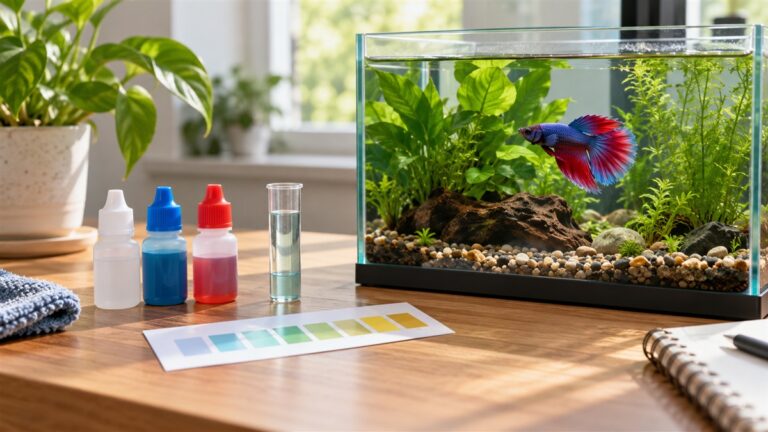
A chlorine tester for aquarium water is a small test, usually a strip or a drop kit, that shows whether chlorine is present in the water you plan to add. Many betta keepers meet chlorine only as a line on a label, so the test is easy to skip. This guide explains what to look for on the listing, where a chlorine reading fits next to ammonia and pH checks, and which strip kits in this group name chlorine clearly. Read the quick answer first, then the sections on free and total readings and the pH scale.
Quick answer
Choose a strip kit whose listing names chlorine in plain words, and check the pH scale and the number of strips before you buy. Free chlorine appears in several listings in this group, and one listing names total chlorine instead. A pool or hot tub meter is a different product type, so it is not a pick here. The IFAS ammonia guide covers ammonia and nitrite, not chlorine, so for chlorine you rely on the listing and its color card. Test the water you add, read the card under the same light each time, and follow the label for any water treatment you use.
What a chlorine reading does and does not tell you
A chlorine reading tells you about the water in front of you, at the moment you test it. It does not tell you how the water will change over the next week, and it does not tell you about the fish. That makes the reading useful as one step in a routine, not as a diagnosis.
Read the exact name on the listing. Several kits here say Free Chlorine. One says Total Chlorine. The names are not the same thing, and a strip only reads the parameter printed on its pad. If you need a specific reading for your water supply, check which parameter the kit names before you buy it.
Free chlorine and total chlorine
Listings in this group use two names. The AAwipes, Aqueon, DaToo, AESCULIX and WHITE SHARK OCEAN listings all name free chlorine. The AKSBTEC listing names total chlorine. Pick the kit whose wording matches the reading you want, and write that name on the bottle so you remember what it measures.
Do not assume the two readings are interchangeable. The listings do not explain how the readings relate to each other, so do not guess. Ask the maker if the difference matters for your water source.
Why the pH scale matters on a chlorine strip
Many multi-parameter strips share one pad or one bottle for several readings. The pH scale on the listing tells you what the kit can show for acidity. The IFAS ammonia guide is a useful reminder that pH changes the toxic share of ammonia, so a pH reading is not a side detail. In the wild, the Siamese fighting fish overview on Wikipedia gives a water pH range from slightly acidic (pH 6.9) to highly alkaline (pH 8.2). A kit whose pH scale stops at 8.0 may not show the top of that range clearly. If pH is your main concern, a dedicated pH test kit for aquariums may suit you better.
The Aqueon listing gives a pH range of 6.5 to 8.0. The AKSBTEC listing gives a pH range of 0-14. A wider scale is not always better, because the card must still show a clear color difference. Check how the card reads the values you care about.
Strip kits, multi-parameter bottles and the ammonia check
Most chlorine testers in this group are strips that also read other parameters. That bundling has a real benefit. One dip gives you chlorine, pH and sometimes ammonia in the same routine. It also has a cost. The bottle’s count is shared across every parameter, and the wait times differ from pad to pad.
Ammonia still needs its own attention. The IFAS guide states that ammonia is colorless and, even at levels toxic to fish, odorless, so testing is the only way to know it is present. The same guide says a good ammonia kit includes a thermometer, because the toxic share depends on temperature and pH. A chlorine strip does not replace that ammonia check. If a kit includes an ammonia pad, use it. If it does not, plan a separate ammonia test on the schedule the guide describes. A dedicated ammonia test kit is one way to cover that check.
Several listings in this group explain separate dip times for the ammonia pad, such as holding the ammonia pad longer than the other pads. Read the instructions on each bottle, because the times are part of the method.
Freshwater, marine and pool products
Many listings say they work for freshwater and saltwater aquariums, ponds and pools. A betta is a freshwater fish, so the saltwater claim does not add value to your routine. The pool claim matters more. A chlorine strip for an aquarium should show a clear chlorine color card for aquarium water. A pool or hot tub meter is built for different water and different ranges.
The Salt Tester for Saltwater Pool listing in the same group describes a pool and hot tub meter that also reads free chlorine. It is a device for pools and spas. That is a different product type from a strip kit for a betta tank, so it is not a match for a betta tank.
The Kactoily listing is a monitor for pH, ORP, salinity, TDS and temperature. It does not name chlorine, so it is not a chlorine tester here.
Reading the card
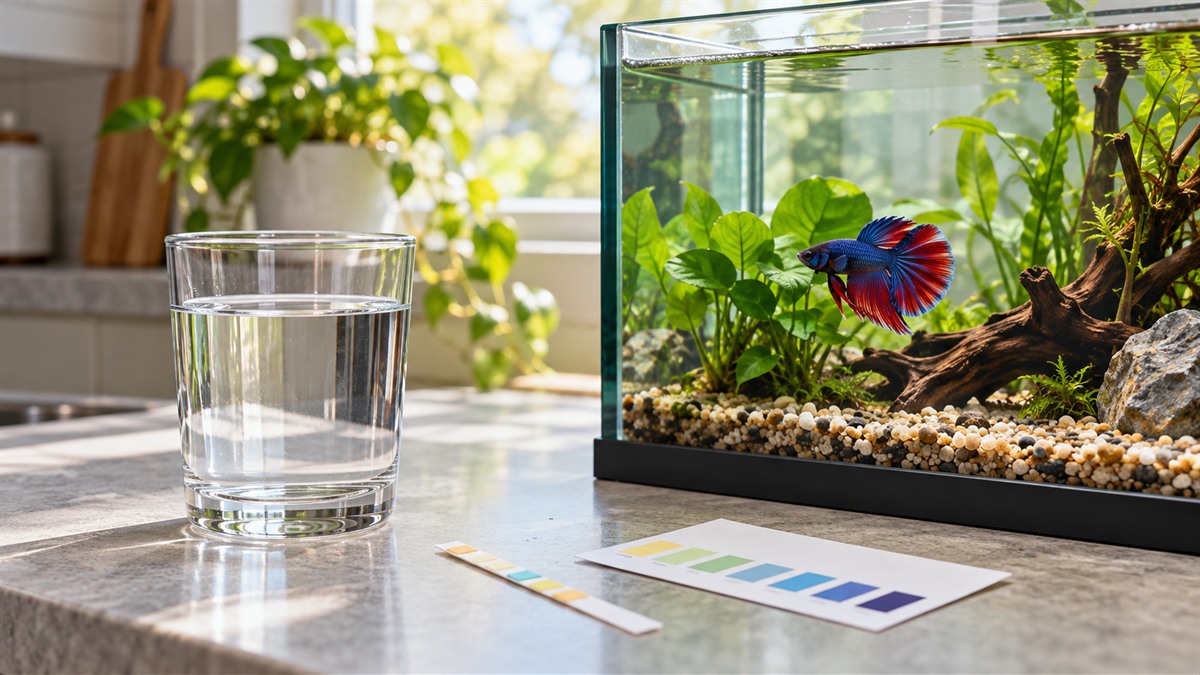
A color card is only as useful as the way you read it. Hold the strip flat for the time the listing gives, and compare the pad with the card as soon as the wait ends. Do not read the pad after it has dried for a long time, because the color can keep shifting.
Use the same light each time, ideally daylight near a window rather than a bulb with a yellow tint. Keep the card close to the pad so you compare them side by side. If you are colorblind, ask someone else to read the card with you, or choose a kit whose card has clear, well-separated steps.
Write the reading down with the date, the parameter, and the water you tested. A single chlorine reading means less than the trend across several weeks. If the readings change from week to week, note what you changed in the tank or in the water you add.
Products that fit this
These five strip kits name chlorine on the listing and suit an aquarium routine. Each card below states what the listing says about its parameters, count, scale and use.
1. AAwipes 8-in-1 Aquarium Test Kit for Fish Tanks – Quick & Accurate Water Testing Strips (Eight-in-one, free chlorine)
Specs from the listing (checked 2026-10-11):
- Number of Items: 50
- Item Weight: 2.39 ounces
- Specific Uses for Product: Indoor
- Package Dimensions: 5.39 x 2.13 x 2.09 inches; 2.4 ounces
Pros
- The listing names Free Chlorine among its eight tests.
- The listing states 50 strips in the bottle.
- The listing says the strips come in a well-sealed bottle to protect them from moisture.
Cons
- The listing says the strips work in ponds and pools too, so the kit is not specific to aquarium water.
- The listing does not state a color scale for the chlorine pad.
- The ammonia pad needs its own longer dip, which adds a step to each full check.
Best for: Keepers who want a chlorine pad inside a larger set of aquarium readings.
Skip if: You want a chlorine-only reading, or a chlorine test with a printed numeric scale.
View on Amazon (affiliate link)
2. Aqueon 7-in-1 Aquarium Test Strips, Fast Results for pH, Total Alkalinity, Hardness, Nitrate (Brand-name, seven tests)
Specs from the listing (checked 2026-10-13):
- Ph Range: 6.5 to 8.0
- Unit Count: 50 Count
- Recommended Uses For Product: Aquarium
- Included Components: Test Strips 50 Count
- Product Dimensions: 1.85 x 1.85 x 5.31 inches; 1.45 ounces
Pros
- The listing names seven tests, including free chlorine, for freshwater and saltwater aquariums.
- The listing says results come in 30 seconds.
- The listing states 50 strips per bottle.
Cons
- The listing gives a pH range of 6.5 to 8.0, which is narrower than the scale on some kits in this group.
- The warranty line is a satisfaction guarantee on the product, not a stated test accuracy.
- The bullets do not give a color scale for the chlorine pad.
Best for: Keepers who want a brand-name kit with a clear seven-test list and a quick read.
Skip if: You need a pH reading wider than the listed 6.5 to 8.0 range.
View on Amazon (affiliate link)
3. DaToo 8 in 1 Aquarium Test Kit Fish Tank Test Strips Accurate Water Quality Testing Strips (Free chlorine with a thermometer)
Specs from the listing (checked 2026-10-13):
- Size: 100 Strips
- Item Weight: 1.44 ounces
- Manufacturer: DaToo
- Package Dimensions: 7.32 x 5.39 x 0.63 inches; 1.45 ounces
Pros
- The title lists ammonia, pH, total alkalinity, carbonate, hardness and free chlorine among its tests.
- The bullets say the kit has an extra thermometer for the other readings.
- The listing says the strips use thickened fiber paper that resists tearing and color bleeding.
Cons
- The listing gives a wait of 2-3min for the ammonia pad, which is longer than the other readings.
- The listing does not state a pH range, so check the card before you rely on the pH color.
- The listing describes a full check as several steps, so a complete routine takes longer than a single dip.
Best for: Keepers who want free chlorine and a thermometer in one bottle of 100 strips.
Skip if: You want a printed pH range on the listing, because this one does not state one.
View on Amazon (affiliate link)
4. 9-In-1 Aquarium Test Strips – 100 Strips for Freshwater & Saltwater | Tests pH, Nitrate, Nitrite (Nine parameters, 100 strips)
Specs from the listing (checked 2026-10-13):
- Item Weight: 3.2 ounces
- Included Components: 100 Strips
- Specific Uses for Product: Fish Tank Test Strips
- Style: 9-In-1 Test Kit
- Package Dimensions: 5.35 x 2.17 x 2.13 inches; 3.21 ounces
Pros
- The listing says results come in 60 seconds when the strip is held horizontally.
- The listing says the strips work for freshwater and saltwater aquariums.
- The listing says each resealable bottle contains 100 single-use strips.
Cons
- The listing gives a 60-second hold, which is longer than the 30-second reads on several other kits in this group.
- The listing claims up to 2 years of weekly testing, which depends on how well the cap keeps moisture out.
- The bullets do not give a color scale for the free chlorine pad.
Best for: Keepers who want a 100-strip bottle with free chlorine among nine tests.
Skip if: You need results faster than a 60-second hold.
View on Amazon (affiliate link)
5. 11 in 1 Aquarium Test Strips Kit | Aquarium Ammonia Test Strips | 150 Strips | Quick Accurate (Total chlorine, wide pH scale)
Specs from the listing (checked 2026-10-13):
- Ph Range: 0-14
- Recommended Uses For Product: Comprehensive Freshwater or Saltwater Aquarium Testing
- Unit Count: 150 Count
- Included Components: 9-in-1 aquarium test strips, Ammonia test strips, temperature test strip, tube
- Material Type: PVC plastic
Pros
- The listing names eleven parameters, including total chlorine, pH, ammonia and temperature.
- The listing includes a temperature test strip in the kit.
- The listing states a unit count of 150 in a single kit.
Cons
- The listing gives a pH range of 0-14, which does not show what the card reads at each step.
- The bullets mention a high range pH for marine tanks, which a betta tank does not need.
- The listing names PVC plastic as the material, which is a packaging note rather than a test method.
Best for: Keepers who want a total chlorine reading and a temperature strip in the same bottle.
Skip if: You want a freshwater betta-only kit with a narrow, clearly printed pH scale.
View on Amazon (affiliate link)
How to choose
Choose the AAwipes kit if you want a chlorine pad in an eight-in-one bottle and you are comfortable with a shared bottle for several readings.
Choose the Aqueon kit if you want a brand-name seven-test strip for freshwater or saltwater and a stated pH range of 6.5 to 8.0. If you want strips for water quality generally, compare the water quality test strips for a fish tank before you settle on one bottle.
Choose the DaToo kit if you want free chlorine in a bottle of 100 strips and you value an included thermometer for the other readings.
Choose the WHITE SHARK OCEAN kit if you want a 100-strip bottle with free chlorine among nine tests and you accept a longer hold on each strip.
Choose the AKSBTEC kit if you specifically need a total chlorine reading and you want a temperature strip in the same bottle. Its pH scale is wide, so read the card closely.
Skip all five kits if you need a chlorine reading only, with a clear color scale printed on the bottle. None of these listings states a numeric chlorine scale in its bullets, so check the card before you buy.
How long a 100-strip bottle lasts
These numbers are an illustration only.
Step 1. Weekly tests in a year: 1 test a week times 52 weeks equals 52 tests.
Step 2. Bottle length in weeks: 100 strips divided by 1 test a week equals 100 weeks.
Step 3. Bottle length in years: 100 weeks divided by 52 weeks a year is about 1.9 years.
Step 4. Check the result by working backward: 1.9 times 52 is about 99, which is close to the 100 strips in the bottle.
Real use is rarely this neat. A bottle shared across several readings lasts less time for each reading, and a second weekly check will halve the length of a chlorine-only bottle. Count the parameters you test each week, then divide the bottle count by that total.
The estimate shows why a bigger count is only useful when your routine matches it. A large bottle that you finish in a year may cost you less per test than a small one, but only if you test as often as the bottle assumes.
Mistakes to avoid
Buying a pool meter for a betta tank is the first mistake. A pool meter is built for a different water and a different range. Use an aquarium strip kit for the tank.
Assuming free and total chlorine are the same reading is the second. The listings name different parameters, so read the exact name before you buy.
Ignoring the pH scale is the third. A chlorine strip with a narrow pH range may not show the top of the range that betta keepers use as a reference. Check the scale on the bottle.
Skipping the ammonia check because a kit includes chlorine is the fourth. The IFAS guide says ammonia is invisible to the eye and must be tested for. A chlorine pad does not do that job.
Reading the card in poor light is the fifth. Color cards are compared by eye, so read them under the same light each time, and keep the bottle out of direct sun.
Using an old strip is the last. Keep the cap sealed and store the bottle in a cool, dry place. A strip that has taken on moisture can give a reading you cannot trust.
FAQ
Do I need a chlorine tester for a betta tank?
Many keepers test the water they add, so a chlorine check is a useful habit. It is not a substitute for ammonia testing, water changes or a working filter.
Is a chlorine strip the same as a chlorine drop test?
Not necessarily. A strip gives a color reading on a pad, while a drop test uses liquid reagents. Read the listing to see which method the kit uses, because the steps and the timing differ.
Why does the listing say free chlorine instead of chlorine?
Free chlorine is the name the listing uses for the reading. Some kits name total chlorine. Pick the kit whose name matches the reading you want.
Can I use a pool meter for my aquarium?
The pool meter in this group is built for pools and spas. Use an aquarium strip kit for a betta tank, because the ranges and the water type differ.
What does the IFAS guide say about testing?
The IFAS guide covers ammonia and nitrite. It recommends weekly ammonia tests in a production system and an immediate test when fish appearance or behavior changes. It does not cover chlorine, so use the listing and the label for chlorine decisions.
What should I do if a reading looks wrong?
Check the bottle date, the wait time and the light you read under. Repeat the test with a fresh strip. If a fish is unwell, consult an experienced fish keeper or an aquatic vet rather than relying on a single reading.
Bottom line
Choose a strip kit whose listing names chlorine in plain words, and match the name to the reading you need. Use the AAwipes, Aqueon, DaToo or WHITE SHARK OCEAN kit for free chlorine in a multi-parameter bottle, and the AKSBTEC kit for total chlorine. Keep a separate ammonia check on your schedule, and read the card under the same light each time.
Sources
- UF/IFAS guide: Ammonia in Aquatic Systems: ammonia is odorless and colorless at toxic levels, a good kit includes a thermometer, and weekly ammonia tests in a production system
- Siamese fighting fish overview: natural pH range for bettas in the wild