Best Nitrate Monitor for an Aquarium: Strips and Apps Compared
As an Amazon Associate we earn from qualifying purchases. Details
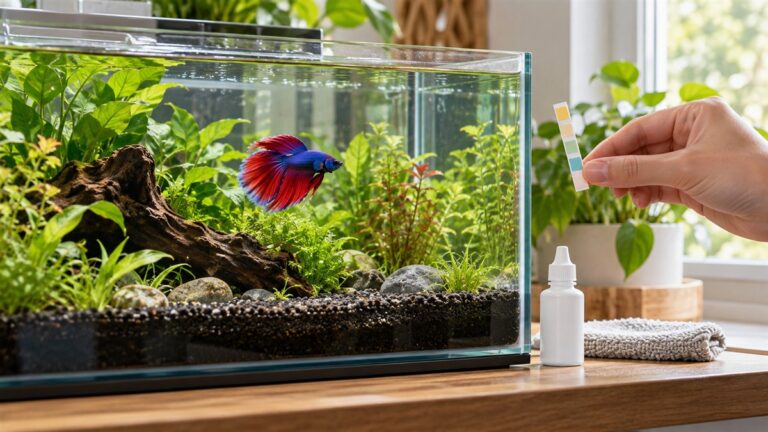
A nitrate monitor for an aquarium is a tool that tells you how much nitrate is in the water, either by a strip with a color card, a digital kit that you read with an app, or a device that stays in the tank. For a betta keeper, the search is often confusing. Many listings say monitor when they mean a set of test strips, and a few devices measure other parameters entirely. This guide sorts those types, explains what a nitrate reading can and cannot tell you, and names the nitrate-capable kits in this group. Read the quick answer first, then the section on how the readings fit together.
Quick answer
No listing in this group is a continuous nitrate monitor that stays in the tank. The closest option is a digital, app-guided strip kit, and the other picks are strip sets that include a nitrate pad. Choose a kit whose listing names nitrate in plain words, then check the pack count, the other parameters in the bottle and whether ammonia is included. A Wi-Fi monitor in this group tracks pH, ORP, salinity, TDS and temperature but not nitrate, so it is not a pick here. The IFAS ammonia guide covers ammonia and nitrite, not nitrate, so decide on nitrate with your own log and the listing.
What a nitrate monitor can and cannot show
A nitrate reading is a snapshot of the water you test. It shows the nitrate level at that moment, and it can help you see a trend across weeks. It does not diagnose a fish, and it does not explain the cause of a change on its own.
The three types of product in this group behave differently. A strip kit gives you a color match on a pad. A digital kit uses an app to read a strip or a pad. A device stays in the water and records readings over time. Only the first two types are on the market here, so think of a nitrate monitor as a routine rather than a gadget that runs itself.
Strips with a nitrate pad
Most picks in this group are strip sets. The Aqueon listing gives a seven-test strip for pH, total alkalinity, hardness, nitrate, nitrite, free chlorine and iron, with results in 30 seconds. The Aquatic Eden listing names nine parameters, including nitrate, on one strip. The Merydi listing names nitrate among eight tests on a single strip.
Strip sets share one bottle across several readings. That is useful, but it means the count you see on the box covers every pad, not nitrate alone. Read the listing closely before you estimate how long a bottle lasts.
App-read digital kits
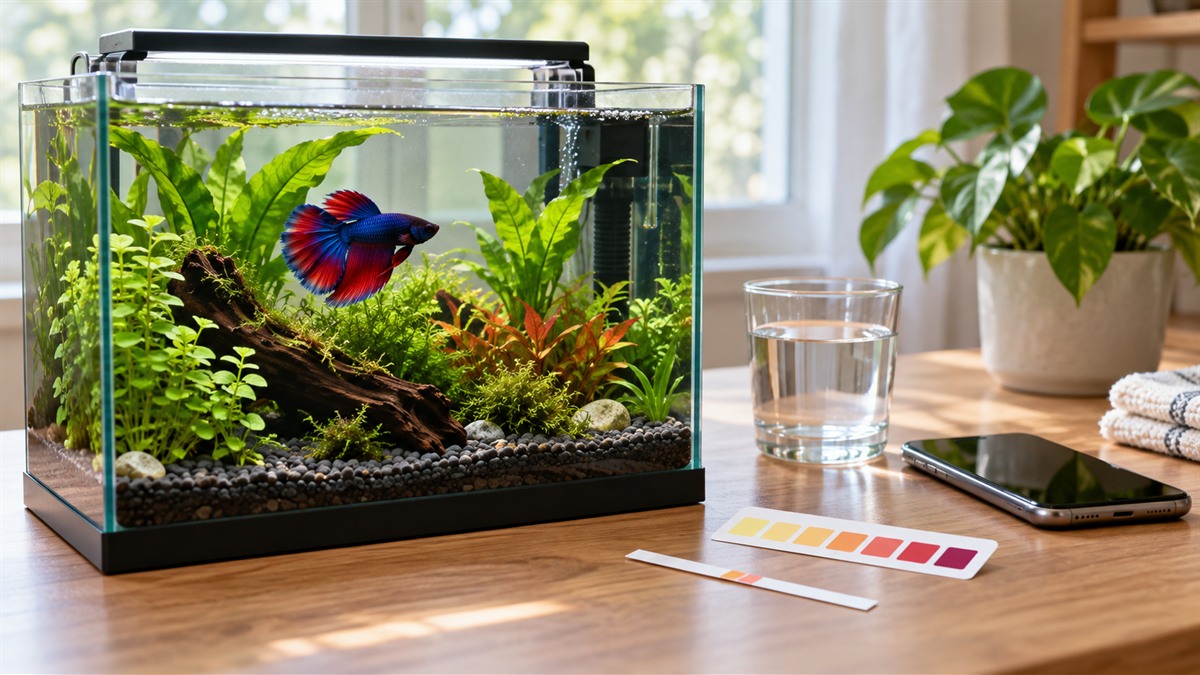
The Droplytix listing describes an app-enabled workflow. It says you dip, scan and receive a result for ammonia, nitrate, nitrite, pH and more. This is closer to what many shoppers mean by a monitor, because the reading is made with a device rather than by eye. It is still a set of strips, not a sensor that stays in the tank, so you still need a routine for when you test.
Devices that stay in the tank
The Wi-Fi monitor in this group is the nearest thing to a device. Its listing describes pH, TDS, EC, ORP, specific gravity, salinity and temperature, with 24-hour online monitoring. It does not name nitrate. If you need a nitrate reading, that monitor will not give it to you, however much it can track. Check the parameter list on any device before you buy it for nitrate. If you only need ammonia, an ammonia test kit for an aquarium is a more direct choice.
Why nitrate sits next to ammonia and nitrite
Nitrate is one of several nitrogen readings a keeper watches, and it makes most sense when read beside ammonia and nitrite. The IFAS guide states that ammonia is colorless and, even at levels toxic to fish, odorless, so the only way to know whether ammonia is present is to test the water. It also states that nitrite is toxic to fish at levels as low as 0.10 mg/L. Nitrate is not covered in that guide, so a nitrate reading should be judged against your own trend, not against a number we cannot cite.
Several kits in this group pair nitrate with ammonia and nitrite on one strip or one bottle. That pairing is convenient, but it leaves one question open. A nitrate reading tells you where a number sits. It does not tell you whether the water is safe for a fish. Use the reading with your ammonia and nitrite results, and keep all three in the same log.
The IFAS guide also says a new biofilter needs six to eight weeks to build up enough bacteria to effectively reduce ammonia and nitrite levels. During that build-up, readings can swing. Log them, do not change several things at once, and keep testing on your schedule.
Products that fit this
These five picks name nitrate on the listing and suit a betta tank. Each card below states what the listing says about its parameters, count and use. None is a continuous device. For more options, browse the fish aquarium water test kit picks before you decide.
1. Digital Aquarium Water Test Kit, App-Enabled 10-in-1 Fish Tank Test Kit for Freshwater & Saltwater (Digital, app-read)
Specs from the listing (checked 2026-10-13):
- Ph Range: 6.0-8.0
- Unit Count: 10 Count
- Included Components: Mobile App, Test strips
- Model Number: 10-in-1 Aquarium Kit
- Number of Items: 10
Pros
- The listing describes an app-enabled workflow with a dip, a scan and a readout.
- The listing says it measures ammonia, nitrate, nitrite, pH, GH, KH and chlorine.
- The listing says it is meant for betta tanks among other aquariums.
Cons
- The included components list ten strips, a small count for a routine that checks several parameters.
- The listing does not state how the app reads the color, or whether it needs a phone camera.
- The listing gives a pH range of 6.0-8.0, which stops short of the 8.2 upper end cited for bettas in the wild.
Best for: Keepers who want an app to read each result and do not need a large strip count.
Skip if: You want a device that stays in the tank, or more than ten tests from one kit.
View on Amazon (affiliate link)
2. Aqueon 7-in-1 Aquarium Test Strips, Fast Results for pH, Total Alkalinity, Hardness, Nitrate (Brand-name, seven tests)
Specs from the listing (checked 2026-10-13):
- Ph Range: 6.5 to 8.0
- Unit Count: 50 Count
- Recommended Uses For Product: Aquarium
- Included Components: Test Strips 50 Count
- Product Dimensions: 1.85 x 1.85 x 5.31 inches; 1.45 ounces
Pros
- The listing names seven tests, including nitrate, nitrite and free chlorine, for freshwater and saltwater.
- The listing says results come in 30 seconds with a hold for each strip.
- The listing states 50 strips per bottle.
Cons
- The listing gives a pH range of 6.5 to 8.0, narrower than some kits in this group.
- The warranty line is a satisfaction guarantee on the product, not a stated test accuracy.
- The listing does not state a color scale for the nitrate pad.
Best for: Keepers who want a brand-name kit with nitrate and chlorine in one seven-test strip.
Skip if: You need a pH reading wider than the listed 6.5 to 8.0 range.
View on Amazon (affiliate link)
3. 9-in-1 Aquarium Water Test Kit – 100 Freshwater & Saltwater Test Strips | Fish Tank Kit for pH (Nine parameters, 100 strips)
Specs from the listing (checked 2026-10-13):
- Brand: Aquatic Eden
- Ph Range: 6.2 – 8.4
- Unit Count: 100 Count
- Included Components: 100 Aquarium Test Strips
- Material Type: Chemically coated aquarium water test kit
Pros
- The listing names nine parameters, including nitrate, nitrite, pH, chlorine, iron and copper.
- The listing says results come in 60 seconds (1 minute) with the strip held horizontally.
- The listing states 100 aquarium test strips in the kit.
Cons
- The listing gives a pH range of 6.2 – 8.4, which does not match the range printed on other kits here.
- The listing says the strips are chemically coated, which is a material note rather than a test method.
- The listing does not give a color scale for the nitrate pad.
Best for: Keepers who want nitrate among nine parameters and a 100-strip bottle for regular checks.
Skip if: You need results faster than a 60-second hold.
View on Amazon (affiliate link)
4. Aquarium Test Strips 8 In 1, 150ct Aquarium Ammonia Test Strips for Saltwater Freshwater (Eight tests, nitrate included)
Specs from the listing (checked 2026-10-13):
- Item Weight: 3.17 ounces
- Color: 8 Way
- Package Dimensions: 5.24 x 2.17 x 2.13 inches; 3.17 ounces
- Package length: 5.24 inches
Pros
- The listing names eight tests, including nitrate, nitrite, hardness, total alkalinity, pH, free chlorine and ammonia.
- The listing states a count of 150 strips in the title.
- The listing gives the package weight, which helps you plan storage.
Cons
- The listing gives little detail beyond its title and one bullet, so check the card before you rely on it.
- The listing does not state a pH range for the card.
- The listing does not state the wait time for each pad.
Best for: Keepers who want a nitrate pad in a simple eight-test set with a large strip count.
Skip if: You want a listing with a clear pH range and a stated timing for each pad.
View on Amazon (affiliate link)
5. 9-In-1 Aquarium Test Strips – 100 Strips for Freshwater & Saltwater | Tests pH, Nitrate, Nitrite (Nine tests, 60-second hold)
Specs from the listing (checked 2026-10-13):
- Item Weight: 3.2 ounces
- Manufacturer: WHITE SHARK OCEAN
- Style: 9-In-1 Test Kit
- Included Components: 100 Strips
- Specific Uses for Product: Fish Tank Test Strips
- Package weight: 3.21 ounces
Pros
- The listing names nitrate among nine parameters, including pH, nitrite, total hardness and free chlorine.
- The listing says each resealable bottle holds 100 single-use strips.
- The listing says the strips work for freshwater and saltwater aquariums.
Cons
- The listing says results take 60 seconds with the strip held horizontally, which is longer than some kits here.
- The listing claims up to 2 years of weekly testing, which depends on how well the cap keeps moisture out.
Best for: Keepers who want nitrate and free chlorine in one bottle of 100 single-use strips.
Skip if: You need a quick result, because the listing's hold is 60 seconds.
View on Amazon (affiliate link)
How to choose
Choose the Droplytix kit if you want an app to read each result and you are comfortable with a dip-and-scan routine.
Choose the Aqueon kit if you want a brand-name seven-test strip that includes nitrate and chlorine. Its pH range is narrower than some kits in this group, so read it against your routine.
Choose the Aquatic Eden kit if you want nine parameters, including nitrate, on a bottle of 100 strips. Check the pH range and the count, because the listing’s numbers need care.
Choose the Merydi kit if you want a nitrate pad in a simple set with a stated count of 150 strips. The listing gives less detail than some others, so read the card before you rely on it.
Choose the WHITE SHARK OCEAN kit if you want nitrate among nine parameters and a 100-strip bottle with a 60-second hold. It takes longer to read than a dip-and-wait kit.
Choose a separate nitrate-only test if you want a single parameter in a bottle. The strip sets here share their count across several readings, so a dedicated product may be simpler for a single parameter. If pH is the second reading you want, a pH test kit for an aquarium pairs well with a nitrate-only routine.
Skip any kit that does not name nitrate in its listing. Several products in this group test nitrite alone or test pH and salinity on a device, and those are a different product type.
How many weekly checks one bottle gives
These numbers are an illustration only. The bottle holds 150 strips.
Step 1. Strips used in a year: 1 strip a week times 52 weeks equals 52 strips.
Step 2. Weeks the bottle lasts: 150 strips divided by 1 strip a week equals 150 weeks.
Step 3. Years the bottle lasts: 150 weeks divided by 52 weeks a year is about 2.9 years.
Step 4. Check the result by working backward: 2.9 times 52 is about 151, which matches the bottle count.
If you read the same strip twice a week, the bottle lasts 75 weeks, which is about 1.4 years. The count of pads on a strip does not change how many strips you use, because one dip reads all of its pads.
The estimate shows why a bottle’s count is only half the question. The shelf life printed on the bottle, the testing schedule and the pad count together decide how long the set serves you.
Logging a nitrate trend
A single nitrate reading is hard to use on its own. A short log is more useful, because it shows whether a reading is rising, falling or flat. Record the date, the parameter name as the bottle prints it, the reading, the color you matched and any change you made that week, such as a water change, a new fish or a change in feeding.
Test at the same point in your routine each time, ideally before a water change. That keeps the comparison fair. If you change the water on a fixed day, use the same day for the test. A trend across four or more weeks says more than any one strip.
Keep the log with the bottle. When you open a new bottle, start a new column or sheet so the readings from different strip batches do not blur together. This is a simple habit, but it protects the comparison you care about most.
Mistakes to avoid
Buying a device for a parameter it does not measure is the first mistake. The Wi-Fi monitor in this group does not name nitrate, so it will not answer a nitrate question.
Treating a monitor word as a promise of continuous readings is the second. Every pick here is a test you run by hand or with an app. Plan your schedule before you assume a reading is always available.
Reading the card in poor light is the third. Compare each pad under the same light, and keep the card close to the strip during the comparison.
Using a strip after its shelf life is the fourth. The IFAS guide does not cover strip shelf life, so use the printed date and the bottle’s own advice. Keep the cap sealed between uses.
Reading nitrate alone and ignoring ammonia is the fifth. The IFAS guide states that ammonia is odorless and colorless at toxic levels, so a nitrate result does not show ammonia.
Changing several things after one reading is the last. Log the reading, repeat the test with a fresh strip, and change one thing at a time.
FAQ
Is there a continuous nitrate monitor in this group?
No. The picks here are strip kits and an app-read digital set. None of them stays in the tank and reports on its own.
Does the Wi-Fi monitor measure nitrate?
Its listing names pH, TDS, EC, ORP, specific gravity, salinity and temperature. It does not name nitrate, so it is not a nitrate monitor.
Which parameters should I test with nitrate?
Most picks read ammonia, nitrite and pH on the same strip. The IFAS guide recommends weekly ammonia tests in a production system and an immediate test when fish behavior changes. Use that as a guide for timing, and log each reading.
How often should I check nitrate?
Pick a schedule you can keep. Many keepers test weekly and test more often after a change in the tank. This is a common rule of thumb, not a fixed rule, so adjust it to your setup.
Can a strip kit replace a nitrate-only test?
It can cover nitrate in the same dip, but the count is shared across several pads. A dedicated nitrate test may be simpler if you need only one reading.
Should I test before or after a water change?
Test before the change, so the reading shows the tank as it was between changes. Then test the new water if your routine includes it, and log both readings separately. Keep the timing the same each week so the comparison stays fair.
Can a nitrate reading alone tell me the tank is safe?
No. A nitrate reading is one number, and this guide’s sources do not give a nitrate target to judge it against. Read it with your ammonia and nitrite results, your log and your own observations of the fish, and consult an experienced fish keeper or an aquatic vet if you are worried.
What should I do if nitrate looks high?
Check your log, confirm the reading with a fresh strip, and look at the water change routine and the filter. If a fish is unwell, consult an experienced fish keeper or an aquatic vet rather than relying on the reading.
Bottom line
Choose a nitrate-capable strip or app-read kit that names nitrate clearly on the listing, and keep the reading in a log beside ammonia and nitrite. The Droplytix kit is the closest to a monitor in this group, and the Aqueon, Aquatic Eden, Merydi and WHITE SHARK OCEAN kits are the strip sets to compare. Skip any device that does not name nitrate, and plan the bottle around the number of weekly checks you will really run.
Sources
- UF/IFAS guide: Ammonia in Aquatic Systems: ammonia is colorless and odorless at toxic levels, nitrite is toxic at levels as low as 0.10 mg/L, and biofilter timing