Best Phosphate Test Kit for Your Betta Tank: What to Check
As an Amazon Associate we earn from qualifying purchases. Details
If you are looking for the best phosphate test kit, you first need to know which kits in the listings actually test phosphate, and which ones leave it out. This guide sorts the options that name phosphate and explains what to check before you buy. A common rule of thumb for a single betta is a heated, filtered tank of 5 gallons or more, so the kit you choose should fit that tank and the way you plan to test. Most kits in this group test several parameters, so phosphate is often one line among many.
Quick answer
Confirm that the listing names phosphate before you consider a kit. Several kits in this group test ammonia, nitrite, nitrate, pH and hardness but never name phosphate, so they are not picks here. For a liquid reagent kit with a stated phosphate count, look at the Pawfly and Vaterbeing 5 in 1 kits. For strips that include phosphate, look at the AESCULIX or HYCHEK packs. Choose strips for quick checks. Choose liquid reagents for a planned schedule with a known number of phosphate tests.
What the phosphate keyword changes
A phosphate search is narrower than a general water test search. Most of the criteria below come from that narrower goal. Three of them change which kit is right for you. The fourth and fifth change how you use it.
Some water problems have no smell and no color. The UF/IFAS guide on ammonia notes that ammonia is colorless and odorless, so a test is the only way to know whether it is present. That is one reason a test kit matters, even when the tank looks fine. Phosphate is a different parameter, so do not assume that a kit built for ammonia will cover it.
Phosphate has to be named
Read the title and the bullets for the word phosphate. Some listings name it in the title, others only in a bullet, and a few leave it out. A listing that names phosphate in a bullet still counts, but you should confirm the parameter list before you buy. If the listing does not name phosphate anywhere, do not assume it is included.
Liquid reagent or test strip
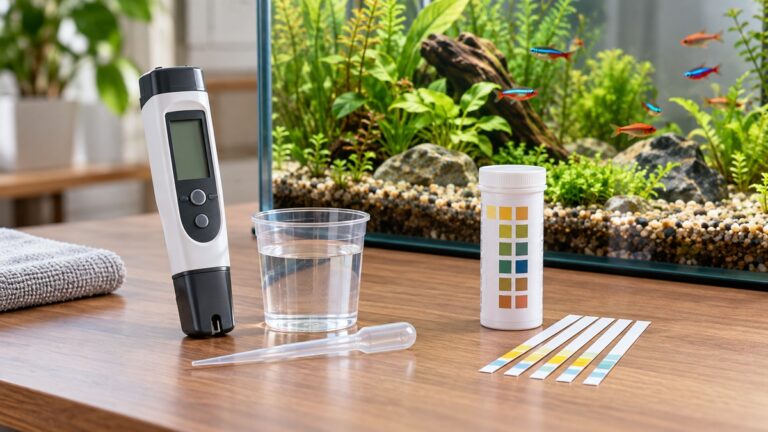
Liquid reagent kits use vials and drops. Strip kits use a dip and a color chart. Liquid kits usually take more steps, so they suit a planned check. Strips suit a quick check. Neither format is better by default. Choose the one you will actually use on the schedule you set.
Test count and how long it lasts
Count the phosphate tests, not the total tests. A kit can say 170 strips and still contain only 20 phosphate strips. Add up the count for each parameter, then compare it with how often you plan to test. Storage also matters. Some listings say the strips come in a sealed bottle, and that helps them stay usable longer. Keep the cap closed after each use, as the listing instructs.
Parameters for a betta tank
A betta tank is a small, closed system, so a kit that tests only one parameter is rarely enough. Look for a set that covers ammonia, nitrite, nitrate and pH along with phosphate. If you need a closer look at pH on its own, the pH test kit guide covers that side of the choice. Check the parameter list on each kit, and make sure the list includes the ones you care about most.
Directions and what the listing leaves out
Read the directions field, then the bullets. Some listings give a clear step count and a timing for each reading. Others give timing in the bullets and leave the directions field vague or unfinished. If the two do not match, confirm the steps before you test.
1. Pawfly 5 in 1 Aquarium Water Master Test Kit, Fish Tank Water Testing Kit (Liquid reagents with 40 phosphate tests)
Specs from the listing (checked 2026-10-11):
- Item Weight: 10.9 ounces (about 0.68 lb)
- Package Dimensions: 7.4 x 4.92 x 3.5 inches; 10.93 ounces
- Color: Blue Standard Kit Pack
- Included Components: Aquarium Water Master Test Kit
- Directions: Adults 18 years and older.
- Specific Uses for Product: Helps monitor water quality and prevent invisible water problems
Pros
- The listing states 265 measurements, including 40 phosphate tests
- The listing describes liquid reagents with color-matching charts included
Cons
- The listing does not give a phosphate range for the readings
- Liquid reagent kits usually take more steps than a strip
Best for: A planned testing schedule that needs a liquid format and a stated phosphate count.
Skip if: You want a quick strip you can read in a few seconds.
View on Amazon (affiliate link)
2. 5 in 1 Aquarium Water Master Test Kit, Fish Tank Testing Kit (Same five parameters, listed warranty)
Specs from the listing (checked 2026-10-11):
- Item Dimensions LxWxH: 7.2 x 4.7 x 3.5 inches
- Item Weight: 6.4 ounces
- Size: Medium
- Warranty Description: 1-Year Warranty
- Color: Green
- Directions: Adults 18 years and order.
Pros
- The listing states 40 phosphate tests within 265 total tests
- The warranty field lists a 1-Year Warranty
Cons
- The directions field reads Adults 18 years and order, which looks like a typo
- The listing says the liquid is more accurate than strips but gives no accuracy figure
Best for: A buyer who wants a five parameter liquid kit with a listed warranty.
Skip if: You need clear directions on the listing before you start.
View on Amazon (affiliate link)
3. 9-in-1 Aquarium Test Strips, 100 Count Fish Tank Water Test Kit for Freshwater & Saltwater, Tests (One strip with phosphate in the same dip)
Specs from the listing (checked 2026-10-11):
- Unit Count: 123 Count
- Ph Range: 6.5 – 8.5
- Recommended Uses For Product: Home Water, Tap Water, Well Water, Aquarium, Swimming Pool
- Included Components: 9-in-1 Aquarium Test Strips
Pros
- The listing names phosphate among nine parameters on one strip
- The bullets say to dip for 2 seconds and read after about 30 seconds
Cons
- The title says 100 count while the unit count field reads 123 Count
- The listed uses include tap water, well water and swimming pools, not only aquariums
Best for: A tester who wants one dip that covers many parameters and a short wait.
Skip if: You need a count you can confirm before you order.
View on Amazon (affiliate link)
4. 12 in 1 Accurate Aquarium Test Kit, Fresh and Salt Water Test Strips (Strips across three types)
Specs from the listing (checked 2026-10-11):
- Specific Uses for Product: Fish Tanks, Ponds, Aquariums, Fish Bowls
- Included Components: Aquarium Test Kit, Instructions, Test Tube
- Item Package Dimensions L x W x H: 5.28 x 3.78 x 2.28 inches
- Package weight: 5.29 ounces
Pros
- The listing gives 170 strips: 100 of 10-in-1, 50 ammonia and 20 phosphate
- The bullets give separate pH readings for fresh and salt water
Cons
- Only 20 of the 170 strips are phosphate strips
- The listed uses include fish bowls, which this site does not recommend for a betta
Best for: A reader who wants phosphate and ammonia strips in one pack.
Skip if: You only need phosphate, or you plan to test a bowl.
View on Amazon (affiliate link)
How each pick fits a betta tank
Each pick below names phosphate in its listing. Each one gets one write-up. The product card above shows the full spec list, so this section adds only what the listing means for a small betta tank.
Pawfly 5 in 1: liquid reagents with a stated phosphate count
The listing names five parameters: pH, nitrite, nitrate, ammonia and phosphate. It says the kit uses liquid reagents and gives a stated count for each. The listing gives 265 measurements in total, and phosphate is listed at 40 of them. The bullets also say that color-matching charts are included. The listing states that it works in freshwater and marine tanks. The listing does not give a phosphate range, so you cannot tell from the listing how the readings map to exact levels. Pick this kit if you want a liquid format and a stated phosphate count you can plan around. Skip it if you want a quick strip you can read in a few seconds, since liquid kits usually take more steps. For a comparison with a different master kit, see the API freshwater master test kit chart.
Vaterbeing 5 in 1: the same five parameters, a different listing
The title and bullets name the same five parameters, pH, ammonia, nitrite, nitrate and phosphate. The listing says the kit measures these five parameters and gives 40 phosphate tests. It also gives a 1-Year Warranty in its warranty field. The bullets say the liquid reagent is more accurate than traditional strips, but the listing does not give an accuracy figure to back that up. The directions field reads Adults 18 years and order, which looks like a typo. Pick this kit if you want a liquid format with a listed warranty and a clear phosphate count. Skip it if you need clear directions on the listing before you start, since the directions field is unclear.
AESCULIX 9 in 1: one strip with phosphate in the same dip
The bullets say one strip checks nine parameters, including phosphate, nitrate, nitrite, pH and free chlorine. The bullets say to dip the strip for 2 seconds, shake off excess water, and wait about 30 seconds before comparing to the color chart. The listing says it works in freshwater and saltwater tanks. The title says 100 count, but the unit count field reads 123 Count, so rely on neither number until you confirm the count. The listed uses also include tap water, well water and swimming pools, so the kit is not limited to aquariums. Pick this kit if you want one dip that covers many parameters and a short wait time. Skip it if you need a count you can confirm before you order.
HYCHEK 12 in 1: strips across three types
The listing says the pack has 170 strips in total: 100 strips for 10 parameters, 50 ammonia strips, and 20 phosphate strips. The 20 phosphate strips are the count that matters for this keyword. The listing says the kit tests 12 parameters and gives separate pH readings for fresh and salt water. The bullets describe vivid color blocks and a sealed bottle for longer storage. The listed uses include fish bowls, which is not a setup this site recommends for a betta. Pick this kit if you want strips that cover phosphate and ammonia in one pack. Skip it if you only need phosphate, or if you plan to test in a bowl.
Kits that do not name phosphate
Several kits in this group do not name phosphate in the title or the bullets. Their parameter lists stop at ammonia, nitrite, nitrate, pH, hardness, alkalinity or chlorine. Those kits can still be useful for those parameters, but they do not answer a phosphate question. Check the parameter list before you add any of them to your cart.
One mail-in lab analysis lists phosphorus among its elements. It is a service that you send a sample to, not a kit you run at home, so it is not a pick here. One app-based digital kit does not clearly name phosphate in its listing, so it is not a pick either. For a home kit, the phosphate line should be easy to find on the listing.
How to choose
Use these rules in order. They change with this keyword, because the phosphate line decides which kit qualifies before anything else.
- Choose a liquid reagent kit if you want a planned schedule and a stated phosphate count.
- Choose a strip kit if you want a quick check across several parameters and the strip count covers your plan.
- Choose a kit with phosphate in the title if you want the parameter on the front of the listing.
- Skip any kit whose listing does not name phosphate, even if the rest of the list looks complete.
- Skip any kit whose count fields disagree until the listing is corrected.
- Skip any kit whose uses include bowls, since a bowl is not the home this site recommends for a betta.
Worked example: how long a phosphate count lasts
A kit with 40 phosphate tests lasts 40 divided by 1 equals 40 weeks, which is less than a full year of 52 weeks.
That schedule roughly doubles the time a count lasts, but it also lowers how often you see a reading.
That is half of the 40-week runway in the first example, so a strip pack with fewer phosphate strips runs out sooner on the same schedule.
Common mistakes
- Buying on the title alone. Confirm that the bullets name phosphate, then check the parameter list.
- Adding the total count together and treating it as phosphate tests. Count the phosphate tests only.
- Testing only when something looks wrong. A UF/IFAS guide for production systems advises testing ammonia once a week and right away when fish appearance or behavior changes. That is a starting point for a home tank too, not a rule for betta care.
- Reading a color chart in poor light. Compare the strip or the reagent against the chart under steady light.
- Skipping a kit’s directions. A typo in a directions field is a reason to confirm the steps before you test.
- Using a kit with bowl uses as the basis for a betta setup. A bowl is not the home this site recommends.
- Relying on one test for the whole tank. A phosphate reading does not tell you about ammonia or nitrite. If you need an ammonia-specific choice, the ammonia test kit guide covers that side.
FAQ
Does a 5 in 1 kit test phosphate?
Only if its listing names phosphate. The two 5 in 1 kits in this guide name phosphate, and each one gives a stated phosphate count. Check that count against how often you plan to test before you buy.
Are test strips or liquid kits better for a betta tank?
Neither is better by default. Strips give a quick check across several parameters. Liquid reagents suit a planned schedule and a known test count. Match the format to how often you will actually test.
How often should I test a betta tank for phosphate?
The UF/IFAS guide on ammonia advises weekly testing in a production system, and immediately when fish appearance or behavior changes. Use that as a starting point, not as a betta care rule. A phosphate count that lasts only a few weeks may not fit a weekly plan.
Does one phosphate reading tell me the tank is safe?
No. A single phosphate reading does not cover ammonia, nitrite or nitrate. Use a kit that covers the parameters you care about most, and read the full parameter list before you buy.
What if a strip falls between two colors on the chart?
Compare the strip under steady light, then retest if you are unsure. The listing gives a color chart for matching results. Do not force a reading into one box when it sits between two.
Does a kit count as tests or as strips?
It depends on the listing. The HYCHEK listing adds strip types together, so count the phosphate strips separately. The Pawfly and Vaterbeing listings give a count of tests for each parameter, which is easier to plan around.
Do I need a kit that also works with saltwater?
Only if you keep marine fish. Both 5 in 1 kits say they work with freshwater and marine tanks. The AESCULIX and HYCHEK listings also say they work in both, so check the listing if your setup is freshwater only.
Bottom line
Start with the phosphate line. If the listing names phosphate and gives a count, the kit is worth a closer look. For a planned schedule, choose one of the liquid 5 in 1 kits. For quick strip checks across several parameters, choose one of the strip packs, after you confirm its phosphate count. Skip any kit whose listing does not name phosphate, and skip any kit whose count fields disagree until the listing is corrected.
Sources
- UF/IFAS: Ammonia in Aquatic Systems (FA031): ammonia is colorless and odorless, so testing is the only way to know it is present, and ammonia should be tested weekly and when fish behavior changes in a production system.