Betta Granules vs Pellets
As an Amazon Associate we earn from qualifying purchases. Details
The person comparing betta granules and pellets wants to know which format to put in the cup. The sources we opened give an uneven answer: a University of Illinois veterinary column advises “a balanced pelleted or flaked food daily” and never mentions granules, and the UF/IFAS betta publication names flake and pellet foods. Granules are a format that appears only on product pages. This page puts two granule listings next to two betta pellet listings, using only what each Amazon page states. The granule pages were opened on 2026-10-18 and the pellet pages on 2026-10-17. We did not buy, feed or test any of them.
Quick answer
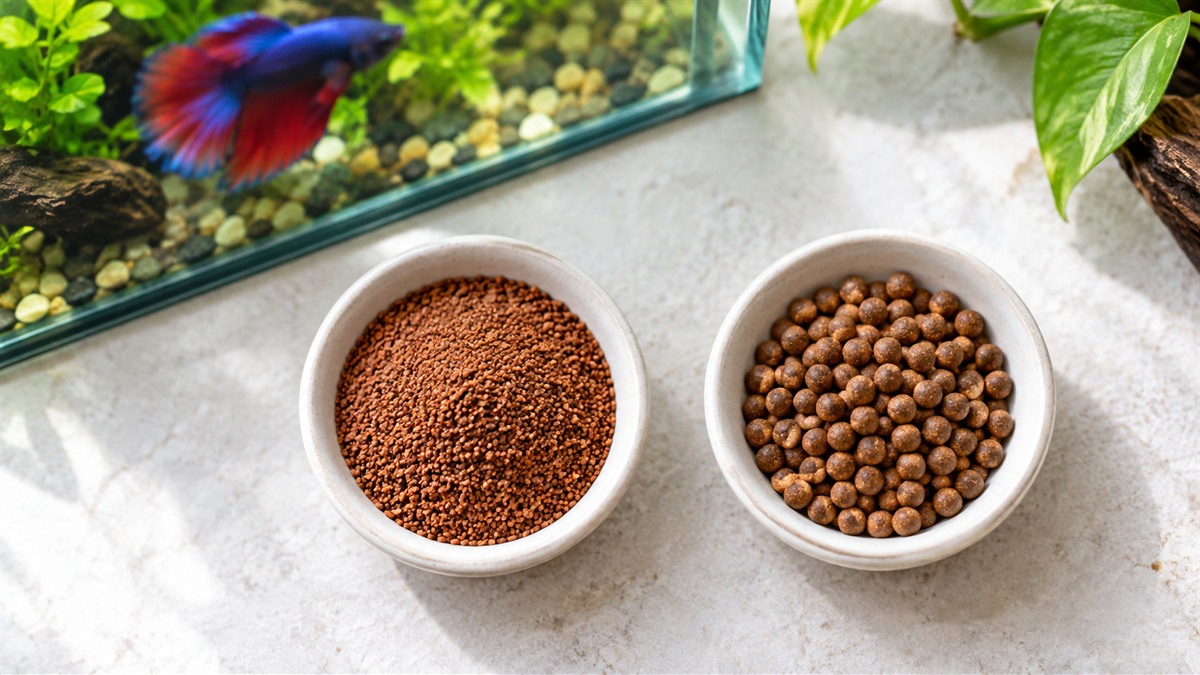
Choose pellets if you want a food made and labeled for bettas, a floating food, or a portion you can count. The Hikari Tropical Betta-BioGold Floating Pellets (0.7 oz) gives pellet counts by fish length, and the Tetra TetraBetta Floating Mini Pellets (0.15 oz, pack of 2) comes with a sliding feeder. Choose granules only if you already keep other small tropical fish or you prefer a slow-sinking food, and then use the TetraMin Tropical Granules (the one granule page that names bettas) or the Fluval Bug Bites Small Granules (the one that states a 0.7 to 1 mm size). Neither format is ruled out by the vet and extension sources we opened.
What the sources we opened say
The Illinois column, “Bettas Need More Than Bowls” by Beth Mueller (April 15, 2019, advice from Dr. Krista Keller), says bettas are carnivores that eat insects and larvae, and advises “a balanced pelleted or flaked food daily,” in an amount the fish can eat “within 3 to 5 minutes, without any food left over.” It adds that leftover food lowers water quality. The UF/IFAS publication Evolution, Culture, and Care for Betta splendens (FA212, no date shown) says commercial dry foods, flake and pellet, are available to hobbyists and warns against overfeeding and water fouling.
Neither says granules are better or worse. They simply do not cover them, so the comparison below rests on the listings.
How we chose
We picked the two granule foods whose pages say they suit small or shy fish (TetraMin, Fluval Small Granules) and the two betta pellets with the most specific feeding directions among those we had already opened for this site (Hikari and Tetra). Aqueon Tropical Granules, which names many other fish and no bettas, is covered in our granules buyer’s guide but left out here. We recorded size, float or sink behavior, directions and ingredients as stated, and we left out prices, ratings and review counts.
Head-to-head table
| TetraMin Tropical Granules | Fluval Bug Bites Small Granules | Hikari Betta-BioGold Pellets | Tetra TetraBetta Mini Pellets | |
|---|---|---|---|---|
| Pack on the page | 3.52 oz, pack of 2 | 1.6 oz, pack of 2 | 0.7 oz (20 g) | 0.15 oz, pack of 2 |
| Names bettas | Yes: “great for bettas, too” | No: “small breed adult fish” | Yes: “for betta fish” | Yes: betta formulation, “ideal for top-feeding bettas” |
| Size stated | No | 0.7 to 1 mm | Not as a number (the page calls them tiny) | Not as a number (“mini-sized”) |
| Sink or float | Slow-sinking | Slow-sinking | Floating | Floating |
| Direction | 2 to 3 times daily, as much as fish can consume in three minutes | As much as fish can eat in two minutes, 2 to 3 times daily | Pellet counts by length, one at a time, never more than 5 at a feeding | 2 to 3 times daily, as much as fish can consume within several minutes |
| Ingredients begin with | Fish meal, dehulled soybean meal, wheat germ meal | Black soldier fly larvae, salmon, fish protein concentrate | Fish meal, wheat flour, soybean meal | Wheat flour, fish meal, wheat gluten |
| Extras | Clear-water claim | No artificial fillers, colors or preservatives (maker’s claim) | Red 3 listed as artificial color | Sliding feeder included |
The four products
1. TetraMin Tropical Granules, 3.52 oz (pack of 2)
Specs (from the listing, checked 2026-10-18): model 16121; manufacturer Tetra; slow-sinking granules for mid-feeding tropical fish; “daily diet for small, juvenile or shy fish – great for bettas, too.”
Best for: a tank with more than one kind of small tropical fish where one food is easier. Skip if: your betta only eats from the surface or you want a size on the page.
View on Amazon (affiliate link)
2. Fluval Bug Bites Tropical Fish Food, Small Granules, 1.6 oz (pack of 2)
Specs (from the listing, checked 2026-10-18): model A6577; manufacturer Rolf C. Hagen (USA) Corp.; “slow sinking micro granule format (0.7-1mm)”; black soldier fly larvae (up to 40 percent) is the first ingredient; indications “Small Breed Adult Fish.”
Best for: someone who wants a stated granule size and an insect-based recipe. Skip if: you want a page that names bettas.
View on Amazon (affiliate link)
3. Hikari Tropical Betta-BioGold Floating Pellets, 0.7 oz (20 g)
Specs (from the listing, checked 2026-10-17): item model number 42055191104; indication “for betta fish.” Directions: for bettas under 1.5 inches (nose to the base of the tail, before the fins) Hikari suggests its separate Micro Pellets, 6 pellets twice a day; for bettas 1.5 to 1.75 inches, three Betta Bio-Gold pellets up to three times daily; add one pellet per quarter inch of growth, never more than 5 at one feeding; feed one pellet at a time and make sure each is eaten. Ingredients begin with fish meal, wheat flour, soybean meal; red 3 is listed as an artificial color.
Best for: an owner who wants to count pellets. Skip if: your betta is under 1.5 inches, since the directions point to a different Hikari product.
View on Amazon (affiliate link)
4. Tetra TetraBetta Floating Mini Pellets, 0.15 oz (pack of 2)
Specs (from the listing, checked 2026-10-17): model 77023; “mini-sized nutrient-rich floating pellets” described as “ideal for top-feeding bettas”; includes a sliding feeder; direction 2 to 3 times daily, only as much as the fish can consume within several minutes; ingredients begin with wheat flour, fish meal and wheat gluten.
Best for: a first small bag with a feeder. Skip if: you want a larger supply; 0.15 oz bags are small.
View on Amazon (affiliate link)
Where the formats actually differ
- Floating or sinking. Both pellets say floating, both granules say slow-sinking. The Illinois column warns that uneaten food sinks and lowers water quality, so a granule that sinks slowly is in the water longer if the fish misses it. The sources we opened do not say granules harm a betta; this is a question of leftovers.
- Counting. Hikari counts pellets. The granule pages give a time window instead. A count is easier to repeat than “as much as the fish can eat in two minutes.”
- Made for bettas. Three of the four pages name bettas as the intended fish. Only the Fluval page does not.
- Size. Only Fluval states a number (0.7 to 1 mm). The other three describe size in words or not at all.
Worked example. Take a betta that measures 1.6 inches by the Hikari method. The page says three pellets, up to three times daily, so a maximum of 3 x 3 = 9 pellets in a day, each one at a time. For the granules, a betta eating for three minutes three times (the TetraMin maximum) is 9 minutes of food in the water, and two minutes three times (Fluval) is 6 minutes. The Illinois column describes one feeding a day of 3 to 5 minutes. The pellet count has a ceiling you can see; the granule limit is a clock. Both can be too much for one fish, so begin with less than the maximum and remove leftovers.
Mistakes to avoid
- Treating the time window as an amount. Two minutes of a granule and three minutes of a pellet are not the same portion.
- Letting food pile up. A test kit that reads ammonia and routine tank cleaning are how you check whether you are feeding too much.
- Using the vet column as a granule endorsement. It names pellets and flakes only.
- Repeating health claims. Immunity, color and “no fillers” lines on these pages are the makers’ statements.
Who should skip this
If your betta eats its current food, leaves nothing behind and the water stays clear, there is no reason to change format. For a wider set of betta foods, see our betta food guide and the Hikari Betta Bio-Gold page. If your fish refuses food, ask an experienced fish keeper or an aquatic vet.
Frequently asked questions
Are granules or pellets better for a betta?
The sources we opened do not say. The Illinois column recommends pelleted or flaked food. Pellets have more betta-specific listings and floating options; granules appear mostly on general tropical-fish pages.
Do granules sink?
Both granule listings here say slow-sinking. Both pellet listings say floating.
Which format is easier to portion?
Hikari gives pellet counts by fish length, which is easier to repeat than a time window. The granule pages give two to three minutes of eating time.
Can I mix granules and pellets?
The sources we opened do not address mixing. If you try it, count it as one feeding and remove what is left.
How long should my betta eat each time?
The pages say two to three minutes (granules) or several minutes (Tetra pellets), and Hikari uses counts. The Illinois column says 3 to 5 minutes with nothing left over, once daily.
Conclusion
If you want a rule you can follow, pick a floating betta pellet and count it. If you want a granule for a mixed tank, pick TetraMin (names bettas) or Fluval (states a size), feed less than the maximum and watch the water. Either way, the choice is about directions and leftovers, not a proven winner.