Best Ultra Quiet Fish Tank Air Pump: 8 Models Compared
As an Amazon Associate we earn from qualifying purchases. Details
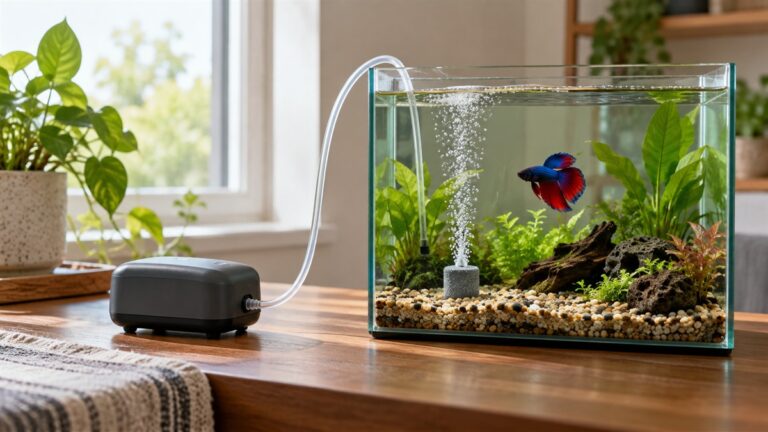
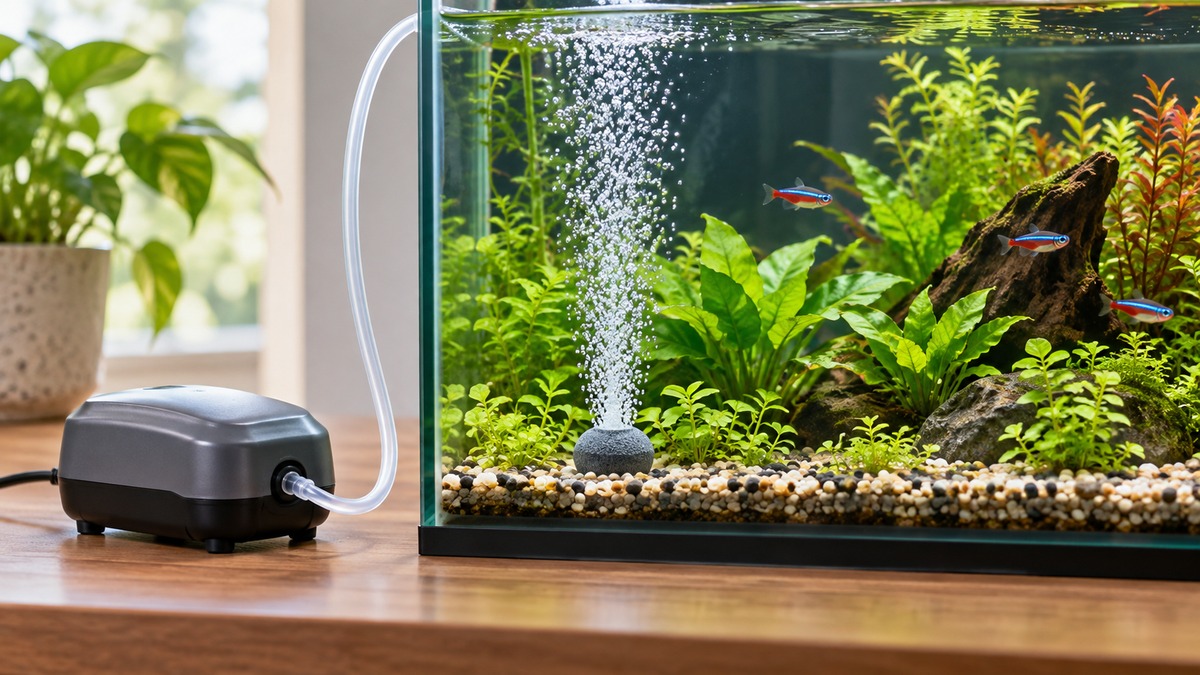
An ultra quiet fish tank air pump pushes air through an air stone, which adds surface movement and dissolved oxygen without a loud motor. This guide compares eight air pumps that suit small tanks, sorts them by how they make air and what their listings say about noise, and points out where listings contradict themselves. Air pumps in general have a moving part, such as a diaphragm or piston, so the word quiet on a listing needs a number behind it. Decibel figures, airflow units and placement rules separate one pump from another. Read those details before you look at the title.
Quick answer
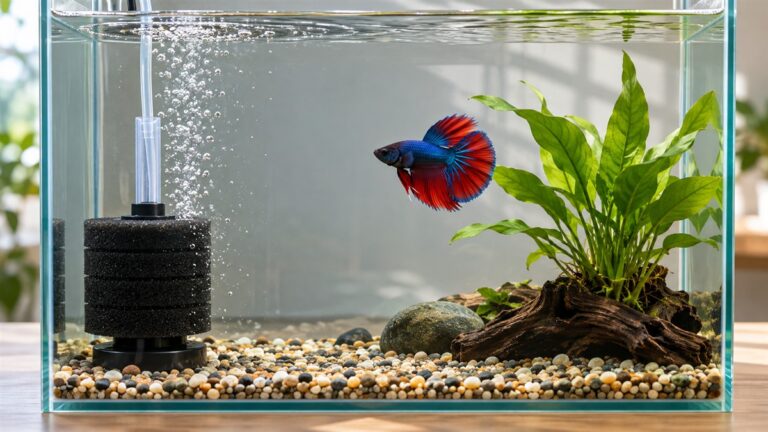
Pick the pump whose listing states a noise figure you can compare, at an airflow you can compare. For a small betta tank, check two numbers: the decibel figure and the airflow in one unit. Several listings give figures between 25 and 33 dB, while others give only words such as ultra quiet or super silent. Place the pump above the water line, or choose a model with a check valve if it may sit lower. Keep the tank heated, filtered and at least 5 gallons for one betta.
At a glance
Figures below are the ones stated in this post and its product listings.
| Listing | Stated noise level | Other stated figure |
|---|---|---|
| Pump listing A | 25 dB in low mode | 40 dB at highest airflow |
| Pump listing B | 33 dB or less | Written as a ceiling |
| Pump listing C | 30 dB for gentle aeration | Under 30 dB for operation in another listing |
| Pump listing D | Compares with traditional pumps above 55 dB | Airflow 1.5 liters per minute equals 25 GPH |
Noise figures are the listing’s own claims; check each listing before buying.
What matters for this keyword
Four details decide how an ultra quiet pump performs in a betta tank. The title rarely tells you any of them.
Decibel figures and what they cover
Only some listings give a decibel figure. One gives 30 dB for gentle aeration. Another gives 33 dB or less, written as a ceiling. A third gives 25 dB in its low mode and 40 dB at its highest airflow, and it compares that maximum with the hum of a refrigerator. A fourth says under 30 dB for its operation. Three listings give no figure at all. One listing compares itself with traditional pumps, which it says produce noise above 55 dB, and claims its own pump is nearly 40 percent lower, which is a relative claim rather than a reading. No listing explains how its noise was measured, so compare figures only when they come from the same kind of statement.
How the pump makes air
Listings describe two kinds of drive. Several describe a thin piezoelectric ceramic plate that vibrates to move air, and one of them says there is no motor at all. Others describe a floating motor with anti-vibration pads. The general fact still applies: air pumps contain a moving part, such as a vane, piston, impeller or diaphragm, to push air through the airstone. A ceramic plate still vibrates to push air, so the drive name alone does not settle the noise question. Judge silence by the decibel figure and the mounting, not by the drive name.
Airflow units and tank fit
Listings express airflow in gallons per minute, gallons per hour, liters per minute and milliliters per minute. Put every pump on one unit before you compare. Some listings are internally inconsistent. One lists its airflow as 7.1 gpm in one field and 7.1 GPH in a bullet. Those are different units for the same number, so the two figures cannot both be right, and you should rely on neither. Another lists 1.5 liters per minute and 25 GPH, and those agree. Size claims also conflict in places. One pump’s title says 20 gallons while its bullet says up to 15 gallons. Another’s title says 20 to 210 gallons while its bullet says up to 20 gallons.
Placement, check valves and sponge filters
Placement decides whether a quiet pump causes trouble. One listing says the pump must sit above the water surface and asks you not to lower it. Another describes a check valve that stops water flowing back into the pump when it sits below the water level. Check the included list before you buy, because a check valve is only useful if it comes in the box. One pump’s included list does not show a check valve at all. Also watch for conflicting advice about sponge filters. One listing says its pump is not suitable for sponge filters or protein skimmers, while a different listing names sponge filters as a use. If you plan to run a sponge filter, read those lines before you buy.
Power and running cost
Every pump in this group describes a plug-in power source, so none is a battery pump. Where listings give a figure, power draw runs from 1.3 watts to 1.5 watts. That gap is small, as the worked example below shows. A quiet pump still runs for hours each day, so its draw adds up over a month. Choose on noise and airflow fit rather than on watts alone.
How to choose
Choose by noise evidence first, then airflow fit, then placement and valves. These rules cover most decisions:
- Choose the pump with the lowest decibel figure you can compare when two pumps have similar airflow in the same unit.
- Choose a model with a check valve in the box if the pump may sit near or below the water line.
- Choose a model with a knob or regulating valve if you want to lower the airflow for a quiet room.
- Choose a model whose title, color field and bullets agree on size, or confirm the size on the product page before you buy.
- Choose a higher-airflow model only if you run more than one air stone or a sponge filter. A common rule of thumb is to match airflow to the number of air stones and filters you run.
Before you order, write down the decibel figure, the airflow in one unit, whether a check valve is included, and the maximum tank size. Put the four details side by side, and the better choice usually becomes clear.
When two pumps score about the same on noise and airflow, choose by the parts list. A pump that includes a check valve and tubing you can use as listed saves a second shopping trip. A pump that needs tubing cut to fit, or a separate check valve, can still work, but plan for those steps before the pump arrives.
1. Pawfly Nano Silent Aquarium Air Pump, Mini Bubbler with Accessories, 1.3 W Portable Oxygen Aerator (Lowest stated decibel figure)
Specs from the listing (checked 2026-10-11):
- Power Source: Corded Electric
- Horsepower: 1.3 watts
- Included Components: Air Tube Suction Cups2, Check Valve1, Air Stone1, Double-Sided Suction Cups1, Hooks1, 1m Air Tube1, Instruction Manual (6 Languages)*1
Pros
- Listing gives 30 dB for gentle aeration
- Includes a check valve that prevents back-siphoning, according to the listing
- Air stone, tubing and suction cups are listed as included
Cons
- Airflow is 7.1 gpm in one field and 7.1 GPH in a bullet, so rely on neither figure
- Listed for 1-3 gallon betta tanks, below the 5-gallon minimum this site sets for one betta
Best for: Keepers who want the lowest stated decibel figure in a small tank
Skip if: You need a figure in one airflow unit or a tank above 15 gallons
View on Amazon (affiliate link)
2. hygger 1.5 Watt Mini Aquarium Air Pump, Quiet Aerator with Air Stone Tubing Suction Cup Clip, Small (Piezo pump with 33 dB ceiling)
Specs from the listing (checked 2026-10-11):
- Air Flow Capacity: 420 milliliters_per_minute
- Maximum Pressure: 12 kilopascal
- Warranty Description: 2 Year Manufacturer
Pros
- Listing gives 33 dB or less, written as a ceiling
- Airflow is listed as 420 milliliters per minute in one unit
- Listing gives a two-year manufacturer warranty
Cons
- Listing says it is not suitable for sponge filters or protein skimmers
- No check valve appears in its included list, and the listing asks you to keep it above the water
Best for: Keepers with a tank of 5 gallons or more who keep the pump above the water line
Skip if: You plan to run a sponge filter or need a check valve in the box
View on Amazon (affiliate link)
3. AQUANEAT Aquarium Air Pump for 20-210 Gallon Tank, Fish Air Bubbler, Hydroponic Oxygen Aerator (Basic pump with no decibel figure)
Specs from the listing (checked 2026-10-11):
- Operation Mode: Automatic
- Connector Type: AC Plug
- Hose Length: 3.3 feet
Pros
- Four rubber feet are listed to limit sliding and noise
- Listing says it can run a small air stone, a sponge filter or a bubble ornament
- Kit includes tubing, a stone and a check valve
Cons
- Title says 20 to 210 gallons while a bullet says up to 20 gallons, so the size claim conflicts
- No decibel or airflow figure appears on the listing, so noise is judged by wording only
Best for: Keepers who want a basic pump for a small tank and accept a wording-only noise claim
Skip if: You need a decibel figure to compare, or a sponge filter at a larger tank size
View on Amazon (affiliate link)
4. HITOP 2W Single Outlet Aquarium Air Pump, 25GPH Fish Tank Aerator with Accessories, Quiet Oxygen (Compact pump with regulating valve)
Specs from the listing (checked 2026-10-11):
- Air Flow Capacity: 1.5 liters per minute
- Wattage: 2
- Warranty Description: 1 Year Manufacturer
Pros
- Regulating valve included to adjust air volume
- Listed as 25 GPH, or 1.5 liters per minute, in two matching units
- Listing says it comes with 12-month after-sales service
Cons
- Setup asks you to cut the air tube to fit the regulating valve
- Quietness is described with words such as super silent, with no decibel figure
Best for: Keepers who want an adjustable small pump with accessories in the box
Skip if: You do not want to cut tubing during setup
View on Amazon (affiliate link)
5. Nano Ultra Quiet Aquarium Air Pump 1.5W Mini Oxygen Aerator with Accessories for 1-15 Gallon Fish (Piezo pump with relative noise claim)
Specs from the listing (checked 2026-10-11):
- Air Flow Capacity: 500 milliliters_per_minute
- Maximum Pressure: 12 kilopascal
- Hose Length: 1 meters
Pros
- Listing gives 500 milliliters per minute of airflow
- Includes a safety check valve, according to the listing
- Listing gives a 1-meter air tube
Cons
- Noise claim is relative: nearly 40% lower than traditional pumps above 55 dB, with no own decibel reading
- Item count reads 8 in one field and 1 Count in another, so the box contents are unclear
Best for: Keepers who want a piezo drive with a check valve in the box
Skip if: You need a decibel number to compare against other picks
View on Amazon (affiliate link)
6. Uniclife Aquarium Air Pump Dual Outlet Fish Tank Aerator with Accessories for 5-200 Gallon Tank (Dual outlet with low mode)
Specs from the listing (checked 2026-10-11):
- Air Flow Capacity: 0.5 gpm
- Maximum Pressure: 16 kilopascal
- Hose Length: 3.2 feet
Pros
- Listing gives 25 dB in the Low mode
- A rotary knob controls the amount of air
- Includes one air stone disc, 3-foot tubing, one check valve and two connectors
Cons
- Maximum noise is 40 dB at the highest airflow, which the listing compares to a refrigerator hum
- Title says 5-200 gallon tanks, while the color field and a bullet say 5 to 30 gallons, so the size claim conflicts
Best for: Keepers with a bedroom tank who run the pump on its Low setting
Skip if: You need the largest airflow for a bigger tank
View on Amazon (affiliate link)
7. AQUASMITH Aquarium Air Pump,Ultra-Quiet/Small Size/More Output Air Pump for Fish Tank (Knob-controlled model with a range)
Specs from the listing (checked 2026-10-11):
- Air Flow Capacity: 1.8 liters per minute
- Maximum Pressure: 14 kilopascal
- Operation Mode: Manual
Pros
- Listing gives under 30 dB operation with a floating motor
- A knob controls airflow without unplugging
- Listing describes a visual guide for a 3-minute setup
Cons
- Title shows 29GPH, while a bullet lists 16, 29, 57 and 80 GPH models, so check which model you buy
- Names a 2-80 gallon range without saying which model covers which size
Best for: Keepers who want a decibel-described pump with an airflow knob
Skip if: You want one clear model size with no model list to read
View on Amazon (affiliate link)
8. JOR 1.3W Aquarium Air Pump, Aerator with Accessories for 20-gal Fish Tank (Piezo nano pump with suction cup)
Specs from the listing (checked 2026-10-11):
- Air Flow Capacity: 450 milliliters_per_minute
- Maximum Pressure: 12 kilopascal
- Hose Length: 39.4 inches
Pros
- Listing gives 450 milliliters per minute of airflow
- Describes a thin piezoelectric ceramic plate for quiet running
- Kit includes a suction cup, two air stones and two silicone air tubes
Cons
- Title says 20-gal tank while a bullet says up to 15 gallons, so the size claim conflicts
- No decibel figure appears; quiet is described in words only
Best for: Keepers with a 15 to 20 gallon tank who want a suction-cup pump
Skip if: You need a decibel figure or a tank above 20 gallons
View on Amazon (affiliate link)
Setup checklist
- Place the pump above the water line, on a dry surface near the tank.
- Attach the tubing and the air stone. If the pump has a knob, set it low for a bedroom tank.
- If the pump may sit lower than the water, confirm that a check valve is in the box before you connect anything.
- Run the pump and watch for steady bubbles. Adjust the knob slowly rather than all at once.
- Clean the air stone as its listing directs, and keep the tubing free of kinks so the airflow stays steady.
For a betta, the how big of a tank do betta fish need guide explains why tank size should come before equipment choices.
When you may not need one
Some tanks already get enough surface movement from the filter outlet, and an extra pump then adds noise without adding much. Before you buy, look at what the tank already does. If your filter gives steady surface movement and you do not plan to run a sponge filter, a pump is a helpful extra rather than a need. If you do plan to run a sponge filter, the pump becomes part of that setup, because one listing names sponge filters as a use and the sponge-filter lines decide which pumps fit. If you are still comparing quiet options, the best most silent air pump for aquarium guide is a related search. If a pump you already own stops producing bubbles, the best aquarium air pump not working guide is the place to look next.
Worked example: a month of running time
- Running time: 12 times 30 equals 360 hours.
- The 1.3-watt pump uses 1.3 times 360 equals 468 watt-hours.
- The 1.5-watt pump uses 1.5 times 360 equals 540 watt-hours.
- The difference is 540 minus 468 equals 72 watt-hours over the month.
That gap does not justify a choice on watts alone. Choose on noise and airflow fit, then on whether the pump includes a check valve.
Mistakes to avoid
Treating ultra quiet as a measurement. That phrase is marketing wording. Compare the decibel figure a listing gives, not the adjective.
Mounting the pump below the water line without a check valve. Keep the pump above the water, or choose a model with a check valve in the box.
Ignoring units. Comparing gpm, GPH and milliliters per minute side by side without converting them to one unit leads to a wrong pick.
Buying a pump rated for 1 to 3 gallons for a betta tank. This site’s rule is a heated, filtered tank of at least 5 gallons for one betta, so a pump rated only for small tanks is a poor fit even if it is quiet.
Leaving the airflow at maximum in a bedroom tank. One listing gives 40 dB at its highest airflow. If sound matters, turn the knob to a lower setting.
Forgetting that a pump runs continuously. A small difference in watts adds up over a month, which the worked example below shows.
Assuming any pump works with a sponge filter. Read the sponge-filter lines on the listing before you pair them, because the listings give conflicting advice.
FAQ
How quiet is an ultra quiet fish tank air pump?
Listings give different figures: 30 dB, 25 dB on low, 33 dB or less, and under 30 dB. Compare numbers only when they come from the same kind of statement. A listing with no figure can still be quiet, but you cannot check it against the others.
Does a piezoelectric pump make no sound?
No listing in this group gives a figure of zero noise. Listings describe a piezoelectric ceramic plate that vibrates to move air, so the decibel figure is the number that helps you compare. Judge the pump by that figure, not by the drive name.
Can I run this kind of pump on batteries?
The pumps in this group describe plug-in power, and none lists a battery backup. Plan for a power cut separately if you need one.
What airflow does a betta tank need?
A common rule of thumb is to match airflow to the air stones and filters you run, not to the tank size alone. A betta tank with one air stone needs less airflow than a tank with several stones or a sponge filter. Convert the listing’s airflow to one unit before you compare.
Where should the pump sit?
Above the water line is the simplest rule, and one listing says so directly. Another describes a check valve that stops water flowing back into the pump when the pump sits below the water level. That feature helps if you cannot keep the pump above the water.
Is a small pump enough for a betta?
A pump adds surface movement and oxygen, but it does not replace a heater or a filter. This site recommends a heated, filtered tank of at least 5 gallons for one betta. Bettas tolerate low oxygen thanks to the labyrinth organ, according to the cited encyclopedia entry, so a pump is a helpful extra rather than a substitute for good care.
Which pick should I start with?
Start with the pick that has the lowest stated decibel figure at an airflow you can compare. Then confirm the check valve and the tank size before you order.
Bottom line
Start with the decibel figure the listing gives, convert every airflow figure to one unit, then check the valve and the size line. Keep the pump above the water or choose a model with a check valve. A pump rated for 1 to 3 gallons does not fit the 5-gallon minimum this site sets for one betta. When two picks are close, take the one whose listing gives plain numbers over the one that gives only adjectives.
Sources
- Air pump, Wikipedia: air pumps push air through an airstone and contain a moving part such as a vane, piston, impeller or diaphragm
- Siamese fighting fish, Wikipedia: bettas take in surface air through a labyrinth organ and tolerate low oxygen
Bài viết liên quan: Best Ultra Quiet Fish Tank Air Pump, Best Betta Fish Pump: Quiet Air Pumps Compared, Best Aquarium Fish Tank Oxygen Air Pump: 7 Picks Compared.