Best 5 Gallon Sponge Filter: What to Check Before You Buy
As an Amazon Associate we earn from qualifying purchases. Details
A 5 gallon sponge filter pulls water through a sponge, cleans it, and returns it to the tank with a gentle current. For a betta, that design is a good fit, because the flow can be soft and the sponge gives beneficial bacteria a place to live. This guide explains how to check the size range on a listing, how flow and power type change the choice, and how to keep the sponge working. The picks below come from the listings in this group, and each is described by what its listing says.
Quick answer
Choose a sponge filter whose size range includes 5 gallons with some room to spare. A range that stops right at 5 gallons leaves no margin for a tank that is slightly over its label. Check whether the flow is adjustable, and whether the filter needs an air pump or a power outlet. Confirm the sponge and any other media you will need to replace. Avoid any listing that suggests a size far above your tank, because a filter sized for 10 to 20 gallons may run stronger than a betta needs.
What a sponge filter does
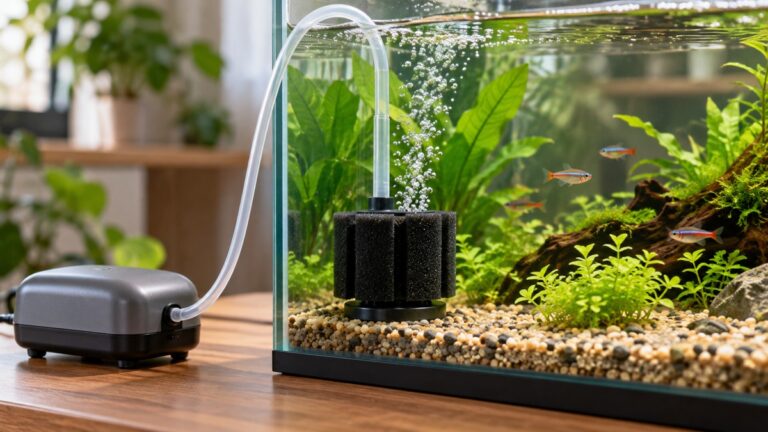
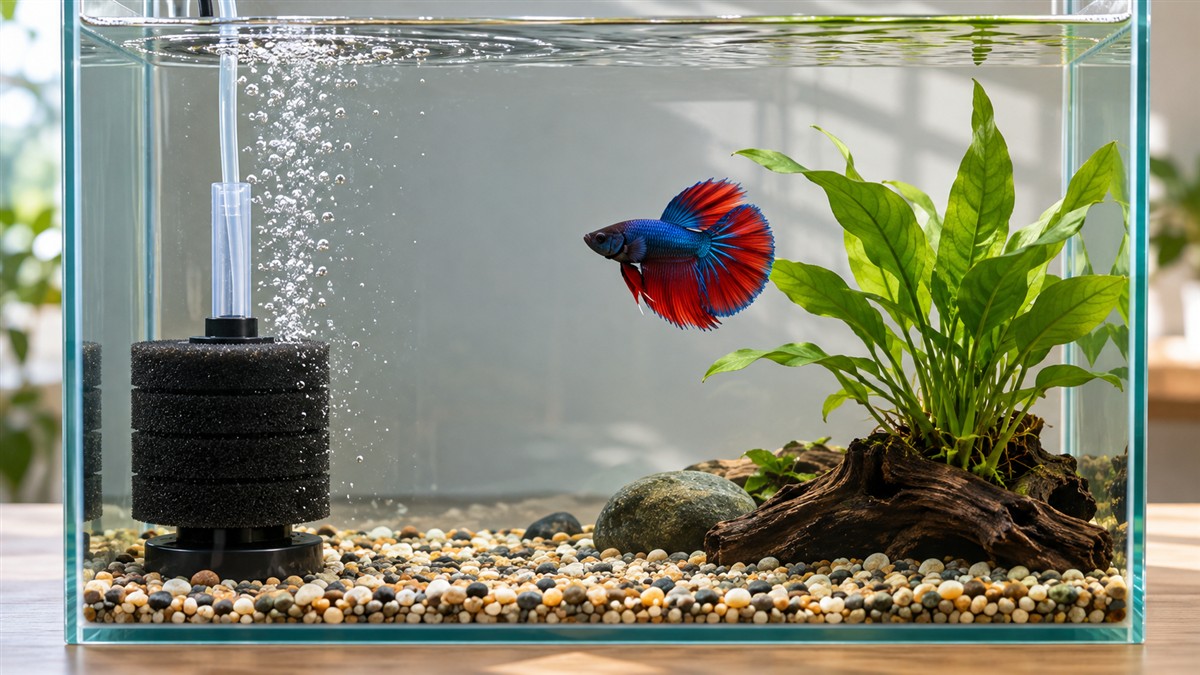
A sponge filter moves water through a porous sponge. Debris stays in the sponge, and the bacteria that break down waste grow on it. The water then flows back into the tank through an outlet. This design can be gentle, and it is a common choice for small fish tanks because it is simple to clean and easy to place.
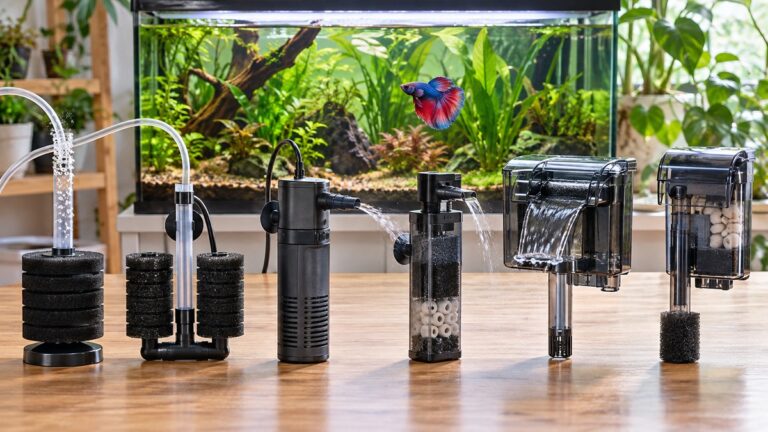
Sponge filters come in two broad types. An air-driven sponge filter uses an air pump to pull water through the sponge. An electric sponge filter has a small submersible pump built into the unit. The listings in this group include both kinds, and the difference matters for setup, noise and upkeep.
Air-driven and electric types
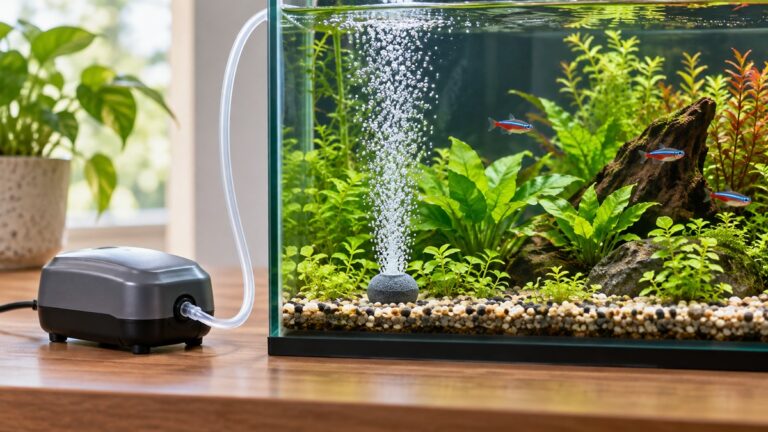
An air-driven sponge filter depends on the air pump. Wikipedia describes an air pump as a pump for pushing air, and it says that aquarium pumps supply air through an airstone. The pump has a moving part that creates a low-pressure area, which pulls in more air. Keep that in mind when you plan an air-driven filter: the pump is a separate machine that needs power and its own maintenance.
An electric sponge filter does not need a separate air pump. It plugs into power, and its built-in pump draws water through the sponge. The listings in this group describe electric sponge filters that can be placed in the tank with suction cups and that run without an air line. The trade-off is that the outlet must be near the tank.
Why 5 gallons changes the choice
A 5 gallon tank is the smallest size this guide recommends for a single betta. The filter’s size range has to cover that tank, with enough margin that the filter does not sit at the very edge of its rating. A range that tops out at exactly 5 gallons works, but it gives you no room if your tank holds slightly more water or if you expand the setup later.
For the wider question of whether a 5-gallon tank suits one betta, see is a 5 gallon tank good for a betta.
Some listings in this group give a size range far above 5 gallons. A filter sized for 10 to 20 gallons can work in a 5-gallon tank, but it may run stronger than a betta prefers. Check the flow and the adjustment before you decide.
1. 5-in-1 Aquarium Submersible Filter for 3-5 Gallon Fish Tank Ultra-Quiet Small Internal Aquarium (3-5 gallon sponge and quartz filter)
Specs from the listing (checked 2026-10-11):
- Size: S
- Item Weight: 9.1 ounces
- Included Components: rain pipe
Pros
- The listing sizes the filter for 3 to 5 gallons, which covers a 5-gallon tank
- The listing describes a reusable black sponge and quartz balls as filter media
- The listing describes a 3W motor with an 80 GPH flow rate
Cons
- The size range tops out at 5 gallons, so the filter has no margin above the site's floor
- The listing does not state whether the flow is adjustable
Best for: Owners with a 5-gallon tank who want a submersible sponge filter with reusable media.
Skip if: You want a size range with room above 5 gallons, or you need a confirmed flow control.
View on Amazon (affiliate link)
2. Aquarium Filter for 5-10 Gallon Tank – Ultra Quiet Submersible Filter Pump, 4W Energy Efficient (5-10 gallon filter with knob)
Specs from the listing (checked 2026-10-11):
- Horsepower: 4 watts
- Included Components: Filter body, Pump, Filter sponge, Oxygenation tube, Regulating valve
- Maximum Lifting Height: 2 feet
Pros
- The listing includes a regulating valve and a filter sponge in the parts list
- The listing describes an adjustable knob for water flow
- The listing gives 4 watts and a 105 GPH flow rate
Cons
- The title says 5 to 10 gallons, while a bullet says 3 to 15 gallons, so confirm the size range before you buy
- The listing gives no flow setting numbers for the knob
Best for: Owners with a 5-gallon tank who want an adjustable knob and a sponge filter with an oxygenation tube.
Skip if: You need the listing's size range to be consistent, or you want a flow setting in numbers.
View on Amazon (affiliate link)
3. AQQA Internal Aquarium Filter for 2-10 Gallon Tank, Adjustable Flow (2-10 gallon sponge and carbon filter)
Specs from the listing (checked 2026-10-11):
- Size: Medium 79 GPH for 2-10 Gallon
- Item Weight: 14.9 ounces
- Included Components: 1* Rain Bar Outlet, 1* Replacement filter Cartridge, 1* User Manual, 1*Aquarium filter
Pros
- The listing describes a bottom water intake that it says keeps the motor submerged during evaporation
- The listing describes a high-density sponge with activated carbon for dual filtration
- The listing says the flow control valve works with a 79 GPH pump, and the noise is below 30 dB
Cons
- The included replacement cartridge is a consumable part, and the listing does not state how often to replace it
- The listing does not say the flow control reaches a very gentle setting
Best for: Owners with a 5-gallon tank who want a sponge and carbon filter with a flow control and a wide size range.
Skip if: You want a sponge-only filter with no carbon, or you need a stated minimum flow setting.
View on Amazon (affiliate link)
4. Aquarium Electric Sponge Filter with Submersible Water Pump Silence Motor for Shrimps,Bettas (Venturi sponge filter for 10-20 gallons)
Specs from the listing (checked 2026-10-11):
- Size: 10 to 20 Gallons
- Included Components: sponge filter
- Specific Uses for Product: Bettas, Fry, Nanos, Shrimps, small fish
Pros
- The listing describes a Venturi nozzle and rain mode that it says are gentler for fry and shrimp
- The listing says no separate air pump is needed
- The listing describes physical and biochemical filtration with ceramic media balls
Cons
- The listing suggests a 10 to 20 gallon tank, so a 5-gallon tank is below its suggested range
- The listing says the filter plugs into a power source, so an outlet must be near the tank
Best for: Owners who want a gentle Venturi outlet and can run the filter in a tank larger than 5 gallons.
Skip if: Your tank is 5 gallons and you do not want to run a filter above its suggested range.
View on Amazon (affiliate link)
Flow and the turnover number
Filter flow is often given in gallons per hour, or GPH. A common rule of thumb is to divide the flow by the tank volume, which gives the number of turnovers per hour. That number is a planning tool, not a welfare rule. For a betta, a strong turnover can be too much, even when the number looks ideal for a community tank.
For a betta, the more useful question is whether the current is gentle. Look for a flow control, a sponge outlet, or a diffuser that softens the stream. If the listing gives only a flow rate and no control, note that the flow is not confirmed as adjustable, and check the manufacturer’s manual before you rely on it.
How to choose a 5 gallon sponge filter
Use these rules before you compare individual listings.
Check the size range first
The range should include 5 gallons and leave some margin. A listing that says 3 to 5 gallons has its top at 5. A listing that says 2 to 10 gallons has room above your tank. A listing that says 10 to 20 gallons is sized for a larger tank.
Check the power type
Decide whether you want an air pump or an electric pump. An air-driven filter needs a pump and an air line. An electric filter needs an outlet near the tank. Each one changes where the equipment sits and how you run the tank.
Check the flow control
Look for a flow control valve, a dial, or a choice of outlets. The listings in this group describe different options. Some describe a dial or a regulating valve. Others describe outlets such as a rain bar, a Venturi nozzle or a duckbill nozzle. An outlet choice is not the same as a dial, so read the listing carefully.
Check the media
Sponge filters use a sponge, and many also use carbon, quartz balls or ceramic bio-media. Read which media come in the box, and check how often the listing says to replace each one. A carbon part needs replacing on its own schedule, and a sponge can be rinsed and reused.
Check the noise claim
Listings often describe a filter as quiet, and some give a decibel figure. The figure is the manufacturer’s claim, and this guide does not verify it. Read the claim, and use it as one input among the size range, power type and flow control.
Worked example: turnover at 80 GPH
That gives 80 divided by 5, which equals 16 turnovers per hour. Many owners find that number high, and for a betta, the goal is a gentle current, not a high turnover. This is why flow control matters more than the headline number.
Now suppose you rinse the sponge every two weeks. Over a 90-day period, that is 90 divided by 14, which equals about 6.4 rinses. Round that to six or seven rinses, and mark them on your calendar. Keep the rinse water in a small container of tank water, not tap water, because several listings in this group say to rinse sponges in aquarium water.
The lesson is that flow and upkeep both shape the filter’s real effect. Choose a filter with a flow you can control, and plan the cleaning so the sponge does not clog and change the current without warning.
Setting the filter up
Read the directions before the first run. One listing in this group says the filter must be completely immersed in water for use, and that rule applies to many submersible designs. Fill the tank to the level the listing recommends, place the filter so its intake and motor are under water, and plug in only after the unit is fully submerged.
Place the suction cups on a clean, dry part of the glass, and check that they hold before you walk away. Many listings in this group describe suction cups as the way the filter stays in place, and a loose cup can let the unit shift. Check the outlet, too. If it points straight at the spot where your betta rests, adjust the angle or the flow control.
Run the filter for a day or two before you add the fish, so you can hear the motor and check the flow. A filter that is loud, vibrates or changes its flow on its own needs attention before it is used with a live betta.
Keeping the sponge working
A sponge filter works because bacteria live on it. UF/IFAS notes that nitrifying bacteria need oxygen and alkalinity to function. If those needs are not met, the bacteria can stop working, and ammonia and nitrite can rise. A sponge filter in a new tank is part of the same process, so it needs time to mature, just as a new biofilter does, which UF/IFAS says takes six to eight weeks.
Rinse the sponge when the listing says to rinse it, and use aquarium water for the rinse. Do not rinse every part at once. Keep part of the old media in the filter when you clean, so the bacteria have a place to stay. Replace parts only on the schedule the listing gives, and write each date down.
Mistakes to avoid
Most sponge filter problems come from skipping the details on the listing.
Choosing by size label alone
A filter that says it fits your tank can still be a poor fit if the range leaves no margin. Check the top of the range, not only the word that matches your tank.
Assuming the air pump is included
Several air-driven listings in this group say the pump is sold separately or must be added. Read the included parts before you order.
Ignoring the outlet placement
An air-driven filter needs an air line route. Plan where the equipment sits before you set the tank.
Rinsing in tap water
Several listings say to rinse the sponge in aquarium water, not tap water. Keep rinse water from the tank, and avoid soaking the sponge in tap water.
Letting a sponge clog
A clogged sponge can change the flow without warning. Check the sponge on your regular schedule, and rinse it when the listing says to rinse it.
FAQ
Is a sponge filter good for a 5 gallon betta tank?
It can be. A sponge filter is generally gentle, and it gives bacteria a place to grow. Choose one whose size range covers 5 gallons with some margin, and check whether the flow can be controlled.
Do I need an air pump for a sponge filter?
Not always. Air-driven sponge filters need an air pump. Electric sponge filters have a built-in pump and plug into power. Check the listing before you buy.
What size range should I look for?
Look for a range that includes 5 gallons with room above it. A range that stops at 5 gallons leaves no margin. A range that starts at 10 gallons is sized for a larger tank.
Is a higher GPH better for a betta?
Not necessarily. A high flow can be too strong for a betta. The common rule of thumb gives turnovers per hour, but for a betta the goal is a gentle current. Check the flow control.
How often should I rinse a sponge?
Follow the listing’s routine. Some listings say to rinse a sponge every two to four weeks, and others describe a replacement every few months. Rinse in aquarium water, not tap water.
Does a sponge filter remove ammonia?
This guide does not claim a specific removal rate. The bacteria on the sponge help with the biological cycle, which UF/IFAS describes as taking six to eight weeks to build in a new biofilter. Test the water to see the result.
Should I use a filter sized for 10 to 20 gallons in a 5 gallon tank?
Only with care. The listing suggests a larger tank, so check the flow and the adjustment before you use it. A filter that runs stronger than a betta prefers should be turned down or swapped.
For more filter options, see the best water filter for betta fish guide, and the best small sponge filter with air pump guide.
Bottom line
For a 5 gallon betta tank, choose a sponge filter whose size range includes 5 gallons with margin, and check the flow control before you buy. Decide between an air pump and an electric pump, and confirm what media the listing includes. Plan the rinse schedule, rinse in aquarium water, and treat the headline flow number as a planning figure, not a welfare rule.
Sources
- Air pump, Wikipedia: an air pump pushes air, aquarium pumps supply an airstone, and all air pumps contain a moving part that creates a low-pressure area.