Best Aquarium Water Treatment Kit for a Betta Tank
As an Amazon Associate we earn from qualifying purchases. Details
An aquarium water treatment kit is a set of products meant to make tap water and tank water safer for fish. Many shoppers expect a single box that handles everything, but the listings in this group do not agree on what a treatment is. Some are water conditioners for tap water. Others are full starter tanks with filters and heaters. This guide sorts those product types, explains what each one can and cannot do for a betta, and names the single conditioner that fits the keyword. Read the quick answer first, then the water change and biofilter sections.
Quick answer
A water treatment kit, in practice, is a water conditioner used during water changes and when adding fish. The API Stress Coat listing is the only conditioner in this group, so it is the only pick here. Starter tanks that come with filters and heaters are a different product type, so they are not picks for this keyword. Water changes and a steady biofilter do more than any single bottle. Use the conditioner for new water and new fish, test your water on a schedule, and read the label before every dose.
What a treatment product can and cannot do
A treatment product changes some properties of water. It does not replace the biological work that keeps a tank stable over time. The University of Florida IFAS guide on ammonia makes this point clearly. It says water changes and ammonia-binding products can reduce ammonia toxicity in the short term, but that a properly designed and sized biofilter is the better long-term answer.
That short-term versus long-term split should shape your buying decision. A conditioner helps with the water you add. A filter and a healthy colony of bacteria handle the waste that builds up between changes. If you are tempted to buy a treatment to fix a tank that is already cloudy or smelly, start with the readings and the basic routine first.
Water changes come first
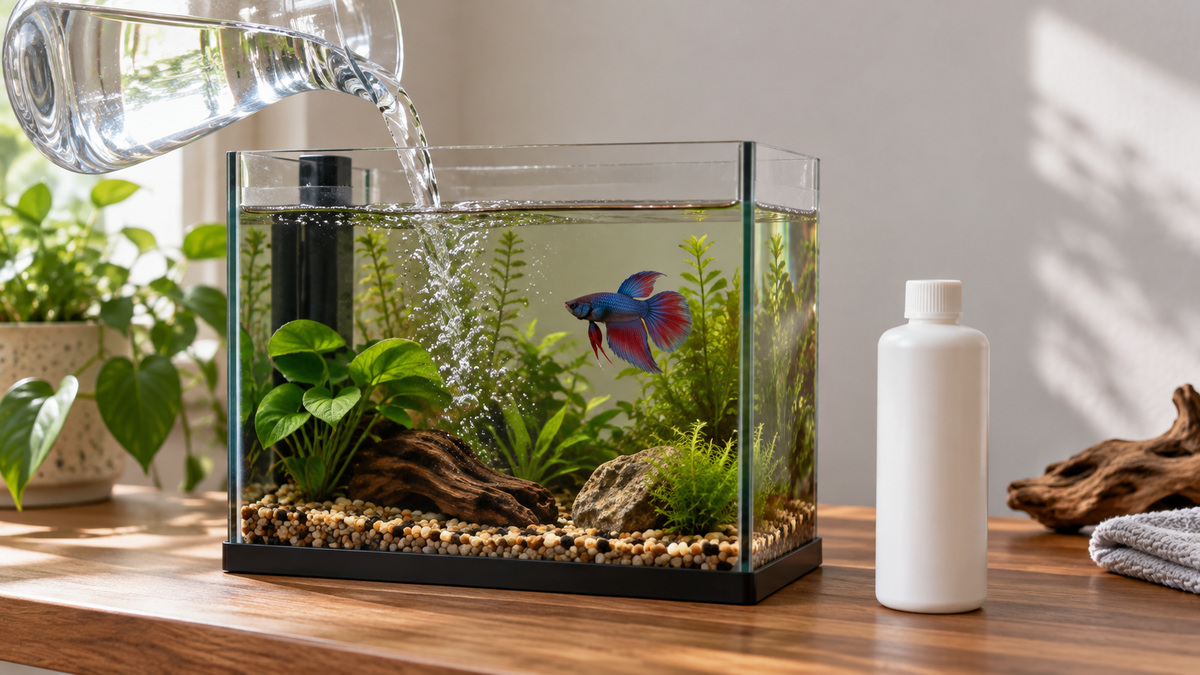
Regular water changes remove waste and refresh the water in the tank. The IFAS guide lists water changes among the short-term ways to reduce ammonia toxicity. A change does not need a special product to be useful, but the water you add should be treated before it reaches the fish. That is where a conditioner earns its place.
Use the same routine each week, and note the date and the amount you changed. A conditioner is one step in that routine, not a substitute for it. Keep your container clean, and do not add water that is hotter or colder than the tank without letting it adjust first.
Before each change, work through a short checklist. Confirm the tank readings from your last test. Decide how much water to remove, and make sure the new water is ready. Treat the water you add, wait for the mix to settle, and then check that the fish are behaving normally. Write the outcome in your log, so you can compare it with the next change.
A change that is too large can be as hard on a tank as a change that is too small. The safest pattern is a steady, moderate change on a fixed schedule, adjusted by your test results. Avoid large swings in temperature, because the water you add should be close to the tank temperature before it goes in.
Conditioners treat the water you add
The API Stress Coat listing says it removes chemicals from tap water that are harmful to fish. It also says to use the product when adding or changing water and when adding new fish. The listing does not name the chemicals it removes, so ask the maker or read the label if you need a specific answer for your tap water. The listing also claims an aloe vera extract replaces the protective coat on fish. That is a marketing claim. It is not a medical treatment.
For the timing of conditioner use, see when to add water conditioner to a fish tank. The same page is useful if you are unsure whether to dose before or after a change.
Biofilter and time
A biofilter is the colony of bacteria that breaks down ammonia and nitrite. The IFAS guide states that nitrifying bacteria need oxygen and alkalinity to function. If oxygen falls too low, the bacteria can stop working or die, and ammonia and nitrite levels rise. The same guide states that a new biofilter needs six to eight weeks to build up enough bacteria to reduce ammonia and nitrite effectively.
That timing is the reason a new tank can look fine and then swing. A treatment product cannot shorten that build-up. Test your water during those weeks and do not rely on a single bottle to carry the tank.
Medications and beneficial bacteria
Some disease treatments can harm the bacteria in a biofilter. The IFAS guide states that some treatments, especially antibiotics, can harm nitrifying bacteria. If a fish is sick or injured, do not treat it on the strength of a conditioner listing. Consult an experienced fish keeper or an aquatic vet, and follow the instructions they give you for any medicine.
Which product type fits this keyword
Three product types appear in this group, and only one of them is a treatment in the sense of this keyword.
Water conditioners are small bottles dosed by volume. They are used during water changes and when new fish arrive. The API Stress Coat listing is the only conditioner here.
Starter tanks are full setups with a tank, a filter, lighting and sometimes a heater. Several starter kits in this group describe themselves as complete betta sets. They are tanks, not treatment products, so they are not picks for this keyword. If you need a tank, see what size aquarium a betta fish needs before you buy one.
Test kits are the third type. They tell you what is happening in the water, but they do not change it. Pair any conditioner with a test routine, and read the freshwater fish tank water test kit guide if you need a testing option.
Products that fit this
Only one listing is a treatment product for this keyword. Its listed item weight is 6.4 ounces, and its product dimensions are 5 x 1 x 5 inches. Its card below states what the listing says about its dose, uses and components.
1. API Stress Coat Aquarium Water Conditioner 16-Ounce Bottle (Conditioner for water changes)
Specs from the listing (checked 2026-10-11):
- Liquid Volume: 0.48 liters
- Item Form: Liquid
- Unit Count: 16 Ounce
- Pet Type: Fish
- Allergen Information: Apple Free
Pros
- The listing says it removes chemicals from tap water that are harmful to fish.
- The listing gives a dose of 5 ml for each 10 gallons of aquarium water.
- The listing says to use it when adding or changing water and when adding new fish.
Cons
- The listing does not name the specific chemicals it removes from tap water.
- The listing does not state a shelf life for the bottle once it is opened.
- The aloe vera claim is marketing wording in the listing and is not a treatment plan for a sick fish.
Best for: Keepers who change tap water for a betta tank and want one conditioner for water changes and new fish.
Skip if: You want a disease treatment or a product for a sick fish; for that, consult an experienced fish keeper or an aquatic vet.
View on Amazon (affiliate link)
How to choose
Choose a water conditioner if your main need is treating tap water during water changes and when you add fish. The API Stress Coat listing gives a clear dose and a clear list of uses.
Choose a full starter tank if you do not yet have a tank, but know that it is a different product type. Check the tank volume, the filter, the heater and the lighting before you buy, and read the listing’s own notes about usable water.
Choose a test kit if you want to know what is happening in the water before you treat it. A conditioner cannot tell you whether ammonia is rising. A test can.
Skip the search for a single bottle that claims to do everything. The IFAS guide’s short-term and long-term split is a better guide. Use the conditioner, the water change routine, the test schedule and the biofilter together.
Read the bottle before every dose. Labels differ, and the number on a listing is only a starting point. Follow the printed label for the tank volume you actually have.
Worked example: dosing a conditioner for a 15 gallon tank
This example uses hypothetical numbers only. We apply the label’s ratio to a tank of that size.
Step 1. Find the number of 10-gallon units: 15 divided by 10 equals 1.5.
Step 2. Multiply by the label dose: 1.5 times 5 equals 7.5 ml.
Step 3. Check the result by working backward: 7.5 divided by 5 equals 1.5, which matches the tank size divided by 10.
Round to the nearest measure your cap or dropper allows, and read the label again before you pour. A dose calculated from a ratio is still only a guide. If the bottle’s own instructions differ, follow the bottle.
The example also shows why the tank’s real volume matters. A tank rated by the maker’s total capacity may hold less water once décor and substrate are in place. Measure the water you actually add, not the number on the box, before you dose.
Mistakes to avoid
Treating the conditioner as a fix for a dirty or unstable tank is the first mistake. A bottle does not remove waste that is already in the water. Test the water and change part of it first.
Dosing for the tank’s total capacity instead of the water you add is the second. Decorations and substrate take up space, so the water volume is lower than the box suggests. Measure what goes in.
Skipping the test schedule is the third. The IFAS guide recommends weekly ammonia tests in a production system and an immediate test when fish appearance or behavior changes, including reduced feeding. A home tank is not a production system, but the timing logic still helps.
Using a treatment during a new tank’s build-up without testing is the fourth. A new biofilter needs six to eight weeks. Early readings can swing, and a treatment does not shorten that period.
Using a disease product with a biofilter in place is the fifth. Ask an experienced fish keeper or an aquatic vet before you combine treatments with a working filter.
Trusting marketing claims over the label is the last. The aloe vera claim on the conditioner listing is not a treatment plan. Read the printed use instructions and follow those.
FAQ
Do I need a water treatment kit for a betta tank?
You need a way to make the water you add safe, and a conditioner is the simplest tool for that. You also need a filter, regular water changes and a test routine. A conditioner alone does not complete the setup.
Can a conditioner replace a water change?
No. The IFAS guide lists water changes as a short-term way to reduce ammonia toxicity, and a conditioner does not remove waste that is already in the tank.
When should I use a conditioner?
The API listing says to use it when adding or changing water and when adding new fish. Dose the new water, not the whole tank, unless the label says otherwise.
Is a starter tank a water treatment kit?
No. A starter tank is a full setup with a tank, a filter and lighting. Treat it as a tank purchase, and check the tank volume and the filter before you buy.
Can a treatment harm my filter bacteria?
Some treatments can. The IFAS guide states that some disease treatments, especially antibiotics, can harm nitrifying bacteria in a biofilter. Ask an experienced fish keeper or an aquatic vet before you combine a medicine with a working filter.
How much conditioner should I add?
Follow the printed dose for the water you add. The listing gives 5 ml for each 10 gallons of aquarium water, and the worked example above shows how to scale that ratio. Measure the water you are adding, then dose it before it goes into the tank.
Should I dose before or after a water change?
The listing says to use the product when adding or changing water, which points to treating the new water as it goes in. If you are unsure about timing for your own routine, follow the label and the guide linked above before you change anything.
What should I do if a fish looks unwell?
Test the water, check the basics, and consult an experienced fish keeper or an aquatic vet. A conditioner or a water treatment kit is not a diagnosis, and it is not a substitute for advice from a person who can see the fish.
Bottom line
Use a water conditioner for the water you add, keep up a regular water change routine, and test on a schedule. Choose the API Stress Coat listing if you need a conditioner in this group. Choose a starter tank only if you need a tank, and check its real volume. For a sick or injured fish, consult an experienced fish keeper or an aquatic vet before you buy any treatment.
Sources
- UF/IFAS guide: Ammonia in Aquatic Systems: water changes and binding products in the short term, biofilter timing, oxygen and alkalinity for nitrifying bacteria, and the risk of antibiotics to biofilter bacteria