New Life Spectrum Betta Pellets: Feeding Tools and Checks
As an Amazon Associate we earn from qualifying purchases. Details
New life spectrum betta pellets are a food, and this guide cannot verify anything about the food itself. It does not compare formulas, ingredients or pellet sizes. It covers the tools that help you portion and place betta pellets: an automatic feeder, a measuring spoon and two feeding rings, each judged from its own listing. The guide sets out what each tool does, what its listing leaves out, and the water checks that matter more than any gadget. Start with how you feed, then pick the tool that fits your routine.
Quick answer
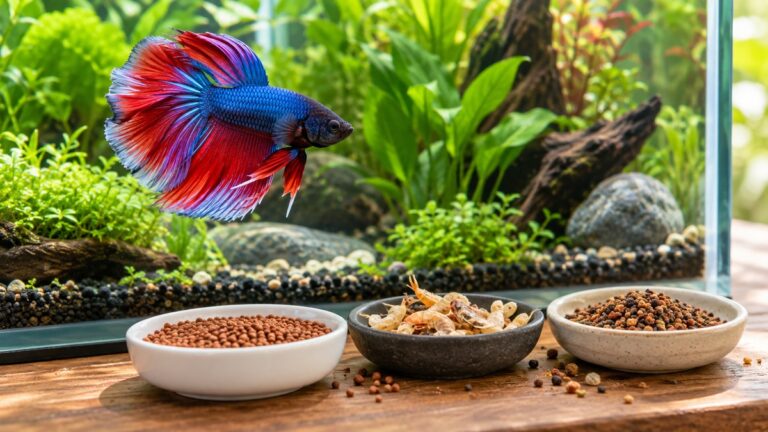
Choose the tool by how you feed. If you hand-feed and want a fixed scoop, the spoon fits, and its listing says it holds approximately six to ten betta pellets per scoop. If you want pellets to stay in one place, a feeding ring fits. The SunGrow title says it suits floating pellets, and the Hikiwin listing describes an enclosed tray. If you feed on a schedule or travel, the automatic feeder fits, with its 8, 12 and 24 hour modes. No tool changes the food. Check the pellet label for size and whether it floats, and watch what your betta finishes.
What matters for this keyword
Four things decide which tool fits a pellet routine. Compare the tools on each one.
Portion control
A spoon or a feeder sets the amount, so the amount is the first thing to check. The spoon listing says it holds about six to ten pellets, but that count depends on pellet size, and the listing does not say which size it used. The feeder’s slider controls the amount, but the listing does not say how much one feeding delivers. Measure a few feedings yourself before you trust either number.
Where the food goes
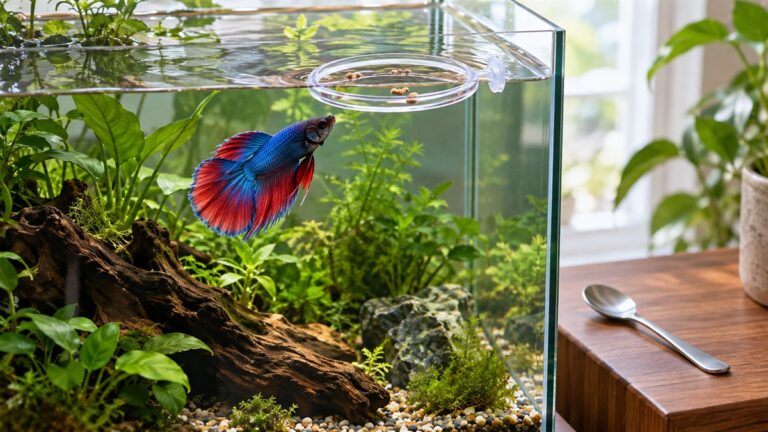
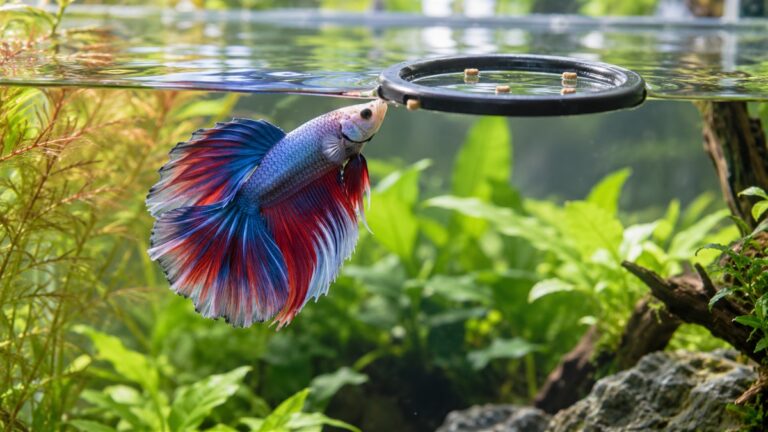
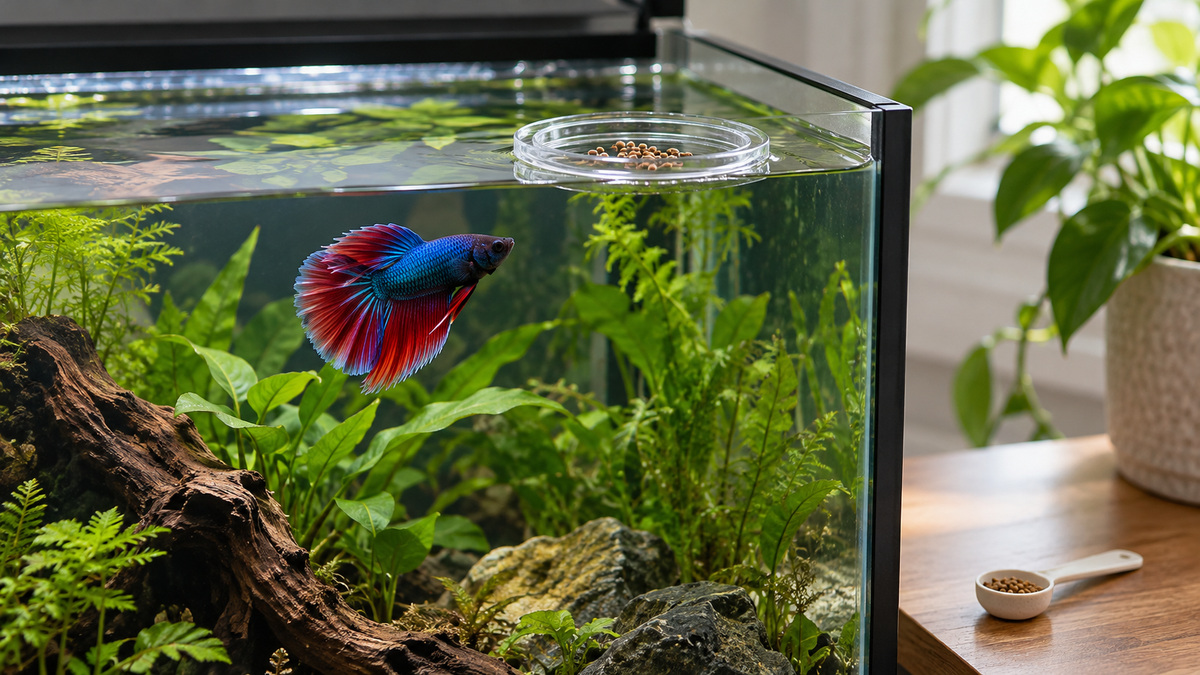
Pellets that float away can drift toward the filter. The SunGrow listing says its ring keeps food contained and reduces food washing into the filter, and the Hikiwin listing says its tray confines pellets to one area. Both are listing claims. Neither listing says whether sinking pellets stay in the ring, so do not assume a ring works for sinking pellets.
Schedule and travel
A feeder runs without you. The Aoyar listing describes three fixed modes, every 8, 12 or 24 hours, plus manual feeding, and it runs on batteries. Scheduled feeding is useful when you are away, but the listing does not say how long the batteries last, so check the battery before you leave.
Cleaning, mounting and the glass
Every tool here adds a surface to clean. The Aoyar listing says hand wash only. The NORXUAZE listing says its spoon rinses clean in seconds. The Hikiwin tray and the SunGrow ring use suction cups, so the glass where they sit becomes part of the set-up. Plan the spot before you fill the tank.
Reading a feeding-tool listing before you buy
Feeding listings mix claims with measurements. Read these five fields first.
- Power. The Aoyar listing says battery powered, but its included components do not list a battery, so check whether one ships.
- Mount. The Aoyar feeder clamps to a cover between 0 and 1 inch thick, or sticks on with double-sided tape. The SunGrow and Hikiwin products use suction cups. Pick the mount your tank can take.
- Capacity. The feeder lists 200 ml, and the Hikiwin tray lists 0.1 liters. Neither listing says how many feedings each one covers.
- Dimensions. The Hikiwin dimensions conflict. Its bullets describe a tray of 3.93 by 2.36 by 1.57 inches, while its item dimensions field reads 1 by 1 by 0.1 inches. Rely on neither figure until you check the listing.
- Warranty. The Aoyar listing gives a one-year warranty. The SunGrow listing says no warranty.
Those five fields decide fit before you compare anything else.
Water checks before feeding changes
A feeding tool does not manage water quality. For ammonia, the UF/IFAS guide says ammonia is colorless and, even at levels toxic to fish, odorless, so only testing shows whether it is present. A good ammonia kit includes a TAN test, a pH test and a thermometer, because the toxic share depends on pH and temperature. Nitrite is toxic to fish at levels as low as 0.10 mg/L. A new biofilter needs six to eight weeks before it reduces ammonia and nitrite well. Its audience is aquaculture and hobby systems, so treat it as general guidance.
What a feeding tool cannot do
A feeding tool sets the portion and the spot, and nothing more. It cannot tell you whether the water is safe, and it cannot replace a water change or a healthy biofilter. The UF/IFAS guide says water changes and ammonia-binding products can reduce ammonia toxicity in the short term, but a properly designed and sized biofilter is the better long-term approach. The same guide notes that some disease treatments, especially antibiotics, can harm the nitrifying bacteria in a biofilter.
If your fish looks unwell, or you are weighing a treatment, consult an experienced fish keeper or an aquatic vet before you act. Do not treat a feeder or a ring as a fix for a health problem, and do not use a feeding change to mask one.
1. Automatic Fish Feeder Dispenser for Aquarium: 200ml Large Capacity Auto Feeders for Small Tank (Best for scheduled feeds)
Specs from the listing (checked 2026-10-13):
- Power Source: Battery Powered
- Capacity: 200 ml
- Operation Mode: Automatic
- Warranty Description: 1 Year
- Product Care Instructions: Hand Wash Only
Pros
- The listing gives three fixed feeding modes, every 8, 12 or 24 hours, plus manual feeding.
- The slider adjusts the feeding volume, which the listing says helps prevent overfeeding.
- The listing describes a moisture-proof lid that cuts how much water vapor reaches the food.
Cons
- The listing says battery powered, but its included components do not list a battery.
- The listing states hand wash only, so the feeder needs a rinse-and-dry routine.
- The listing does not say how many feedings its 200 ml capacity covers, so check the slider setting against your fish's portions.
Best for: Keepers who feed on a schedule or travel, and who can keep the feeder dry and clean.
Skip if: You want to hand-feed pellets one at a time, or you need a battery included in the box.
View on Amazon (affiliate link)
2. SunGrow Fish Food Feeding Ring, Stop Water Turbulence from Washing Food & Floating Plants into (Best for keeping pellets in one spot)
Specs from the listing (checked 2026-10-13):
- Material: Plastic
- Item Dimensions L x W x H: 4"L x 4"W x 0.35"H
- Item Weight: 20 g
- Warranty Description: No Warranty
- Operation Mode: Manual
Pros
- The title says it suits flakes and floating fish pellets, which matches a floating-pellet routine.
- The listing includes a matching black suction cup to hold the ring in place.
- The listing says it keeps food contained, which restricts flakes and pellets from floating into the filter.
Cons
- The listing states no warranty, which the specs field also says.
- The listing does not mention sinking pellets, so do not assume the ring fits them.
- Its category fields say dog breed size and small breeds, which are not fish fields, so check the spec sheet before you rely on them.
Best for: Keepers who want floating pellets kept in one spot in a single tank or a community tank.
Skip if: You need a warranty, or your pellets sink.
View on Amazon (affiliate link)
3. Betta Food Spoon Mini – Tiny Feeding Tool Holds 6-10 Fish Food Pellets Per Scoop, Prevent (Best for hand-measured portions)
Specs from the listing (checked 2026-10-13):
- Material: Alloy
- Item Length: 2.8 inches
- Included Components: 6 Pcs Mini Spoons
- Unit Count: 6 Count
- Metal Stamp: 14K
Pros
- The listing says the mini spoon holds approximately 6-10 betta pellets per scoop.
- The listing gives an item length of 2.8 inches, so the spoon is compact.
- The listing includes six mini spoons, which gives you spares.
Cons
- Several fields use jewelry terms, such as Metal Stamp 14K and Stone Color, which do not fit a feeding tool. Rely on the bullets and the alloy material field, and check the listing before you buy.
- The listing's 6-10 pellet count depends on pellet size, and the listing does not give the pellet size used.
- Some bullets are unfinished, so read them as the listing's own claims.
Best for: Hand-feeders who want a fixed scoop size and a few spare spoons.
Skip if: You need a spoon sized for a different pellet, or you want a stated metal grade.
View on Amazon (affiliate link)
4. Clear Acrylic Fish Feeding Ring, Fish Tank Betta Feeding Tray with Suction Cup, Aquarium Shrimp (Best for a clear enclosed tray)
Specs from the listing (checked 2026-10-13):
- Material: Acrylic
- Capacity: 0.1 liters
- Item Dimensions L x W x H: 1"L x 1"W x 0.1"H
- Color: transparent
- Product Dimensions: 1 x 1 x 0.1 inches; 4.66 ounces
Pros
- The listing says the enclosed tray confines fish food pellets to a specific area.
- The listing says the clear acrylic gives visibility for monitoring feeding.
- The listing describes a strong suction cup that attaches to the inner glass.
Cons
- Its dimensions conflict: the bullets give 3.93 by 2.36 by 1.57 inches, while the item dimensions field gives 1 by 1 by 0.1 inches.
- The listing gives a capacity of 0.1 liters and does not say how many feedings that covers.
- The listing does not describe how long the suction cup holds.
Best for: Keepers who want pellets to stay in a boxed tray near one spot in the tank.
Skip if: You need the dimensions to match, or you need a stated capacity for a full feeding.
View on Amazon (affiliate link)
How to choose
- If you hand-feed and want a fixed scoop, choose the NORXUAZE spoon. Keep it for pellets only, and check the count against your own feedings.
- If you want pellets in one spot near the glass, choose the SunGrow ring for floating pellets, or the Hikiwin tray if you want an enclosed area. Check the mount first.
- If you feed on a schedule or travel, choose the Aoyar feeder. Check the battery and the slider before you leave.
- If you keep more than one fish, plan for at least 45 litres, about 10 gallons, as the species reference says for a betta housed with other fish. Males are highly territorial, so a second feeding ring does not replace tank size.
Compare the four tools on the same four checks: portion, spot, schedule and cleaning.
Setting up the routine
Once you have chosen a tool, set it up in a fixed order so you can read the results.
- Test the water first. Use a kit that includes the tests described above, and write down the results before you add food to a new set-up.
- Fix the ring or tray to the glass in a spot you can reach for cleaning, so the food stays in your fish’s reach and the spot stays easy to clear.
- Set the portion with the tool you chose. Use the spoon’s count or the feeder’s slider, and count the pellets in a few scoops yourself rather than trusting the listing alone.
- Watch the first few feedings. If food sits in the ring or tray after your fish has moved on, lower the portion.
- Check the filter and the glass after the first few days, then keep a regular clean-out routine.
The sources in this guide do not give a feeding schedule, so ask an experienced fish keeper how often to feed your betta. Keep the answer in your notes next to the tool’s settings.
Worked example: the spoon count across one week
The spoon listing gives six to ten pellets per scoop. Across six feedings, that is 36 pellets at the low end and 60 at the high end. Measure your own scoop before you trust either figure, because the count changes with the pellet size.
- 6 days x 1 feeding = 6 feedings.
- If one feeding equals one spoon of about six to ten pellets, then 6 x 6 = 36 pellets at the low end and 6 x 10 = 60 pellets at the high end.
That is arithmetic, not a feeding amount. Follow the pellet label, watch what your fish finishes, and adjust the feeder slider or the spoon count to match.
Common mistakes
- Treating the scoop as a dose. The spoon count depends on pellet size, and the listing does not state the size it used.
- Buying a ring for sinking pellets. The SunGrow title names floating pellets only.
- Skipping the power check. The Aoyar listing names battery power, and its components do not list one.
- Trusting one dimension figure. The Hikiwin listing disagrees with itself, so check the listing before you rely on any single number.
- Assuming a feeder fixes the water. Test for ammonia and nitrite, as the UF/IFAS guide describes, whatever tool you use.
- Feeding a new set-up before the water is checked. Run the water checks in the routine above first, then add food.
FAQ
Does this guide rank the pellets?
No. It covers feeding tools and water checks, not the pellet itself. For the food, read the pellet label for its size and whether it floats, and compare the maker’s own specifications before you choose. The best betta food guide is the place to compare foods.
Can I use a feeding ring with sinking pellets?
The SunGrow title says the ring suits flakes and floating fish pellets, and the listing does not mention sinking pellets. Do not assume it works with them. Check whether your pellet floats before you buy a ring.
Is the automatic feeder right for a single betta?
It fits if you need scheduled or travel feeding. The listing says the slider controls the amount, and its three fixed modes run every 8, 12 or 24 hours. Set the slider to a portion you have measured yourself, and keep the feeder dry and clean, since the listing says hand wash only.
How many pellets does the spoon hold?
The listing says approximately six to ten betta pellets per scoop. That count depends on pellet size, and the listing does not say which size it used. Measure a few scoops of your own pellets before you rely on the count.
Can several fish share one feeding ring?
Plan as if they cannot. Males are highly territorial and frequently fight when kept together. The SunGrow listing says several rings can help restrict bullies in a community tank, but housed with other fish, a betta needs at least 45 litres, about 10 gallons, so a ring does not replace tank size.
Does a feeding ring keep food out of the filter?
The SunGrow listing says it keeps food contained and reduces food washing into the filter. The Hikiwin listing says its tray confines food to a specific area. Both are listing claims. Check the filter after a few feedings to see what happens in your own tank.
What water checks matter more than the tool?
Test for ammonia and nitrite, and keep a thermometer in the tank. The UF/IFAS guide says a good ammonia kit includes a TAN test, a pH test and a thermometer. Nitrite is toxic at levels as low as 0.10 mg/L, and a new biofilter needs six to eight weeks before it works well.
Does the moisture-proof lid matter?
The Aoyar listing describes a moisture-proof lid that cuts how much water vapor reaches the food cylinder, and it ties that to keeping food dry and free of clumps. That is a listing claim. Dry storage stays your job: keep the lid closed and store the pellets away from steam and damp air.
What if my betta ignores the ring or tray?
A ring or tray only holds food in one place. It does not make a fish feed. If your betta ignores the food, check the water, then the portion and the spot, and ask an experienced fish keeper before you change the routine. If you think the fish is unwell, consult an aquatic vet.
For tank size, read the how big of a tank do betta fish need guide. For cleaning routines, the best way to clean a betta fish tank guide covers the steps.
Bottom line
Choose the tool by routine: the spoon for hand-measured feeds, a floating-pellet ring for one spot, the Hikiwin tray for an enclosed area, and the Aoyar feeder for schedules and travel. Check the mount, power and dimensions before you buy, and measure the portion yourself. This guide does not rank the pellets themselves, and none of these tools fixes the water, so test for ammonia and nitrite as well.
Sources
- Siamese fighting fish (Wikipedia): males are highly territorial and fight when kept together, and housed with other fish a betta needs at least 45 litres, about 10 gallons
- UF/IFAS FA31, Ammonia in Aquatic Systems: ammonia is colorless and odorless, a good kit includes a TAN test, pH test and thermometer, nitrite is toxic at 0.10 mg/L, and a new biofilter needs six to eight weeks