Best Aquarium Water Tester: Digital Kit or Test Strips?
As an Amazon Associate we earn from qualifying purchases. Details
An aquarium water tester shows you what is in the water before your betta shows you a problem. A new biofilter needs six to eight weeks to build up enough bacteria to reduce ammonia and nitrite, so a tester matters most in a new tank. Choosing one comes down to two things: how you read the result, and how often you will check. This guide compares two options. One is a digital kit that sends results to a phone app. The other is a bottle of 8-in-1 test strips that you read by color. Both list freshwater use. Use the comparison to pick the format that fits your routine, then confirm the details on each product listing before you buy.
Quick answer
Pick the digital kit if you want results in a phone app and do not mind relying on a phone. Pick the strip bottle if you want to read color by eye and check your tank about once a week. Either way, make sure pH and ammonia are on the list. The UF/IFAS ammonia guide notes that the toxic share of ammonia depends on pH and temperature, so a kit without pH leaves you guessing. The digital listing gives a pH range of 6.0-8.0. The strip listing names pH in its title. Count your planned tests before you buy, because each listing states a count that you must translate into weeks.
What matters for this keyword
Which parameters each format covers
Both formats cover the core checks for a betta tank, but they do it differently. The digital listing names ammonia, nitrate, nitrite, pH, GH, KH and chlorine in its bullets. The strip listing names pH, ammonia, alkalinity, hardness and chlorine in its title, and adds free chlorine, nitrate, nitrite and hardness in its bullets. Neither listing states the test method behind each reading, so check the manual before you act on a result you do not understand. Parameter coverage is only half the story. A listed parameter still needs a reading you can interpret, which is where the color steps and the manual matter. If you need only one parameter, a pH test kit guide may fit better than a multi-test format.
How each format reads results
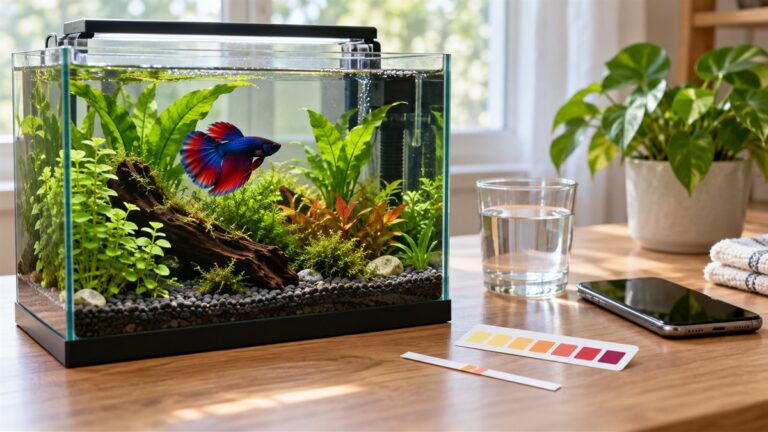
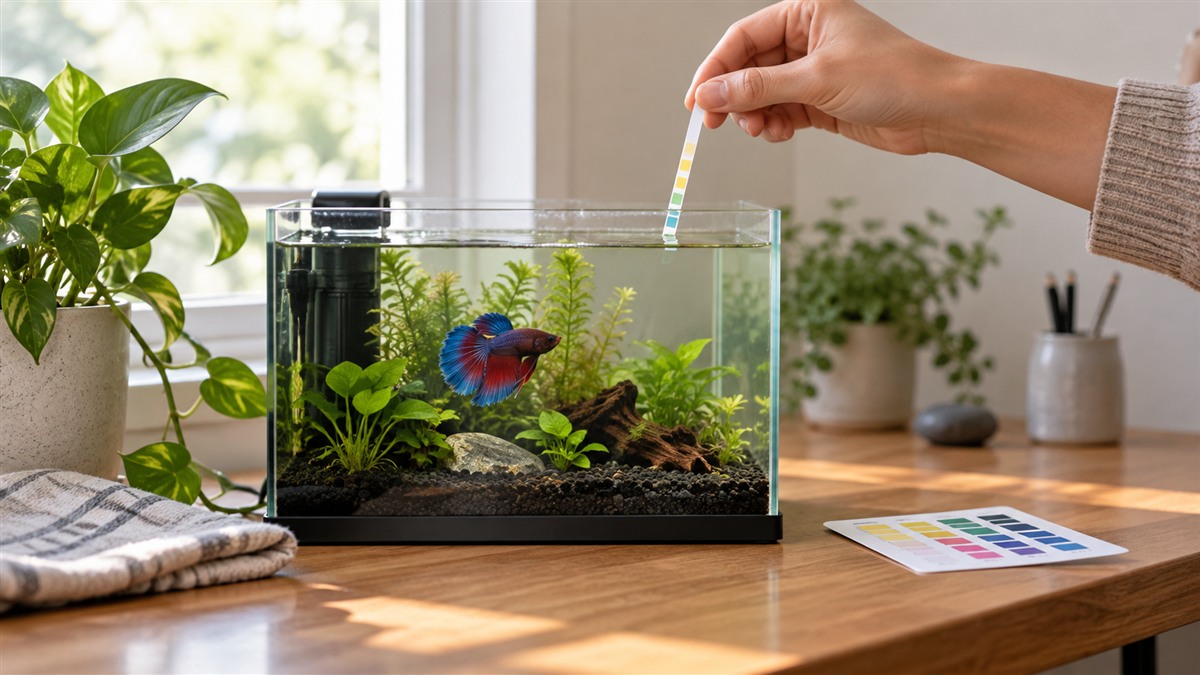
The digital listing says you dip the strip, scan it, and receive detailed results. It also says its strips give readings with no color guessing. The strip listing gives timed steps. Dip the test strip into water for 2 seconds for pads 1-7, hold it horizontally for 30 seconds for those pads, and dip the ammonia pad separately for 5 seconds. Set a timer for each step, because the listing gives exact times. If ammonia is your only concern, a dedicated ammonia test guide covers that category in more depth.
Storage and shelf life
The strip listing says its strips come in a well-sealed bottle that protects them from moisture and other environmental factors. It does not state a shelf life in months. The digital listing does not state a shelf life for its strips either. Keep the bottle sealed between uses, since that seal is what the listing relies on to protect the strips.
Freshwater and saltwater use
Both listings state freshwater and saltwater use. The strip listing also names ponds, pools and shrimp tanks. The digital listing names betta tanks, shrimp tanks and reef aquariums. Neither listing gives salinity ranges, so check the manual before you use either format on a saltwater tank.
How to choose
Choose the digital kit if you want readings in a phone app and you are comfortable keeping a phone near the tank. Choose the strip bottle if you want a result you read by color, without a phone. If you need a saltwater reading, check the listed pH range before you buy.
Who each format suits
A single-betta owner who checks once a week has the simplest case. Either format can cover that schedule for a long stretch, as long as the count on the listing is what you expect. The strip bottle suits a reader who prefers timed steps and reading by color. The digital kit suits a reader who wants results on a phone screen and is comfortable keeping the phone close to the tank.
A new-tank owner has a harder case. In the first weeks, many owners want to check more often than once a week, and that is when a count runs down fastest. Count the checks you expect before you open the bottle, and keep spare strips or tests on hand so that you are not tempted to skip a check when a result looks odd.
A reader with two or more tanks should weigh the count first. Each tank checked weekly uses its own strip on each check, so the count matters more with every tank you add.
The two options
1. Digital Aquarium Water Test Kit, App-Enabled 10-in-1 Fish Tank Test Kit for Freshwater & Saltwater (Best for app-based readings)
Specs from the listing (checked 2026-10-13):
- Ph Range: 6.0-8.0
- Unit Count: 10 Count
- Included Components: Mobile App, Test strips
Pros
- Results come through an app, and the listing says its strips need no color guessing
- Bullets name ammonia, nitrate, nitrite, pH, GH, KH and chlorine
Cons
- The listing does not say whether its 10 count means strips or complete tests
- The listing does not state which phones the app supports
Best for: Readers who keep a phone near the tank and want results in an app.
Skip if: Skip it if you do not want to depend on a phone or an app for readings.
View on Amazon (affiliate link)
2. AAwipes 8-in-1 Aquarium Test Kit for Fish Tanks – Quick & Accurate Water Testing Strips (Best for reading by color)
Specs from the listing (checked 2026-10-11):
- Number of Items: 50
- Color: 50 Strips
- Package Dimensions: 5.39 x 2.13 x 2.09 inches; 2.4 ounces
Pros
- Title lists pH, ammonia, alkalinity, hardness and chlorine; bullets add nitrate and nitrite
- Sealed bottle described as protecting the strips from moisture
Cons
- The color field reads 50 Strips, a labeling slip to check before you buy
- The listing does not state a shelf life in months
Best for: Readers who want a phone-free check and can match colors by eye.
Skip if: Skip it if you want an app-based result or find color matching hard.
View on Amazon (affiliate link)
Digital app kit
The digital kit is the only option here that reads results with a phone. The listing says it comes with a mobile app and test strips, and it gives a pH range of 6.0-8.0. It does not state ranges for its other parameters. It also does not say whether its 10 count means ten strips or ten complete tests, so confirm that before you plan a schedule. The listing names betta tanks among its uses, but it does not say the app works on every phone.
Skip this kit if you do not want to depend on a phone or an app for readings, or if you prefer to match colors yourself.
Strip bottle
This bottle holds 50 strips according to its description. Its color field reads “50 Strips”, which looks like a labeling slip, so the description count is the one to use. The title lists pH, ammonia, alkalinity, hardness and chlorine, and the bullets add nitrate and nitrite. Each check takes a short dip and a timed wait, and the listing gives the times. The package measures 5.39 inches long, 2.13 inches wide and 2.09 inches tall, and weighs 2.4 ounces. The item alone weighs 2.39 ounces. The listing does not state a shelf life in months, so write the opening date on the bottle when you start using it.
Skip this bottle if you want an app-based result, or if matching colors by eye is hard for you.
What to check on the listing before you buy
Use this short checklist before you order. Each item comes from what the listings state.
- The count. The strip listing gives 50 strips in its description, but its color field reads 50 Strips. The digital listing gives a unit count of 10. Find out whether that means strips or complete tests.
- The parameters. Confirm that pH and ammonia are on the list. Then check whether you also need nitrate and nitrite, since both listings name them.
- Phone needs. The digital listing includes a mobile app. It does not state which phones the app supports, so check the app details before you buy.
- Size. The strip package measures 5.39 x 2.13 x 2.09 inches. Measure your storage spot first if space is tight.
- Water type. Both listings state freshwater and saltwater use. The digital listing gives a pH range of 6.0-8.0, so confirm that range suits the water you plan to test.
Weekly checks for 52 weeks need 52 strips. The bottle holds 50 strips. 52 − 50 = 2, so the bottle runs out two weeks early. If the digital kit’s 10 count means ten strips, 52 checks need 52 ÷ 10 = 5.2 kits, so you would round up to six kits. Recheck the count on each listing before you buy, because the arithmetic depends on it.
Reading results over time
A single reading is a snapshot of one moment. Writing down the date, the parameter and the result each time gives you a record, so you can see whether a number is climbing or holding steady. This habit is general advice rather than a rule from either listing, and it works the same for both formats. If one result looks wrong, retest the same parameter once, following the listed steps. Then compare it with your earlier entries before you change how you care for the tank.
Worked example: checks at twice a week
The AAwipes listing says experts recommend testing at least twice a week, and its description gives 50 strips. At two checks a week, one 50-strip bottle lasts 50 ÷ 2 = 25 weeks. A full year of twice-weekly checks needs 2 × 52 = 104 strips, so 104 − 50 = 54 strips are short after the first bottle.
Mistakes to avoid
Judging by count alone. A 50-strip bottle or a 10-count kit only gives you a total.
Reading outside the timed steps. The strip listing gives exact times for each step. Follow them rather than guessing when to read.
Assuming the app works on your phone. The digital listing does not state which phones its app supports. Check that before you buy, not after the kit arrives.
Treating one number as a trend. One reading is a snapshot. Compare several checks before you decide that a number is rising or falling.
Trusting a method you cannot see. UF/IFAS notes that one ammonia method can read falsely high after formalin use within 24 to 72 hours, and with ammonia-binding products and many water conditioners. Neither listing states its method. Read the manual before you act on an ammonia reading taken after a treatment.
Judging water by how it looks. Ammonia is colorless and, even at toxic levels, odorless. A clear tank and a calm betta do not show what a test shows.
FAQ
Do I need a water tester if my betta looks healthy?
Yes, because bad water can be invisible. UF/IFAS states that ammonia is colorless and odorless even at toxic levels, so testing is the only way to know it is present. A tester checks the water. It does not diagnose your fish.
Is a digital tester more accurate than test strips?
The listings do not give accuracy figures, so no fair ranking is possible from them. The digital listing says its results come with no color guessing. The strip listing describes its results as accurate in one of its bullet headings. Choose by how you prefer to read results, and check the manual for the method.
How often should I test a betta tank?
A common rule of thumb is a weekly check, plus a check after a water change, after adding a fish, or whenever fish appearance or behavior changes. The last trigger comes from UF/IFAS guidance written for production systems, so treat the weekly schedule as a starting point.
Which parameters matter most for a betta tank?
Ammonia and nitrite matter most in a new or unsettled tank. UF/IFAS says nitrite is toxic to fish at levels as low as 0.10 mg/L. Ammonia toxicity depends on pH and temperature, so check pH as well. For nitrate-specific decisions, see the nitrate monitor guide.
Can I use either tester in a saltwater aquarium?
Both listings state saltwater use. The digital listing gives a pH range of 6.0-8.0, and the listing does not say whether that range suits saltwater. Check the manual’s ranges before you act on a reading.
What should I do if a result looks wrong?
Retest the same parameter, following the listed steps and times. The listings state no troubleshooting steps. If the problem continues or your fish show signs of distress, consult an experienced fish keeper or an aquatic vet.
Bottom line
Choose the digital kit if you want results in an app and will keep a phone near the tank. Choose the strip bottle if you want a phone-free check and can match colors by eye. Before you buy, confirm that pH and ammonia are on the list, and divide the strip or test count by your planned checks. If the count falls short, buy a second pack rather than stretching the schedule.
Sources
- UF/IFAS, Ammonia in Aquatic Systems (FA031): ammonia is colorless and odorless at toxic levels; toxic share depends on pH and temperature; nitrite toxic at 0.10 mg/L; biofilter takes six to eight weeks; one method can read falsely high after formalin or ammonia-binding products.