Best Betta Fish Plastic Plants: Three Picks and What to Check
As an Amazon Associate we earn from qualifying purchases. Details
Betta fish plastic plants give a betta cover, resting spots and something to explore, without the lighting and pruning that live plants need. This guide explains what to check before you buy one: tank size, the plant’s base, leaf edges, material and cleaning. It compares three plastic options whose listings give enough detail to judge, and it explains when a plastic plant is the wrong choice. Plastic plants will not die or wilt, but they cannot warn you about water problems, so treat them as decor, not as a replacement for care.
Quick answer
For a single betta in a heated, filtered tank of at least 5 gallons, buy a plastic plant with soft leaves, a stable base and a height that fits your water depth. The first pick meets those checks most fully: its listing describes a set for 5 gallon or larger tanks, soft leaves and a base for holding each plant in the gravel. If you only want one leaf-style piece to rest on, the third pick is simpler. Whatever you buy, inspect the edges and rinse the piece before it goes in the water. Plastic is an option, not a requirement.
Why plastic plants suit some betta tanks
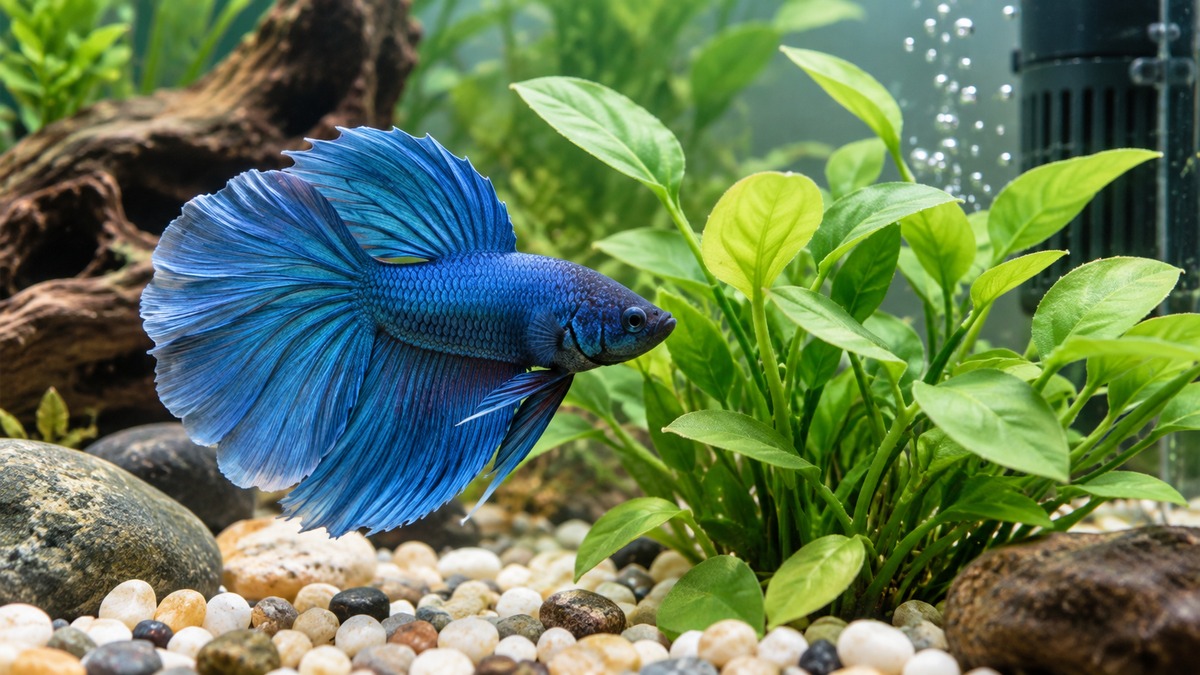
Plastic plants have one clear advantage: they stay the same from week to week. Two of the three listings say the plants need no special lighting and no pruning, so there is one less routine to manage. The bigger benefit is cover. A plant that breaks up the open water gives your fish somewhere to rest and a place to retreat when the tank is busy.
The main limit is that a plastic plant does nothing for the water. It does not take up waste or produce oxygen, so it cannot replace filtration, water changes or testing. Ammonia is colorless, and even toxic levels are odorless, so the only way to know whether it is present is to test the water. A plastic plant looks the same whether the water is clean or not, so keep a test routine alongside your decor.
The UF/IFAS guide, written for aquaculture, recommends testing ammonia once a week and immediately whenever fish appearance or behavior changes, including reduced feeding. A home tank is not a production system, but the principle carries over: a betta that starts eating less is a reason to test, not a reason to add more decor. For a living alternative, see the live plants guide for betta tanks.
Setting up the plant before the water goes in
Set the plant up on the bench, not in the tank. Rinse it in warm water and let it air out. Press the base into the gravel and turn the plant to check that it stands upright. Place it before you fill the tank, so the base sits in place instead of floating. Fill slowly so the decor does not shift. When the tank is full, check each piece again, and compare its height with the water line rather than with the tank’s outer rim.
Criteria that matter for this keyword
For this keyword, four checks decide whether a plastic plant suits a betta tank. Each one depends on the piece, so check it on every item you consider.
Leaf edges and fin contact
Betta fins are delicate, so the edge of every leaf matters more than its color. The first pick’s listing says its leaves are soft and lifelike and do not scratch the fish. The second pick’s listing describes its material and base but says nothing about its edges. The third pick’s listing is silent on edges as well. Run a finger along each leaf on arrival and look for burrs, seams or sharp corners. Remove any piece that catches your skin, because a piece that catches your fingers can catch fins too.
Base and stability
A plant that floats or tips can move around the tank and look wrong. The first pick says each plant has its own base for holding it in the gravel. The second pick describes a durable base at the bottom that helps stop floating. The third pick does not describe a base, so check its shape before you buy it, and plan to set it firmly in the substrate if you choose it.
Tank size and height
Measure your tank before you choose a plant. The first pick says it suits 5 gallon or larger fish tanks, with heights from 2 inches to 8 inches. The second pick says it suits most fish tanks, and each piece measures 5.9 by 5.9 by 3.5 inches. The third pick measures 6 by 4 by 2 inches. Compare each height with the water depth, not the tank’s outer height. A plant that rises above the water line does nothing for the fish. For the tank itself, see the guide to what size aquarium a betta needs.
Material, smell and cleaning
The three listings use different materials. The first pick’s listing says plastic. The second says polyvinyl chloride (PVC), and its listing says the material has good corrosion resistance and is not easy to fade. The third is listed as plastic and resin, and its listing says a new piece may have a slight smell, which should disappear after washing in warm water and airing out. Rinse each new piece before it goes in the tank, and rinse them again during water changes.
Checking a listing before you buy
Start with the pack size. The first pick is a set of eight pieces, the second is two pieces, and the third is one piece. A set gives you more height options, but it also takes up more of the tank, so count the pieces against the open water you want to keep. Next, look for three words in the listing: a tank size, a base and a description of the edges. If one of those is missing, you are guessing on that point. Look at the dimensions too. Compare the overall size with the tank’s width, not only its height. Finally, check the material line. A plastic plant and a silk plant are different products, and this guide covers plastic only.
Some listings contradict themselves. If one field says silk and another says plastic, treat the material as unknown rather than picking one. Choose a listing whose details agree with each other, and ask the seller to settle the question before you order if it matters to you.
How to choose
Use one rule. If your tank is 5 gallons or larger, choose a piece with a stable base and soft, checked edges, and match its height to your water depth. If you want a single leaf to rest on, choose a single leaf-style piece, then check its edges and rinse it. If a listing says nothing about tank size, base or edges, choose a different listing rather than guessing.
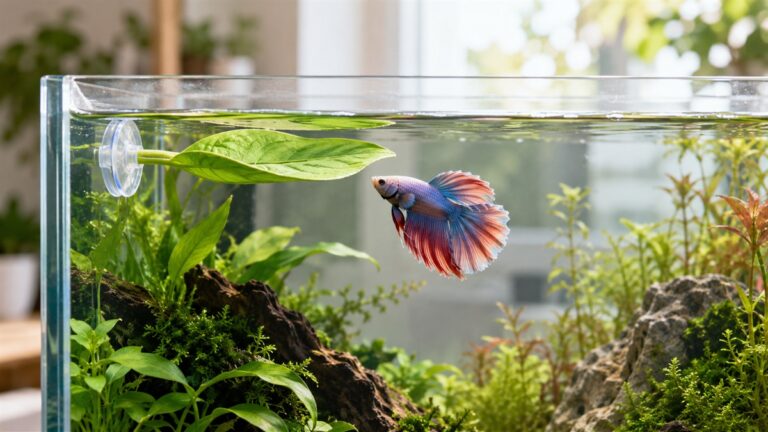
Bettas set up territories even when housed alone and enjoy a decorated tank, so decor has a real purpose here. Use it with restraint and keep the middle of the tank open so your fish can swim. For a leaf hammock in particular, see the betta fish hammock guide.
1. Ameliade Aquarium Artificial Plants & Rock Cave Betta Fish Tank Decor Set (Best overall)
Specs from the listing (checked 2026-10-11):
- Material: Plastic
- Product Dimensions: 5.4"D x 5.4"W x 3.4"H
- Item Weight: 11.2 ounces
- Included Components: Plastic plants, Rockery decoration
Pros
- Listing says it suits 5 gallon or larger fish tanks
- Listing describes soft leaves that will not scratch the fish
- Each plant has its own base for holding it in the gravel
- Set covers several heights, listed from 2 inches to 8 inches
Cons
- Listing does not give the height of each individual piece
- Rockery dimensions are not stated, so fit in a small space is unclear
- Eight pieces in one set can crowd a tank that is only just 5 gallons
Best for: A tank of 5 gallons or larger that needs cover at several heights, from low leaves to a tall piece
Skip if: Your tank is smaller than 5 gallons, or you want a single simple leaf
View on Amazon (affiliate link)
2. 2pcs Aquarium Plants Decorations Artificial Fish Tank Plants Plastic Fish Tank Accessories Green (Best two-piece set)
Specs from the listing (checked 2026-10-11):
- Material: Polyvinyl Chloride
- Item Dimensions D x W x H: 5.9"D x 5.9"W x 3.5"H
- Item Weight: 0.09 kg
- Recommended Uses For Product: interior home decor, office or workplace settings, outdoor decor for covered spaces, staging for events or photography, aquarium decor
Pros
- Two pieces per listing, each 5.9 by 5.9 by 3.5 inches
- Listing describes a durable base that helps stop floating
- Listing says it needs no light or pruning and will not wither
- Material is listed as polyvinyl chloride with good corrosion resistance
Cons
- Listing does not describe the leaf edges
- Listing says it suits most fish tanks but gives no tank size
- Product type field reads only a slash, so the category is unclear
Best for: Owners who want a two-piece, bushy look in a standard heated, filtered tank
Skip if: You need the leaf edges confirmed before buying, or you want a single leaf-style piece
View on Amazon (affiliate link)
3. Fish Tank Decor Aquarium Decorations Ornaments Betta Leaf pad Hammock 6inch Plastic Artificial (Best single leaf-style piece)
Specs from the listing (checked 2026-10-11):
- Material: Plastic, Resin
- Product Dimensions: 6"D x 4"W x 2"H
- Item Weight: 0.05 kg
- Recommended Uses For Product: betta fish tank decor
Pros
- Single piece listed at 6 by 4 by 2 inches
- Material is listed as plastic and resin
- Listing names betta fish tank decor as its use
- Listing warns a new piece may smell and says warm-water washing helps
Cons
- Listing does not describe the base or the leaf edges
- The smell warning means a rinse and airing before first use
- Listing gives no tank size or size range
Best for: A betta that needs one resting leaf in a tank of 5 gallons or more
Skip if: You want a multi-piece set, or a plant with a described base
View on Amazon (affiliate link)
Worked example: a 5-gallon tank with several heights
You set up a 5-gallon tank and want cover at several heights. The first pick’s listing describes a set with 1 rockery, 3 short plants, 3 medium plants and 1 tall plant, which it calls 8 different styles. Count them: 1 + 3 + 3 + 1 = 8. If you keep only the plants and leave the rockery out, the count is 3 + 3 + 1 = 7 plant pieces. Put the tall piece at the back, the short pieces toward the front, and leave the middle open so your betta has room to swim. Rinse all 8 pieces before they go in.
Mistakes to avoid
Treating decor as a home
Plastic plants do not make a small bowl a suitable home. This site recommends a heated, filtered tank of at least 5 gallons, and it does not recommend bowls or any tank under 2.5 gallons, whatever the decor looks like.
Reading “no maintenance” as “no cleaning”
The first pick’s listing says these plants need no pruning and do not wither. That does not mean they never need attention. Check for film on the leaves and rinse them during water changes.
Skipping the rinse on a new piece
A new plastic piece can smell when it arrives. The third pick’s listing says the smell should disappear after warm-water washing and airing. Give the piece that time before it goes in.
Buying before you know the base
A plant that looks upright in its photo may still float or tip in water. If the listing says nothing about a base, pick another piece or plan to set it firmly in the substrate yourself.
Taking a tidy tank as proof of clean water
A tank with a neat plant arrangement can still hold a harmful ammonia level, because ammonia gives no color or smell even at toxic levels. If your betta changes behavior, including eating less, test the water before you add anything else.
Crowding the open water
Eight pieces can fill a tank quickly once you add a rock or a heater. Keep the middle and upper water open so your betta can swim and rest in a clear space.
FAQ
Are plastic plants safe for a betta’s fins?
Check the edges when the plant arrives. The first pick’s listing says its leaves are soft and will not scratch the fish, but the other two listings do not describe their edges. Run a finger over every leaf, remove any piece with a burr, seam or sharp corner, and do not add a piece you cannot check.
How big should the tank be?
This site recommends a heated, filtered tank of at least 5 gallons for a single betta. The first pick’s listing says it suits 5 gallon or larger fish tanks. Measure the water depth and choose a height that stays below the surface.
Do plastic plants need special light?
No. The first pick’s listing says it needs no special lighting or substrate, and an artificial plant does not depend on light to look the same. Keep the tank light you already use for your fish and for seeing them clearly.
Plastic or silk: which should I choose?
This guide covers plastic only. Silk plants are a different category, and this site covers them in the silk plants guide for betta. Choose by the edge and base you can check, not by the material name alone.
How often should I rinse them?
Rinse them during each water change and whenever a film builds up on the leaves. Use warm water. Skip soap unless the maker tells you to use something else.
Can I mix plastic plants with other decor?
Yes, but keep open swimming room. The first pick’s set already covers a range of heights, from 2 inches to 8 inches, so you may not need extra plants. Add one rock or one leaf-style piece and stop there.
What should I check after the first week?
Start with the base, since a plant that has shifted or tipped needs to be reset. Then run a finger over the leaves again, rinse the set and test the water. Watch how your betta uses the decor. Remove any piece the fish avoids, because a plant that goes unused gives no benefit and adds a piece to clean.
Do plastic plants wear out?
The first pick’s listing says its plants neither die nor become wilted. They can still crack or chip with rough handling or age. Check for cracks during cleaning, and replace any piece with a sharp broken edge, because a broken edge carries the same risk as a rough one.
Bottom line
Buy a plastic plant only if you can check its leaf edges, its base and its height against a heated, filtered tank of at least 5 gallons. If all three check out, the first pick has the broadest fit, and the third pick suits a single resting leaf. If a listing leaves any of the three unclear, choose another piece or skip the plant. A betta needs clean water, a heater and a filter first, and decor second.
Sources
- Siamese fighting fish: bettas set up territories even when housed alone and enjoy a decorated tank
- UF/IFAS, Ammonia in Aquatic Systems (FA31): ammonia is colorless and odorless at toxic levels, so testing is the only way to detect it