Best Betta Flakes or Pellets
As an Amazon Associate we earn from qualifying purchases. Details
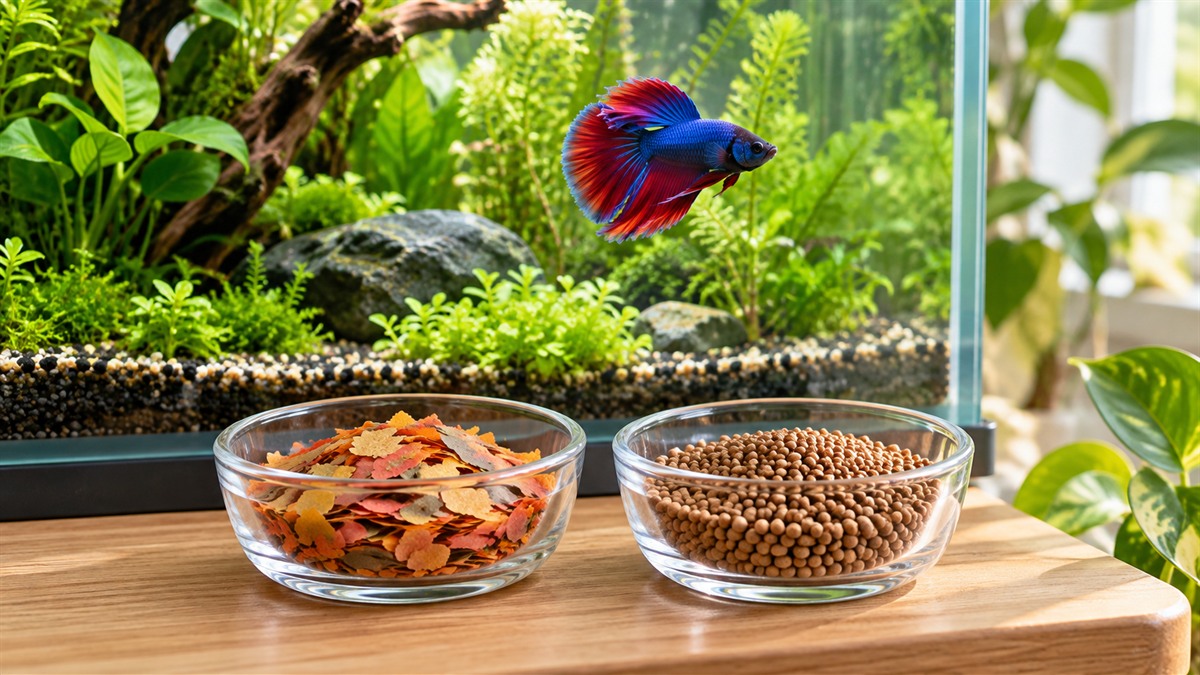
Flakes or pellets is one of the first questions a new betta owner asks, and the honest answer from the sources we opened is that neither format is ruled out. A University of Illinois veterinary column advises “a balanced pelleted or flaked food daily,” and the UF/IFAS betta publication calls both flake and pellet foods available options. What differs is the product on the shelf: how it is labeled, what the directions tell you to measure, and how much you have to guess. This page compares two betta flake listings and four betta pellet listings that we opened on Amazon on 2026-10-17, using only what each listing states. We did not buy, feed or test any of them.
Quick answer
If you want flakes, the Tetra BettaMin Flakes (0.81 oz, pack of 2) give a feeding line on the page (“two to three times daily, only as much as your fish can consume within several minutes”), while the Top Fin Betta Flakes (0.81 oz) page gives ingredients but no feeding amount. If you want pellets, the Hikari Tropical Betta-BioGold Floating Pellets (0.7 oz) has the most specific pellet counts, the Tetra TetraBetta Floating Mini Pellets (0.15 oz, pack of 2) is the smallest bag and has a sliding feeder, the Ocean Nutrition Betta Pellets (2.65 oz) gives a maximum of 7 pellets twice daily, and the API Betta Food Pellets page gives a 2-minute rule. No listing here proves one format is better for every betta.
How we chose
We searched Amazon for betta flakes and betta fish food pellets and kept listings that name bettas in the title and are plainly one format: flakes or pellets. Freeze-dried foods, food blocks, combo bundles, feeders and water treatments were left out. Each product page was opened once. We recorded the pack size, the ingredients and feeding directions the page states, and anything where the page contradicts itself. We did not record prices, star ratings or review counts.
Comparison at a glance
| Product | Format | Pack size stated | Feeding direction on the page | Notes |
|---|---|---|---|---|
| Top Fin Betta Flakes | Flakes | 0.81 oz (22.9 g) | None; the field only says to store in a cool dry place | Ingredients listed; vitamin C and “does not cloud water” are listing claims |
| Tetra BettaMin Flakes | Flakes | 0.81 oz, pack of 2 (selector also offers pack of 1) | 2 to 3 times daily, as much as the fish can consume within several minutes | Ingredient list includes FD&C Red #3 |
| Tetra TetraBetta Floating Mini Pellets | Floating mini pellets | 0.15 oz, pack of 2 | 2 to 3 times daily, as much as the fish can consume within several minutes | Sliding feeder included |
| Hikari Tropical Betta-BioGold Floating Pellets | Floating pellets | 0.7 oz (20 g) | Pellet counts by fish length, one pellet at a time | Red 3 listed in ingredients |
| Ocean Nutrition Betta Pellets | Pellets (float or sink not stated) | 2.65 oz (75 g) in the title; 2.6 oz in the selector | Up to 7 pellets twice daily, placed on the surface | Title says 41.5 percent protein |
| API Betta Food Pellets | Pellets, “designed to float” (manufacturer text) | Title: .78 oz, pack of 2; selector: 1 oz, pack of 2 | Twice a day, what the fish eats in 2 minutes | Description says three minutes in one place |
The six products
1. Top Fin Betta Flakes, 0.81 oz
Specs (from the listing, checked 2026-10-17): manufacturer Top Fin; package 2.82 x 1.85 x 1.85 inches, 1.28 ounces (shipping weight, not the 0.81 oz of food); set name “Betta Flakes 1-0.81 Ounce.”
What the listing says: added vitamin C, “does not cloud water when used as directed,” and a formula “designed specifically for betta fish digestive systems.” The ingredient list starts with fish meal, dried yeast, ground brown rice, soy protein concentrate and wheat gluten, and includes fish oil, shrimp meal, spirulina, paprika oleoresin and beta-carotene as colors. The support and digestion statements are the manufacturer’s and we did not check them.
Best for: an owner who wants a plain betta flake and is happy to use the pack’s printed directions.
Skip if: you want the feeding amount on the page. The only direction in the listing is how to store it.
View on Amazon (affiliate link)
2. Tetra BettaMin Flakes, 0.81 oz, pack of 2
Specs (from the listing, checked 2026-10-17): model 16838; manufacturer Tetra; package 1.88 x 1.88 x 2.88 inches, 2.56 ounces; the size selector lists 0.81 oz in a pack of 2 or a pack of 1. The title adds “Blacks & Grays,” which we cannot explain from the page.
What the listing says: “nutritionally balanced, high protein, color promoting food for Siamese Fighting Fish (Betta Splendens).” The feeding line is “Feed two to three times daily, only as much as your fish can consume within several minutes.” Ingredients begin with fish meal, dried yeast, ground brown rice, shrimp meal and wheat gluten, and include brine shrimp, krill and FD&C Red #3. The page’s own summary line says picky bettas “gobble these up when they reject pellets” and calls them “tiny flakes made for betta mouths.” That line is a summary of the listing, not a result we saw.
Best for: a betta owner who wants a flake with a stated feeding window and a two-pack.
Skip if: you want to avoid listed artificial color. Red #3 is in the ingredients.
View on Amazon (affiliate link)
3. Tetra TetraBetta Floating Mini Pellets, 0.15 oz, pack of 2
Specs (from the listing, checked 2026-10-17): model 77023; manufacturer Tetra; package 0.5 x 4 x 6.88 inches, 0.29 ounces; selector offers a pack of 1 or a pack of 2 (0.15 oz each).
What the listing says: “mini-sized nutrient-rich floating pellets” described as “ideal for top-feeding bettas,” with a sliding feeder in the pack. Feeding line: 2 to 3 times daily, only as much as the fish can consume within several minutes. Ingredients start with wheat flour, fish meal, wheat gluten, potato protein and corn starch.
Best for: a first bag of pellets in a small quantity.
Skip if: you want a larger supply; 0.15 oz bags are small.
View on Amazon (affiliate link)
4. Hikari Tropical Betta-BioGold Floating Pellets, 0.7 oz (20 g)
Specs (from the listing, checked 2026-10-17): item model number 42055191104; indication “for betta fish”; package 4.8 x 2.7 x 0.6 inches, 0.88 ounces (shipping weight).
What the listing says: ingredients begin with fish meal, wheat flour, soybean meal, rice bran and potato starch, and include krill meal, fish oil, spirulina, garlic and astaxanthin; red 3 is listed as an artificial color. Directions: for bettas under 1.5 inches (nose to the base of the tail, before the fins) Hikari suggests its separate Micro Pellets at 6 pellets twice a day; for bettas 1.5 to 1.75 inches, three Betta Bio-Gold pellets up to three times daily; add one pellet per quarter inch of growth, never more than 5 at one feeding; feed one pellet at a time and make sure each is eaten.
Best for: an owner who wants pellet counts by fish length.
Skip if: your betta is under 1.5 inches. The directions point to a different Hikari product for that size.
View on Amazon (affiliate link)
5. Ocean Nutrition Betta Pellets, 2.65 oz (75 g)
Specs (from the listing, checked 2026-10-17): manufacturer Ocean Nutrition; package 3 x 3 x 3 inches, 2.72 ounces; selector offers 0.53 oz and 2.6 oz.
Listing conflict, shown as is: the title says 2.65 oz while the size selector says 2.6 oz. The difference is small, but check the size you add to the cart.
What the listing says: the title states 41.5 percent protein and “no water clouding.” Ingredients begin with fish meal, wheat flour, soy-bean meal and krill meal. Directions: “Feed up to 7 pellets twice daily depending on the size of your Betta and the water temperature. Place pellets gently on the water surface.” Use within 6 months after opening. The listing gives no pellet size and does not say whether the pellets float.
Best for: a larger bag with a stated maximum pellet count.
Skip if: you want a stated pellet size or a stated float behavior. Neither is in the text.
View on Amazon (affiliate link)
6. API Betta Food Fish Food Pellets
Specs (from the listing, checked 2026-10-17): model 805Z; manufacturer Mars Fishcare; package 1.5 x 2 x 2 inches, 2.24 ounces; selector offers 0.36 oz, 1 oz, and 1 oz in a pack of 2.
Listing conflicts, shown as is: the title says “.78-Ounce Container (Pack of 2),” while the size selector says 1 oz in a pack of 2. The directions say to feed twice per day “only the amount of food your Betta will consume in 2 minutes,” while the description says “within three minutes.” The ingredient field shows only preservatives (BHA, citric acid, propyl gallate), so we cannot list ingredients.
What the listing says: the manufacturer text says bettas have an “upper” mouth position they use to get food off the surface, and that these pellets are designed to float. The description also says overfeeding and low palatability lead to unconsumed food that raises ammonia. It claims up to 30 percent less ammonia from the food; that is the manufacturer’s claim and we did not check it.
Best for: an owner who wants a clear 2-minute feeding rule.
Skip if: you want to read the ingredients on the page, or you need the title and selector sizes to agree.
View on Amazon (affiliate link)
What the sources we opened say
A University of Illinois College of Veterinary Medicine column by Beth Mueller, “Bettas Need More Than a Bowl” (April 15, 2019, with feeding advice attributed to Dr. Krista Keller), says bettas are carnivores that eat insects and insect larvae and advises “a balanced pelleted or flaked food daily.” It suggests feeding the amount the fish can eat “within 3 to 5 minutes, without any food left over,” and notes that left-over food sinks to the bottom and leads to poor water quality. It also says bettas can be overfed.
The UF/IFAS publication Evolution, Culture, and Care for Betta splendens (FA212, by Craig Watson, Matthew A. DiMaggio, Jeffrey E. Hill, Quenton Tuckett and Roy Yanong; no publication date shown) says many commercial dry foods, both flake and pellet, and live or frozen options are available to hobbyists, that overfeeding and water fouling should be avoided, and that in small or lightly filtered tanks frequent water changes keep uneaten food and ammonia from reaching harmful levels. It says grow-out diets in commercial production should contain at least 35 percent protein. That figure is about commercial grow-out, not an at-home rule, so we do not use it to judge any product here.
Neither source says flakes are better or worse than pellets. That is why the choice below comes down to the listings: which gives you directions you can follow, and which you can keep clean.
How to choose between flakes and pellets
- Which has a direction you can measure? Pellets can be counted. Hikari and Ocean Nutrition give counts. Flake listings here give a time window instead, which is harder to measure.
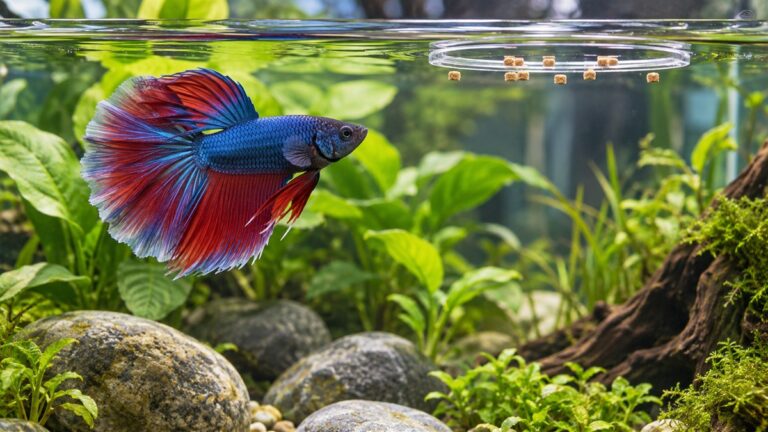
- Where does the food go? The Illinois column says leftover food sinks and hurts water quality. Look for the float behavior on the page; Tetra and Hikari state floating pellets, API says “designed to float,” and the Ocean Nutrition listing does not say.
- What are the ingredients? Compare the first few. Top Fin, BettaMin, Hikari and Ocean Nutrition open with fish meal, the Tetra pellets open with wheat flour, and the API page shows no ingredients beyond preservatives.
- How big is the bag? A 0.15 oz bag and a 2.65 oz bag are very different purchases for one fish.
For example, if you choose Ocean Nutrition at the listing maximum of 7 pellets twice daily, that is up to 14 pellets a day. If you see pellets left after the first serving, the listing’s “up to” means you can use fewer. Under the Illinois rule you would then wait for the fish to finish rather than add more.
Mistakes to avoid
- Treating a time window as an amount. “Several minutes” (Tetra), 2 minutes (API) and 3 to 5 minutes (Illinois) are not the same rule. Start small and look at the water.
- Trusting a title size. API and Ocean Nutrition both have a title that differs from the size selector.
- Letting food pile up. A test kit that reads ammonia and regular tank cleaning are how you find out whether you are feeding too much, especially in a small container such as the setups in our piece on keeping a betta in a bowl.
- Repeating health claims. Several listings say their food supports immunity or digestion. We did not check those statements, and we do not rely on them.
Who should skip this
If your betta eats its current food, you see no leftovers and the water stays clear, there is no reason to switch format. If your fish will not eat at all, this page cannot diagnose why. The Illinois column does not cover refusal to eat, so contact an aquatic veterinarian.
Frequently asked questions
Are flakes or pellets better for a betta?
The sources we opened do not say. The Illinois column accepts “pelleted or flaked” food, and UF/IFAS lists both. The practical difference is in the listing directions and in how much food ends up uneaten.
Which format has clearer feeding directions here?
Pellets. Hikari and Ocean Nutrition give pellet counts. The two flake listings give a time window or nothing.
How long should I let my betta eat?
The listings say 2 minutes (API) and several minutes (Tetra), and Hikari and Ocean Nutrition give pellet counts instead. The Illinois column says 3 to 5 minutes with no food left over. Use the shorter window if you see leftovers.
Do bettas prefer floating food?
The API manufacturer text says bettas use an “upper” mouth position to take food from the surface. The university sources we opened do not discuss it, so treat it as the manufacturer’s statement.
Can I mix flakes and pellets?
The sources we opened do not address mixing. Follow each pack’s directions and watch what is left in the tank.
Conclusion
Neither format wins on the evidence we opened. If you want a count you can follow, pick a pellet with directions: Hikari for length-based counts, Ocean Nutrition for a stated maximum, Tetra for a small bag with a feeder, or API for a 2-minute rule. If you prefer flakes, Tetra BettaMin gives a feeding window, while Top Fin gives ingredients without a direction. Start with a small amount, remove what is left and read the pack.