Best Freshwater Master Test Kit: Two Liquid Kits Compared
As an Amazon Associate we earn from qualifying purchases. Details
A freshwater master test kit measures several water parameters in one box, so you can check a betta tank before you add fish and while the fish is in it. This guide compares the two liquid master kits in the data, and it explains where a test-strip kit or a mail-in lab analysis fits better. Each card shows the listing’s own parameter list, test counts and warranty, plus its pros and cons. Testing is not optional for a betta tank. Ammonia has no smell or color even at levels that harm fish, so the only way to know its level is to test the water.
Quick answer
Choose a liquid master kit if you want the measurements to be read against a color chart, with a stated count of tests for each parameter. Both kits in this guide measure pH, nitrite, nitrate, ammonia and phosphate, with 265 measurements in total. Choose a strip kit if you want faster checks and a wider list of parameters, such as hardness, alkalinity and chlorine. Whichever format you choose, test the water during the first weeks of a new tank and any time fish behavior or appearance changes.
What a master test kit should measure
A master kit is useful only if it covers the readings you will act on. Four parameters matter most for a betta tank, and the two kits here cover three of them directly.
- Ammonia. UF/IFAS notes that ammonia is colorless and, even at levels toxic to fish, odorless. A kit must measure it, because a fish cannot warn you before the level rises. Both picks list ammonia among their parameters.
- Nitrite. UF/IFAS states that nitrite is toxic to fish at levels as low as 0.10 mg/L, so a kit that reads nitrite is essential. Both picks list nitrite.
- Nitrate. Nitrate is a later reading in the nitrogen cycle, and both picks list it as one of their five measurements.
- pH. The toxic share of ammonia depends on pH and temperature. UF/IFAS says a good ammonia test kit should include a pH test and a thermometer for that reason. Both picks list pH, but neither lists a thermometer, so buy one separately.
Phosphate is the fifth parameter in both kits. The listings describe it as part of the monitoring, but they do not describe what phosphate means for a betta tank, so treat it as an extra reading rather than a betta requirement.
Note what the two kits do not measure. Neither lists hardness, chlorine or alkalinity. Strip kits in the data cover those parameters, so the trade-off is real: a liquid master kit covers the nitrogen cycle more deeply, while a strip kit covers more parameters at a glance.
Liquid kits, strips and lab analysis
The data includes three formats, and they suit different readers.
| Format | What the listings state | Counts stated | How you read it |
|---|---|---|---|
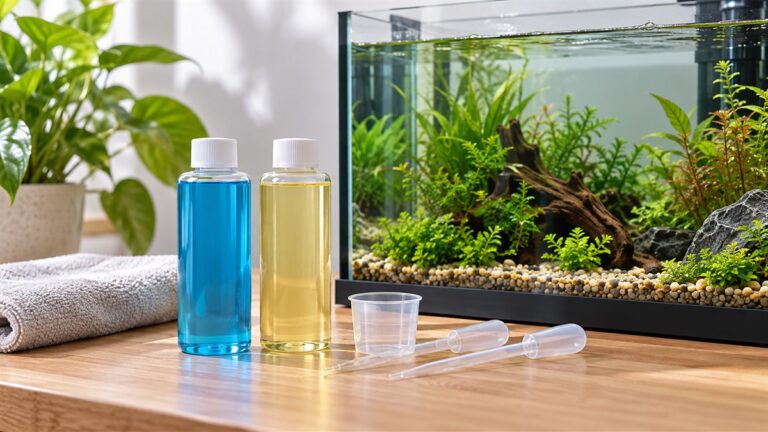
| Liquid master kit (two picks) | Five parameters: pH, nitrite, nitrate, ammonia, phosphate | 265 measurements | Compare the color with a chart |
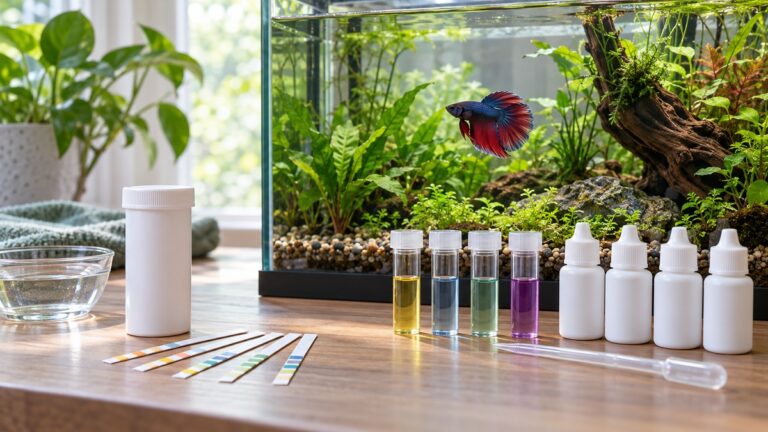
| Test-strip kits | 8 to 12 parameters per strip | 10 to 170 strips | Dip, wait, compare the pads |
| Digital app strip kit | 10 parameters with an app | 10 strips | Scan with an app |
| Mail-in lab analysis | Many elements and salinity | One test | Results come by email |
The table makes one point clear. A liquid master kit is the most focused choice for a nitrogen-cycle check on a freshwater tank. A strip kit gives more parameters per check. The mail-in lab analysis is a different service and not a home test, so it is not a pick for a betta tank.
The picks
Each card shows the listing’s specs, pros and cons. The cards are the only place this guide describes each kit.
1. Pawfly 5 in 1 Aquarium Water Master Test Kit, Fish Tank Water Testing Kit (Best liquid kit with stated counts)
Specs from the listing (checked 2026-10-11):
- Color: Blue Standard Kit Pack
- Included Components: Aquarium Water Master Test Kit
- Specific Uses for Product: Helps monitor water quality and prevent invisible water problems
- Item Weight: 10.9 ounces
- Item Package Dimensions L x W x H: 7.4 x 4.92 x 3.5 inches
- Item package dimensions: 7.4 inches long, 4.92 inches wide, 3.5 inches high
Pros
- The listing says it measures five parameters: pH, nitrite, nitrate, ammonia and phosphate.
- The bullets give 265 total measurements, with pH at 100, nitrite at 45, nitrate at 50, ammonia at 30 and phosphate at 40.
Cons
- The listing covers five parameters and does not list hardness, chlorine or alkalinity, which strip kits in the data often include.
- The listing says to compare the water's hue with the color swatches, so results depend on your eye and your light.
Best for: Owners who want a liquid kit that covers the nitrogen cycle and phosphate, with stated counts.
Skip if: You need hardness or chlorine testing in the same kit.
View on Amazon (affiliate link)
2. 5 in 1 Aquarium Water Master Test Kit, Fish Tank Testing Kit (Best liquid kit with a warranty)
Specs from the listing (checked 2026-10-11):
- Warranty Description: 1-Year Warranty
- Color: Green
- Size: Medium
- Item Weight: 6.4 ounces
- Included Components: Aquarium Water Master Test Kit
- Item package dimensions: 7.2 inches long, 4.7 inches wide, 3.5 inches high
Pros
- The listing gives a one-year warranty, which the Pawfly listing does not state.
- The bullets list the same 265 tests across pH, nitrite, nitrate, ammonia and phosphate, so the counts can be compared directly.
Cons
- The bullets describe the kit as more accurate than strips, but the listing names no test or standard for that claim.
- The listing gives no shelf life for the reagents, so note the date you open the kit and check the expiry printed on it.
Best for: Owners who want a liquid master kit with a stated warranty and the same test counts.
Skip if: You need hardness or chlorine testing in the same check.
View on Amazon (affiliate link)
How to choose
Choose by rule, and check the listing’s parameters before you order.
- Choose the Pawfly kit if you want a liquid kit that lists its measurement counts by parameter. The listing gives pH 100, nitrite 45, nitrate 50, ammonia 30 and phosphate 40, which adds to 265.
- Choose the Vaterbeing kit if you want the same five parameters with a stated one-year warranty. Its counts match the Pawfly listing, so the warranty is the main difference you will see in the listings.
- Choose a strip kit instead if you need hardness, alkalinity or chlorine in the same check. Strip kits in the data list those parameters, and the liquid kits do not.
- Choose a digital strip kit if you want to scan results with an app. The listing gives 10 strips and an app, so plan how often you will need to buy more.
- Skip the mail-in lab analysis for a betta tank that you test at home. It returns one result per sample, and it does not give a quick check.
Keep one rule in mind for every format. A test shows the water at one moment. A betta tank changes over days, so the schedule of tests matters as much as the kit you buy.
How to read a liquid kit
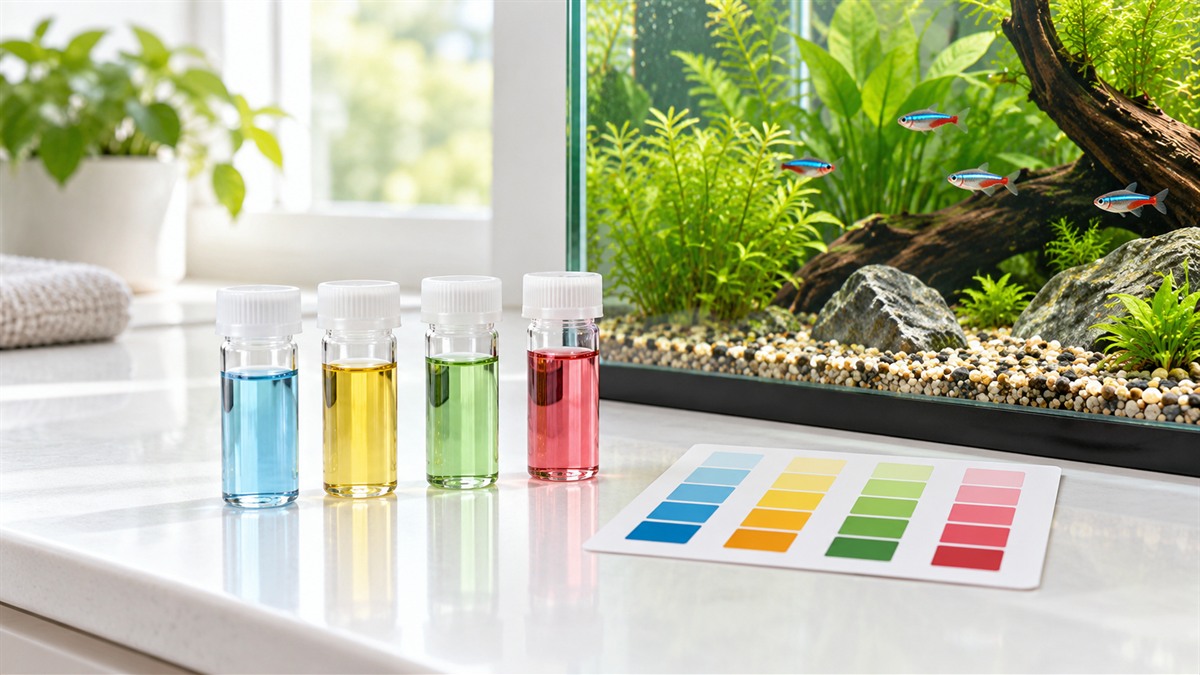
The listings say that you compare the color of the water sample with a chart. The steps below are general guidance for liquid tests, not claims from the listing. Follow the instructions printed on the kit.
- Rinse the test tube with clean water from the tank, not tap water, so the sample is not changed.
- Add the reagent in the amount the instructions give, and cap the tube before shaking.
- Hold the tube against a white background in good light, and compare the color with the chart at the time the instructions give.
- Write down the reading and the date, so you can see the trend over several tests.
Read the chart in good light, because a dim room can make two colors look the same. If a reading is unclear, repeat the test with a fresh sample before you act on it.
Worked example: how many tests a schedule uses
Each test uses one reading per parameter. Two tests times 5 parameters equals 10 readings in a week. Ten readings times 6 weeks equals 60 readings for the start-up period.
Now compare that with the listed counts. The kit’s counts are per parameter, so the ammonia count of 30 is the limit on ammonia readings, not on weeks. Divide the ammonia count by your planned ammonia readings: 30 divided by 2 equals 15, which is the number of weeks of twice-weekly ammonia tests the kit would cover. Do the same arithmetic for each parameter you test often. The result shows which reading runs out first.
Test before a betta goes in
Test the water before you add the fish, and test again after the first few days. UF/IFAS states that a new biofilter needs six to eight weeks to build up enough bacteria to reduce ammonia and nitrite, so the readings may change over that period. Keep a log of each result, and do not add the betta until the readings are steady.
UF/IFAS also recommends weekly ammonia testing in a production system, and immediate testing whenever fish appearance or behavior changes, including reduced feeding. That guidance is for production systems, but it is a useful model for a home betta tank: test weekly, and test right away if your betta stops eating or changes its color.
Be careful with some treatments. UF/IFAS notes that Nessler’s method can give a falsely elevated ammonia reading after formalin use within 24 to 72 hours, and with ammonia-binding products and many water conditioners. The ammonia salicylate method is not affected by those. If you use a treatment or a conditioner, check which method your kit uses.
Keep a simple test log
Write each result in a notebook or a phone note, with the date, the time, the parameter and the color you matched. A log shows a trend that a single reading hides. A slow rise in ammonia across three tests tells you more than one high number on one day.
Add notes for anything that changed that day. Record a water change, a new decor piece, a new fish, a treatment or a missed feeding. When a reading moves, the note often points to the cause.
Keep the kit in a cool, dry place away from direct sunlight, and close the caps tightly after each use. Note the date you open each reagent, since the listings give no shelf life, and replace any reagent that looks cloudy or has changed color on its own.
Mistakes to avoid
- Testing once and assuming the tank is safe. A tank changes over days. Test on a schedule, and keep a record.
- Ignoring the chart’s light. Colors look different in dim light or under a warm lamp. Read the chart by a clean white background.
- Reading a result after a treatment without checking the method. Some ammonia readings are affected by formalin and by ammonia-binding products. Check your kit’s method before you trust a reading.
- Expecting a master kit to test everything. Neither liquid kit in this guide lists hardness, chlorine or alkalinity. Use a strip kit or a separate test if you need those.
- Using a lab result as a daily check. A mail-in analysis gives one result after a delay. It cannot tell you what the tank did last night.
FAQ
Do I need a master test kit for a betta?
You need some way to test the water. A master kit covers the nitrogen cycle and pH, which are the readings most useful for a betta tank. A strip kit can cover more parameters, but it may not give the same depth on ammonia and nitrite.
How often should I test a betta tank?
UF/IFAS recommends weekly ammonia testing in production systems, and immediate testing when fish appearance or behavior changes. Test more often during the first six to eight weeks of a new tank, when the biofilter is still building up.
Why does ammonia matter more than the other readings?
UF/IFAS notes that ammonia is colorless and odorless even at toxic levels, so testing is the only way to know it is present. The toxic share also rises with pH and temperature, which is why a good kit includes a pH test and a thermometer.
Is a liquid kit more accurate than strips?
The Vaterbeing listing says the liquid reagents are more accurate than traditional strips, but it names no test or standard for that claim. Treat it as the listing’s claim. Both formats can be useful, and the right choice depends on the parameters you need.
Do these kits measure hardness or chlorine?
The two liquid picks here measure five parameters, and neither covers hardness, chlorine or alkalinity. Strip kits in the data list those parameters, so choose a strip kit if you need them.
What if my reading looks wrong?
Repeat the test with a fresh sample, and check the instructions for the timing and the lighting. If the reading stays unusual and your betta looks unwell, consult an experienced fish keeper or an aquatic vet. Do not dose a medication based on a test result alone.
Can I use the kit for a planted tank?
The listings describe their kits for freshwater tanks, and the same readings apply to a planted tank. Keep the nitrogen-cycle readings in mind, and test before and after any change to the plants or the light.
Bottom line
For a betta tank, a freshwater master test kit should cover ammonia, nitrite, nitrate and pH, and the two liquid kits here do. Choose the Pawfly kit or the Vaterbeing kit if you want a color-chart test with stated counts. Choose a strip kit if you also need hardness, alkalinity or chlorine. Test before the betta goes in, test through the first six to eight weeks, and test right away if your fish stops eating or changes behavior.
For related setup reading, see best aquarium heater for betta fish for heating, best ammonia test kit for aquarium for a focused ammonia check, and best way to clean a betta fish tank for routine water care.
Source notes: the ammonia, nitrite, pH, thermometer, biofilter and treatment-interference points come from UF/IFAS, written for aquaculture and hobbyist systems. Apply the production-system timing as a model, not as a fixed rule for a home tank.
Sources
- UF/IFAS: Ammonia in Aquatic Systems: ammonia is odorless and colorless at toxic levels, nitrite is toxic at 0.10 mg/L, and a new biofilter takes six to eight weeks to build up.
- UF/IFAS: Ammonia in Aquatic Systems: a good ammonia kit includes a pH test and a thermometer, and some ammonia methods are affected by formalin and ammonia-binding products.