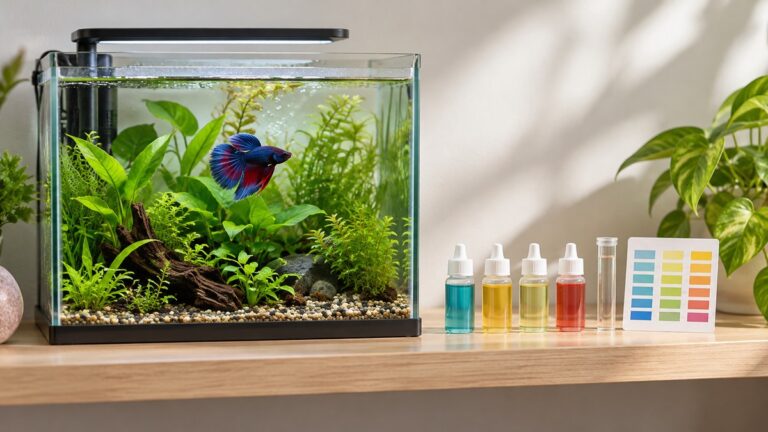
Best Electronic Aquarium Tester for a Freshwater Betta Tank
As an Amazon Associate we earn from qualifying purchases. Details
An electronic aquarium tester gives a digital number where a color chart or test strip asks you to match a color by eye. This guide covers the two electronic testers built for aquariums in this comparison, explains which readings matter for a freshwater betta tank, and shows where a digital tester stops being enough. Tolerance is not the same as good water, so a reliable reading helps you catch problems early. Figures below come from each listing. Check the listing before you buy, because listings change.
Quick answer
For a freshwater betta tank, the first pick is the better fit if you want pH and temperature readings you can check from a phone. Choose it only if you will keep its probe calibrated and clean. Choose the second pick only if the tank is marine or brackish, because a freshwater betta tank has no salt level to track. Neither electronic tester replaces an ammonia or nitrite test. The first pick’s listing links ORP to ammonia and nitrite, but it does not list an ammonia or nitrite reading. Keep a dedicated ammonia test kit in the cabinet.
What matters for an electronic tester
- Freshwater or saltwater. A betta lives in freshwater, so salinity and specific gravity readings have little use in that tank. Those readings matter for marine and brackish aquariums.
- Which readings you get. For a betta tank, pH and temperature are the readings to watch first. TDS, which measures dissolved solids, can add context. Check which readings the listing names and which it leaves out.
- Calibration and consumables. Calibration is part of the routine, not a one-time step. The first pick’s listing includes a three-point calibration kit and says the EC calibration solution is sold separately.
- Probe placement. The first pick’s listing asks for a spot with consistent flow to get accurate readings. Place the probe where water moves steadily, not in a still corner of the tank.
- Power and alerts. The first pick’s listing describes app, phone and text alerts for values you set. The second pick runs on two AAA batteries and turns off after 60 seconds of inactivity, according to its listing.
Why pH and temperature change the answer
Ammonia is colorless and, even at levels toxic to fish, odorless, so the only way to know whether ammonia is present is to test the water. That single fact is the main reason an electronic tester cannot be the whole tank check.
Whether ammonia harms fish depends on more than the total amount. Un-ionized ammonia is about 100 times more toxic to fish than ionized ammonium, and the share of un-ionized ammonia rises with higher pH and higher temperature. That is why a good ammonia test kit includes a pH test and a thermometer. A pH or temperature reading from an electronic tester is useful context for that calculation. It is not an ammonia reading. If you want a closer look at the pH side on its own, the pH test kit guide covers that choice.
Nitrite matters too. Nitrite is toxic to fish at levels as low as 0.10 mg/L. A new biofilter takes six to eight weeks to build up enough bacteria to reduce ammonia and nitrite. During that window, you need direct readings for ammonia and nitrite, and these electronic testers do not list either one among their readings.
The same UF/IFAS guide says nitrifying bacteria need oxygen and alkalinity to work. If oxygen falls, the bacteria can stop working or die, and ammonia and nitrite levels rise. In the aquaculture setting of that guide, dissolved oxygen should be monitored and raised if it falls below 5 mg/L. A home betta tank differs from a production system, so treat that number as context, not a home target.
Water changes and ammonia-binding products can reduce ammonia toxicity in the short term. For long-term control, the same guide says a properly designed and sized biofilter is the better answer. A monitor helps you notice a pH or temperature change that affects that balance. It does not build the biofilter.
How to choose between the two
Choose the first pick if all of these are true: your tank is freshwater, you want pH and temperature readings between your manual checks, you will calibrate the probe on a schedule, and you want alerts on your phone.
Choose the second pick if your tank is marine or brackish and you need specific gravity and salinity readings. Skip it for a betta-only freshwater tank, since its three readings are aimed at salt water.
Choose neither as a replacement for a test kit. A kit that reads ammonia and nitrite covers the gap a monitor leaves open. If you can afford only one purchase for a new betta tank, the ammonia and nitrite test comes first, and an electronic monitor is an add-on.
What to check on the listing before you buy
Read the listing for these points before you buy any electronic tester, and compare the answers with your tank type. Size and weight differ too: the first pick’s package weighs 1.34 pounds, and the second pick’s item weighs 8.8 ounces.
- Which readings it names. A betta tank needs pH and temperature. Salinity-only meters do not cover pH.
- Calibration parts. Confirm whether the calibration powders or solutions are included. The first pick includes pH and ORP powders, but the EC solution is separate.
- Power source. The first pick’s specs do not name a power source, so check the listing for batteries or an adapter before you plan a mounting spot.
- Probe care. The first pick’s listing tells you to replace the probe protective cap before use. Confirm that the cap and probe are what you expect when the box arrives.
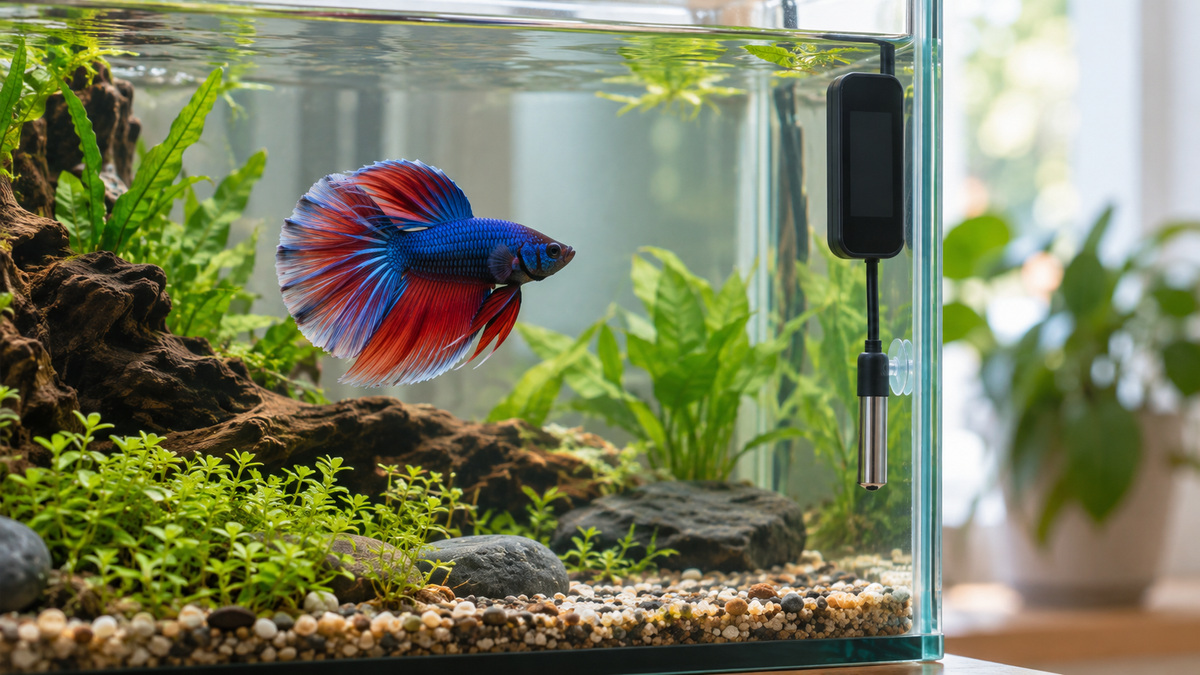
- Probe type and mounting. Check whether the probe sits in the water on a cable or clips to the tank. The listing describes a placement with consistent flow for accurate readings.
- Freshwater label. A tester labeled for salt water or a pool may not suit a betta tank, even when it mentions aquariums.
The two picks
The first pick: continuous freshwater readings
The first pick reads pH, ORP, salt, specific gravity, TDS, EC and temperature in one unit, according to its listing. For a betta tank, pH and temperature are the readings to watch. Its calibration kit includes pH powders for 4.01, 6.86 and 9.18 and a 256 mV ORP powder, so you can run a three-point calibration. The app alerts are its main reason to buy, but they depend on a probe that stays clean and calibrated. Do not choose it if you want one quick check now and then with no setup.
The second pick: marine and brackish salinity
The second pick is a pen-type meter with three readings: specific gravity from 1.000 to 1.045, salinity from 0 to 55 ppt, and temperature. Its listing describes automatic temperature compensation and a low battery indicator. Those readings suit a marine reef tank, which the listing names as a use. They do not help a freshwater betta, because a freshwater betta tank has no salinity to measure. Keep it for a tank that holds salt water, and see the salinity tester guide for more choices in that group.
1. Kactoily Smart Aquarium Monitor All in One pH/ORP/Salt/S.G/TDS/EC/Temp 24h Online Freshwater (Best for continuous freshwater readings)
Specs from the listing (checked 2026-10-13):
- Item Form: Device
- Model Number: KY-YGWIFI-07US
- Package Dimensions: 9.21 x 6.02 x 2.24 inches; 1.34 pounds
Pros
- The listing says you can set minimum and maximum values in the Tuya Smart app and get alerts by app, phone or SMS.
- The listing includes calibration powders for pH 4.01, 6.86 and 9.18, plus 256 mV ORP powder, for three-point calibration.
- The listing covers pH, ORP, salt, specific gravity, TDS, EC and temperature in one unit.
Cons
- The listing says the EC calibration solution is not included and must be bought separately.
- The listing tells you to replace the probe protective cap before use.
- The specs do not name a power source, so check the listing for batteries or an adapter.
Best for: Keepers who want readings they can watch from a phone and who will calibrate the probe.
Skip if: Skip it if you want one quick check now and then with no setup, or if you do not want an app and probe maintenance.
View on Amazon (affiliate link)
2. Digital Salinity Meter 3-in-1 Saltwater Tester – Specific Gravity, Salinity & Temperature Pen (Best for marine and brackish salinity checks)
Specs from the listing (checked 2026-10-13):
- Item Weight: 8.8 ounces
- Material: Silica Gel
Pros
- The listing gives specific gravity from 1.000 to 1.045, salinity from 0 to 55 ppt and temperature readings.
- The listing says it turns off automatically after 60 seconds of inactivity and shows a low battery indicator.
- The listing says it runs on 2 AAA batteries.
Cons
- Its three readings are salinity-related, so a freshwater betta tank gets little use from it.
- pH, ammonia and nitrite are not among its readings.
- Its temperature readings are given in degrees Celsius, so check that your thermometer scale matches.
Best for: Keepers of marine or brackish tanks who need specific gravity and salinity readings.
Skip if: Skip it for a freshwater betta tank, where pH and ammonia tests tell you more.
View on Amazon (affiliate link)
Worked example: a new five-gallon betta tank
The biofilter needs six to eight weeks to build up enough bacteria in a 5 gallon betta tank. Work out the reading count for both ends of that window.
At six weeks, 6 x 7 = 42 days, so you take 42 pH and temperature readings before the biofilter is expected to be established.
At eight weeks, 8 x 7 = 56 days, so you take 56 readings for the same window.
Those 42 to 56 readings give you a pH and temperature history. They do not tell you the ammonia or nitrite level. For that, you still need a kit that reads both, on the days you choose.
Common mistakes
- Reading pH as ammonia. pH changes how much ammonia is the toxic form, but pH alone does not tell you how much ammonia the tank holds.
- Skipping calibration. The first pick’s kit is built around three-point calibration. Readings taken without that routine are harder to trust.
- Buying salinity gear for a freshwater tank. The second pick measures salt-related values that a freshwater betta tank does not contain.
- Testing a new biofilter with no ammonia data. A new biofilter needs six to eight weeks, so early pH readings do not show whether it is working.
- Trusting one ammonia method after a treatment. The UF/IFAS guide says Nessler’s method can read falsely high after formalin use within 24 to 72 hours, and with ammonia-binding products and many water conditioners. The salicylate method is not affected by those products. Ask an aquatic vet about any treatment before you change the tank.
- Using antibiotics without checking the biofilter. The same guide says some disease treatments, especially antibiotics, can harm the nitrifying bacteria in a biofilter. Ask an experienced fish keeper or an aquatic vet before you treat a sick fish.
A simple routine that uses both
The UF/IFAS guide suggests weekly ammonia checks in a production system, so a fixed weekly day is a sensible starting point for a home tank too.
Read the monitor’s pH and temperature every day, and write each reading in a notebook with the date. The notebook shows the trend, and the trend is what the monitor is good for. When the pH reading rises, the toxic share of any ammonia present rises too, so check the ammonia result from that same day rather than guessing from the monitor alone.
Keep the routine short. A monitor that you calibrate and read every day is more useful than one you set up once and forget. A test kit you run on the same day each week is more useful than one you run only after a problem appears.
FAQ
Can an electronic aquarium tester replace an ammonia test?
No. Ammonia is odorless and colorless even at toxic levels, so testing the water is the only way to know it is there. The first pick’s listing links ORP to ammonia and nitrite, but a dedicated ammonia test is still the direct check.
Which readings matter most for a freshwater betta tank?
For most freshwater betta keepers, pH and temperature are the two readings to watch on an electronic tester, because the toxic share of ammonia depends on both. Ammonia and nitrite still need their own tests.
Do I need a salinity meter for a betta tank?
Usually not. A freshwater betta tank has no salt level to track. Salinity and specific gravity readings belong to marine and brackish tanks.
How often should I check my readings?
In the aquaculture setting of the UF/IFAS guide, ammonia is tested once a week and immediately when fish look or behave differently, including reduced feeding. Use that rhythm as a starting point for a home tank, and test more often while the biofilter is still forming.
Do I need to calibrate a monitor probe?
Yes, if you want its readings to mean much. The first pick’s listing includes a three-point calibration kit, so calibration is part of its routine. Replace the probe protective cap before use, as the listing says.
Can a water conditioner change an ammonia reading?
It can. Nessler’s method can read falsely high after formalin use within 24 to 72 hours, and after ammonia-binding products and many water conditioners, according to the UF/IFAS guide. The salicylate method is not affected by those. Read your test’s directions before you trust a number taken after a treatment.
Who should I ask about treating a sick betta?
Ask an experienced fish keeper or an aquatic vet. This guide does not give treatment or dosing advice.
Bottom line
For a freshwater betta tank, start with an ammonia and nitrite test you can read at home. Add the first pick only if you want pH and temperature readings between checks and will keep its probe calibrated. Skip the second pick unless the tank holds salt water.
Sources
- UF/IFAS, Ammonia in Aquatic Systems (FA31): ammonia and nitrite toxicity, pH and temperature effects, test methods, biofilter timing, oxygen and antibiotic cautions.