Estes Stoney River Premium Aquarium Sand: Listing Review
As an Amazon Associate we earn from qualifying purchases. Details
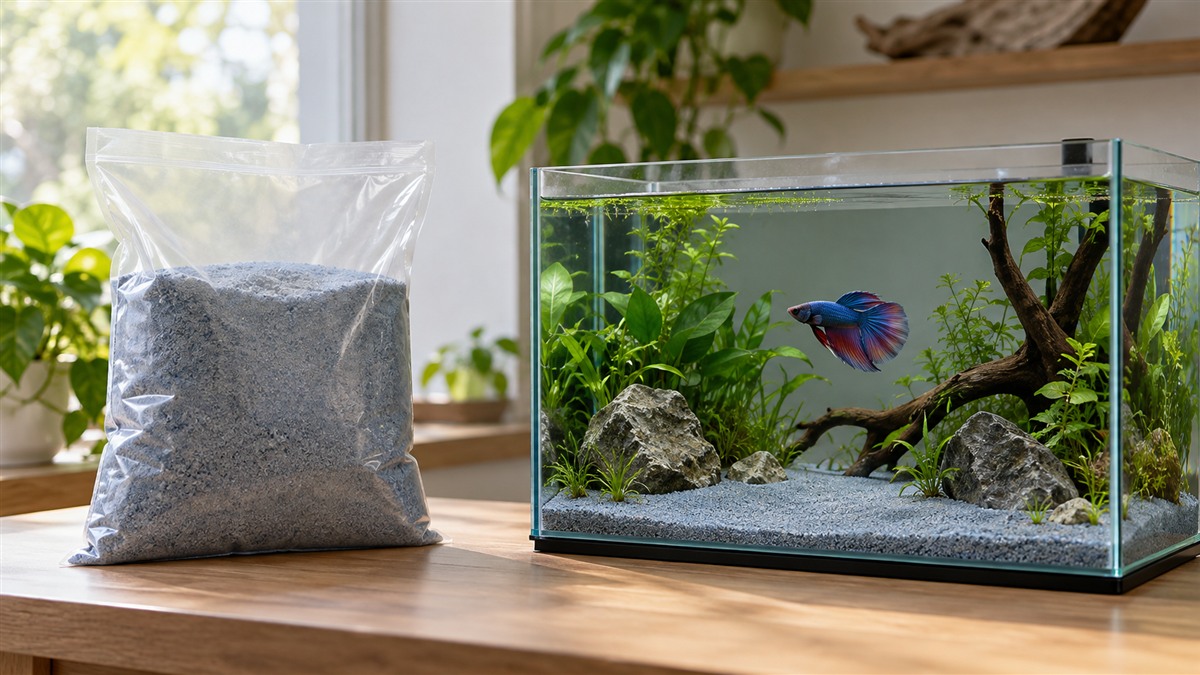
If you are looking at Estes Stoney River premium aquarium sand, this guide covers the one listing in this set that carries the Stoney River name. It is a 5-pound bag of blue aquatic sand sold for freshwater and marine aquariums. The listing says it will not affect pH and is safe for freshwater aquariums. This guide sets out what the listing states, what it leaves open, and what to check before you put sand in a betta tank. It keeps to what the listing says and does not add claims from outside it.
Quick answer
Buy this listing only if you want a 5-pound bag under the Stoney River name and you will confirm the pH claim in your own tank. Skip it if you need a stated grain size, because the specs give none. The listing’s own words are the source for the pH and freshwater claims. For a betta, water chemistry matters more than the sand, so check your readings after setup and before you add fish.
What the listing states
The listing’s brand field reads Spectrastone, and its manufacturer field reads Estes Gravel Products. The product is sold under the Stoney River name. Both names appear as written, so use them as the listing gives them.
The weight and size fields agree. The item weight field gives 5 pounds, the unit count field gives 80 ounces, and the package dimensions are 10 x 7 x 1 inches. Five pounds is 80 ounces, so those two figures match.
The bullet points make three claims. The listing says the sand will not affect pH, that it is safe for use in freshwater aquariums, and that it has a non-toxic coating. Each one is the listing’s own claim. None of them is a measurement you can check from the box.
The allergen field reads Abalone Free. That is a label, not a measurement of how the sand behaves in a tank.
What the listing leaves open
The specs give the item form as granules, but they give no grain size. Grain size affects how the sand packs, how it settles, and how easily debris sits on top. Without that number, you cannot compare this bag with another sand on size alone.
The color is listed as blue in the title and as marine blue in the included component text. The specs do not show a finished color photo or a swatch range, so the color you see may differ from the name.
The listing does not describe a depth for a betta tank. Depth depends on your tank footprint, so measure the footprint before you buy. Rinsing and handling details are not in the listing either. Check the manufacturer’s instructions before use.
1. Stoney River Blue Aquatic Sand Freshwater and Marine Aquariums, 5-Pound Bag (The only listing under the Stoney River name)
Specs from the listing (checked 2026-10-13):
- Item Weight: 5 pounds
- Unit Count: 80 Ounce
- Product Dimensions: 10 x 7 x 1 inches; 5 pounds
Pros
- The listing says it will not affect pH.
- The listing says it is safe for use in freshwater aquariums.
- The listing names a non-toxic coating.
Cons
- The specs give no grain size, only the item form as granules.
- The color appears as blue in the title and as marine blue in the included component text, with no swatch.
- The pH and safety statements are the listing's own claims and need a test in your tank.
Best for: Keepers who want a 5-pound bag under the Stoney River name for a freshwater or marine tank.
Skip if: Skip it if you need a stated grain size or a color you can confirm from the specs.
View on Amazon (affiliate link)
Sand and a betta tank
Sand is a substrate choice, and the choice does not change the basic water rules. Ammonia is colorless and odorless even at toxic levels, so the only way to know whether it is present is to test the water. The toxic share of ammonia rises with higher pH and higher temperature.
That is why the pH claim in this listing needs your own test. A sand that does not affect pH is a useful claim, but a claim is not a reading. Test the water after you set up the tank, and again on a schedule.
A new biofilter needs six to eight weeks to build up enough bacteria to reduce ammonia and nitrite. Sand does not shorten that window. Plan your first fish after the biofilter has had time to develop, and test during that period.
For a single betta, the tank itself should be large enough for the fish. This site’s guidance is a tank of at least 5 gallons, and the what size aquarium for betta fish guide walks through the choice.
Worked example: splitting the bag between two tanks
The bag holds 80 ounces, so each tank gets half of it.
80 ounces / 2 = 40 ounces per tank.
Each tank would get 40 ounces, which is half of the bag. Whether that depth works depends on the footprint of each tank, which you should measure before you pour. A shallow layer over a small footprint uses less sand than a deep layer over the same footprint.
Mistakes to avoid
- Buying on the name alone. Several sand listings use similar names. Compare the brand, the manufacturer, and the weight before you order.
- Trusting the pH claim without a test. The listing says it will not affect pH. Confirm that in your own water before you add fish.
- Skipping the layout check. Measure the tank footprint and plan the depth first, rather than pouring the whole bag and adjusting later.
- Forgetting the cleaning routine. A sand bed needs maintenance. The how to gravel vac sand guide covers the cleaning side of that routine.
FAQ
Is this sand safe for a betta?
Its listing calls it safe for freshwater aquariums. Check the manufacturer’s manual for use details, and test your water after setup before you add a fish.
Will this sand change the pH of my tank?
Its listing claims it will not affect pH. Treat that as the listing’s claim, and confirm it with your own test. The ammonia toxicity question depends on pH, so the test matters.
How much sand do I need?
The bag is 5 pounds, which the listing gives as 80 ounces. How much you need depends on the footprint and depth you choose. Measure the tank before you buy.
Is sand better than gravel for a betta tank?
That is a separate choice with its own trade-offs. The sand vs gravel for freshwater aquarium guide compares the two.
Why do the brand and manufacturer names differ?
Both are printed on the listing, and the product is sold under the Stoney River name.
Does the listing call this sand premium?
The listing’s text does not use the word premium. The word in the keyword comes from how people search for the product, not from the listing itself.
Bottom line
Buy the listing if its facts fit your tank: a 5-pound bag, a freshwater or marine use, and a pH claim you will confirm with your own water test. Skip it if you need a stated grain size or a color you can confirm from the specs.
Sources
- UF/IFAS, Ammonia in Aquatic Systems (FA31): ammonia toxicity depends on pH and temperature, and biofilter timing.