Best Large Aquarium Air Pumps
As an Amazon Associate we earn from qualifying purchases.
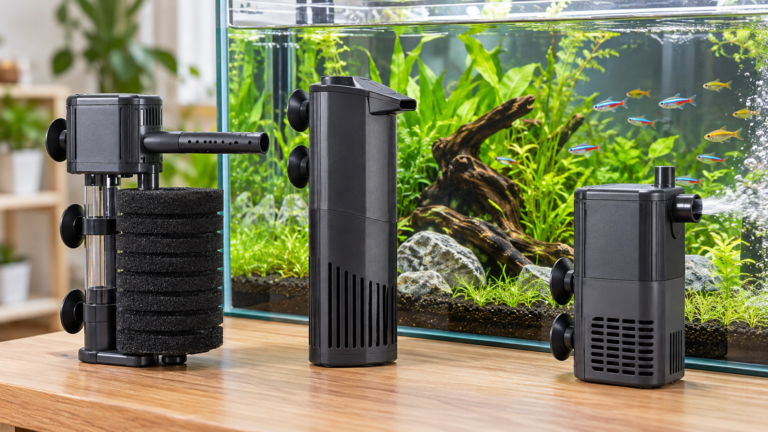
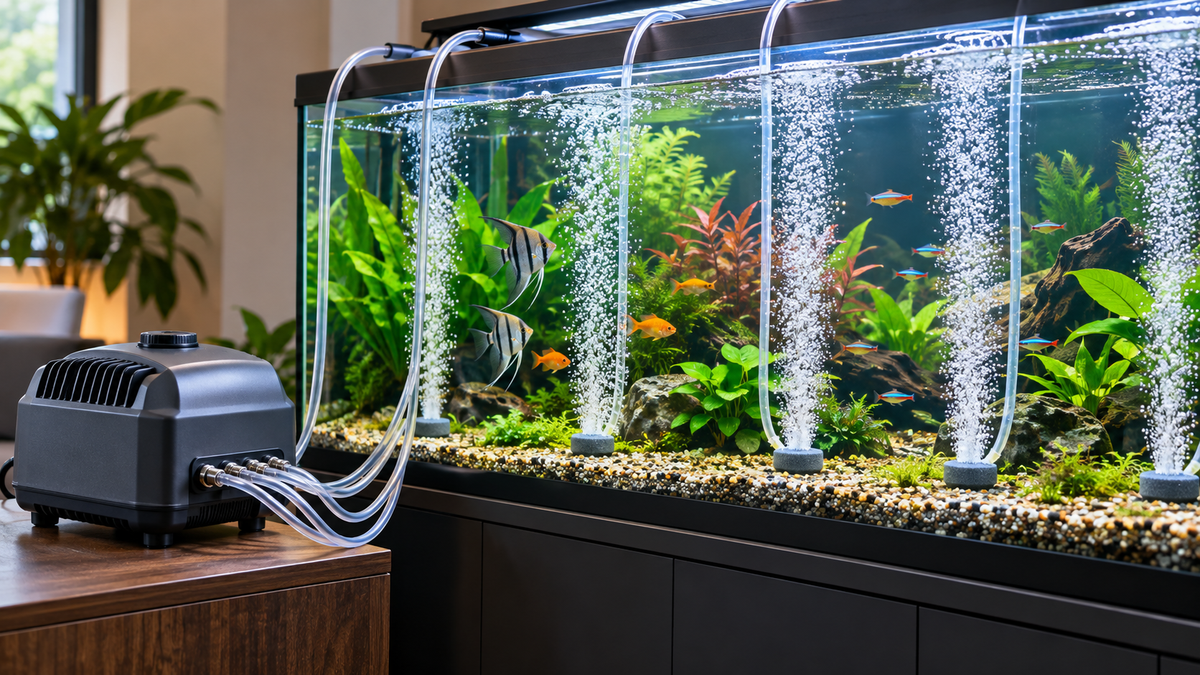
A large aquarium air pump is only as useful as the air-driven equipment it has to run. Start by counting every sponge filter, air stone and breeder box that needs air, then compare each pump’s stated airflow, pressure, wattage and outlet count. For one large display tank with two air-driven devices, the hygger HG219 dual-outlet pump is the most practical starting point in this group. For four separately adjustable branches, the AQQA 10W four-outlet kit fits better. The AquaMiracle ACO001 and VIVOSUN commercial pumps make sense only for high-demand systems that can tolerate heat, noise and a ventilated installation area.
Quick answer
- Best for one large display with two outlets: hygger HG219 4W dual-outlet pump.
- Best complete two-line kit: Uniclife 4W pump with two air stones, 6.5 feet of tubing, two check valves and two connectors.
- Best for four balanced branches: AQQA 10W four-outlet pump with a four-outlet manifold and individual regulators.
- Best stated airflow per watt among the calculated pumps: AquaMiracle ACO001, 600 GPH on 18 W.
- Best for six branches in a ventilated room: VIVOSUN 25W commercial pump, with its conflicting airflow figures flagged before you buy.
Large aquarium air pumps compared
The table below uses only the figures stated on each product’s Amazon page. Where a page contradicts itself, the conflict is shown rather than silently corrected. Stated airflow is a maximum under the seller’s test conditions, so treat it as a comparison point and not as delivered flow at your tank depth.
| Product | Stated airflow | Stated pressure | Power | Outlets | Included with the pump | Best fit |
|---|---|---|---|---|---|---|
| Uniclife UL080 | 64 GPH | 0.016 MPa | 4 W | 2 | 2 air stones, 6.5 ft tubing, 2 check valves, 2 connectors | Basic two-line setup |
| hygger HG219 | 360 L/h (listed as 95 GPH) per outlet, read with caution | 20 kPa (0.02 MPa) | 4 W | 2 | 2 air stones, 2 tubes of 4.9 ft, 2 check valves, manual | Adjustable large display |
| AQQA GUS-AQ067-10W | 237 GPH (10W model) | 0.026 MPa (10W model) | 10 W | 4 | Short tube, 4-outlet manifold, 4 check valves, 4 × 2 m tubes, 4 air stones | Several branches |
| AquaMiracle ACO001 | 600 GPH; 2270 L/h in the specification table | 0.02 MPa (20 kPa) | 18 W | 6 | Air manifold and air pump | Commercial use in a ventilated room |
| VIVOSUN 634 GPH | Conflicting: 634 GPH in the title, 40 L/min in the specification table, 25 L/min in a bullet | Up to 0.03 MPa in a bullet | 25 W | 6 | Air pump only | High-demand manifold in a ventilated area |
Two rows need a warning label. The VIVOSUN page gives three different airflow values, and the title’s 634 GPH is close to the 40 L/min specification (about 634 GPH), while the bullet’s 25 L/min (about 396 GPH) is far lower. The hygger page states 360 L/h in its specification table and “95GPH(360L/H)*2” in a bullet, which can mean 95 GPH per outlet or 190 GPH across both outlets. Neither ambiguity is resolved by the page, so the comparison below uses conservative assumptions and says so.
Product picks
1. hygger HG219 dual-outlet pump: best for one large display
The hygger HG219 gives the most useful combination for a single large display. It has two stainless-steel outlets, a control knob, two check valves, two air stones and two 4.9-foot tubes. Its specification table lists 4 watts, a maximum pressure of 20 kilopascals and a 1-year warranty, and it is listed for fish tanks up to 120 gallons. The bullets describe a double-layer housing, a thickened ABS shell and four shockproof rubber pads intended to reduce motor noise, with a stated maximum of 35 dB.
Two outlets let you run one air stone near each end of a long tank, or a sponge filter alongside a separate diffuser. The knob matters more than the headline maximum. Clockwise increases airflow and counterclockwise reduces it, and the page specifically mentions freshwater fish, saltwater coral and hydroponic setups. A large pump connected to a gentle betta-friendly setup can create excessive bubbling or lift water through a sponge filter too aggressively if it cannot be turned down. Start at a low setting and increase it only until the air-driven equipment works properly.
The housing claims a noise ceiling, but noise figures from different sellers are not measured under identical conditions. Placement often changes the result more than the rating does. A pump that rests on a hollow cabinet, touches a wall or sits against a loose cord can sound louder than its specification suggests. Use the rubber feet, keep the body clear of surrounding objects and check the knob position before judging the noise.
Limitation: the “95GPH(360L/H)*2” wording is ambiguous. It may describe capacity per outlet rather than a total measured under working backpressure. The page also lists a 5.9-foot power cord and US 110–120 V operation, so confirm the cord reaches your outlet before buying.
Skip if: you need four or six separately controlled branches, or the device you plan to run requires a pressure specification beyond what the page provides.
2. Uniclife UL080 64 GPH: best complete two-outlet kit
Uniclife packages a 4-watt pump with two air stones, 6.5 feet of airline tubing, two check valves and two connectors. The bullets state a maximum flow of 64 GPH, a pressure of 0.016 MPa and suitability for 10- to 100-gallon fresh or marine aquariums. The title says 5- to 200-gallon, so the bullet’s narrower range is the safer planning figure. A rotary knob adjusts both outputs together, which is simpler than balancing separate valves.
This is the easiest product in the group to understand as one basic installation. The included parts cover two air lines without an immediate search for valves, tubing or stones. For a beginner who wants to run two sponge filters, or a filter plus a bubbler, that complete set of parts is often worth more than a higher unloaded airflow figure. Keep in mind that the knob controls the whole pump, so one branch cannot be trimmed without affecting the other.
The bullets state 25 dB on low and up to 45 dB at maximum output, and they note that the figures were measured with experimental equipment and may deviate from actual use. A specific maintenance point is also written into the listing: the air intake cotton can block, reducing output, and the buyer should replace it when airflow drops. Check that cotton before assuming the motor has failed.
Limitation: 64 GPH is far below the commercial pumps, and the single rotary knob gives less control than a manifold with a valve for each branch.
Skip if: you intend to supply several deep tanks, long bubble walls or more than two independent devices.
3. AQQA 10W four-outlet pump: best for four balanced branches
The 10-watt AQQA model bridges ordinary dual-outlet pumps and metal-bodied commercial units. Its bullets state 237 GPH and 0.026 MPa for the 10W version, and the kit includes a four-outlet manifold, four check valves, four 2-meter tubes and four air stones. The page also describes an in-line switch that can be turned to adjust airflow or stop it, plus an air volume regulator on each outlet of the metal manifold.
Individual regulators are what make this pump useful for mixed branches. A sponge filter in a deeper tank may need a different valve position from a small air stone in a shallow aquarium. Separate valves let you balance visible output at each branch rather than forcing every line to share one setting. The bullets also say the copper-wire motor and rubber cup are designed for steadier output than a traditional diaphragm pump, though that claim is the seller’s and has not been tested here.
The page advertises the 10W model for up to 600 gallons and the 15W model for up to 1000 gallons. Do not treat those as guarantees that a 600-gallon installation will be adequately aerated. Depth, diffuser resistance, livestock load and the number of connected devices all change delivered airflow.
Limitation: the specification table has unit fields that do not match the bullets. It lists 356 gpm and 0.03 kilopascal, while the bullets assign 356 GPH and 0.03 MPa to the 15W model. This comparison uses the 10W bullet figures, 237 GPH and 0.026 MPa, because they belong to the model being compared.
Skip if: you only need one quiet air stone in a small aquarium. A four-branch system adds tubing, valves and adjustment work you will not use.
4. AquaMiracle ACO001: best stated airflow per watt
The AquaMiracle ACO001 is an 18-watt commercial pump with a stated 600 GPH flow, 0.02 MPa pressure and a 120-volt AC plug. Its specification table lists 2270 liters per hour, which matches the 600 GPH bullet closely. It includes a chrome-coated metal manifold with six outlets, and each outlet has its own adjusting knob. The housing is aluminum with an enlarged surface intended to dissipate heat. The page says the pump is lubricant-free and includes a 1-year warranty.
On the listed numbers, this model supplies the highest airflow per watt in our calculation: 600 divided by 18 is 33.3 GPH per watt. That metric is useful for comparing electrical input with headline output, but it is not a promise of airflow at the end of six loaded lines. Backpressure and depth reduce what reaches each diffuser.
The bullets advise a well-ventilated location and note that a cooling fan may extend the pump’s life. That is a real installation constraint. A metal commercial pump should not be hidden in a sealed cabinet simply because its tubing can reach the aquarium. The title also lists 600, 1000, 1200 and 1750 GPH variants, so confirm that the item you buy is the 600 GPH ACO001 described in the bullets.
Limitation: the included components are the pump and manifold. The listing does not include airline tubing, check valves or air stones, so budget for a complete branch on each outlet you use.
Skip if: the pump must sit in a bedroom, inside an enclosed stand, or beside a single low-demand display tank.
5. VIVOSUN 634 GPH: best six-branch high-demand pump
The VIVOSUN commercial pump uses a 25-watt electromagnetic motor and six adjustable valve outlets. Its bullets say it is compatible with 1/4-inch airlines and that it runs continuously, and the page describes aluminum alloy heat-radiating plates, a metal manifold and a copper outlet nozzle. It is positioned for aquariums, ponds, hydroponics, fish farms and seafood restaurants, and the bullets state a noise level under 60 dB.
The airflow figures do not agree. The title says 634 GPH, the specification table says 40 liters per minute, and a bullet says 25 L/min. Forty liters per minute is about 634 GPH, so the title and specification table roughly agree, while the bullet describes a much smaller pump. Because the page is inconsistent, this comparison does not rank VIVOSUN on airflow per watt. What can be compared is its physical design and its six-outlet format.
The stated noise ceiling is substantially higher than the low figures claimed for the small hygger and Uniclife pumps, although cross-listing sound measurements are not standardized. For a fish room this may be acceptable. Next to a bed or a work desk, it deserves careful consideration. The page also lists only the pump, so you will need tubing, check valves and stones for every branch.
Limitation: the conflicting airflow values prevent a clean capacity or efficiency conclusion. Ask the seller to confirm the flow rate before relying on it for a planned manifold.
Skip if: quiet domestic placement matters more than running six lines, or you cannot provide an open, ventilated installation area.
Airflow per watt: an original calculation
The largest headline number is not always the most useful one. To make the comparison less dependent on title wording, we divided each coherent stated airflow figure by its wattage:
Airflow efficiency = stated maximum GPH ÷ stated watts.
| Pump | Calculation | Stated airflow per watt | Important caveat |
|---|---|---|---|
| Uniclife UL080 | 64 ÷ 4 | 16.0 GPH/W | Maximum bullet output with the cotton clear |
| hygger HG219 | 190 ÷ 4 | 47.5 GPH/W | Assumes “95 GPH × 2” means 190 GPH total, which the page does not confirm |
| AQQA 10W | 237 ÷ 10 | 23.7 GPH/W | Four loaded branches will add resistance |
| AquaMiracle ACO001 | 600 ÷ 18 | 33.3 GPH/W | Unloaded maximum, consistent across the bullets and specification table |
| VIVOSUN 634 GPH | Not calculated | Not comparable | Title, specification table and bullet give different airflow values |
This table does not tell you which pump will deliver the most air at a particular depth. It exposes the uncertainty instead. Pressure, tubing length, valve position, diffuser condition and the number of branches all influence delivered flow. A modest pump with a clear pressure rating can outperform a larger headline number in a restrictive setup.
The hygger row is the one most likely to mislead. If its per-outlet reading is correct, the total is 190 GPH and the efficiency is high for a 4-watt pump. If the 95 GPH figure already describes the pump as a whole, the efficiency is about 23.8 GPH per watt. Either way, the pump’s knob and the number of connected devices will decide the practical result more than the rating does.
How to size a large aquarium air pump
Count devices, not just gallons
Write down every sponge filter, air stone, ornament and breeder box that needs air. One 120-gallon display with two stones is a different job from twelve 10-gallon tanks with twelve sponge filters. Outlet count and distribution hardware often determine the correct pump before the aquarium volume does. Tank size is a rough starting point; the air demand comes from the devices.
Account for depth and resistance
An air pump has to push air against the water column, and then through tubing, valves and diffusers. A long bubble wall or a clogged air stone can create more backpressure than a small open diffuser. Pondkeeper’s description of a check valve makes the same point from the plumbing side: the valve is meant to sit anywhere along the airline without affecting air flow in a meaningful way, but every fitting still adds some restriction. The Tetra Q&A also notes that a pump losing power or becoming very loud may have a worn rubber diaphragm, which is one reason to keep a spare pump on hand for critical systems.
Choose controllable surplus
A small reserve is useful when stones age or you add a second device, but uncontrolled excess is noisy and can produce unwanted water movement. Prefer an adjustable pump or a properly configured manifold. Follow the pump manual rather than pinching tubing to reduce output. Restricting the outlet with a clamp forces the pump against resistance it was not designed to handle, and the Uniclife listing’s own guidance points toward keeping the intake clear, not toward strangling the line.
To find the real reserve, open one branch at a time and observe the device at its installed depth. If the last branch causes every earlier sponge filter to weaken, the system has no usable reserve even though bubbles remain visible. Conversely, a manifold that must bleed a large amount of air for ordinary operation suggests the pump is larger than the present setup needs.
Separate aeration from filtration
Bubbles are not a complete filter. Aqueon’s guide explains that an air pump drives a sponge filter by drawing water through the sponge, where foam provides mechanical and biological filtration. If the pump only feeds a decorative stone, the aquarium still needs its own filtration and a maintenance plan. The general air-pump guidance on Aqueon’s page also says aeration helps maintain dissolved oxygen, which is a supporting benefit rather than a substitute for filtration or water changes.
For a betta-scale setup, the same reasoning applies on a smaller scale. Our guide to canister filters for aquariums compares a different filtration route, and our betta fish tank setup guide shows how air-driven equipment fits into a complete tank.
Safe installation for a large air system
- Keep the pump dry and ventilated. Do not place a non-submersible air pump where splashes can reach it, or inside a closed space that traps heat. The AquaMiracle page specifically recommends a well-ventilated location.
- Use check valves in the correct direction. Pondkeeper describes a non-return valve that stops water flowing back into the pump if the power fails. Use one on every line where the pump could end up below the water level.
- Connect every port you intend to use. The Tetra Q&A states that a two-port pump becomes very loud if tubing is not attached to both ports, so either connect both lines or leave the spare port closed by design.
- Create a drip loop. Route the power cord below the outlet before it rises to the plug. Follow the manufacturer’s electrical instructions for any cord length you add.
- Place the pump on a stable surface. Rubber feet cannot isolate vibration if the housing touches a wall, a stand panel or a loose object. The hygger page describes rubber pads for this reason, but they only help when the pump is free of contact.
- Avoid kinked tubing. A pinched line increases resistance and makes branch balancing misleading. Trace every line before adjusting a valve.
- Keep the intake clear. The Uniclife listing warns that blocked intake cotton can reduce output and recommends replacing it. Check the cotton whenever airflow drops.
- Open and balance branches gradually. Begin with valves open enough to avoid severe restriction, then make small changes while watching each driven device.
Common problems and what to check first
The pump is louder after installation
Check whether the housing touches a stand, wall or cord, whether a line is kinked, and whether a diffuser is clogged. Excessive backpressure makes the motor work harder, so inspect each branch before assuming the motor has failed. A pump that is very loud or has lost power may have a worn diaphragm, as the Tetra guidance notes.
Output is weaker than expected
Begin with the intake cotton, then the knob or manifold valve, then each stone. A stone that has aged or a tube that has been pinched can take away more air than a small change at the pump will restore. Compare the same branch before and after each change.
One branch starves when another opens
This is a balancing problem. Use the individual valve on the starving branch rather than the pump knob alone, and recheck the other devices after each adjustment. A multi-outlet pump gives you more ways to balance; a single-knob pump gives you fewer.
How we chose
We selected five pumps that cover distinct large-system needs rather than five near-identical units. The priorities were stated airflow, stated pressure, wattage, outlet count, adjustment method and included parts such as check valves, stones and tubing. Product claims come only from each product’s Amazon page. Prices, star ratings, review counts and sales ranks were not used.
Where a page disagreed with itself, we showed the disagreement rather than correcting it. That applies to the VIVOSUN airflow values, the hygger per-outlet wording and the AQQA unit fields. Manufacturer and aquarium-care guidance was opened on October 27, 2026, and it was used only to explain how air pumps are installed and maintained.
What we could not verify
None of the five product pages gives a shared test standard for delivered airflow at the same water depth, tubing length and backpressure. Noise claims also lack a common measurement distance and room condition, so headline GPH and decibel figures should not be read as laboratory-equivalent comparisons.
We could not verify how evenly each manifold divides air when every branch carries a different load. The pages do not give diaphragm replacement intervals, and the commercial pumps do not state a replacement schedule for their air stones or valves. Tank-volume claims also ignore stocking density, temperature and the oxygen demand of individual systems.
FAQ
Does a bigger aquarium always need a bigger air pump?
No. The required pump depends on the number and resistance of the air-driven devices, the depth of the water and the circulation already provided by filtration. A large aquarium with strong surface agitation may need less supplemental air than a rack of small tanks running several sponge filters.
Can one large pump run several fish tanks?
Yes, if the pump has adequate pressure and airflow and the system uses a suitable manifold, individual valves and check valves. Plan every branch and leave room to balance them. A failure of the shared pump affects every connected tank, so critical systems need an outage plan.
How many outlets should I buy?
Buy for the number of devices, not the number of aquariums. One tank may use two sponge filters, and each branch may serve one device. Avoid filling every port on an oversized manifold merely because the ports exist, since unused open ports can make a pump louder.
Why does my large air pump sound louder after installation?
The housing may be touching the stand or wall, a line may be kinked, a diffuser may be clogged or a valve may be creating backpressure. Check external contact and every branch before deciding the motor is at fault.
Should the pump sit above or below the aquarium?
Follow the model’s manual. When a pump is at or below the water line, back-siphoning is a specific risk, and a check valve in the line is the usual protection. Keep the unit dry, provide a drip loop and never place it where aquarium water can drip onto it.
Does an air pump add oxygen directly through bubbles?
Its main practical benefit is water movement and surface agitation, which help gas exchange, according to the general guidance we read. A stone also circulates water, and a pump can drive a sponge filter. The visible quantity of bubbles alone is not a complete measure of oxygen conditions in the tank.
Bottom line
Choose the smallest adjustable pump that can run every planned device at the required depth, with a sensible reserve. Pick the hygger HG219 for a two-line large display, the Uniclife kit for a complete basic setup, the AQQA 10W for four balanced branches, and the AquaMiracle or VIVOSUN commercial pumps only when a six-line, high-demand system justifies the extra airflow, heat and noise.
Sources
- Pondkeeper, “Pondxpert Electroair 4mm Check Valve,” opened October 27, 2026: https://www.pondkeeper.co.uk/pondxpert-electroair-4mm-check-valve/p3261
- Aqueon, “Ultimate Fishkeeping Guide,” opened October 27, 2026: https://www.aqueon.com/ultimate-fishkeeping-guide
- Tetra, “Aquarium Q&A,” opened October 27, 2026: https://tetra-fish.com/learning-center/getting-started/aquarium-qa