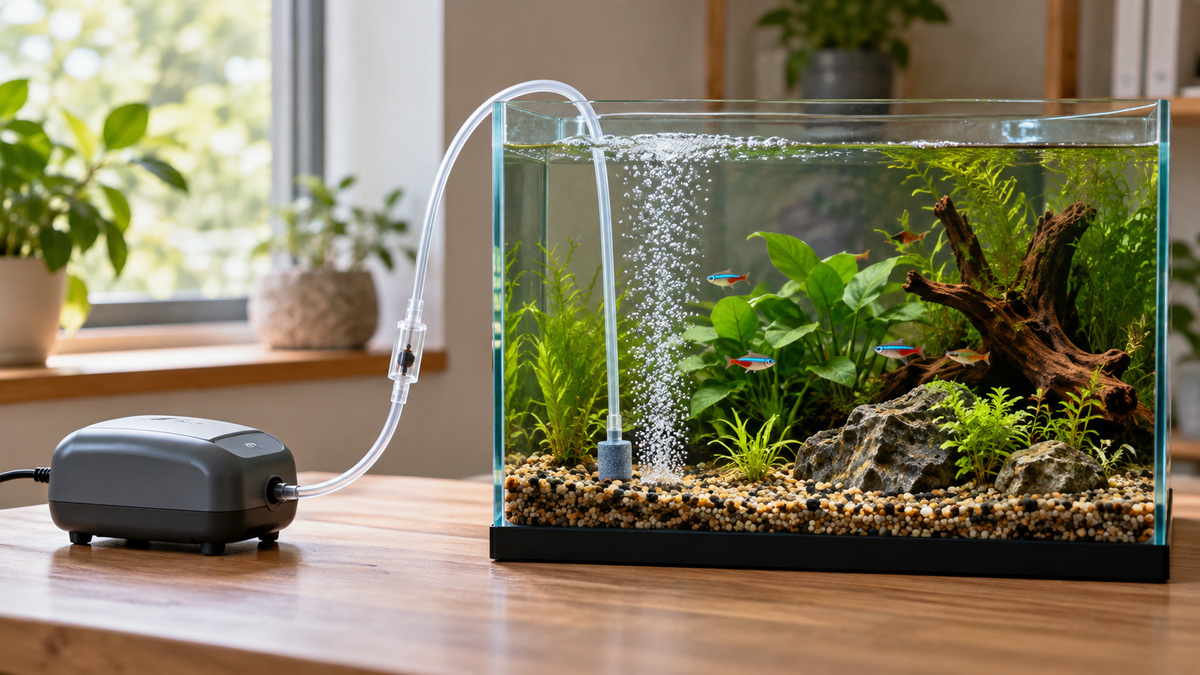
Best Air Pumps for Freshwater Tank: Sizing by Volume, Air Stone and Check Valve
As an Amazon Associate we earn from qualifying purchases. Details
The best air pumps for freshwater tank setups are the ones whose stated tank size covers your tank and whose stated airflow can feed every air stone or sponge filter you plan to run. Nine of the twelve listings in this set name a tank size in the title or bullets, and the stated airflow runs from about 0.45 to 38 liters per minute. That spread is why tank volume should come before brand. This guide sorts the pumps by tank volume, works through the air stone and check valve set-up, and says plainly what the listings and the university pages we opened do not cover.
Quick answer
- Match the tank size first. Choose a pump whose stated range contains your tank volume. Uniclife and JOR state different tank sizes in the title and the bullets, and the Tetra bullet describes a family of sizes, so read both before you order.
- Count the outlets and devices. The pumps here have one outlet (Aqua Culture), two (Uniclife and HITOP), four (Active Aqua) or six adjustable valve outlets (Simple Deluxe). Aqua Culture also says it runs up to three air-powered devices.
- Put a check valve in the line. Five listings name a check valve in the package: Aqueon, Uniclife, Aqua Culture, HIERYAN and the Pawfly air stone. The Aqua Culture bullet gives the reason, which is to stop water siphoning into the pump during a power outage.
- Treat airflow as a planning number. The listings do not measure oxygen in the water. A university aquaculture guide says aeration should keep dissolved oxygen above 60 percent of saturation, so check the water as well as the pump.
Start with tank volume, not the pump name
Each listing states its numbers in a different place. Some give a tank range in the title, some in a bullet, some only in the specification sheet, and three give no tank size at all. Table 1 puts the figures side by side. Where a row gives two numbers, both are kept, because the difference changes which pump fits.
Table 1: Stated tank size and airflow by listing
| Listing | Tank size as stated | Airflow as stated |
|---|---|---|
| Tetra Whisper pump | Up to 60 gallons (title); bullet lists 10 to 100 gallon models | 2.6 liters per minute (specification) |
| Active Aqua 4-outlet pump | Not stated | 15 liters per minute, 240 GPH (bullet) |
| Aqueon QuietFlow 10 | 2 to 10 gallons (title and bullet) | Not stated |
| Uniclife dual-outlet pump | 5 to 200 gallons (title); 10 to 100 gallons (bullet) | 64 GPH (bullet); 64 gpm (specification) |
| Aqua Culture single-outlet pump | 5 to 15 gallons (title and bullet) | 1200 cc per minute (title and specification) |
| HITOP dual-outlet pump | 10 to 100 gallons (title and bullet) | 5 liters per minute (specification) |
| Simple Deluxe six-outlet pump | Not stated | About 38 liters per minute (bullet and specification) |
| JOR 1.3 W mini pump | 20 gallons (title); up to 15 gallons (bullet) | 450 milliliters per minute (bullet and specification) |
| HIERYAN sponge kit with oxygen pump | 1 to 10 gallons (bullet, for the mini filter) | Not stated |
| XINYOU sponge filter, not a pump | Up to 10 gallons (bullet) | Not applicable |
| UPETTOOLS sponge filter, not a pump | 10 to 40 gallons (title and bullet) | Not applicable |
| Pawfly air stone, not a pump | Not stated | 1.5 liters per minute maximum (bullet) |
Three listings give no tank size: the Active Aqua pump, the Simple Deluxe pump and the Pawfly air stone. For the two pumps, the volume match has to come from the airflow and from your own tank, not from a stated range.
Volume arithmetic
A US gallon is 3.785 liters, so a 10-gallon tank holds 10 x 3.785 = 37.85 liters. The listings give airflow in liters per minute, so the conversion puts the tank and the pump on the same scale.
Divide the listed airflow by the top of the stated tank range to get a planning ratio in liters per minute for each gallon. This is our arithmetic. No listing or university page gives it:
- Aqua Culture: 1.2 / 15 = 0.08 liters per minute for each gallon.
- Tetra: 2.6 / 60 = 0.043 liters per minute for each gallon, although the 2.6 figure is not tied to a size in the listing.
- HITOP: 5 / 100 = 0.05 liters per minute for each gallon.
- JOR, using the 20 gallon title: 0.45 / 20 = 0.0225 liters per minute for each gallon.
The same HITOP pump gives 5 / 10 = 0.5 liters per minute for each gallon at the bottom of its range. The ratio falls tenfold across that range, so a single figure taken from the top of a range says little about a small tank.
A higher ratio does not mean more oxygen in the water. The aquaculture guide we opened sets its target in dissolved oxygen, not in airflow: “The level of aeration should be sufficient to sustain dissolved oxygen levels above 60% saturation throughout the system.” The ratio is a way to compare pumps on paper, and nothing more.
Three tank sizes worked through
A 10-gallon tank. Aqueon (2 to 10 gallons), Aqua Culture (5 to 15), Uniclife (5 to 200 in the title, 10 to 100 in the bullet), HITOP (10 to 100) and the HIERYAN kit (1 to 10 for its mini filter) all state a range that includes 10 gallons. The JOR bullet also includes it, although its title says 20.
A 20-gallon tank. Tetra (up to 60), HITOP (10 to 100), Uniclife (5 to 200 in the title, 10 to 100 in the bullet) and the JOR title (20 gallons) all include 20. The JOR bullet says up to 15 gallons, so JOR is the one to confirm before you buy. Aqueon (2 to 10) and Aqua Culture (5 to 15) do not include 20.
A 40-gallon tank. Tetra (up to 60), HITOP (10 to 100) and Uniclife (both of its ranges) include 40 gallons. The Tetra bullet describes its 40 gallon pump with a single outlet, so check the outlet count for the size you buy. Active Aqua and Simple Deluxe state no tank size, so their fit for 40 gallons cannot be checked from the listing.
Electrical use: what the watt figures add up to
Watts measure the power a pump draws, and airflow measures the air it moves. The listings give both, and they are not the same measure. Five pumps state a usable watt figure: Simple Deluxe at 18 W (bullet), Active Aqua at 6 W (specification), Uniclife at 4 W (bullet), HITOP at 3 W (specification) and JOR at 1.3 W (bullet). Aqueon’s specification gives a battery capacity of 1.5 watts beside a corded power source, which does not square with a mains pump, so we did not use it.
The UF/IFAS 4-H marine guide states the basic need: “You will need to have access to a power outlet.” The pages we opened say little more about power, so the rest of this section relies on the listings. The Uniclife bullet says its figures were measured with experimental equipment and may deviate from actual data, so treat its wattage as the listing’s own figure.
The running figures below assume 24 hours a day. That is our planning assumption, not a figure from any listing or guide:
- Simple Deluxe: 18 x 24 = 432 watt-hours a day. 432 / 1000 = 0.432 kWh a day. 0.432 x 30 = 12.96 kWh over 30 days.
- Active Aqua: 6 x 24 = 144 watt-hours a day. 144 / 1000 = 0.144 kWh a day. 0.144 x 30 = 4.32 kWh over 30 days.
- JOR: 1.3 x 24 = 31.2 watt-hours a day. 31.2 / 1000 = 0.0312 kWh a day. 0.0312 x 30 = 0.936 kWh over 30 days.
At rated watts, the 18 watt pump draws 13.8 times the power of the 1.3 watt JOR, since 18 / 1.3 = 13.8. The listings carry no price, and this guide uses no electricity rate, so these figures measure energy only and say nothing about a running cost.
How the pumps differ on noise and design
Three listings give a decibel figure, and all three are the listing’s own numbers. Active Aqua states a maximum of 45 decibels. Uniclife states 25 decibels on its low setting and a maximum of 45 decibels. Simple Deluxe states less than 60 decibels. Tetra, Aqua Culture, HITOP and JOR describe quiet operation in words such as quiet, whisper and ultra quiet, with no decibel figure. Every noise figure in this guide comes from the listings alone, and the three decibel figures do not say how they were measured.
The bullets describe the drive in different ways. Active Aqua has a special synthetic rubber diaphragm. JOR has a thin piezoelectric ceramic plate. Simple Deluxe names an electromagnetic air pump with a steel cylinder piston. Tetra describes a patented dome-shaped suspended motor. These are the listings’ own words, and they do not tell you how loud, how strong or how long-lived any pump will be.
Air stone and check valve set-up
The set-up order is simple, and the university guide puts the air line early. VM144 lists the parts of a simple home set-up: “The main components of a simple home aquarium set up include the tank itself, a stand, a cover, lighting, a heater, an air pump, and filtration.” It then gives the order for air: “The aquarium should then be filled to the desired depth and air connected prior to adding fish.” So connect the air before any fish go in.
Five listings name a check valve. The Aqua Culture bullet gives the reason: “Check valve included to prevent the siphoning of water into the pump in the event of a power outage.” Uniclife’s package has two check valves. HITOP’s package has two return valves, which the listing names separately, so do not count them as check valves without checking the package.
The listings do not say how high to place the pump relative to the water. The check valve is the only placement-related function they name, so pump height is one of the things this guide could not verify.
The aquaculture guide makes one warning that applies to a stone placed in a filter: “Vigorous aeration of submerged filter beds is not recommended because beneficial bacteria can be dislodged from the substrate decreasing the filter’s effectiveness.” That guide covers recirculating aquaculture systems, so read the warning as a reason, not a rule for your tank. Our set-up reasoning from it is to aim a strong stone’s stream away from the biological media, and to turn the air down where the stone feeds a sponge or media filter. The reasoning is ours, not the guide’s.
Three listings give an adjustment. Active Aqua’s airflow “can be easily adjusted with the pressure dial”. Uniclife has a rotary knob that controls the air for its two outputs. HITOP has manually adjustable air volume and two air regulating valves.
Measure the run before you order. The listings give these lengths: Simple Deluxe 25 feet of 1/4 inch tubing; Uniclife 6.5 feet; HITOP two tubes of 4.9 feet in the bullet and 5 feet in the specification; JOR 39.4 inches; HIERYAN 40 inches. The Pawfly connector fits 3/16 inch tubing. The Active Aqua specification lists a 4 foot hose, while its bullet calls the 4 foot length a cord, so check the package before you assume a hose length.
Common mistakes
- Reading a title range as the whole answer. Uniclife and JOR give tank sizes in the title that their bullets do not repeat.
- Counting a sponge filter as a pump. XINYOU and UPETTOOLS are filters, and the UPETTOOLS bullet says its filter must be used with an air pump.
- Ranking decibel figures against each other. Three listings give decibel figures, and none says how its figure was obtained.
- Reading airflow as oxygen. Liters per minute is the air the pump moves, not the dissolved oxygen in the water, and the aquaculture guide sets its target in dissolved oxygen.
- Forgetting the stone’s pump requirement. The Pawfly stone needs a pump larger than 2 W and does not include one.
How to choose in five steps
- Write the tank volume in gallons and in liters. A 10-gallon tank is 10 x 3.785 = 37.85 liters.
- Keep the pumps whose stated tank range contains your tank, and read the title and the bullets for each.
- Count the air devices you will run, including stones, sponge filters and ornaments, and match that count to the outlet count or the stated device limit.
- Check for a check valve and measure the tubing run before you order.
- Once the pump is running, check the water. The listings do not measure oxygen, and the aquaculture guide says dissolved oxygen should be kept above 60 percent of saturation and checked from time to time.
For a quiet-first shortlist, see best super silent air pump for fish tank. For a small bowl, see best small air pump for fish bowl. For the set-up steps beyond the air line, see setting up an air pump in an aquarium.
1. Tetra Whisper Air Pump for Aquariums Up to 60 Gallons, Non-UL (Dome-motor pump, size range in title)
Pros
- The bullets name a patented dome-shaped motor and sound-dampening chambers for quiet operation.
- The bullets name a separate size for each model, from 10 to 100 gallons.
Cons
- The title says up to 60 gallons, but the bullets say the 60 and 100 gallon models have dual outlets, so this listing's own size is unclear.
- The listing gives no watt figure and no decibel level.
Best for: a planned 10 to 40 gallon tank with one air line, once the outlet count is confirmed on the listing
Skip if: you need a wattage or decibel figure to compare against other pumps
View on Amazon (affiliate link)
2. Active Aqua 4-Outlet Air Pump, 6W, 15 L/min, Silver/Grey, Aquarium Aerator (Four outlets, 15 liters per minute)
Pros
- The bullet states 15 liters per minute, which is 240 GPH, and four outlets for several air devices.
- The bullet gives a maximum noise level of 45 decibels, one of three decibel figures in this set.
Cons
- The listing names no tank size, so the volume match has to come from your own tank.
- The specification lists a 4 foot hose, but the bullet calls the 4 foot length a cord.
Best for: a buyer who wants four air outlets from one pump and a stated decibel ceiling
Skip if: you need a tank size printed on the listing, because none is stated
View on Amazon (affiliate link)
3. Aqueon QuietFlow Aquarium Air Pump 10, For 2-10 Gallon Tanks, Black (Small upright pump with check valve)
Pros
- The title and bullet both give a fit for 2 to 10 gallons.
- The bullets say each pump includes a replaceable check valve, diaphragm and dust filter pad.
Cons
- The listing gives no airflow figure in its title, bullets or specification.
- The specification lists a battery capacity of 1.5 watts beside a corded power source, which we cannot reconcile.
Best for: a 2 to 10 gallon tank where a check valve and a dust filter pad come in the same package
Skip if: you need a flow number to size the pump, because the listing does not state one
View on Amazon (affiliate link)
4. Uniclife Aquarium Air Pump Dual Outlet Fish Tank Aerator with Accessories for 5-200 Gallon Tank (Dual outlet, two check valves)
Pros
- The bullet gives 25 decibels on the low setting and a maximum of 45 decibels, both as listing figures.
- The package names two air stones, a 6.5 foot tube, two check valves and two connectors.
Cons
- The title says 5 to 200 gallons, while the bullet says 10 to 100 gallons.
- The bullet gives 64 GPH for airflow, but the specification sheet gives 64 gpm.
Best for: a dual-outlet set-up that needs a rotary air control and check valves in the box
Skip if: you need one consistent flow figure, because the listing gives two units
View on Amazon (affiliate link)
5. Aqua Culture 5 – 15 Gallon Single Outlet Aquarium Air Pump with Check Valve. Easy To Set Up. Air (Single outlet, check valve, 5 to 15 gallons)
Pros
- The title and bullet both give a 5 to 15 gallon fit, and the title gives 1200 cc per minute.
- The bullet says the check valve prevents water siphoning into the pump during a power outage.
Cons
- The bullet says it runs up to three air-powered devices, so a larger air set-up falls outside the listing.
Best for: a 5 to 15 gallon tank with one or two air devices and a check valve in the line
Skip if: you need more than three air devices or a second outlet
View on Amazon (affiliate link)
6. HITOP Dual Outlet Aquarium Electric Air Pump, Whisper Adjustable Fish Tank Aerator, Quiet Oxygen (Dual outlet, 3 W, adjustable air)
Pros
- The title and bullet both give a 10 to 100 gallon fit, and the bullet gives 3 W.
- The package includes two return valves, two air stones, two tubes and two air regulating valves.
Cons
- The specification gives 5 liters per minute, but the bullets give no airflow figure.
- The bullets describe the noise as ultra quiet and whisper, with no decibel figure.
Best for: a dual-outlet set-up that needs air adjusted separately for each stone
Skip if: you need a decibel figure, because the listing gives none
View on Amazon (affiliate link)
7. Simple Deluxe Air Pump with Adjustable Air Flow Outlets for Aquarium, Fish Tank and Hydroponic (18 W, six outlets, about 38 liters per minute)
Pros
- The bullet and specification both give about 38 liters per minute of air.
- The bullets name six adjustable valve outlets and 25 feet of 1/4 inch tubing.
Cons
- At 18 watts it has the highest stated power draw in this set, which matters most for electricity use among these pumps.
- The listing gives no tank size, so the volume match is not stated.
Best for: several air-powered devices in a larger tank, where airflow matters more than power draw
Skip if: you run one small air stone in a small tank, because the listing gives no tank size to match against
View on Amazon (affiliate link)
8. JOR 1.3W Aquarium Air Pump, Aerator with Accessories for 20-gal Fish Tank (1.3 W mini pump for bowls and small tanks)
Pros
- The bullet gives 1.3 watts and 110 volts, the lowest stated power figure among the pumps here.
- The kit includes a suction cup, two air stones and two silicone tubes.
Cons
- The title says 20 gallons, while the bullet says tanks up to 15 gallons.
- The stated flow is 450 milliliters per minute, the lowest airflow of the pumps in this set.
Best for: a small bowl or tank with one air stone, where low power draw is the first priority
Skip if: you run several air stones on a 20 gallon tank, because the stated airflow is the smallest in this set
View on Amazon (affiliate link)
9. HIERYAN Super Mini Aquarium Single Sponge Filter with Oxygen Pump (Sponge filter kit with oxygen pump)
Pros
- The title and package list say an oxygen pump comes with the mini sponge filter.
- The package includes a 40 inch hose, an air stone and a check valve.
Cons
- The listing gives no airflow figure and no watt figure for the pump.
- The filter is sized for 1 to 10 gallon bowls and small tanks, so it does not suit a larger tank.
Best for: a 1 to 10 gallon bowl or small tank that needs a filter and an air pump in one kit
Skip if: you need a pump for a larger tank, because the kit is sized for 1 to 10 gallons
View on Amazon (affiliate link)
How we chose
The twelve listings come from the product catalog for this keyword, which was checked on 2026-10-20. The title, bullets and specification fields were the only product text used, and we did not open any product page. The catalog stores no price or rating for these listings, so none was used. We did not rank by sales rank or availability.
We kept all twelve. Nine are pumps or pump kits. The other three are two sponge filters and an air stone, and each needs a pump. They are labeled as such and placed last, so no one reads them as a pump. The selection questions were these, in order: is the item a pump or does it include one, does the listing state a tank size, does it state airflow or watts, and does it name a check valve, an outlet count or a tubing length.
What we could not verify
- Product pages. We did not open the twelve product pages, so materials and warranty terms beyond the listing fields are not covered here.
- Airflow at a set pressure. Pressure figures come in psi, kilopascal, megapascal and pascal, and no listing gives airflow at a stated pressure.
- Decibels. The three decibel figures come from listings that do not say how they were measured. The Uniclife bullet says its figures came from experimental equipment and may differ from actual data.
- Wattage. Five pumps state a usable watt figure. Aqueon’s battery figure conflicts with its corded power source, and Tetra, Aqua Culture and the HIERYAN pump state no watt figure.
- Tank size conflicts. Uniclife, JOR and Tetra give tank sizes that differ between the title and the bullets, so the stated range for each is unclear.
- Active Aqua hose or cord. The specification and the bullet describe the same 4 foot length in different words.
- Oxygen in the tank. No listing measures dissolved oxygen. The university pages we opened describe aquaculture systems and set their oxygen target for those systems, not for a betta or a community tank.
- Pump height. The listings do not say how high to place a pump relative to the water.
- Running cost. The listings carry no price, and this guide uses no electricity rate.
- Tetra flow. The 2.6 liters per minute figure is not tied to a tank size, so the ratio above for Tetra is only a rough comparison.
- Warranty figures. Warranty lengths such as 90 days, one year, 180 days and six months are the listings’ own claims.
FAQ
How many air devices can one pump run?
The listings give outlet counts, not device counts, except Aqua Culture, which says it runs up to three air-powered devices. Active Aqua has four outlets, Simple Deluxe has six valve outlets, and Uniclife and HITOP have two outlets each. Count your stones, sponge filters and ornaments, and keep that total within the outlet count. The listings do not say how much air each device uses.
Do I need a check valve?
Five listings name one. The Aqua Culture bullet gives the reason: water siphoning back into the pump during a power outage. The listings do not say whether your set-up needs one. Because they also do not say where the pump sits, this guide gives no placement rule.
How much electricity does a pump use?
Use the watt figure from the listing and multiply it out. For the 18 W Simple Deluxe, 18 x 24 = 432 watt-hours a day, which is 0.432 kWh. Over 30 days, if it runs around the clock, that is 12.96 kWh. Only five pumps in this set state a usable watt figure, and those figures are the listings’ own.
Where should the air stone go?
The listings do not state a placement. The aquaculture guide says aeration must keep dissolved oxygen up for both the fish and the biological filter, and it warns that vigorous aeration of filter beds can dislodge beneficial bacteria. Our placement reasoning from that warning is to keep a strong stream away from the biological media. That reasoning is ours, not a figure from the guide.
Do the sponge filters in this set come with a pump?
Two do not. The UPETTOOLS bullet says its filter must be used with an air pump, and the XINYOU listing does not say a pump is included. The HIERYAN kit includes an oxygen pump. The UF/IFAS 4-H marine guide defines a sponge filter as a filter that provides both mechanical and biological filtration. That definition comes from a marine guide, so it describes the filter type and not a freshwater rule.
Bottom line
Choose the pump whose stated tank range contains your tank and whose outlet count covers every air device you plan to run. Check the check valve and the tubing run before you order, and treat the listed airflow as a planning number rather than a measure of oxygen.
Sources
- UF/IFAS 4-H Marine Aquarium Project Book, 4H433: the power outlet requirement and the sponge and mechanical filter definitions; a marine guide, used for those lines only
- UF/IFAS VM144, Aquarium Setup and Maintenance (archival PDF): the parts of a simple set-up, the air connected before fish, and mechanical filter maintenance
- UF/IFAS FA12, Principles of Water Recirculation and Filtration in Aquaculture (PDF): aeration and dissolved oxygen, and the warning on vigorous aeration of filter beds; an aquaculture guide
- UF/IFAS FA31, Ammonia in Aquatic Systems: dissolved oxygen and nitrifying bacteria; an aquaculture guide