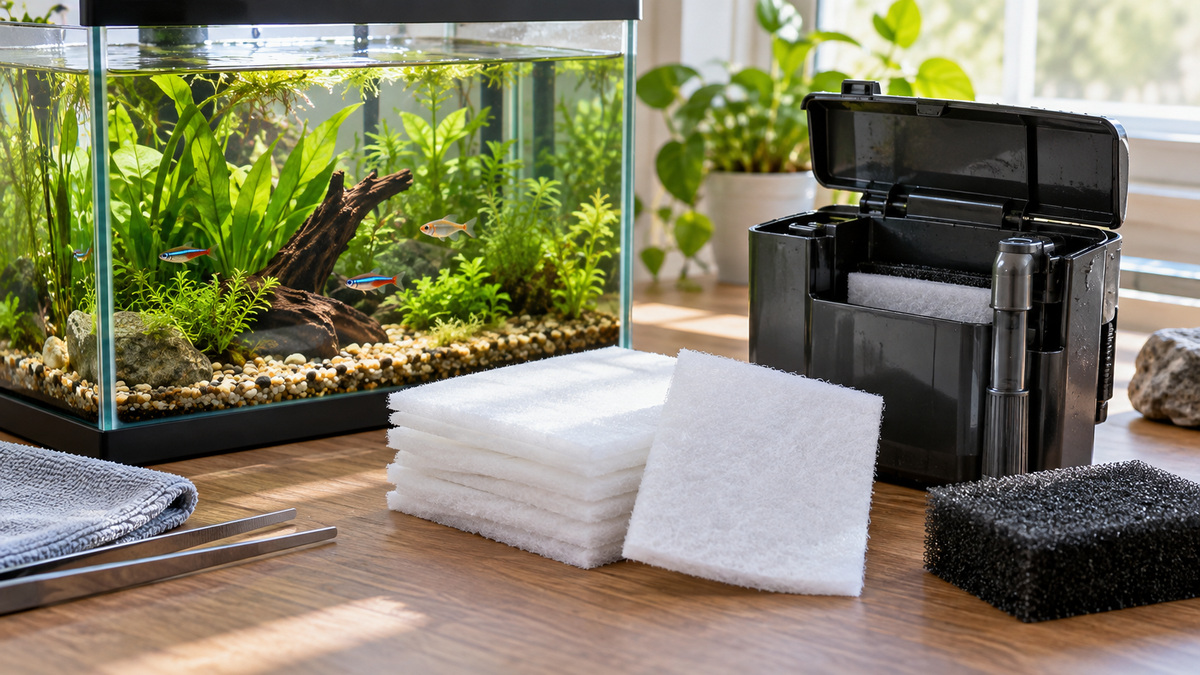
Fine Filter Pads for Aquarium: How to Choose and Cut to Fit
As an Amazon Associate we earn from qualifying purchases. Details
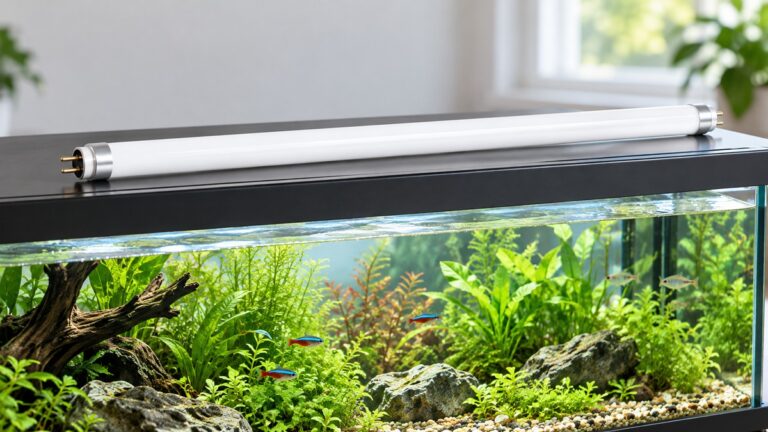
Fine filter pads for aquarium filters are mechanical media: a floss, polishing pad or foam sheet that catches small particles as water moves through it. The UF/IFAS 4-H marine guide defines mechanical filtration as a method that uses a filtering medium to remove particles from the water, and the same idea applies to a freshwater filter. The question most buyers have is which pad to pick and how to fit it. This guide answers that with nine Amazon listings, using only the titles and the listing fields we captured, and it says plainly what the pages we opened do not cover.
Quick answer
- Start with the job. A polishing pad or floss is for catching particles. A foam sponge also catches particles, and the UF/IFAS 4-H guide says microorganisms growing on a sponge’s surface also remove toxic substances.
- Put it early in the flow. UF/IFAS FA-12 says small particles are usually removed as the first component of biofiltration, so the pad goes before the biological media.
- Measure first. Only two of the nine listing titles give a size. For the other seven, measure your filter slot yourself.
- Inspect and clean as needed. The pages we opened give no fixed change interval. They say filters should be inspected and cleaned as required.
What a fine filter pad does
The UF/IFAS 4-H Marine Aquarium Project Book lists three types of filter: “biological, chemical, and mechanical.” Mechanical filtration is the type that removes solid particles, so a fine pad belongs to that group. The same book gives the process in one line: “Particles are removed from the water as it passes through the sponge.” That sentence is about a sponge, but the physical idea is the same for a floss pad. Water goes through a medium, and particles stay behind in it.
The marine guide is written for saltwater tanks, so this guide uses it only for the definition. It gives no freshwater figure, and it does not say how fine a pad needs to be to do its job.
The second point in that guide matters for the foam pads in this set. It describes sponge filters as providing “both mechanical and biological filtration.” When a foam pad works in a sponge-style setup, it does two jobs at once. The pages we opened do not say that floss or polishing pads do the biological job too, so this guide does not claim it for them.
The word “fine” also needs care. The listing titles use polishing, floss, bio foam and, in one case, ultra fine with a micron figure. The pages we opened do not define those words for aquarium pads. This guide uses each listing’s own words and does not invent a grading system for them. A reader who needs a grade should look for the manufacturer’s own specification, and we did not capture one for any of these nine listings.
Where the pad sits in the filter
UF/IFAS FA-12, Principles of Water Recirculation and Filtration in Aquaculture, gives the clearest order for mechanical media. It says that “small particles of matter are usually removed prior to, or as the first component of biofiltration.” In plain terms, catch the solids before they reach the biological media. A pad placed after the biological media has to catch what the bacteria did not already process, which is a harder job for the pad and for the biofilter.
The same publication explains why that order matters. Solids that build up in a biofilter add oxygen demand, but the publication notes that the process “reduces the need for frequent cleaning if the solids do not become re-suspended or interfere with normal water flow.” Keeping solids out of the biological part protects it from clogging and keeps the clean-up work in one place.
Mechanical media also has a known weak point. FA-12 states, “Mechanical filters require regular cleaning since they are prone to clogging when dirty.” A fine pad is a mechanical medium in this sense, so it will clog when it fills. That is the reason to look at it often, not only when the water looks cloudy.
The biological part is the other half of the decision. UF/IFAS FA31, Ammonia in Aquatic Systems, says: “A new biofilter requires six to eight weeks to build up sufficient bacteria to effectively reduce ammonia and nitrite levels.” When you change a fine pad, keep the established biological media in place. The six-to-eight-week figure applies to a new biofilter, not to a pad, so do not read it as a pad schedule.
FA-12 also lists “uniform water flow through the filter” and “sufficient void space to prevent clogging” among the main design concerns for a biofilter. Those are biofilter concerns, and the pages we opened do not apply them to a fine pad. Our planning reasoning is that a pad packed so tightly that flow drops will clog sooner. That is an inference from the clogging sentence above, not a figure from any page.
The nine listings at a glance
All nine products came from one Amazon search results page for this keyword. The table uses only what each title says, because the titles are the only product text we captured for most listings.
| Listing (brand as given, or the start of the title) | Type named in the title | Size or form named in the title |
|---|---|---|
| Aquatic Experts polishing pad with filter floss wording | Polishing pad, filter floss | None |
| Aquatic Experts filter floss media roll | Filter floss, media roll | None |
| Aquatic Experts polishing pad, second listing with the same title | Polishing pad, filter floss | None |
| Ultra fine polishing floss (no brand in our data) | Polishing floss, cut-to-size | 50 micron |
| MAQIHAN white filter media pad | Filter media pad, white filter floss | 39.4 x 11.8 inch |
| Bio filter foam sponge pad (no brand in our data) | Bio filter media foam sponges | None |
| Aquatic Experts polishing pad, shorter title | Polishing pad | None |
| Aquatic Experts bonded filter pad | Bonded filter pad, cut to fit | 12 x 72 x 0.75 in |
| AQUANEAT bio sponge foam pad | Bio sponge foam, cut-to-fit | None |
Two titles give a size: the MAQIHAN pad and the bonded pad. Seven give none, so for those seven the only fit check is your own measurement. Three listings share the Aquatic Experts name and polishing wording. Their titles do not say how they differ, and this guide does not claim a difference between them.
The floss and polishing listings name the same job, catching fine debris. The foam listings name a biological job as well, which matches the description of sponge filters in the UF/IFAS 4-H guide. Two listings name a cut-to-fit or cut-to-size option, which lets you trim the pad to a slot. Neither title says how much waste the trimming creates.
Cut to fit: the arithmetic from the titles
Three formulas do most of the work. They are planning tools, and they use only the numbers printed in the titles:
- Face area in square inches = length x width.
- Square feet = square inches / 144, because one square foot is 12 inches by 12 inches.
- Pad volume in cubic inches = length x width x thickness.
Bonded pad, 12 x 72 x 0.75 in. The face is 12 x 72 = 864 square inches, and 864 / 144 = 6 square feet. The volume is 12 x 72 x 0.75 = 648 cubic inches. The title says cut to fit, so the sheet is meant to be trimmed to a slot.
Planning example for the bonded pad: suppose a slot is 12 inches wide and 6 inches deep, which is 72 square inches. Then 864 / 72 = 12 slots from one face, before any waste from cutting. This is our planning estimate, not a figure from the listing.
MAQIHAN pad, 39.4 x 11.8 inch. The face is 39.4 x 11.8 = 464.92 square inches, and 464.92 / 144 = 3.23 square feet. The title gives no thickness, so the volume cannot be calculated from the listing.
Planning example for the MAQIHAN pad: a 6 x 8 inch slot is 48 square inches. Then 464.92 / 48 = 9.69, so the face holds nine full 6 x 8 inch pieces, because 9 x 48 = 432. The remaining 464.92 minus 432 leaves 32.92 square inches for cutting waste. This is our planning estimate too.
Ultra fine polishing floss, 50 micron. The title gives a micron figure and cut-to-size, but no length or width, so no face area can be calculated. The pages we opened do not say how the micron figure was measured, so the number is useful only as the listing’s own statement.
For the seven listings without a size, the calculation stops at your own measurement. Measure the slot in inches, write down the length, width and depth, and compare that with the title only where the title gives a size. If the slot is larger than the pad’s stated size, you will need to cut two or more pieces or buy a different format.
How often to inspect and replace
The pages we opened do not give a cleaning or replacement interval for fine pads. FA-12 says filters should be “inspected and cleaned as required.” That puts the timing in your hands, and the trigger is the pad itself, not the calendar.
The clogging point from FA-12 gives the practical checks. Look at the pad when water flow drops, when the pad looks full of debris, or when the outflow changes. The outflow check is our suggestion, not a source claim. Write down the date of each check so you can see how fast the pad fills in your own tank. That record is your own data, and it is more reliable than a number borrowed from another setup.
Rinsing is the open question. The university pages we opened do not say whether a pad should be rinsed in tap water, tank water, or not at all. This guide therefore gives no rinse instruction. If you rinse a pad, follow the directions for that product, and remember that none of the nine product pages were opened for this guide.
Common mistakes
- Choosing by the word fine alone. The titles use several different words, and the pages we opened do not define them for pads.
- Filling the slot to the edge. Clogging is the main warning in FA-12 for mechanical media, so leave room for the water to pass. This is our planning reasoning from that clogging sentence.
- Replacing the biological media with the pad. A new biofilter needs six to eight weeks to build up bacteria (FA31), so keep the established biological media when you change a pad.
- Trusting a size you have not measured. Seven of the nine titles give no size at all.
- Comparing micron figures across brands. Only one title has a micron figure, and the pages we opened do not say how it is measured.
- Ignoring flow. A pad that slows the outflow is doing its job and also telling you it needs attention.
How to choose a pad for your filter
Work through these steps in order:
- Measure the slot. Record length, width and depth in inches before you open any listing.
- Decide the job. For particles only, a floss or polishing pad matches the mechanical description in the UF/IFAS 4-H guide. For particles plus a surface that also carries biological work, a foam sponge matches its description of sponge filters.
- Pick a form. A roll needs cutting, a sheet needs trimming, and a cut-to-size pad needs a measurement. Only the bonded pad and the MAQIHAN pad give a size in the title.
- Place it first. Put the pad before the biological media, as FA-12 describes.
- Set your check. Inspect the pad when the flow drops, and keep the biological media in place when you change the pad.
If your filter is a small low-flow unit, compare the flow path with best low flow filter for betta. For a small external unit, see best external filter for small fish tank. Both are on this site, and both cover the filter rather than the pad.
1. Aquatic Experts Aquarium Polishing Filter Pad, Water Polishing Pad for Aquarium Filters, Filter (Polishing pad that names filter floss)
Pros
- The title calls it a polishing filter pad for aquarium filters.
- The title also uses the words filter floss, so the type is named.
Cons
- The title gives no size, thickness or cut-to-fit option.
Best for: a buyer who wants a polishing pad named by its use in aquarium filters
Skip if: you need a set size, because the title does not give one
View on Amazon (affiliate link)
2. Aquatic Experts Aquarium Filter Floss for Fish Tank Filters, FilterFirst Aquarium Filter Pad, Media (Floss sold as a media roll)
Pros
- The title describes it as a media roll, so it comes in a length you cut.
- The title names it filter floss for fish tank filters.
Cons
- The title gives no roll length, width or thickness.
Best for: a filter slot where you want to cut your own pad from a roll
Skip if: you need a pad with a fixed size stated in the title
View on Amazon (affiliate link)
3. Aquatic Experts Aquarium Polishing Filter Pad, Water Polishing Pad for Aquarium Filters, Filter (Second polishing listing with the same title)
Pros
- The title names a polishing pad for aquarium filters with filter floss wording.
- It is one of three listings in this set with the same polishing wording.
Cons
- Its title matches another listing, and the title does not say how the two differ.
Best for: a buyer who will check the listing details before choosing between the two
Skip if: you want a clear reason to pick this listing over the other one with the same title
View on Amazon (affiliate link)
4. Aquarium Polishing Filter Pad, Ultra Fine 50 Micron Filter Floss for Crystal Clear Water (Only pad with a micron figure in the title)
Pros
- The title gives a 50 micron figure, the only micron number among these nine titles.
- The title says cut-to-size, so the pad can be trimmed to a slot.
Cons
- The title does not say how the 50 micron figure was measured.
Best for: a buyer who wants a polishing floss with a micron figure and a cut-to-size format
Skip if: you need a named brand, because our data gives none for this listing
View on Amazon (affiliate link)
5. MAQIHAN Aquarium Filter Media Pad, White Filter Floss, 39.4 x 11.8 Inch (White floss with a stated size)
Pros
- The title gives 39.4 x 11.8 inch, so the face area can be planned.
- The title names white filter floss and a filter media pad.
Cons
- The title gives no thickness and no cut-to-fit option.
Best for: a planner who will measure a slot against a 39.4 by 11.8 inch sheet
Skip if: you need a thickness figure, because the title does not give one
View on Amazon (affiliate link)
6. Aquarium Sponge Filter Pad, Bio Filter Media Foam Sponges (Foam sponge for bio media)
Pros
- The title calls it a bio filter media foam sponge, a foam type rather than floss.
- The UF/IFAS 4-H guide describes sponge filters as doing mechanical and biological filtration.
Cons
- The title gives no size, so the fit has to be measured on your own filter.
Best for: a filter where you want foam that does mechanical and biological work
Skip if: you need a fine polishing or floss pad, since the title names foam sponges
View on Amazon (affiliate link)
7. Aquatic Experts Aquarium Polishing Filter Pad, Water Polishing Pad for Aquarium Filters (Polishing pad with a shorter title)
Pros
- The title names a water polishing pad for aquarium filters.
- It is the only polishing listing here without the words filter floss.
Cons
- The title does not name any size, thickness or cut option.
Best for: a buyer who wants a polishing pad and does not need the floss wording
Skip if: you want the floss type named in the title
View on Amazon (affiliate link)
8. Aquatic Experts Bonded Aquarium Filter Pad, 12x72x0.75 in, Cut to Fit (Bonded pad with a stated thickness)
Pros
- The title gives 12 x 72 x 0.75 in, the only thickness figure in these titles.
- The title says cut to fit, so it can be trimmed to a slot.
Cons
- The title names bonded but does not say what the bonding material is.
Best for: a planner who wants a stated 0.75 inch thickness and a cut-to-fit sheet
Skip if: you need a material or density figure, because the title does not give one
View on Amazon (affiliate link)
9. AQUANEAT Aquarium Bio Sponge Foam Filter Media Pad, Cut-to-fit for Fish Tank, Sump, Pond (Cut-to-fit foam for tanks, sumps and ponds)
Pros
- The title says cut-to-fit and names fish tank, sump and pond uses.
- The title names a bio sponge foam with sump and pond uses.
Cons
- The title does not say which tank size or filter it fits.
Best for: a setup with a sump or pond where you want a cut-to-fit foam
Skip if: you need a fine polishing or floss pad, since the title names bio sponge foam
View on Amazon (affiliate link)
How we chose
The nine listings came from one Amazon search results page for this keyword, opened on 2026-10-19. We kept all nine that the search returned and did not rank them. We did not open any product page, so each listing is described by its title and brand field only.
For the explanation of pads, we used only university publications that we opened ourselves: the UF/IFAS 4-H marine guides for the filter-type definitions, UF/IFAS FA-12 for placement and clogging, and UF/IFAS FA31 for the biofilter timing. Search snippets and retailer or hobby pages were not used as proof of anything in this guide.
Each pick card gives a reason taken from its own title, a skip case and a limit. No two pick cards use the same reason text.
What we could not verify
- Product pages. We did not open any of the nine product pages, so materials, density, pore size, flow rate, pack counts, care instructions and warranty are not covered here.
- Thickness. Only the bonded pad gives a thickness in its title, 0.75 in. The other titles give none.
- Micron figure. The 50 micron figure appears in one title. The pages we opened do not say how it is measured or whether it can be compared with other pads.
- Same-title listings. Two listings have the same title, and the titles do not say how they differ.
- Brand data. Two listings have no brand in our data.
- Cleaning interval. No university page we opened gives a number of days or weeks for a fine pad.
- Rinse water. No university page we opened says whether tap water, tank water or plain water should be used to rinse a pad.
- Bacteria on floss. The pages we opened do not say whether floss or polishing pads hold bacteria.
FAQ
What is a fine filter pad for an aquarium?
It is a mechanical filter medium, such as a floss, polishing pad or foam sheet, that removes particles from the water as it passes through. The UF/IFAS 4-H marine guide uses the same definition for mechanical filtration. That guide is written for saltwater tanks, so this guide uses it only for the definition. The pages we opened do not set a size standard for fine pads.
Where should a fine pad go in the filter?
Before the biological media. FA-12 says small particles of matter are usually removed prior to, or as the first component of biofiltration. Keeping particles out of the biological part helps it avoid clogging and reduces the need for frequent cleaning.
How often should I change a fine filter pad?
The pages we opened do not give a number of days. FA-12 says filters should be inspected and cleaned as required, and it warns that mechanical filters clog when they are dirty. Inspect the pad when the flow drops or the pad looks full, and write down the dates so you learn how fast it fills in your own tank.
Can I rinse a pad under tap water?
We did not find a university page that answers this, so this guide makes no rinse recommendation. Check the directions for the pad you buy, and do not treat a retailer’s wording as a university answer.
Is a foam sponge pad the same as a fine floss pad?
Not for the biological job. The UF/IFAS 4-H marine guide says a sponge filter “provides both mechanical and biological filtration.” The pages we opened do not say that floss or polishing pads do the same, so the foam pads and the floss pads in this set are best compared for different jobs.
Do I need to keep the biological media when I change a pad?
Yes, as a precaution. UF/IFAS FA31 says a new biofilter needs six to eight weeks to build up bacteria, so removing established biological media together with the pad is the change to avoid. The pages we opened do not give a timing for changing a pad alone.
Bottom line
Choose a floss or polishing pad when you want particle capture only, and a foam sponge when you also want the biological job. Measure the slot first, because seven of the nine titles give no size. Put the pad before the biological media, keep that media in place, and inspect the pad whenever the flow drops.
Sources
- UF/IFAS 4-H Marine Aquarium Project Book, 4H433: the three filter types, the mechanical filtration definition and the sponge filter description; a marine guide, used only for definitions
- UF/IFAS 4-H Marine Aquarium Adult Partner Guide, 4H434: the same three filter types and the mechanical filtration definition; a marine guide, used only for definitions
- UF/IFAS FA-12, Principles of Water Recirculation and Filtration in Aquaculture: placement of mechanical media before biofiltration, clogging, inspection and biofilter design concerns
- UF/IFAS FA31, Ammonia in Aquatic Systems: the six to eight week establishment time for a new biofilter