Best Sand on Top of Gravel Aquarium for Bettas
As an Amazon Associate we earn from qualifying purchases. Details
sand on top of gravel aquarium setups appeal to betta owners who want a soft surface with stable planting underneath. This guide helps you decide if that layered look fits your tank, which grain sizes mix less, and what to check on the listing before you buy. You will see how sand caps behave over gravel, what makes cleaning harder, and when to choose a single substrate instead. The focus is welfare-first care for a single betta in a heated, filtered tank, with plants and decor that leave open swimming space.
Quick answer
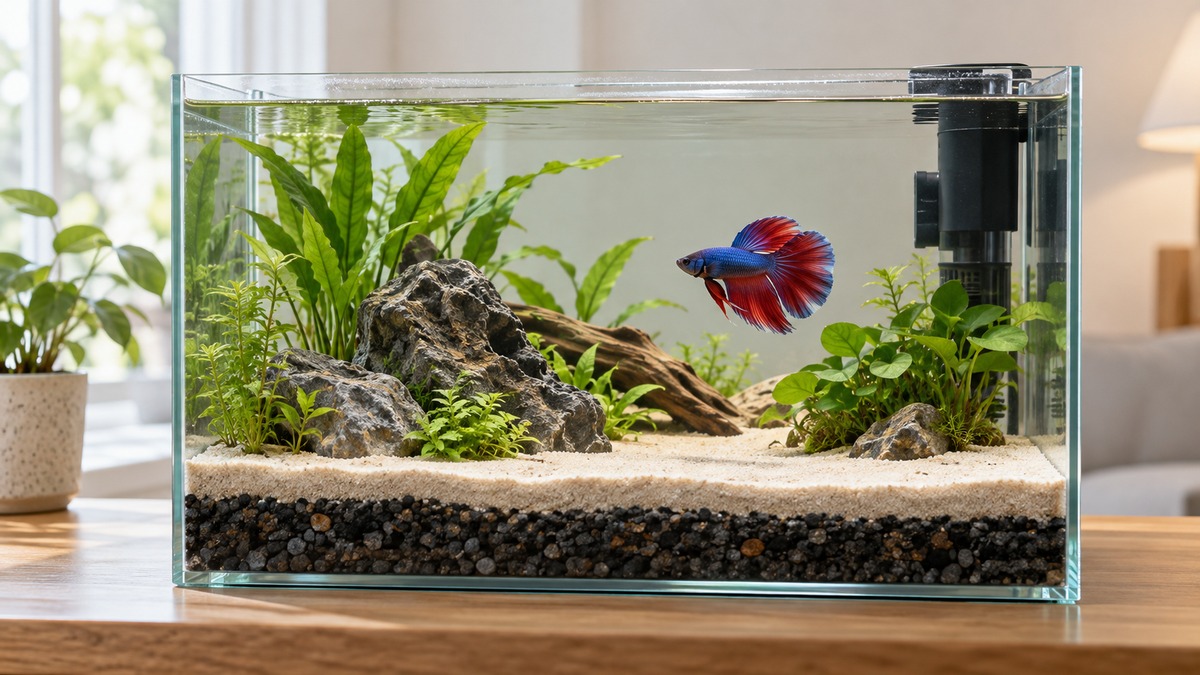
You can use sand on top of gravel aquarium substrate, but the layers blend over time in most betta tanks. Fine sand sifts down between coarse gravel when you pour water, move plants, or gravel vac. If you want that two-layer look, choose fine sand in beige, black, or black with highlights for the top and small, smooth gravel below. Rinse before use, add the cap gently, and clean with a hovering siphon motion. To mix sand and gravel aquarium substrate with less mess, many owners pick grains close in size. For bettas that rest on the bottom, a smooth top layer matters more than color.
1. YISZM Aquarium Sand, 2lbs Beige Fish Tank Sand, Aquarium Gravel Substrate (Best overall)
Specs from the listing (checked 2026-10-11):
- Item Weight: 1.96 pounds
- Color: Beige
- Size: 2 lbs
- Included Components: Aquarium Sand
Pros
- States safe habitat phrasing for fish and plants
- States it resists clouding and settles quickly
- Small beige bag suits trial caps and patches
Cons
- Listing does not state particle size in mm
- Small bag covers little area in one purchase
Best for: owners testing a light sand cap over dark gravel
Skip if: you need full-base coverage in one bag
View on Amazon (affiliate link)
2. Aqua Natural Aquarium Substrate, Diamond Black Fine Gravel, 10lb (Best base layer)
Specs from the listing (checked 2026-10-11):
- Item Weight: 10 pounds
- Color: Black
- Size: 10LB
- Material: Stone
Pros
- Stated 1-2mm size pairs well under fine sand
- Natural quartz composition with planted-tank contrast
- Large 10lb bag suits a full base
Cons
- Directions say not recommended for snails or bottom feeders
- Dark color shows light sand grains after mixing
Best for: layered beds that need a fine, stable gravel base
Skip if: you keep snails or bottom feeders covered by that warning
View on Amazon (affiliate link)
3. FANTIAN 5 lbs Aquarium Sand,Beige Fish Tank Sand, Aquarium Substrate Gravel (Best measured grain)
Specs from the listing (checked 2026-10-11):
- Item Weight: 4.96 pounds
- Color: Beige
- Size: 5 LB
Pros
- Clear 0.4-0.8 mm size helps plan mixing
- States no toxins and will not bleed in water
- Mid-size 5 LB bag covers more than patch bags
Cons
- Needs multiple rinses to remove dust
- Water may cloud and needs filtration time before fish
Best for: planners who want a stated fine-sand size
Skip if: you want a no-rinse setup
View on Amazon (affiliate link)
4. GloFish Aquarium Sand, Black with Fluorescent Accents, 5 lbs (Best dark look)
Specs from the listing (checked 2026-10-11):
- Item Weight: 5 pounds
- Color: Black
- Material: Stone
- Special Feature: Compatible with GloFish lighting
Pros
- Black base with highlights for bold contrast
- Listed for use as substrate or accent
- Stone material in a 5-pound bag
Cons
- Highlight effect needs blue LED lights
Best for: dark caps and accent streaks over gravel
Skip if: you use only warm white light
View on Amazon (affiliate link)
5. 2lbs Aquarium Gravel, 1/5''(5mm) Pea Gravel-Natural River Pebbles (Best pebble zones)
Specs from the listing (checked 2026-10-11):
- Item Weight: 1.98 pounds
- Color: 1/5 inch
- Size: 2 Pounds
Pros
- Natural river-stone look for borders and rings
- Clear 4-6 mm scale for structure
- Small pack for accents without rebuilding bed
Cons
- Coarse gaps let fine sand sift down fast
- Color and shape vary by bag
Best for: edging, plant rings, and small gravel zones
Skip if: you want a lasting sharp sand-over-gravel line
View on Amazon (affiliate link)
is placed after the criteria below, so you can match grain size and bag weight to your footprint first.
What matters for sand over gravel in a betta tank
Grain size gap controls mixing. The listings here state 0.4-0.8 mm fine sand, 1-2 mm fine gravel, and approx. 4-6 mm pea gravel. A 0.4-0.8 mm sand will fall through 4-6 mm gaps faster than it will fall through 1-2 mm gaps. If you want a visible cap that lasts longer, pair sand with the smaller gravel base, not the coarsest pebbles. Check the listing for particle size before you buy, because color photos alone do not show scale.
Top texture matters for resting fins. Bettas often perch on leaves and sometimes rest near the bottom. Bettas are exceptionally tolerant of low oxygen levels and poor water quality thanks to a labyrinth organ that allows them to take in surface air, yet they still need a clean, heated, filtered home with soft surfaces. Source notes on natural range and hardiness do not change the need for gentle decor. A smooth sand top feels more even than coarse stone, while rough or sharp gravel below can work its way up. The listing does not always state smoothness, so check the listing for shape and finish words.
Bag weight must match footprint and cap plan. The picks here list 1.96 pounds, 1.98 pounds, 4.96 pounds, 5 pounds, and 10 pounds. A 2 lbs bag suits a small accent or a patch repair, while 5 lbs or 10LB bags suit a fuller base or cap. Tank size in the listing is often total capacity, not usable water volume, and substrate displaces water, so plan by length and width rather than by label gallons. For welfare, keep a single betta in a heated, filtered tank of 5 gallons or more, with calm water and places to hide. Never use bowls, vases, or tiny cubes as a home.
Rinse and clouding behavior differ by product. One sand listing says to rinse under running water with stirring to remove dust, then run filtration for 1-2 days before adding fish. Another says the sand resists clouding and settles quickly. A third notes fine sand has dust and needs washing a couple of times. Treat every bag as dusty until the rinse water runs clear. Keep fish out of cloudy water during setup and follow the conditioner and filter maker steps.
Color and light change the look more than you expect. Beige sand brightens a tank and shows debris. Black sand or black with fluorescent accents darkens the base and can make light plants and fish stand out. One black sand lists compatibility with GloFish lighting and blue LED lights, which matters only if you run that style of light. If you use Top Fin Color Changing Led Aquarium Light Bar or another colored light, test the look on a small patch first. For planted ideas, see Best Aquarium Plants for Sand Substrate.
Cleaning method must fit a cap. To mix sand and gravel aquarium substrate and keep it neat, you need a gentle hover, not a deep dig. Learn How to Gravel Vac Sand before you layer, because plunging the siphon into the cap pulls sand up and mixes layers. If cleaning ease is your top need, read Is Sand or Gravel Easier to Clean in an Aquarium and Sand vs Gravel for Freshwater Aquarium. If you are choosing only for a betta, start with Is Sand or Gravel Better for Bettas.
Picks for layering sand over gravel
Beige fine sand in a small bag for caps and patches
This pick is YISZM Aquarium Sand in Beige, Size 2 lbs, with Item Weight 1.96 pounds. The listing describes a sand substrate in Black, White, and Beige, with weight options 2 lbs, 5 lbs, 10 lbs, and 20 lbs. It states the sand is carefully processed to ensure it is safe for all aquatic creatures and provides a comfortable habitat for fish, plants, and other tank inhabitants. It also says the sand resists clouding and settles quickly. For a sand on top of gravel aquarium plan, the small bag fits a thin top layer over a small footprint, a foreground patch, or a trial cap. Use it where you want a light, natural seabed look over darker gravel. Who should skip it: skip if you need to cover a wide base in one bag, because 1.96 pounds will not go far. Check the listing for current grain size and rinse steps, since the listing does not state particle size in mm for this color.
Fine black quartz gravel that pairs well under sand
This pick is Aqua Natural Aquarium Substrate, Diamond Black Fine Gravel, 10lb, with Item Weight 10 pounds. The listing states 1-2mm particle size and describes the material as graded to 1–2 mm, between sand and traditional pebble gravel. It names the material as natural quartz gravel and stone, in Black, with Style Classic. Bullets note large surface area that promotes good bacteria growth and visual contrast with a planted tank. Directions say rinse until water runs clear, place in base of aquarium, with a note that it is not recommended for snails or bottom feeders. For layering, 1-2 mm grains leave smaller gaps than coarse pebbles, so a sand cap stays visible longer. Who should skip it: skip if you keep snails or bottom feeders named in that direction, or if you want a pale base. Check the listing for care and compatibility details.
Beige fine sand with stated grain size for planning
This pick is FANTIAN Aquarium Sand in Beige, Size 5 LB, with Item Weight 4.96 pounds. The listing states the gravel size is 0.4-0.8 mm fine sand and says rinse before use. It says no toxins, no foreign matter, and that the sand will not bleed in water. It warns the fine sand has dust and needs washing with water a couple of times before putting it into the tank. It also says after adding sand the water may become slightly cloudy and to allow the filtration system to run for 1-2 days before adding fish. For a cap, 0.4-0.8 mm sand will sift into coarse gravel, so pair it with the finest gravel base you have. Who should skip it: skip if you do not want to rinse several times, because this one clearly needs it. Check the listing for color and weight options.
Black sand with highlights for dark caps and accents
This pick is GloFish Aquarium Sand, Black with Fluorescent Accents, 5 lbs, with Item Weight 5 pounds. The listing names Material as Stone, Color as Black, and Special Feature as Compatible with GloFish lighting. It says the sand creates a colorful base, complements aquarium decor, and stands out under GloFish blue LED lights. It says use as a substrate or accent, along with GloFish plants and ornaments sold separately. For sand on top of gravel aquarium designs, this works as a dark cap or as accent streaks over a plainer gravel bed. The 5 pounds weight suits more coverage than small patch bags. Who should skip it: skip if you run warm white light only and do not want fluorescent highlights, because the accent effect needs blue LED lights. Check the listing for grain detail, since the listing does not state particle size in mm.
Small natural pebbles for the lower gravel layer
This pick is Aqualyra Aquarium Gravel, 2lbs, described as 5 mm Pea Gravel-Natural River Pebbles, with Item Weight 1.98 pounds. The listing states approx. 4-6 mm pieces and describes water-washed river stone in mixed earthy neutrals. It calls the 2 lb pack a targeted amount for small-tank accents, replacement patches, plant-base rings, or a narrow riverbank. It says rinse before aquarium use and notes natural color and piece shape vary by bag. For layering, use this as the bottom structure around plant bases, driftwood, or rock clusters, then cap lightly with sand if you accept faster mixing through 4-6 mm gaps. Who should skip it: skip if you want a long-lasting sharp line between layers, because coarse gaps invite sand to sift down. Check the listing for shape smoothness before use with a betta that rests low.
1. YISZM Aquarium Sand, 2lbs Beige Fish Tank Sand, Aquarium Gravel Substrate (Best overall)
Specs from the listing (checked 2026-10-11):
- Item Weight: 1.96 pounds
- Color: Beige
- Size: 2 lbs
- Included Components: Aquarium Sand
Pros
- States safe habitat phrasing for fish and plants
- States it resists clouding and settles quickly
- Small beige bag suits trial caps and patches
Cons
- Listing does not state particle size in mm
- Small bag covers little area in one purchase
Best for: owners testing a light sand cap over dark gravel
Skip if: you need full-base coverage in one bag
View on Amazon (affiliate link)
2. Aqua Natural Aquarium Substrate, Diamond Black Fine Gravel, 10lb (Best base layer)
Specs from the listing (checked 2026-10-11):
- Item Weight: 10 pounds
- Color: Black
- Size: 10LB
- Material: Stone
Pros
- Stated 1-2mm size pairs well under fine sand
- Natural quartz composition with planted-tank contrast
- Large 10lb bag suits a full base
Cons
- Directions say not recommended for snails or bottom feeders
- Dark color shows light sand grains after mixing
Best for: layered beds that need a fine, stable gravel base
Skip if: you keep snails or bottom feeders covered by that warning
View on Amazon (affiliate link)
3. FANTIAN 5 lbs Aquarium Sand,Beige Fish Tank Sand, Aquarium Substrate Gravel (Best measured grain)
Specs from the listing (checked 2026-10-11):
- Item Weight: 4.96 pounds
- Color: Beige
- Size: 5 LB
Pros
- Clear 0.4-0.8 mm size helps plan mixing
- States no toxins and will not bleed in water
- Mid-size 5 LB bag covers more than patch bags
Cons
- Needs multiple rinses to remove dust
- Water may cloud and needs filtration time before fish
Best for: planners who want a stated fine-sand size
Skip if: you want a no-rinse setup
View on Amazon (affiliate link)
4. GloFish Aquarium Sand, Black with Fluorescent Accents, 5 lbs (Best dark look)
Specs from the listing (checked 2026-10-11):
- Item Weight: 5 pounds
- Color: Black
- Material: Stone
- Special Feature: Compatible with GloFish lighting
Pros
- Black base with highlights for bold contrast
- Listed for use as substrate or accent
- Stone material in a 5-pound bag
Cons
- Highlight effect needs blue LED lights
Best for: dark caps and accent streaks over gravel
Skip if: you use only warm white light
View on Amazon (affiliate link)
5. 2lbs Aquarium Gravel, 1/5''(5mm) Pea Gravel-Natural River Pebbles (Best pebble zones)
Specs from the listing (checked 2026-10-11):
- Item Weight: 1.98 pounds
- Color: 1/5 inch
- Size: 2 Pounds
Pros
- Natural river-stone look for borders and rings
- Clear 4-6 mm scale for structure
- Small pack for accents without rebuilding bed
Cons
- Coarse gaps let fine sand sift down fast
- Color and shape vary by bag
Best for: edging, plant rings, and small gravel zones
Skip if: you want a lasting sharp sand-over-gravel line
View on Amazon (affiliate link)
How to choose sand and gravel that stay layered longer
Start with grain pairing, not color. Sand in the 0.4-0.8 mm range will move through 4-6 mm pebble gaps with little help. The same sand over 1-2 mm fine gravel has less room to fall, so the cap reads as a cap for more weeks. If you love the pebble look, accept blending or use pebbles only in zones, such as rings around plants. To compare blended styles, see Best Gravel and Sand Substrate Mix and Best Black and White Sand Mix Aquarium.
Match bag weight to area, not to tank label. A package of 1.96 pounds or 1.98 pounds is a patch bag. A bag of 4.96 pounds or 5 pounds covers more, and 10 pounds suits a full base in a wider tank. Package Dimensions such as 7.99 x 4.96 x 1.69 inches or 12.2 x 8.82 x 1.73 inches tell you shipping size, not coverage depth. Measure length and width of your own tank, then check the listing for coverage guidance. If the listing does not state coverage, buy less than you think for a first cap and add more after rinsing.
Read rinse, dust, and fish-timing notes. Listings here range from settles quickly to needs multiple rinses to run filtration for 1-2 days before adding fish. Take the stricter note as your plan. Rinse in a clean bucket with no soap, stir, pour off cloudy water, and repeat until clearer. Fill slowly over a plate or bag to avoid blasting the cap. Cycle and condition water per your filter and conditioner makers, and add the betta only when water is clear and stable.
Plan cleaning before you pour. Sand caps do not like deep gravel washing. Hover the siphon just above the sand to lift debris, then swirl and release clean sand that lifts. Keep plant roots anchored by working around stems, not through them. If you prefer deep vacuuming, choose one substrate instead. For betta-specific texture help, read Do Bettas Prefer Sand or Gravel and Is Sand Better Than Gravel for Fish Tank.
Think about plants and decor weight. Fine sand holds small stems if the cap has enough depth at the planting zone, while coarse pebbles can crush stems if piled high. Heavy rocks can press a cap into the gravel and erase the line. Place hardscape first on the gravel base, then spoon sand around it. For species ideas, see Best Aquarium Plants That Do Well in Sand. For health concerns, consult an experienced fish keeper or an aquatic vet rather than dosing on guesswork.
Layering example: our planning estimate for a small cap
This example shows how bag weight relates to a thin cap. It is our planning estimate, not a maker claim. Numbers are defined here once, then used step by step.
Define the scenario: you have a small betta tank with a bottom area 12 inches long and 8 inches wide. You already have gravel. You want a light sand cap made from a bag with Item Weight 1.96 pounds. You wonder if one bag can dust the whole floor thinly or only cover part of it.
Step 1: find floor area. Multiply length by width. 12 x 8 = 96. Floor area is 96 square inches. Re-check: 10 x 8 = 80, plus 2 x 8 = 16, total 96. Correct.
Step 2: find weight per square inch if spread evenly. Divide bag weight by area. 1.96 / 96 = 0.0204167 pounds per square inch. Re-check by reverse: 0.0204167 x 96 = 1.96. Correct.
Step 3: compare with a larger bag on the same floor. Take Item Weight 4.96 pounds. Divide by 96. 4.96 / 96 = 0.0516667 pounds per square inch. Re-check: 0.0516667 x 96 = 4.96. Correct.
Step 4: compare the two cover rates. Divide larger rate by smaller rate. 0.0516667 / 0.0204167 = 2.5306. The larger bag gives about two and one-half times the weight per square inch on this floor. Re-check: 0.0204167 x 2.5 = 0.0510417, close to 0.0516667, with the small gap from rounding. Correct.
What this changes: on a 12 inch by 8 inch floor, a single 1.96 pounds bag gives a very light dusting if spread edge to edge. It fits better as a foreground patch or a trial cap. A 4.96 pounds bag gives a more visible cap on the same floor. A 10 pounds bag gives about five times the 1.96 pounds rate on the same floor, which suits a full base plus cap in wider tanks. Always check the listing for depth advice, because weight alone does not set depth when grains differ.
Comparison built only from listing data
| Product | Color / Size stated | Weight stated | Grain stated | Use note from listing |
|---|---|---|---|---|
| YISZM sand | Beige / 2 lbs | 1.96 pounds | The listing does not state mm | Resists clouding and settles quickly |
| Aqua Natural fine gravel | Black / 10LB | 10 pounds | 1-2mm, also graded to 1–2 mm | Rinse until water runs clear; not recommended for snails or bottom feeders |
| FANTIAN sand | Beige / 5 LB | 4.96 pounds | 0.4-0.8 mm fine sand | Rinse before use; run filtration for 1-2 days before adding fish |
| GloFish sand | Black / 5 Pounds | 5 pounds | The listing does not state mm | Compatible with GloFish lighting; use as substrate or accent |
| Aqualyra pebbles | 5 mm pebble / 2 Pounds | 1.98 pounds | Approx. 4-6 mm | Rinse before use; color and shape vary by bag |
Three buying scenarios
You want a bright cap over dark gravel in a small betta tank. Choose the 1.96 pounds beige sand for a trial patch and the 10 pounds black 1-2mm gravel for the base. The small gap between fine sand and 1-2 mm gravel keeps the line cleaner than sand over 4-6 mm pebbles. Rinse both, place hardscape, then spoon sand on top. If debris shows fast on beige, hover-clean more often.
You want low fuss with plants. Choose the 4.96 pounds beige 0.4-0.8 mm sand as the main top and the 1-2 mm black quartz as the lower anchor zone. Plant stems in the zone where the total bed is deepest, then add sand around the crowns. Read Best Adding Sand to a Fish Tank before moving stems, and keep flow gentle.
You want a dark, bold floor with glowing accents. Choose the 5 pounds black sand with fluorescent accents over a small amount of neutral pebbles used only at edges. Keep pebbles in the 4-6 mm range away from the main resting area if your betta sits low. Pair with blue LED lights only if you want the highlight effect, and keep a calm corner with plants for rest.
Five common mistakes with sand over gravel
Adding sand to a dirty gravel bed. Trapped waste clouds the tank when the cap seals it in. Siphon debris first, then rinse the new sand until water runs clearer. Add the betta only after water clears and your filter and conditioner steps are done.
Pouring sand fast from the bag. A fast pour digs craters and shoots gravel upward. Spoon sand in wet handfuls or pour over a plate near the bottom. Fill slowly to protect the line between layers.
Vacuuming like plain gravel. Jamming the tube into the cap sucks sand into the bucket and pulls gravel up. Hover above the sand, let debris lift, and pinch the hose to drop clean grains back. Dull, slow moves keep the cap intact.
Mixing grains far apart in size. Pairing 0.4-0.8 mm sand with approx. 4-6 mm pebbles across the whole floor guarantees quick blending. Keep size ranges close, or zone the coarse stone to borders and plant rings. For fit questions, recheck Is Sand or Gravel Better for Fish Tanks.
Chasing a sharp line forever. Fish dig, filters push, and water changes shift grains. Enjoy a soft blend or refresh the cap in small rinsed batches. If a crisp two-tone floor matters most, use dividers or keep sand and gravel in separate zones rather than stacked sheets.
Care, safety, and when to change course
Rinse every bag, even if the front says clean. Use a clean bucket kept only for fish tasks, with no soap or cleaners. Stir with your hand, pour off milky water, and repeat. If dust remains, the tank may stay hazy and the filter pad may clog faster. Follow the filter maker for pad rinsing and the conditioner maker for water changes.
Watch the betta, not just the substrate. Males are highly territorial and frequently fight when kept together, while female bettas can also become territorial toward one another in confined spaces, so house bettas alone unless you have a sound, species-appropriate plan. Bettas set up territories even when housed alone and enjoy a decorated tank, so leave open swim lanes plus a cave or plants for cover. In the wild, B. splendens is listed as vulnerable because of pollution and habitat destruction, which is one more reason to keep home water clean and stable. Those natural-history points come from the same species page cited in sources.
Know when a cap is wrong for you. If waste sits on pale sand and bothers you, switch to a single dark fine gravel in 1-2 mm. If stems will not stay, use more of the gravel base at planting spots and less loose sand. If the filter blows sand into dunes, baffle flow or move the outflow, using only methods the filter listing or manual allows. For disease or injury, consult an experienced fish keeper or an aquatic vet. Follow the maker’s manual for heaters, filters, and lights.
FAQ
Can you put sand on top of gravel in a betta tank?
Yes, in a heated, filtered tank with room to swim. Rinse the sand, siphon the gravel first, and add the cap slowly. Expect some blending, and hover-clean instead of digging. If you want almost no mixing, choose grains close in size.
Will sand sink into gravel?
Often yes. Fine grains fall into gaps, especially 0.4-0.8 mm sand over approx. 4-6 mm pebbles. Sand over 1-2 mm fine gravel holds its look longer. Movement from fish, plants, and water changes speeds blending.
Is it better to mix sand and gravel aquarium substrate instead of layering?
Mixing gives a stable, natural look and plants root well, but waste can settle between grains. Layering gives a crisp cap at first but needs gentle care. If you like low upkeep, read cleaning guides before stacking. See the care links above.
What sand color shows less waste with a betta?
Dark sand hides debris better than beige, while beige shows waste sooner. Black sand also boosts contrast with plants and light fish. Lighting shifts the effect, so judge color under your own light.
Do I need to rinse bagged aquarium sand?
Yes. Listings here say rinse until water runs clear, wash a couple of times, or expect dust. Rinse in batches, stir well, and pour off cloudy water. Add fish only after the tank is clear and conditioned.
How do I clean a sand cap without sucking it up?
Hover the siphon just above the sand and let debris rise. Swirl the tube to drop heavier grains back. Work in small sections and avoid digging into the lower gravel. Practice on a corner first.
Can I use pebbles under sand for plants?
Yes, but place stone zones with care. Approx. 4-6 mm pebbles suit plant-base rings and borders, while 1-2 mm fine gravel anchors stems with less mixing. Add sand around stems after planting and avoid burying crowns.
Bottom line
Choose close grain sizes if you want sand on top of gravel aquarium substrate to read as two layers: fine sand over 1-2 mm fine gravel lasts better than fine sand over 4-6 mm pebbles. Choose patch bags at 1.96 pounds or 1.98 pounds for trials and 4.96 pounds, 5 pounds, or 10 pounds for fuller coverage. Rinse well, pour slowly, and hover-clean. If upkeep or mixing worries you, skip the stack and use one smooth substrate that fits your light, plants, and cleaning style.
Sources
- Siamese fighting fish: labyrinth organ tolerance, territorial behavior, solitary territories and tank decoration, wild vulnerable status