Betta Hammock DIY
As an Amazon Associate we earn from qualifying purchases. Details
Someone searching for a betta hammock DIY wants to make a resting leaf at home and be sure it will not hurt the fish. The honest picture is thin. We found one detailed homemade method, a foam leaf on a suction cup from an aquascaping shop’s blog, and no veterinary source that endorses any homemade material. The two vet sources we opened agree on the risks that matter, which are sharp edges and pointy parts. This guide walks through that method with its caveats, lists the checks to run, and shows five ready-made hammocks on Amazon for readers who would rather not build one.
Quick answer
If you build one, use a new, plain, uncolored sponge, cut smooth rounded leaves about 5 to 7 cm long, soak them for 24 hours in dechlorinated water, and hang the top leaf 1 to 2 cm below the surface, away from the filter outflow. That advice comes from a single retailer blog, so treat it as a starting point and inspect the leaf often. If you would rather not judge a homemade material yourself, a ready-made leaf from the list below is simpler. Either way, a betta needs a tank of at least 5 gallons first.
What the sources say
The University of Illinois College of Veterinary Medicine column Bettas Need More Than Bowls (April 15, 2019) says sharp-edged decorations can tear a betta’s fins and that decorations should not take up much of the tank. It recommends a tank of at least 5 gallons held at 76 to 81 degrees F. It says nothing about resting spots near the surface.
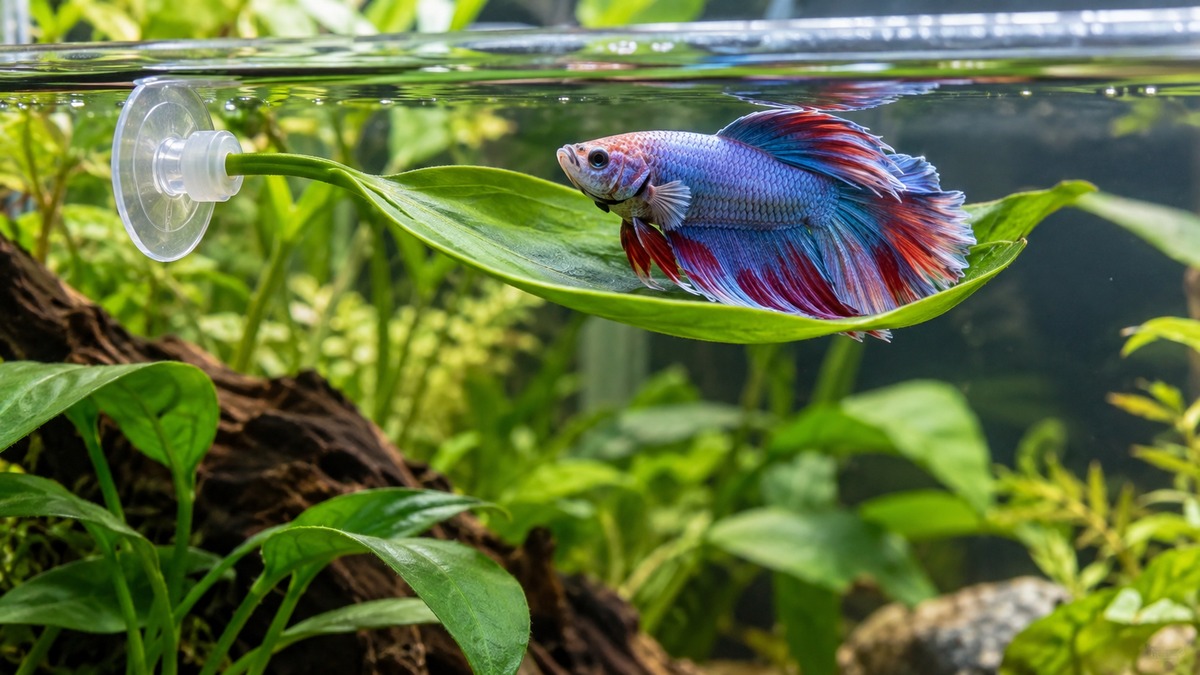
Dr. Jessie Sanders of Aquatic Veterinary Services wrote Betta Fish Tank Decorations (June 14, 2023; the page contains affiliate links). She recommends a flat leaf for resting, especially for long-tailed bettas, and says bettas need rest periods, so more than one resting place helps. She warns against spiky plastic plants and silk plants with pointy attachments, cautions that multi-leaf perches have stems that can tear fins, and advises checking leaves regularly for wear that leaves pointy pieces.
The DIY method comes from DIY Betta Leaf Hammock Build Guide: Suction Cup and Foam Leaf, published on April 26, 2026 by Gensou Premium Aquascaping, a Singapore aquarium retailer. It is a shop blog that promotes the shop’s products. We use its steps and measurements only, and we leave out its claims about benefits to fins, which it does not support with evidence.
The DIY method, step by step
- Gather materials. A brand-new plain kitchen sponge (the blog avoids colored or antibacterial ones), a small suction cup with a hook, thin plastic-coated wire or about 30 lb fishing line, a sharp craft knife and a pin.
- Cut leaves. Sketch an oval or pointed leaf about 5 to 7 cm long (roughly 2 to 2.8 inches) and 3 to 5 cm wide (1.2 to 2 inches). Cut in one smooth motion and round the corners. For a cluster, cut three or four leaves in slightly different sizes.
- Pierce a hole. Make a small hole about 1 cm (0.4 inch) from the base of each leaf, away from thin edges.
- Attach. Thread the line through the leaf and the suction cup hook and tie it off. For a cluster, space the leaves at different heights.
- Pre-soak. Soak the leaves for 24 hours in dechlorinated water, squeezing them now and then and changing the water twice.
- Install. Press the suction cup on the inside of the glass so the top leaf sits about 1 to 2 cm (0.4 to 0.8 inch) under the surface, away from the filter outflow.
- Watch. Look for use in the first 24 to 48 hours. If the fish ignores it after a week, the blog suggests lowering it by 1 cm or moving it to a corner.
Safety checks before and after
- Run a fingertip along every cut edge. Round off anything sharp, as both vet sources warn about edges and pointy parts.
- Do not use colored, scented or antibacterial sponge. The blog calls plain sponge food-grade, but we found no source to back that, so it is the blog’s claim only.
- Inspect the leaf at each water change. Dr. Sanders advises checking leaves for wear; the blog says to replace the sponge every 6 to 9 months as it breaks down and sheds particles.
- Keep it clear of the filter flow, since a low-flow filter is what the Illinois column prefers for bettas.
- If you are unsure about the material, buy a ready-made leaf instead. We did not find an opened source that compares homemade and bought hammocks.
Where the guidance disagrees
The depth advice differs slightly. The Gensou blog puts the top leaf 1 to 2 cm below the surface, about 0.4 to 0.8 inch. The Haulonda listing says to attach its leaf about 3/4 inch below the waterline, or about 1.9 cm. These are close, but neither source explains why, and neither is a veterinary figure. Start near the shallow end and move it if your fish ignores it.
Ready-made alternatives on Amazon
Amazon search for “betta hammock diy” on 2026-10-18 returned only finished hammocks, with no raw materials or DIY kits. Here are five, with data read between 2026-10-10 and 2026-10-18.
| Product | Material | Size on listing | How it mounts |
|---|---|---|---|
| Zoo Med Betta Bed Leaf Hammock, 3 pack | Plastic | Folded 6 x 4 x 1 inches | Suction cup included |
| Haulonda Betta Hammock Leaf Pad, 3 pack | Plastic | 2 inches long | Attach about 3/4 inch below the waterline |
| TYZEMKO Floating Resting Leaf | Not stated | 3.93 x 2.16 x 2.16 inches | Removable suction cup or free floating |
| Laoha 2 PCS Floating Hammock | Plastic, resin (3D printed) | 10 x 5.6 cm or 7 x 4 cm | Floating |
| HOZOE Floating Cave and Hammock | PLA (3D printed) | 3.94 x 3.94 x 1.97 inches; opening about 4 cm | Floating |
Zoo Med Betta Bed Leaf Hammock, 3 pack
Three plastic leaf hammocks with a suction cup, in a pack that folds to 6 x 4 x 1 inches. The dimension field reads 2 inches by 160 inches, which is plainly wrong, so ignore it. Best for: a flat leaf like the one Dr. Sanders recommends. Skip if: you want a floating design.
View Zoo Med on Amazon (affiliate link)
Haulonda 3 Pack Betta Hammock Leaf Pad
Three plastic heart-shaped leaves about 2 inches long. The listing says the leaves are chemical free and BPA free, which are the seller’s words. The Container Type field says Bowl, but a bowl is not the right home for a betta, so ignore it. Best for: a low-cost multi-leaf pack. Skip if: you want a size larger than 2 inches.
View Haulonda on Amazon (affiliate link)
TYZEMKO Floating Resting Leaf with Suction Cup
A single curved ledge, 3.93 x 2.16 x 2.16 inches, with a removable suction cup so it can float or be fixed. The material is not stated. Best for: a single betta in a nano or tabletop tank. Skip if: you need a stated material.
View TYZEMKO on Amazon (affiliate link)
Laoha 2 PCS Floating Betta Hammock
Two 3D-printed plastic and resin floating pieces in 10 x 5.6 cm and 7 x 4 cm sizes, each with a feeding ring and an entrance wider than 3 cm. The dimension field shows 0.1 inch, which conflicts with the bullet sizes, so we use the bullets. Best for: a cave and ring in one piece. Skip if: you want a flat leaf.
View Laoha on Amazon (affiliate link)
HOZOE Floating Betta Cave and Hammock
A 3D-printed PLA piece of 3.94 x 3.94 x 1.97 inches with an opening of about 4 cm. The listing tells buyers to check that the fish is smaller than the opening. Best for: a hide plus a feeding ring. Skip if: you want a leaf shape.
View HOZOE on Amazon (affiliate link)
Worked example: sizing and replacing a three-leaf cluster
For example, cut leaves of 7 x 5 cm, 6 x 4 cm and 5 x 3 cm. In inches those are about 2.8 x 2, 2.4 x 1.6 and 2 x 1.2. Hang the top one 1 to 2 cm under the surface and let the others sit lower, up to about 5 cm (2 inches) deep, which is the range the blog gives. If the sponge is replaced every 6 to 9 months, that is roughly 3 to 4 new sets over two years, because 24 months divided by 9 is about 2.7 and divided by 6 is 4. The interval is the blog’s, so inspect sooner if the foam crumbles.
Mistakes to avoid
- Using a sponge with a scouring side, dye or antibacterial coating.
- Leaving cut edges square and sharp.
- Hanging the leaf where the filter outflow moves it.
- Assuming a homemade leaf is safe because it looks soft. Inspect it each week.
Related guides
For more on resting spots and tank setup, read Best Zoo Med Betta Bed Leaf Hammock, Best Live Plants for Betta Fish Tank, Best Java Moss for Betta Fish and Best Way to Set Up a Betta Tank.
FAQ
Can I make a betta hammock at home?
One shop blog describes a foam leaf on a suction cup. No veterinary source we opened endorses homemade materials, so inspect edges and wear closely, or buy a ready-made leaf.
Why do bettas need a resting leaf?
Dr. Sanders says bettas need rest periods and recommends a flat leaf, with more than one resting place. The Illinois column does not discuss resting spots.
How deep should a betta hammock sit?
The Gensou blog says 1 to 2 cm below the surface, and the Haulonda listing says about 3/4 inch. Neither is a veterinary figure.
What materials should I avoid?
Dr. Sanders warns against spiky plastic plants, silk plants with pointy attachments, and multi-leaf perches whose stems can tear fins. The Gensou blog avoids colored and antibacterial sponge.
Does a hammock replace a proper tank?
No. The Illinois column recommends a tank of at least 5 gallons at 76 to 81 degrees F.