Fish Tank Cycling Kit
As an Amazon Associate we earn from qualifying purchases. Details
A fish tank cycling kit sounds like one box, but Amazon does not really sell it that way. Searching for the phrase mostly returns two kinds of product: bottled nitrifying bacteria, and test kits that let you watch the cycle happen. The closest thing to a single pack is the Seachem Sure Start Pack, which bundles three bottles. This guide compares eight products that make up a cycling set for a new betta tank, shows where the listings disagree with each other and with a University of Florida fact sheet, and ends with a simple shopping rule. Listings were read between 2026-10-17 and 2026-10-18; the fact sheet was opened on 2026-10-18.
Quick answer
For a new betta tank you need two things: a bacteria product, and a way to test ammonia, nitrite and nitrate so you can tell when the cycle has settled. If you want the test side covered, the API Freshwater Master Test Kit lists ammonia, nitrite and nitrate among its tests. For the bacteria side, the listings from API, Microbe-Lift, Fluval, Brightwell and Seachem all sell a bottled bacteria product, and the Sure Start Pack adds a water conditioner (Prime) and a third product (Pristine). Do not rely on the “add fish on day one” wording alone; the next section shows why.
What a cycle is, and how long it takes
The University of Florida IFAS fact sheet Ammonia in Aquatic Systems (FA031), opened 2026-10-18, describes the process in three steps:
- Ammonia-oxidizing bacteria (such as Nitrosomonas) turn ammonia into nitrite.
- Nitrite-oxidizing bacteria (such as Nitrobacter) turn nitrite into nitrate.
- These bacteria need oxygen and alkalinity. The sheet says they stop working effectively when total alkalinity falls below 20 mg/L.
The sheet also says a new biofilter takes six to eight weeks to develop enough bacteria to be effective, and that a healthy system should show zero ammonia. It advises testing at least weekly. The sheet is written for aquaculture, not home tanks, so treat the six to eight weeks as a reference point, not a rule for a betta aquarium.
Where the listings disagree with that timeline
Several listings promise a much faster start. We have not tested any of these claims, and the fact sheet does not test them either. They are shown here so you can weigh them:
- The API Quick Start listing says it allows instant addition of fish when starting a new aquarium.
- The Microbe-Lift Nite-Out II title says “Instantly Cycle Aquariums, Add Fish on Day 1”.
- The Brightwell MicroBacter Start XLF listing says it accelerates the nitrifying bacteria population in 5 to 7 days.
- The Seachem Stability listing says fish may be introduced at any time as long as the dosage is kept up for 7 days.
Against those, FA031 gives six to eight weeks for a new biofilter. Neither side is a betta-specific source. The safest reading is that these are seller claims, and that your own ammonia, nitrite and nitrate tests should decide when the tank is stable, not a bottle’s wording. For tank size and heat, the University of Illinois veterinary column Bettas Need More Than Bowls (15 April 2019) recommends at least 5 gallons and 76 to 81 F.
The eight products compared
| Product | What it is | Size on the listing | Claim about fish |
|---|---|---|---|
| API Quick Start | Nitrifying bacteria | 1 oz (32 oz also listed) | Instant addition of fish |
| Microbe-Lift Nite-Out II | Live bacteria blend | 8 oz | “Add Fish on Day 1” |
| Fluval Cycle | Biological enhancer | 8.4 oz | Useful with new fish |
| Brightwell MicroBacter Start XLF | 15x concentrated bacteria | 125 ml | 5 to 7 days to balance |
| Seachem Stability | Bacteria for the biofilter | 250 ml | Fish at any time if dosed 7 days |
| Seachem Sure Start Pack | Prime, Stability, Pristine | 3 x 100 mL | Establishes the bio-filter |
| Aqueon Pure Live Bacteria | Gel balls of bacteria | 12 pack, 10 gallon each | Not about cycling |
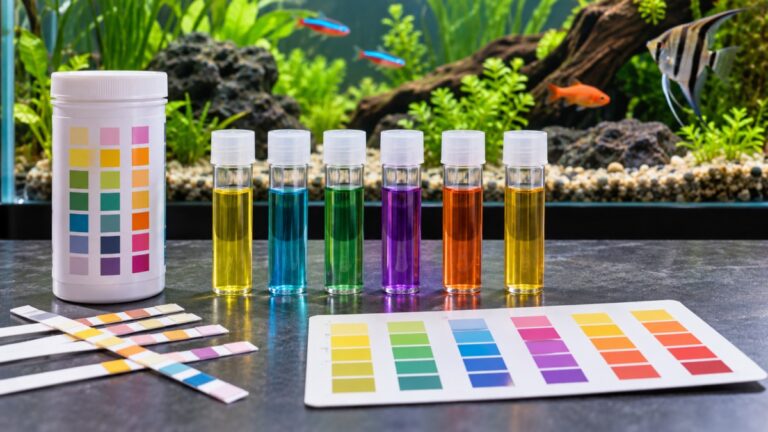
| API Freshwater Master Test Kit | Liquid test kit | 800 tests | Tests ammonia, nitrite, nitrate |
The eight picks
1. API Freshwater Master Test Kit, 800 tests
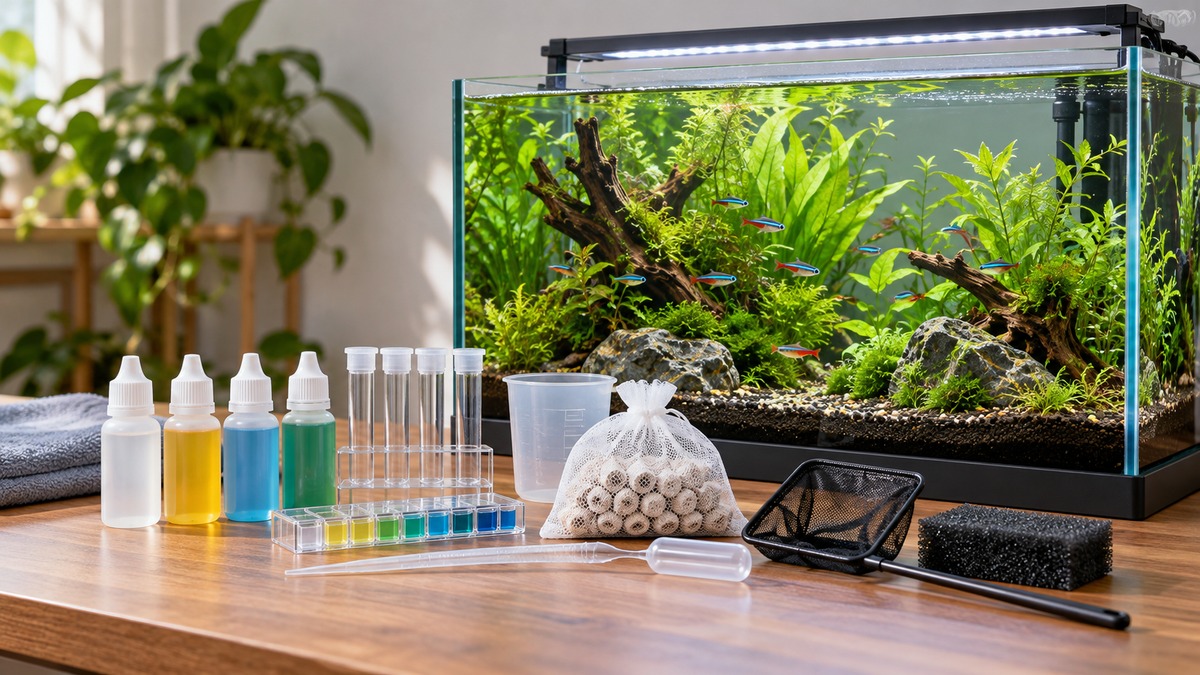
Specs (from the listing, checked 2026-10-17): The kit lists pH, high range pH, ammonia, nitrite and nitrate; 7 bottles of solution, 1 color card and 4 tubes with cap; for freshwater only.
Listing conflict: the bullet says 5 parameters, while the description says six. The 800 total is not broken down per test.
Pros: covers the three readings a cycle is judged by. Cons: you match colors by eye.
Best for: anyone cycling a tank. Skip if: you only want a pass or fail strip.
View on Amazon (affiliate link)
2. Seachem Sure Start Pack, 3 x 100 mL
Specs (from the listing, checked 2026-10-18): contains 100 mL bottles of Prime, Stability and Pristine. The listing says it makes water safe by removing chlorine, chloramine and ammonia, establishes the bio-filter, and eliminates sludge and detritus. Package 6.3 x 5.08 x 1.81 inches; 15.2 ounces.
Pros: the closest thing to a one-box starter. Cons: it does not include a test kit, and dosing is on the labels, which we do not repeat here.
Best for: buyers who want conditioner and bacteria together. Skip if: you already own a conditioner.
View on Amazon (affiliate link)
3. Seachem Stability, 250 ml
Specs (from the listing, checked 2026-10-17): formulated to establish the biofilter in freshwater and marine systems; contains aerobic, anaerobic and facultative bacteria. The listing says fish may be introduced at any time as long as the dosage is maintained for 7 days. Shake well; turn off UV or ozone.
Pros: a named starter with a stated routine. Cons: the stated routine is a 7-day claim, not an independent cycle time.
Best for: a single-bottle bacteria choice. Skip if: you use a UV or ozone unit you do not want to switch off.
View on Amazon (affiliate link)
4. API Quick Start, 1 ounce
Specs (from the listing, checked 2026-10-18): nitrifying bacteria for freshwater and saltwater, model 89A, 1 x 1 x 1 inches and 1.45 ounces; a 32 oz size is also listed. The listing says to use it when starting a new aquarium, adding new fish and changing water and filter media.
Pros: small bottle, repeatable use points. Cons: “instant” fish claim is the one to treat with caution.
Best for: a small tank that needs a small bottle. Skip if: you want the claim backed by a source.
View on Amazon (affiliate link)
5. Microbe-Lift Nite-Out II, 8 ounces
Specs (from the listing, checked 2026-10-18): a blend of live bacteria that, the listing says, decreases ammonia and nitrite toxicity in freshwater and saltwater. It names Nitrosomonas turning ammonia into nitrite and Nitrobacter turning nitrite into nitrate, matching the steps in the UF/IFAS sheet.
Pros: the listing names the bacteria. Cons: “Instantly Cycle” is a seller claim.
Best for: readers who like seeing which bacteria are named. Skip if: you want a smaller bottle.
View on Amazon (affiliate link)
6. Fluval Cycle Biological Enhancer, 8.4 ounces
Specs (from the listing, checked 2026-10-18): model A8349, 2.3 x 2.3 x 6 inches and 8.45 ounces, from Rolf C. Hagen. Listing says beneficial bacteria immediately inoculate aquarium water, and it suits new tanks, new fish, water changes and filter media changes. 16.9 oz and 4 oz sizes also exist.
Pros: several use points listed. Cons: the listing says it “eliminates” ammonia and nitrite, a claim we cannot back.
Best for: buyers who also want it for filter cleanings. Skip if: you want a tested claim.
View on Amazon (affiliate link)
7. Brightwell Aquatics MicroBacter Start XLF, 125 ml
Specs (from the listing, checked 2026-10-18): a 15x concentrated blend for freshwater tanks. The listing says it is shrimp safe, accelerates the nitrifying bacteria population in 5 to 7 days, and is aimed at high-density aquariums.
Pros: concentrated, and freshwater specific. Cons: a “high-density” tank is not a typical betta tank.
Best for: larger or busier freshwater tanks. Skip if: you have one betta in a small tank.
View on Amazon (affiliate link)
8. Aqueon Pure Live Bacteria, 10 gallon, 12 pack
Specs (from the listing, checked 2026-10-18): gel balls that, the listing says, break down harmful waste; it says they cannot be overdosed and are safe for freshwater aquariums. Item model 100537200; 0.9 ounces.
What to know: the bullets we read do not mention cycling or starting a new tank. We include it as a maintenance option, not a cycling start.
Best for: an established tank. Skip if: you are starting from zero.
View on Amazon (affiliate link)
Worked example: how many tests an 8-week cycle uses
This is arithmetic, not a schedule. For example, if you use the six to eight weeks from FA031 as a planning range and test once a week, that is 8 test sessions. At three readings per session (ammonia, nitrite, nitrate), that comes to 8 x 3 = 24 individual tests. If you test every second day instead, 56 days gives 28 sessions, or 84 individual tests. The API Master Test Kit lists 800 tests in total, though the listing does not say how many belong to each parameter.
How to choose
- Always buy a test kit. Bottles claim speed; tests show the real state of your tank.
- One betta, small tank: a small bacteria bottle is enough. Test before you add the fish.
- Want conditioner and bacteria together: the Sure Start Pack.
- Established tank: Aqueon Pure Live Bacteria is a maintenance add-on, not a starter.
- Watch alkalinity: FA031 says nitrifiers slow when total alkalinity drops below 20 mg/L; a KH (carbonate hardness) test is the nearest common home test, though kit makers use the words alkalinity and KH differently, and the API Freshwater Master Test Kit guide covers the main liquid kit.
Related guides
To go further, read Best Ammonia Test Kit for Aquarium, Best API Freshwater Master Test Kit Chart, When to Add Water Conditioner to Fish Tank, and Best Way to Set Up a Betta Tank.
FAQ
Can I add my betta on day one if the bottle says so?
Several listings say so, but those are seller claims. The UF/IFAS sheet gives six to eight weeks for a new biofilter and says a healthy system should read zero ammonia. Tests should decide, and an experienced fish keeper can advise on a specific tank.
Do I need a cycling product at all?
The sources we opened do not say bottled bacteria are required. They describe a cycle that happens as bacteria grow, and the listings sell products meant to speed that up.
Is there a single box called a cycling kit?
Not in the results we read. The Seachem Sure Start Pack is the nearest single pack, but it has no test kit.
Which test kit should I pair with a cycling product?
One that tests ammonia, nitrite and nitrate. The API Freshwater Master Test Kit lists all three.
Why does cycling stall?
FA031 says nitrifying bacteria need oxygen and alkalinity and slow down when total alkalinity falls below 20 mg/L. It also says some antibiotics harm them, so test more often after treatments.