How to Gravel Vac Sand in a Betta Tank
As an Amazon Associate we earn from qualifying purchases. Details
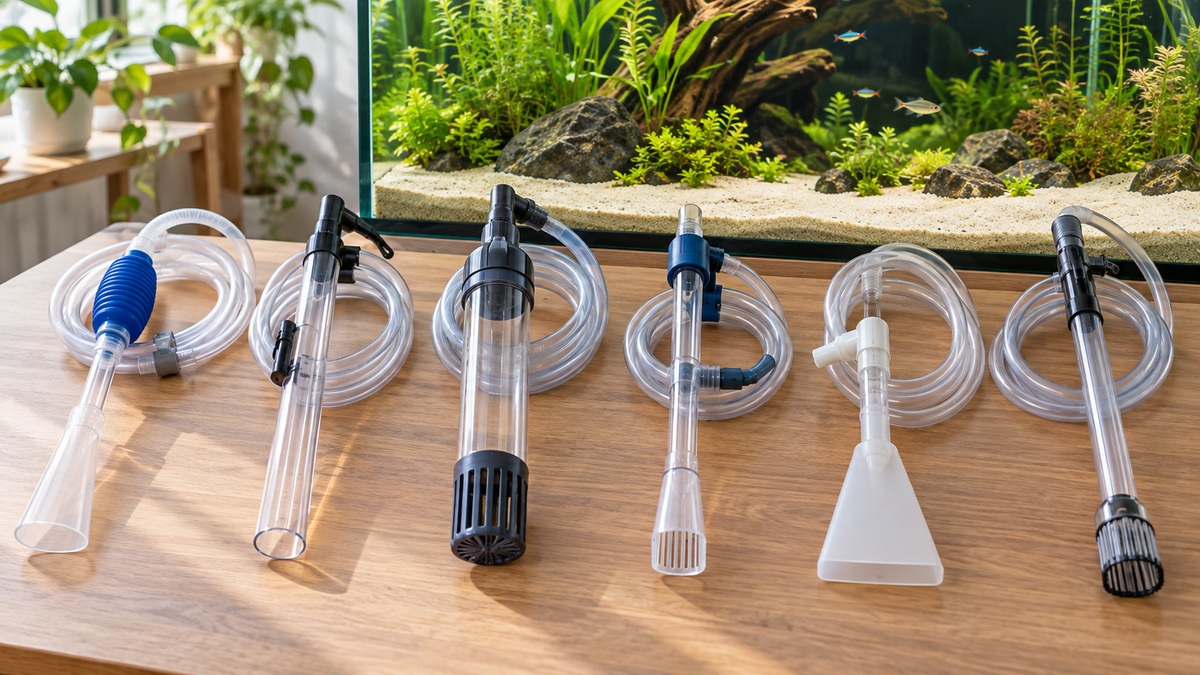
To gravel vac sand in a betta tank, use a siphon with adjustable flow so you can turn the suction down over fine sand. Of the five tools below, the hygger adjustable-flow siphon is the one whose listing says outright that the flow should be reduced for fine sand and raised for gravel or coarse sand. For a small betta tank, the Carefree Fish small vacuum is the one rated for 3 to 8 gallons. Electric models exist, but their pump size and tube length make them better for larger tanks.
At a glance
Figures below are the ones stated in this post and its product listings.
| Cleaner | Stated figure | Other stated figure |
|---|---|---|
| Carefree Fish small vacuum | Rated for 3 to 8 gallons | Gravel particles up to 5 mm; maximum working depth 16 inches |
| hygger water changer | Outlet 19.7 inches (50 cm) lower than the inlet | Water-changing rule |
| Hand-powered compact kit | 6.5 ft hose with 2 extension pipes | Siphon ball and duckbill head |
For a 5 gallon betta tank, a 3 to 8 gallon rated vacuum fits.
Which cleaner fits your tank
- 5 gallon betta tank, hand-powered: the Carefree Fish (3 to 8 gallons) or the AREPK compact kit. Both are described as small-tank tools.
- Fine sand, you want control: the hygger, because the flow can be reduced for fine sand.
- Coarse sand or small gravel, more power wanted: an electric model such as the AKKEE, which includes separate sand-washing tubes for coarse and fine sand.
- You keep shrimp or snails with the betta: the Luigi’s, whose listing describes a filter attachment that protects small fish and invertebrates from being sucked up.
The rule that decides it is particle size versus tool limit, then tank size. The Carefree listing says it works with gravel particles up to 5 mm and has a maximum working depth of 16 inches. The hygger listing gives its water-changing rule: the outlet must be 19.7 inches (50 cm) lower than the inlet. Measure your substrate and your tank depth, then check them against the limits in the listing.
Sand versus gravel: why the cleaning is different
A University of Vermont fish-keeping page says food slips into large gravel, and that too-coarse gravel gives little surface for bacteria. It recommends fine gravel or coarse sand and says to rinse substrate before use. Sand is finer than gravel, so strong suction can pull the sand itself into the tube, which is why the hygger listing ties its flow setting to the substrate. Our sand or gravel cleaning guide compares the two, and the sand or gravel for bettas guide covers the choice itself.
Why bother? Waste and uneaten food sitting in the substrate decays. The University of Florida IFAS ammonia publication says ammonia is colorless and odorless even at toxic levels, and that water changes can reduce ammonia toxicity in the short term; for the long term, a properly sized biofilter is best. A siphon does both jobs at once, because it lifts debris and removes water.
The five tools
1. hygger aquarium gravel vacuum siphon, adjustable flow
- Hand-powered with a siphon ball; 6.5 ft hose, 2 extension pipes, duckbill head, debris vacuum, hose clamp.
- Extension pipe length: 19.8 to 31.5 inches for the S size; 24.2 to 36 inches for the L size. Listed for tanks up to 30 gallons.
- Weight: 14.4 ounces. Black.
The listing describes a flow control valve and says to reduce the flow when cleaning fine sand and raise it for gravel or coarse sand, so you remove waste without pulling out too much substrate. The siphon ball starts the flow with 2 to 5 presses. It also includes a fish-safe filter basket.
Limitation: the water outlet must be 19.7 inches below the inlet for the siphon to work, which means you need a bucket on the floor or a drain below the tank. The S pipe length starts at 19.8 inches, which is long for a small betta tank, so you may be working with a lot of pipe above the water.
View the hygger siphon on Amazon (affiliate link)
2. Carefree Fish small aquarium gravel vacuum and water changer
- Size: S (3 to 8 gallons). Product length 24.8 inches; weight 7.7 ounces.
- Works with gravel particles up to 5 mm. Maximum working depth: 16 inches.
- Includes a wide gravel tube, flow control valve, hose clamp and a 6 ft drain hose.
This is the tool whose listing most directly matches a 5 gallon betta tank. The silicone bulb starts a steady flow after 3 to 5 squeezes, and the listing describes ABS construction and a safe-to-submerge design. The 6 ft hose is adequate for a bucket on the floor beside a desk-height tank.
Limitation: the listing does not say the flow control is designed for fine sand, so you have to do that yourself. The 16 inch depth limit is not an issue for a betta tank, but it rules out taller tanks.
View the Carefree Fish vacuum on Amazon (affiliate link)
3. AREPK compact siphon vacuum and water changer kit
- Three cleaning heads, a thinner straw, a brush, and two sets of replaceable sponges.
- Weight: 8.1 ounces. Package: 9.53 x 4.13 x 2.32 inches. Orange.
The title says it covers gravel and sand cleaning in small tanks, and the listing names betta tanks among the tanks it suits. The thinner straw is meant for tight spots between rocks, wood and plants, which is useful in a decorated betta tank. The pump head detaches at both ends for cleaning.
Limitation: the listing says it suits tanks under 10 gallons and also larger tanks above 10 gallons, so it gives no single tank rating, and it gives no maximum working depth. It also does not say whether flow is adjustable.
View the AREPK kit on Amazon (affiliate link)
4. AKKEE 18W electric aquarium vacuum gravel cleaner
- 18W motor; 1.5 m water hose; 4.92 ft hose length in the specification table.
- Tube extends from 27.95 to 33.6 inches; total length up to 35.8 inches.
- Includes sand-washing tubes for coarse sand and for fine sand, a manure-sucking head, an algae blade, a DC 12V adapter, wired controller and filter bucket.
The listing describes it as a six-in-one: water changing, sand washing, filtering, sand shoveling, brushing and manure removal. The pump motor is mounted at the end, so the listing says you can use it in a low water tank. If you have a large tank to clean this saves effort over hand siphons.
Limitation: it needs a power outlet (the kit includes a DC 12V adapter and a wired controller). For a 5 gallon tank the listed tube length is far longer than you need, and the listing does not give a flow rate you can reduce. Keep it for larger tanks.
View the AKKEE electric cleaner on Amazon (affiliate link)
5. Luigi’s gravel vacuum hand siphon
- Weight: 2.82 ounces. Package: 16.98 x 4.76 x 2.35 inches.
- Hand pump with no priming; one-way valve.
- Attached filter that the listing says protects small fish and invertebrates.
The listing says it clears 30 litres in about five minutes, and that the filter attachment stops shrimp and small fish from being sucked up. For a betta tank with shrimp or snails, that filter is the relevant feature. It is also the lightest of the five.
Limitation: the listing does not name a sand or gravel size limit and has no flow adjustment, so over fine sand you would have to control suction by how you hold it. The brand field is empty.
View the Luigi’s siphon on Amazon (affiliate link)
How to vac sand in a betta tank
- 1. Check the limits. Compare your sand or gravel size and tank depth against the tool’s listing, as above.
- 2. Set up the drain. Place the bucket lower than the tank. The hygger listing says the outlet must be 19.7 inches lower than the inlet.
- 3. Prime the siphon. The hygger needs 2 to 5 presses of the ball and the Carefree needs 3 to 5 squeezes.
- 4. Reduce the flow over fine sand. The hygger listing says to lower the flow for fine sand and raise it for gravel or coarse sand.
- 5. Work in sections. Do part of the tank and leave the rest for the next water change; the aim is to remove waste without pulling out too much substrate.
- 6. Test the water afterward. The IFAS publication says testing is the only way to detect ammonia. See the betta tank cleaning guide for the full routine.
FAQ
Can I use a regular gravel vac on sand?
Only if you can control the suction. The hygger listing says to lower the flow for fine sand, and the Carefree listing gives a 5 mm particle limit. Without adjustable flow, a tool can lift the sand itself.
Which tool suits a 5 gallon tank?
The Carefree Fish listing is rated for 3 to 8 gallons. The AREPK listing says it suits small tanks, though it gives no single volume rating.
Can I use an electric cleaner in a betta tank?
The listings are written for general use. The AKKEE tube extends 27.95 to 33.6 inches and its listing gives no adjustable flow figure, so it is better suited to a larger tank than to a 5 gallon betta tank.
What protects shrimp and small fish from the siphon?
The Luigi’s listing describes an attached filter that prevents small fish, shrimp and other invertebrates from being sucked up. The other listings do not describe one, apart from the hygger’s fish-safe filter basket.
How often should I vac?
The listings do not say. The IFAS publication says water changes reduce ammonia toxicity in the short term, so schedule the vacuuming with your water changes.
Bottom line
For a betta tank with sand, choose the hygger if you want the flow control that suits fine sand, the Carefree if you want a tool rated for 3 to 8 gallons, and the Luigi’s if shrimp share the tank. Leave the electric models for bigger tanks, and test the water afterward.
Bài viết liên quan: Sand or Rocks for a Betta Tank: Which to Choose, Black Friday Betta Tank Checklist: What to Check First.