Do Betta Fish Like to Hide? What the Sources Say
As an Amazon Associate we earn from qualifying purchases.
The person typing “do betta fish like to hide” wants a yes or no, and a sense of whether the tank needs cover. The sources opened for this guide do not say that bettas like to hide, so a yes or no cannot be sourced. What they do describe is the betta’s natural habitat, which was “characterized by heavy emergent vegetation, shallow water,” and what decoration does for fish in general. A betta can use cover in a tank, and this guide explains how to think about that without claiming a preference the sources do not state.
Quick answer
- No opened source says bettas like to hide, so a sourced yes or no is not possible.
- The UF/IFAS betta publication describes wild habitat with “heavy emergent vegetation,” which is cover in the wild, not a proof of preference.
- The Merck Veterinary Manual says decor can “allow fish to have their own territory,” a point it makes for fish in general.
- Choose plants or decor for shelter only as general guidance, and check the listing for size and edges.
What the wild habitat shows
The IFAS publication describes where bettas live in nature. It says the betta “is typically found in standing waters, including shallow ponds, rice paddy fields, and even puddles.” It also gives a summary of the habitats studied: “Overall, these habitats were characterized by heavy emergent vegetation, shallow water, low dissolved oxygen, high temperature, and an acidic pH.”
That description supports one careful inference: in the wild, bettas live among plants. It does not show whether a betta chooses to hide, rests in plants, or uses cover for safety. The sources opened do not measure behaviour in a tank. Treat the habitat point as context, not as proof of a preference.
The same publication also describes breeding behaviour, noting that “In April and May, during the breeding season in Thailand, the betta will move to shallow water edges to breed.” That shows where bettas go at one point in their life, and it still says nothing about hiding in a home aquarium.
What decor does for fish in a tank
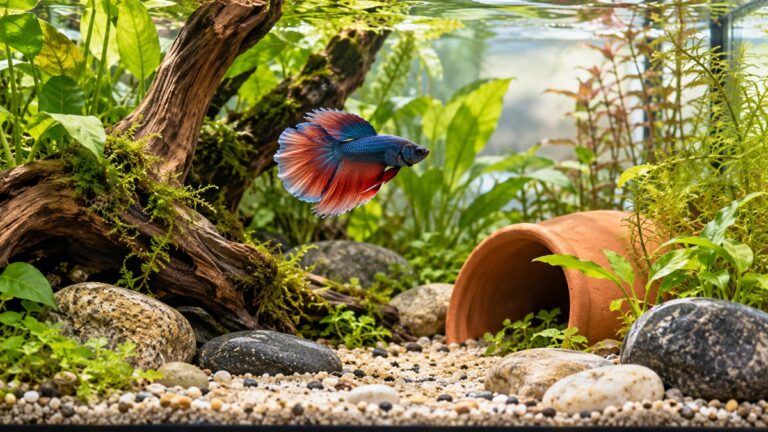
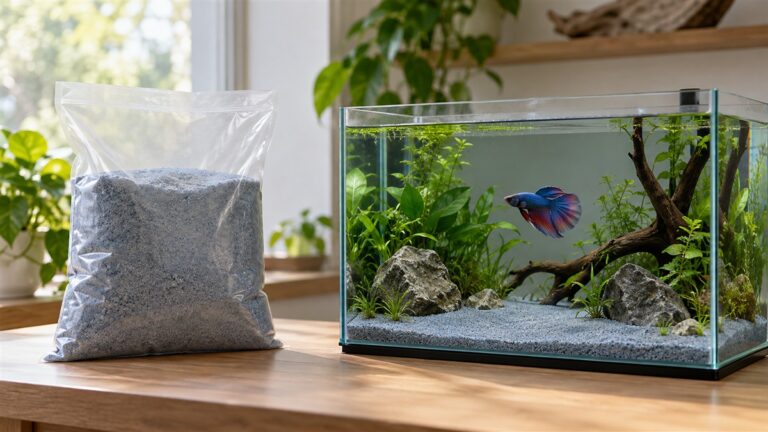
The Merck Veterinary Manual discusses decorative objects in its home-setup guidance. It says that decor is “not only aesthetically pleasing” and can also “allow fish to have their own territory.” It adds that this “can be very important for certain fish, such as freshwater cichlids and many saltwater reef fish.” Bettas are not named in that passage.
So the sourced point is about territory for fish in general. Whether a betta needs its own territory, and whether it uses decor as a hiding place, is not stated. If you add decor, a practical reading of the Merck point is that a tank with some structure gives fish more places to be out of the open. That reading is general guidance.
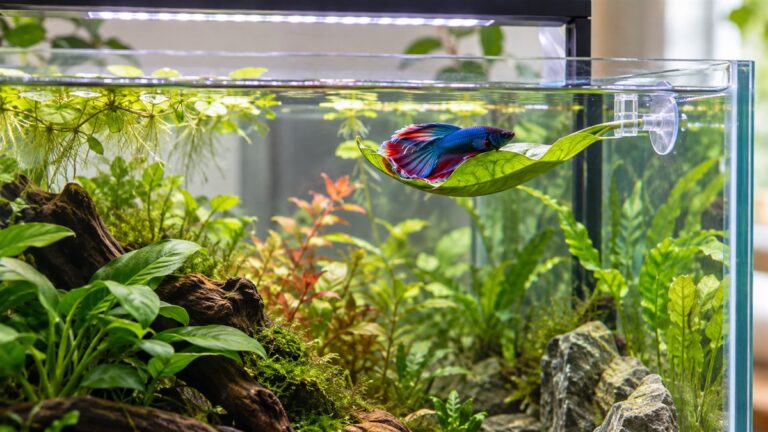
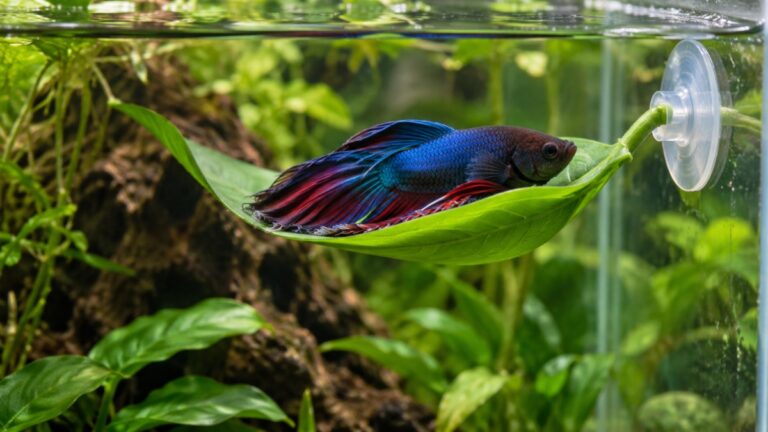
For live cover that also shades the water, see the live plant guide for betta tanks. For resting spots at the surface, see the betta hammock guide.
Plants give shade and stable water
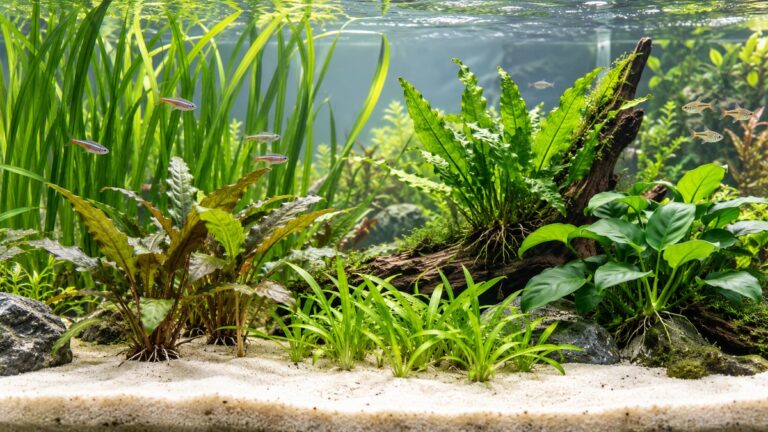
Plants do more than give cover. The Merck page notes that “Plants, and floating plants in particular, can also minimize temperature changes by shading the water to keep it cool.” It also says that aquatic plants “help prevent the growth of algae by absorbing nutrients that would otherwise feed the algae.” These are benefits for the water, and they are separate from any claim about hiding.
The IFAS source adds a welfare limit. It says that “Bettas prefer calm water as shown by research using flow as a stressor.” A dense planting does not add flow, so plants and decor do not conflict with calm water. A heavy filter or a strong outlet can. Check the outlet before you position any cover near it.
Choosing decor with care
The sources do not give a list of safe decor for bettas, and this guide does not rank any item. The general checks below follow from the sources and from basic tank care, and they are labelled as general guidance.
- Check the size against the tank, so that the item does not block the surface or the filter outlet.
- Check the listing for edges, and avoid items that the listing does not describe. The phrase “betta safe” on a listing is a marketing claim, not a standard.
- Rinse new decor before it goes in, since the Merck page recommends rinsing gravel to remove dust that can clog filters.
The rinsing point is about gravel in the Merck text. Apply it to decor as general guidance, not as a sourced rule for decor.
Reading your betta’s habits
Because the sources do not describe betta cover preferences, the most useful evidence is the fish in your own tank. Over a few days, note where the betta rests, whether it stays near the surface or the bottom, and whether it returns to the same spot when the tank is quiet. Change one thing at a time, so you can tell what made a difference. This is general observation guidance, not a sourced method, but it follows the IFAS point that health depends on management and husbandry.
The IFAS stress publication says that “The key to prevention of stress is GOOD MANAGEMENT.” If a change in behaviour is new and persistent, describe it to an experienced fish keeper or an aquatic vet. The opened sources do not explain what such changes mean for bettas, so do not treat a single observation as a diagnosis.
How we chose
The criteria for this guide were set before any search for decor. The sources are a university extension publication on betta biology and a veterinary reference on fish set-up. Retail pages were excluded. No product, price, rating or listing claim appears in the sourced content. Each quotation was checked against the text of a page opened on 2026-10-24.
What we could not verify
The sources do not answer the question this guide is about. They do not say whether bettas like to hide, how often they use cover, or what cover type they prefer. The points below need a separate source before anyone states them as fact.
What the sources do not say
- Whether bettas prefer hiding places, rest spots or open water.
- Which decor types suit bettas, or whether any decor is safe without checks.
- How much cover is enough in a home tank.
- Whether a betta shows stress when it cannot find cover.
Frequently asked questions
Do betta fish hide when they feel scared?
The sources opened do not describe betta behaviour when frightened. The IFAS publication describes habitats with heavy plants, which is context only. For a sourced answer, look for a behaviour study or a university page on betta behaviour.
Do betta fish need hiding places in a tank?
The sources do not say a betta needs hiding places. The Merck page says decor can give fish their own territory, a point made for fish in general. Adding cover is a reasonable step as general guidance, provided the items are safe to use.
Are live plants a good hiding place for a betta?
The sources do not rank plants as hiding places. They do describe plants as shading the water and absorbing nutrients that feed algae. Live plants also add to the water-quality picture, which is a separate benefit.
Should a betta have a surface resting spot?
The sources do not say bettas need a surface resting spot. The IFAS publication describes breeding at shallow water edges, but it does not describe resting habits in a home tank.
Can decor make a betta stressed?
The sources do not describe decor as a stressor for bettas. IFAS lists general stressors such as poor water quality, crowding and aggression, and decor is not among them in the text opened. Keep decor clear of the filter outlet and the heater, and watch the fish after any change.
Sources
- Evolution, Culture, and Care for Betta splendens (UF/IFAS FA212), opened 2026-10-24.
- Providing a Home for Fish, Merck Veterinary Manual, opened 2026-10-24.
- Stress: Its Role in Fish Disease (UF/IFAS FA005), opened 2026-10-24.