Betta Safe Decorations
As an Amazon Associate we earn from qualifying purchases.
Betta safe decorations are hides, caves and resting spots that a betta can use without getting hurt on the object. The person searching for betta safe decorations wants to know which items are safe to put in a betta tank, and what to check on the label. The phrase “betta safe” is a product claim, not a standard. None of the sources we opened defines it, so this roundup treats it as what each listing says, and it names the physical details the listing gives: material, size, finish and care instructions. Those details decide whether an item is likely to suit a betta, and they are the first thing to compare.
Quick answer
- Pick smooth hides with open shapes over items with small openings or thin, sharp parts. Check the listing’s dimensions and material before you buy.
- Treat “betta safe” as the seller’s claim. The sources we opened do not define it for decorations.
- Four picks in this roundup: a ceramic rock cave, a resin castle cave, an eight-piece sunken ship set, and a leaf hammock that clips to the tank surface with suction cups.
- One listing is dropped because it is vase-shaped, and the site guidance does not recommend vases for bettas.
Why hides matter for a betta
A betta needs somewhere to rest and to get out of the flow of the water. The Merck Veterinary Manual describes decorative objects as more than looks: “Decorative objects are not only aesthetically pleasing but also help ‘divide’ the aquarium and allow fish to have their own territory.” That passage is written for fish in general, not for bettas, but the territory point applies to a small tank where one fish has the whole space.
The IFAS betta publication describes the betta’s natural habitat in shallow, slow water and notes that bettas are labyrinth fishes that breathe air at the surface. That is why a resting spot near the top of the tank is a common choice for owners, and why the hammock in this roundup sits at the surface. The IFAS source does not say which decoration to buy. It does note that small, lightly filtered tanks need frequent water changes so that “ammonia and other dissolved wastes are not allowed to reach harmful levels.” Decorations that trap food or waste in crevices can make that harder to manage, so pick items you can rinse and check.
Decorations also take up space. The Merck page advises placing larger objects before the tank is filled, because “Larger decorative objects, such as large rocks, coral skeletons, or driftwood, are easier to place before the tank is filled with water because they can be moved much more easily.” Measure the listing’s dimensions against your tank before you order, and place heavy or large items before adding water.
Comparison table
The table uses only what each listing states. Where a listing gives two sizes or two materials, both are shown and the conflict is named.
| Item (listing) | Material | Size stated | Finish, mounting and care stated |
|---|---|---|---|
| Ceramic rock cave with two holes (Zcblcyj) | Ceramic | 3.7 in D x 3.54 in W x 3.8 in H | Glazed; “Spot Clean with mild soap and water, avoid harsh chemicals”; mounting field reads “Tabletop” |
| Resin castle hideout (SiissaPeksid) | Resin | Specs: 3.2 in D x 6 in W x 5.1 in H. Bullet: about 5.9 x 3.1 x 5.3 in | Polished; “Wipe Clean”; bullets say soak before use; mounting “Freestanding” |
| Sunken ship and plants, 8-piece set (CousDUoBe) | Plastic and resin | Ship 5.3 in x 2.5 in x 4.5 in; plants 2.3 to 4.7 in tall | Fade resistant; flat-bottom design; “rinse with clean water before use” |
| Silicone leaf hammock, 2 pieces (WILLBOND) | Plastic (specs); title says silicone | 4.3 in L x 1.77 in W x 1.77 in H | Suction cup attachment; listing says to clean the glass before attaching |
Calculation: the castle’s listed width of 6 inches is about 1.4 times the hammock’s listed length of 4.3 inches. If you are choosing between a hammock and a hide for the same tank, measure the open water near the surface before you decide, because the hammock takes up far less floor space.
The four picks
Each pick lists what the listing says the item does, who it suits, and when to skip it. The facts come from listing data, not from handling the items.
Ceramic rock cave with two holes (Zcblcyj)
Best for: a tank owner who wants a solid hide with two openings. The listing describes “double holes” and a “smooth polished” finish, and says the cave is “specifically designed for small tanks.”
Skip if: the tank is larger and you want a hide that fills more floor space. The listing gives a 3.7 inch depth and a 3.8 inch height, so it is a compact piece.
Listing limit: the listing calls the ceramic “non-toxic.” That is a seller statement. No source we opened covers ceramic safety for fish. The mounting field reads “Tabletop,” which does not describe placement inside a tank, so check how the item sits before you buy.
Resin castle hideout (SiissaPeksid)
Best for: a reader who wants an enclosed hide with a castle shape and a resting spot on top. The listing describes a “Hidden Cave” and says the item is for “Betta, Shrimp, Goldfish, and more.”
Skip if: you need a confirmed size. The specs give 3.2 by 6 by 5.1 inches, while a bullet gives about 5.9 by 3.1 by 5.3 inches. Measure the item you receive before you place it.
Listing limit: the bullets instruct you to soak the item in “a small amount of baking soda or water for half an hour” before use. The listing also calls the resin “non-toxic.” No source we opened supports that claim.
Sunken ship and plants, 8-piece set (CousDUoBe)
Best for: a reader who wants a layered look from one set. The set has one ship and seven plant pieces, and the listing says the flat bottom “keeps it stable on substrate.”
Skip if: you want a single hide. Most of the set is plants, and the ship is the only hide shape. Skip it if you need the plants to be live, since the listing describes artificial plants.
Listing limit: the listing says the soft leaves “won’t scratch delicate fins.” That is a seller statement. The sources do not address artificial plant leaves.
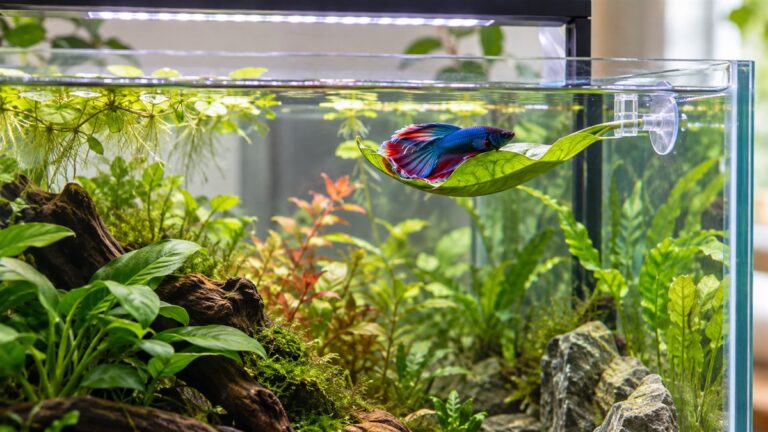
Silicone leaf hammock, 2 pieces (WILLBOND)
Best for: a betta owner who wants a resting spot near the surface. The listing says placing the leaf hammock “near the surface of the tank gives your betta a comfortable place to rest and play.”
Skip if: you do not want suction cups on the glass. The listing says to clean the aquarium surface before adding the suction cups, so the hammock needs a clean, flat spot.
Listing limit: the title says silicone, but the material field says plastic. Ask the seller before you buy if the material matters to you. The listing gives the size as 4.3 inches long and 1.77 inches wide.
Listings dropped from this roundup
- Classical vase hideaway cave (YUCSAWJK, B0GF9F44M9): the listing names it a “Classical Vase Hideaway Cave” and gives a vase-shaped form. The site guidance does not recommend vases for bettas, so the item is dropped even though the listing calls it a betta hideout.
- Leaf hammock, second listing (WILLBOND, B08GC2FQZQ): the same product with a different size and color listing. It repeats the pick above, so only one hammock listing is kept.
How we chose
The selection started from a pool of six listings in the research file for this keyword, checked 2026-10-24. The first filter was type: each item had to be a hide, cave, decoration set or resting spot that can sit in a freshwater tank. The second filter was the listing’s own description: an item had to state a material and a size, so the physical details can be compared. The third filter was shape: vase-shaped items were dropped under the site guidance. Duplicates of the same product were kept once. Price and star ratings were not used.
Within the four picks, the order follows the listing details. The ceramic and resin caves come first because they have a clear material and size. The set and the hammock follow because their listings include fewer dimensions or conflicting material fields.
What we could not verify
The listings describe their products, and the sources we opened describe fish care. Neither answers whether any one decoration is safe for a betta over time. The listings’ claims about “non-toxic” material, “won’t scratch” leaves and “betta safe” wording come from the sellers. No source we opened confirms them.
What the sources do not say
- The sources do not define “betta safe” for decorations, and they do not list materials that are safe or unsafe for bettas.
- The Merck page says decorative objects can divide the aquarium, but it does not say which materials are safest, and its territory example is about cichlids and reef fish, not bettas.
- The IFAS betta publication does not discuss decorations. It covers water quality and the betta’s breathing at the surface.
- The castle listing gives two sizes, and the hammock listing gives a material that conflicts with its title. No source resolves either conflict.
What to check on any listing
Use the listing as a checklist. Confirm the material and the size in the specs, not only in the title. Look for small openings a fish could get caught in, thin points or rough plastic plants, and check the care line for cleaning. If a listing says “betta safe” without naming a material or a size, treat that as a claim you still need to check. The roundup does not claim any item has been checked for sharp edges, because no source we opened covers that.
Placement matters as much as the item. Put large pieces in before the water goes in, leave open swimming room, and keep the hammock on a clean, flat spot if you use suction cups. The Merck page’s advice about placing larger objects before filling the tank applies here.
FAQ
What does “betta safe” mean for a decoration?
No source we opened defines it. Treat it as the seller’s phrase. Check the material, size and openings in the listing, and look for any sharp points or rough plastic plants before you put the item in.
Are ceramic caves safer than resin ones?
The sources do not compare them. The listings describe both as non-toxic, and neither listing gives test results. A ceramic cave in this roundup is described as glazed, and the resin castle asks for a soak before use. Follow each listing’s care line.
Can a betta live with a hammock and no hide?
The sources do not set a rule for this. The IFAS publication notes that bettas breathe air at the surface and need warm, lightly flowing water, so a hammock near the surface is one way to give a resting spot. A hide gives a different kind of cover. Many owners use one of each, but the sources do not require either.
How do I know if a decoration fits my tank?
Compare the listing’s dimensions with the inside of your tank and leave open swimming room. The Merck page advises placing larger objects before filling the tank, so measure first. Where the listing gives two sizes, measure the item you receive.
What should I do if my betta stops eating or hides all the time after I add a decoration?
Check the water first with a test kit, and remove the new decoration to see whether the behavior changes. The sources do not give a diagnosis for this. For signs of illness, consult an experienced fish keeper or an aquatic veterinarian.
Related guides
- For live and silk plant options that give cover, read the live plants guide for betta tanks.
- For a tank size check before you add items, read how big a tank a betta needs.
Bottom line
Choose a decoration whose listing gives a material, a size and a clear care line, and treat “betta safe” as a claim you still need to check against those details before you add it to the tank.
Sources
- University of Florida IFAS Extension, “FA212: Evolution, Culture, and Care for Betta splendens,” https://edis.ifas.ufl.edu/publication/FA212 (opened 2026-10-24)
- University of Florida IFAS Extension, “FA16/FA031: Ammonia in Aquatic Systems,” https://edis.ifas.ufl.edu/publication/FA031 (opened 2026-10-24)
- Merck Veterinary Manual, “Providing a Home for Fish,” https://www.merckvetmanual.com/all-other-pets/fish/providing-a-home-for-fish (opened 2026-10-24)