Aqueon Betta Food
As an Amazon Associate we earn from qualifying purchases.
Aqueon betta food, in the form most shoppers find first, is the Aqueon Nutrinsect Betta Pellets, a 1.41 oz bag of fish-free pellets. The person typing aqueon betta food usually wants to know whether this food is complete enough to be the main diet, how much to feed, and whether it fits a betta kept in a filtered or unfiltered tank. The short answer: it is a plant- and insect-based pellet that the manufacturer says meets daily nutritional needs. Feed it two to three times a day in amounts the fish finishes in about two minutes, and remove what is left. The sources do not publish a guaranteed analysis for this pellet, so its protein content is unverified.
Quick answer
- Best for: an adult betta that needs a daily, fish-free pellet and is fed in small amounts, with a varied diet added alongside.
- Skip if: you need a published protein figure, or you are raising young fish, because the UF/IFAS grow-out guidance calls for a higher protein floor than the listing confirms.
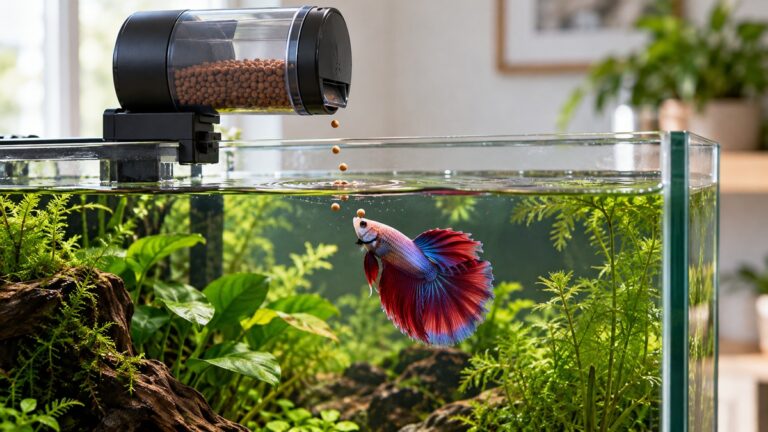
- Feeding rule: two to three small feedings a day, eaten within about two minutes, with leftovers removed about five minutes later.
- Verification gap: the sources we opened list the ingredients but do not state a guaranteed analysis or pellet size.
For a broader comparison of betta foods, see Best Betta Food. For daily amounts across pellet brands, see How Many Pellets to Feed a Betta.
What the product is
The Nutrinsect line is Aqueon’s fish-free range, sold by Central Garden and Pet. The manufacturer page describes Nutrinsect Betta Pellets as “100% fish-free”, with a plant- and insect-based formula. The Amazon listing for the 1.41 oz betta size (ASIN B0BSNZ4M3T) describes the item as a pellet with the flavor “Insects and Algae” and the life stage “All Life Stages”. The manufacturer page says the formula is “designed for optimal palatability and color enhancement”, and the listing names spirulina and a haematococcus algae meal as color sources.
The fish-free claim is the main design choice. The manufacturer page explains that the insect-based proteins are meant to match what a betta eats in the wild, and it says the food is “easily digestible”. Those are the manufacturer’s statements. None of the sources we opened measure digestibility, and none compare this pellet to a fish-based food in a controlled setting.
Specs from the listing and manual
| Spec | Value | Where it comes from |
|---|---|---|
| Package size | 1.41 oz (about 40 g) | Amazon listing, size field |
| Product dimensions | 1.75 x 1.75 x 3.31 inches | Amazon listing, product details |
| Form | Pellet | Amazon listing, item form |
| Life stage | All Life Stages | Amazon listing |
| Fish-free claim | “100% fish-free” | Aqueon manufacturer page |
| Feeding rule | 2 to 3 times a day, eaten in 2 minutes | Aqueon manufacturer page and Amazon listing directions |
| Ingredient list | 46 listed items | Amazon listing, ingredients field |
| Guaranteed analysis | Not in the sources we opened | Not stated |
The listing’s dimensions describe the package, not the food. The listing does not state pellet diameter, sinking or floating behavior, or how many pellets are in the bag. Those are the first things an owner would need to know before choosing a bag size, and they are missing from the sources.
The ingredient numbers
The listing gives 46 ingredient entries, with no weight or percentage for each one. Counting the entries by source group gives a rough view of how much of the list is animal-derived. The count is by entry, not by weight, so it does not show what share of the pellet is protein.
| Group | Listed items | Count |
|---|---|---|
| Insect or worm-based | Dried Mealworms, Dried Black Soldier Fly Larvae, Dried Bloodworms | 3 |
| Crustacean-derived | Shrimp Meal, Freshwater Shrimp, Krill Oil | 3 |
| Plant, algae, and yeast | Ground Peas, Dried Kelp, Spirulina, Haematococcus Algae Meal, Brewers Dried Yeast, Inulin, Agar-Agar, Carob Bean Flavor, Turmeric, Garlic | 10 |
| Vitamins and minerals | Vitamin A, Vitamin D3, Vitamin B12, Vitamin E, Vitamin K activity, Vitamin C source, Niacin, Riboflavin, Thiamine, Pyridoxine, Biotin, Folic Acid, Iron, Zinc, Copper, Manganese, Iodine, Selenium, and others | about 25 |
| Amino acids and other additives | L-Lysine, DL-Methionine, Threonine, Betaine, L-Carnitine, Choline Chloride, Tannic Acid, Rosemary Extract, Mixed Tocopherols | about 9 |
Formula: animal-derived share by entry = (insect or worm entries + crustacean entries) / total entries = (3 + 3) / 46 = 6 / 46, or about 13 percent. The count treats the three insect and worm entries and the three crustacean entries as animal-derived, and it counts the vitamin and amino acid entries as additives. The result shows the list is mostly plant, algae, and additive entries by count. It does not show protein content, because the listing does not give any protein figure.
The listing’s ingredient order runs with ground peas first, then insect and shrimp items. Ingredient lists are normally ordered by weight, but the sources do not say that explicitly for this product, so the order is not treated here as a measurement of the pellet’s composition.
Who it suits
- An adult betta that does not do well on a fish-based pellet, if you want to avoid fish-derived ingredients for ethical or personal reasons.
- An owner who wants a single daily food with a short, clear feeding rule and does not need a protein number on the bag.
- A betta kept in a filtered tank that is maintained on a schedule, since the Aqueon care sheet allows once or twice daily feeding in filtered aquariums.
- An owner who will add variety, as the Aqueon care sheet recommends, rather than using one pellet alone.
Who should skip it
- An owner who needs a published guaranteed analysis or a protein floor on the label. The sources we opened do not provide one.
- Anyone raising young or growing fish. The UF/IFAS publication says grow-out diets should contain at least 35 percent protein. The listing does not confirm that this pellet reaches that figure.
- An owner who expects a food to float or sink in a particular way. The sources do not state this.
- Anyone who wants a food that matches a specific color-enhancing claim with a published test. The sources state color enhancement as a goal, not as a measured result.
How to feed it: steps from the Aqueon sources
The steps below come from the Aqueon manufacturer page, the Aqueon betta care sheet, and the UF/IFAS publication. Where two Aqueon sources differ, both are shown.
Step 1: Set the tank up before the fish arrives
The Aqueon care sheet says: “Set the container up at least 48 hours before purchasing your new betta.” The point of the step is that a betta arrives in a stable tank, so the first feedings do not add to an unfinished water cycle.
Step 2: Choose a feeding frequency for your tank type
The manufacturer page says to “feed two to three times a day”. The Aqueon care sheet is more specific by tank type. It says: “In unfiltered containers, feed sparingly, once daily. In filtered aquariums, feed once or twice a day.” These two rules conflict for a filtered tank. The conservative reading is to use the care sheet, which covers tank type, and to start at once or twice a day. Use the manufacturer’s two to three feedings only if your water tests and the fish’s body condition support it.
Step 3: Use the portion rule
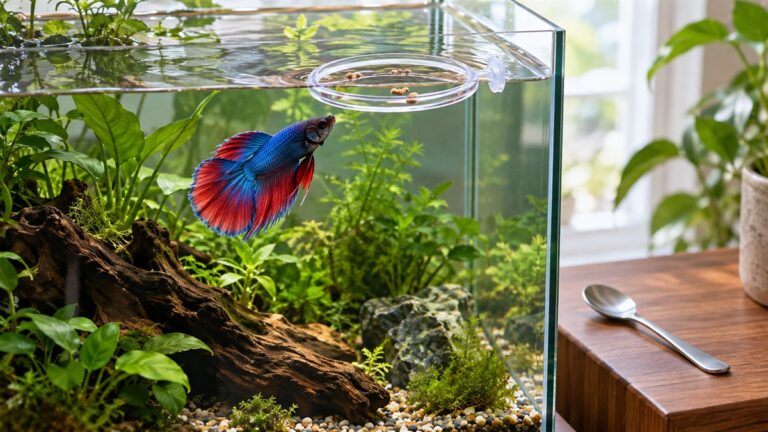
The manufacturer page says to feed “in small amounts that your betta will fully consume in two minutes.” The care sheet says: “All food should be consumed in three minutes or less, any remaining food should be removed.” The two time limits differ by one minute. Using the two-minute limit keeps the portion smaller and is the safer choice for a betta, since uneaten food is the main source of fouling the UF/IFAS publication warns about.
Step 4: Remove uneaten food
The manufacturer page says to “Remove any uneaten food that is still around about five minutes after feeding.” This is the same concern as step 3. The UF/IFAS publication names “avoiding overfeeding and water fouling” as key to proper feeding regimens.
Step 5: Switch gradually from another food
The manufacturer page says: “when switching to a new fish food, do so gradually.” The page advises mixing a small amount of the new food with the current one, then moving over fully once the fish accepts it. A betta that refuses a new pellet should be given time rather than a sudden change.
Step 6: Add variety
The Aqueon care sheet says that “Betta eat insects and other invertebrates in the wild and do best on a varied diet.” It recommends a combination of foods for color and growth, and names Aqueon Tropical Flakes, Tropical Color Flakes, Betta Food and Betta Treat. The sources do not give amounts for each food. The UF/IFAS publication says live or frozen feeds such as bloodworms or adult brine shrimp can be added to a dry diet, which matches the variety idea.
Step 7: Keep the water changed
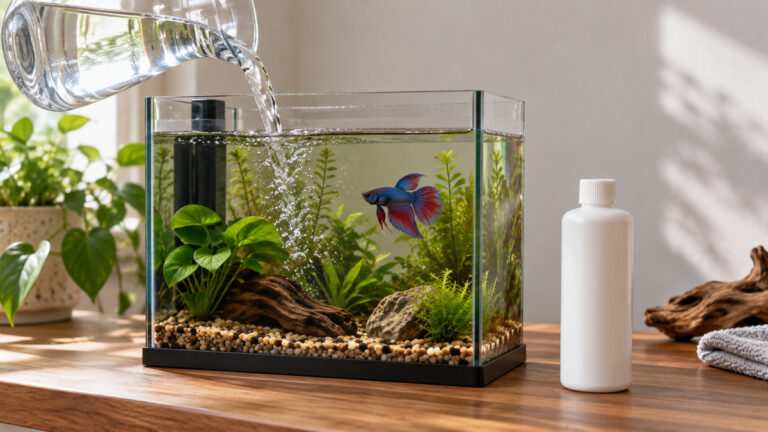
The Aqueon care sheet gives two schedules. For a filtered aquarium it says to “change 25% every 2 to 4 weeks” and to change the filter cartridge at least once per month. For a small unfiltered container it says to change one third of the water every three to four days. The sources do not say how often to change water for a tank with a heater and a filter of a given size, so the schedule above is the one the sources give.
How we chose
The keyword names a single product family, so the review is a product review rather than a comparison. The Nutrinsect Betta Pellets listing was chosen because it is the Aqueon betta-labeled pellet that the sources we opened describe, and because its manufacturer page is the only Aqueon page we opened that covers this exact product. The criteria were: the fish-free claim as stated by the manufacturer; the ingredient list and size from the Amazon listing; feeding rules from the Aqueon manufacturer page and the Aqueon betta care sheet; and the protein floor and overfeeding warning from the UF/IFAS publication. Where the sources disagree, the post says so instead of picking one as correct.
What we could not verify
The sources we opened do not confirm the following items for this product. Each one is a limit of the sources, not a finding about the food.
What the sources do not say
- The guaranteed analysis, including crude protein, crude fat, and fiber. The listing gives an ingredient list only.
- Pellet diameter, sinking or floating behavior, and how long a pellet stays intact in water.
- How many pellets are in the 1.41 oz bag, and how long one bag lasts at a given feeding amount.
- Whether the color-enhancement statement is backed by a published test. The manufacturer says the formula is designed for color enhancement; the sources do not show results.
- Whether the pellet meets the UF/IFAS grow-out protein floor of 35 percent. The publication gives that floor for grow-out diets, not for adult maintenance, and the product does not state its protein figure.
- Any long-term health outcome from feeding a fish-free diet. None of the sources we opened report one.
Where the sources disagree on feeding frequency and the time limit for eating, this post gives both and advises the shorter time limit. For a health concern, such as bloating, a change in color, or refusal to eat, the sources recommend an experienced fish keeper or an aquatic veterinarian. This post does not give medication doses.
Who should buy this, and the one check to make first
Buy the Nutrinsect betta pellet if you want a fish-free daily food with a clear feeding rule, and you can accept that the bag does not state a protein figure. Before buying, check the label on the package you receive for the guaranteed analysis, because the listing and manufacturer page we opened do not show it. If you are raising young fish, choose a food with a published protein figure at or above the UF/IFAS grow-out floor, and treat this pellet as a supplement rather than the staple.
Product link: View on Amazon
FAQ
Is Aqueon betta food a complete diet?
The Aqueon manufacturer page describes the Nutrinsect formula as meeting daily nutritional needs, and the Amazon listing describes it as a complete diet. The sources we opened do not give a nutrient analysis, so the completeness claim is the manufacturer’s statement, not a verified result. Adding variety, as the Aqueon care sheet recommends, is a safer approach than using one pellet alone.
How much Aqueon betta food should I feed?
The manufacturer page says to feed in small amounts that the betta finishes in about two minutes, two to three times a day. The care sheet says once daily in an unfiltered container and once or twice daily in a filtered aquarium. The sources do not give a number of pellets. Count pellets by watching the fish, and remove anything left after about five minutes.
Is this food really fish-free?
The manufacturer page says the product is “100% fish-free”. The Amazon listing lists the ingredients, which include insect-based items and shrimp and krill entries. Krill oil and shrimp meal are crustacean products, not fish, but a buyer who avoids all animal products would need to review the full list.
Can I feed Aqueon betta food every day?
The manufacturer’s directions are daily feeding, two to three times a day in small amounts. The care sheet suggests once daily for an unfiltered container and a variety of foods overall. A daily pellet fits the manufacturer’s directions, but the sources recommend adding variety rather than using one food alone.
Should I mix Aqueon betta food with other foods?
Yes, according to the Aqueon care sheet, which recommends a combination of foods for color and growth. The UF/IFAS publication says live or frozen feeds can be added to a dry diet, and that clean sources of live feed matter. Mix in small amounts and watch for leftovers, since overfeeding is the risk the sources name most often.
Bottom line
Aqueon betta food, in the Nutrinsect pellet form, is a fish-free daily food with a clear two-minute feeding rule and no published protein figure. Feed it in small amounts, remove uneaten food, and add variety, which the Aqueon care sheet recommends. The one rule to keep: if you cannot see a guaranteed analysis on the bag you receive, do not rely on the food as the only protein source for a growing fish.
Sources
- Amazon listing, Aqueon Nutrinsect Fish-Free Fish Food, Betta Pellets, 1.41 oz (ASIN B0BSNZ4M3T, amazon.com/dp/B0BSNZ4M3T), opened 2026-10-24
- Aqueon manufacturer page, Nutrinsect Betta Pellets, opened 2026-10-24
- Aqueon Betta Care Sheet (PDF), opened 2026-10-24
- UF/IFAS FA212, Evolution, Culture, and Care for Betta splendens (PDF), opened 2026-10-24