Do Danios Need a Heater?
As an Amazon Associate we earn from qualifying purchases.
Do danios need a heater? It depends on the room. Zebra danios are a tropical species, and the FishBase species page for the zebra danio (Danio rerio) lists a range of 18°C to 24°C. The sources we opened do not say that a heater is required in every home, and they do not give a safe room temperature for skipping one. What they do cover is why stable water temperature matters, how a heater and a separate thermometer work together, and how to read a tank in a cool or warm room. This guide uses those points to help you decide.
Quick answer
- FishBase lists the zebra danio range as “Tropical; 18°C – 24°C.” If your room stays inside that range, a heater may not be needed. Check it first.
- If the water drops toward the low end of that range or below it, add a heater with a thermostat and keep a separate thermometer in the tank.
- Merck says temperature must stay “in an appropriate range for the fish species you are keeping,” so a steady reading matters more than one reading on one day.
- FishBase lists zebra danios as kept “in groups of 5 or more individuals,” with a “minimum aquarium size 60 cm.”
What the natural range tells you
A species page on FishBase gives the temperature range for the fish in its natural setting. For the zebra danio, the page reads “Tropical; 18°C – 24°C,” and the same page lists the countries of its natural range as Pakistan, India, Bangladesh, Nepal and Myanmar. That figure describes where the fish lives in the wild. It is not a home aquarium instruction, and the page does not say what temperature a tank should hold.
The range still gives you a reference point. Its lower end is 18°C. A room that often falls below that point is a reason to test the water before assuming the fish will be comfortable. Its upper end is 24°C. A tank that runs above that point for long periods is a reason to check placement and light, not just the heater.
Why steady temperature matters
The Merck Veterinary Manual frames temperature as a health factor. It says that “maintenance of the water temperature in an appropriate range for the fish species you are keeping is critical to their health.” The key word is steady. A tank that swings between cool and warm each day can stress fish even when the average looks fine.
Merck also describes how sunlight affects a tank. “Direct sunlight can also cause the water temperature in the tank to rise.” It adds a second warning: “The warmer the water becomes, the less oxygen it will hold. If the water gets too warm, the fish can suffocate and die.” A tank near a window may need a different plan from one in a shaded corner, and the heater is only one part of that plan.
How a heater and a thermometer work together
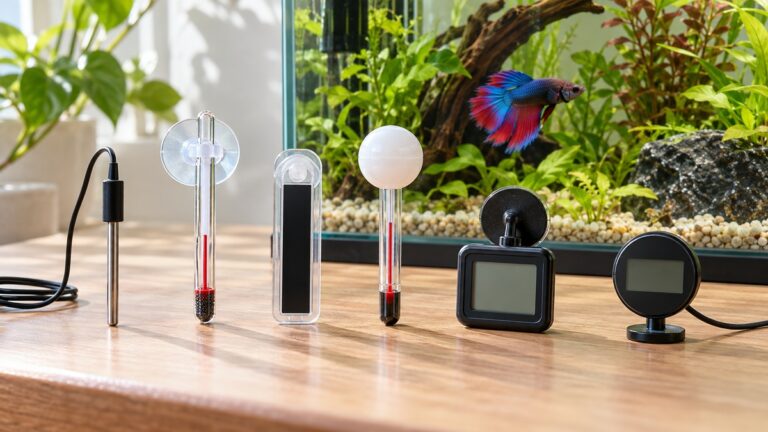
Merck describes a heater as a device that “will typically have a programmable thermostat that you can set to control the water temperature.” That setting is the control. The thermometer is the check. Merck recommends that you “should also have a separate thermometer in the tank to monitor water temperature independently from the heater.” If the heater’s setting and the thermometer disagree, the thermometer tells you what the fish are actually experiencing.
Setup order matters too. Merck gives a clear instruction on this: “Do not plug in the heater until the tank is full of water.” It explains why: “Most heaters are in a glass tube that may shatter if not surrounded by water, which regulates the temperature and prevents the tube from overheating.” Fill the tank, let the heater sit in water, and only then plug it in.
Reading your tank against the range
The table below turns the FishBase range into three simple readings. It is a reading guide, not a rule from the sources. The sources do not set these actions for a home aquarium, so treat them as general guidance.
| Thermometer reading over several days | What it suggests (general guidance) |
|---|---|
| Stays between 18°C and 24°C, including overnight | A heater may not be needed in this room. Keep checking through seasons. |
| Drops below 18°C, especially at night | Add a heater with a thermostat, set to keep the water in the range, and confirm with the separate thermometer. |
| Rises above 24°C for long stretches | Move the tank away from sun and heat sources, and recheck the heater setting before changing anything else. |
Check the reading at the same time each day for a week, then again after any change in room temperature. A single reading in the morning can miss a cold night or a sunny afternoon.
Housing a zebra danio tank
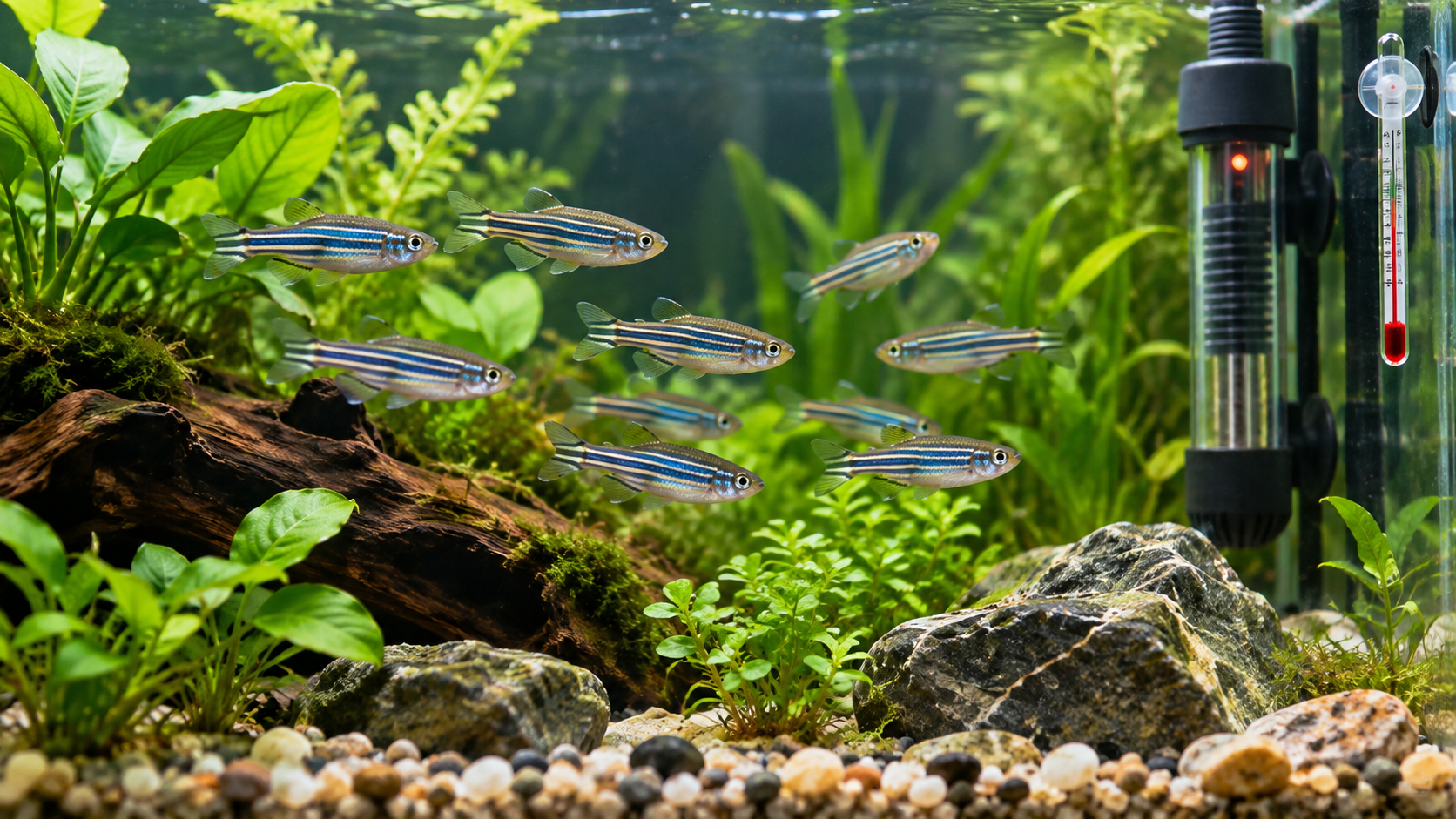
FishBase lists zebra danios as fish kept “in groups of 5 or more individuals,” with a “minimum aquarium size 60 cm.” Those are the figures the sources give, and they matter for temperature too. The sources do not explain how group size changes temperature needs. They do not give a heater wattage for any tank size, so choose a heater by reading the manufacturer’s label and comparing it with the tank’s volume.
Keep the heater out of the fish’s path if the tank has plants or decor. Merck does not give a placement rule for heaters, so the placement advice here is general guidance. Confirm that the heater is fully submerged and that the thermostat dial is reachable for adjustment.
Bettas and danios have different needs. If you also keep a betta, the separate guide on whether betta fish need a heater covers the betta side of the question. Tank size is a separate choice, and how big of a tank betta fish need is about betta housing, not danios. Use each guide for the species it covers.
How we chose
This guide relies on two non-retail sources. FishBase is a species database that records habitat temperature and aquarium housing notes for each species. The Merck Veterinary Manual section “Providing a Home for Fish” is a veterinary reference that covers heaters, thermometers, temperature stability and sunlight. We chose these because each gives a statement that can be quoted and checked. We did not use retail product pages, prices or customer ratings. Where a claim lacked a source, we labelled it as general guidance or left it out.
What we could not verify
Several parts of the question are not answered by the sources we opened. The FishBase page gives a habitat range, not a home aquarium target. The Merck section discusses heaters and thermometers in general and does not name zebra danios. Neither source says how cool a room can get before a zebra danio is harmed in a home aquarium.
What the sources do not say
The sources do not say that zebra danios can or cannot live without a heater in a given room. They do not give a safe winter minimum for a home tank, and they do not say how often a heater should be checked. Merck says that “Goldfish and certain other temperate-water or cold-water fish do fine in water that is room temperature.” It does not place zebra danios in that group, so the sources do not settle the question either way.
Frequently asked questions
Do zebra danios need a heater in a room that stays warm?
If the room stays inside the 18°C to 24°C range that FishBase lists, a heater may not be needed. The sources do not say this is safe for every home, so check the water with a thermometer over several days before relying on room temperature.
What temperature range does FishBase list for zebra danios?
FishBase lists “Tropical; 18°C – 24°C” for the zebra danio. That is the range recorded for the species in its natural setting, not a setting for a home aquarium.
Should the heater be plugged in before the tank is filled?
No. Merck says “Do not plug in the heater until the tank is full of water.” The heater’s glass tube may shatter if it is not surrounded by water, so fill the tank first.
How many zebra danios should be kept together?
FishBase says zebra danios are kept “in groups of 5 or more individuals.” It also gives a “minimum aquarium size 60 cm.” Those are the figures the sources provide. They are not a full stocking rule for every tank.
Can a thermometer replace a heater?
No. A thermometer reads the temperature but does not add heat. Merck recommends a separate thermometer so you can check the heater independently. The sources do not describe a case where a thermometer alone keeps a tank in range.
Sources
- FishBase, Danio rerio (zebra danio) species summary (opened 2026-10-24)
- Merck Veterinary Manual, Providing a Home for Fish (opened 2026-10-24)