Do Platys Need a Heater?
As an Amazon Associate we earn from qualifying purchases.
Do platys need a heater? It depends on the room and on what the tank holds. The FishBase species page for the southern platyfish (Xiphophorus maculatus) lists a natural temperature range of 18°C to 25°C. The sources we opened do not say that a heater is required in every home, and they do not give a safe room temperature for running a platy tank without one. What they do cover is why steady water temperature matters, how a heater and a thermometer work together, and how sunlight changes a tank. This guide uses those points to help you decide.
Quick answer
- FishBase lists the southern platyfish range as “Tropical; 18°C – 25°C.” If your room stays inside that range all week, a heater may not be needed. Test before you decide.
- If the room drops toward or below 18°C, add a heater with a thermostat and keep a separate thermometer in the tank.
- Merck says temperature must stay “in an appropriate range for the fish species you are keeping.” A steady reading matters more than a single reading.
- FishBase gives a “minimum aquarium size 60 cm” for the platy. It does not give a group size for platys, so the group question needs a different source.
Reading the platy’s natural range
FishBase records temperature for the fish in its natural setting. For the southern platyfish, the page reads “Tropical; 18°C – 25°C,” and it gives a native-range box of 23°N to 17°N and 99°W to 86°W. That range describes the wild habitat. It is not a home aquarium instruction, and the page does not state what temperature a tank should hold.
The range still gives you a reference. Its lower end is 18°C. A room that often falls below that point is a reason to test the water before assuming the fish will be fine. Its upper end is 25°C. A tank that stays above that point for long periods needs a check on placement and heat sources, not just the heater.
Stability beats a single reading
The Merck Veterinary Manual treats temperature as a health factor, not a comfort setting. It says that “maintenance of the water temperature in an appropriate range for the fish species you are keeping is critical to their health.” The important word is steady. A tank that swings between cool and warm each day can stress fish even when the average looks acceptable.
Merck also describes how sunlight affects a tank. “Direct sunlight can also cause the water temperature in the tank to rise.” The same section warns: “The warmer the water becomes, the less oxygen it will hold. If the water gets too warm, the fish can suffocate and die.” A tank near a window can warm much faster than one in a shaded corner, so placement is part of the heating plan.
Heater setting versus thermometer reading
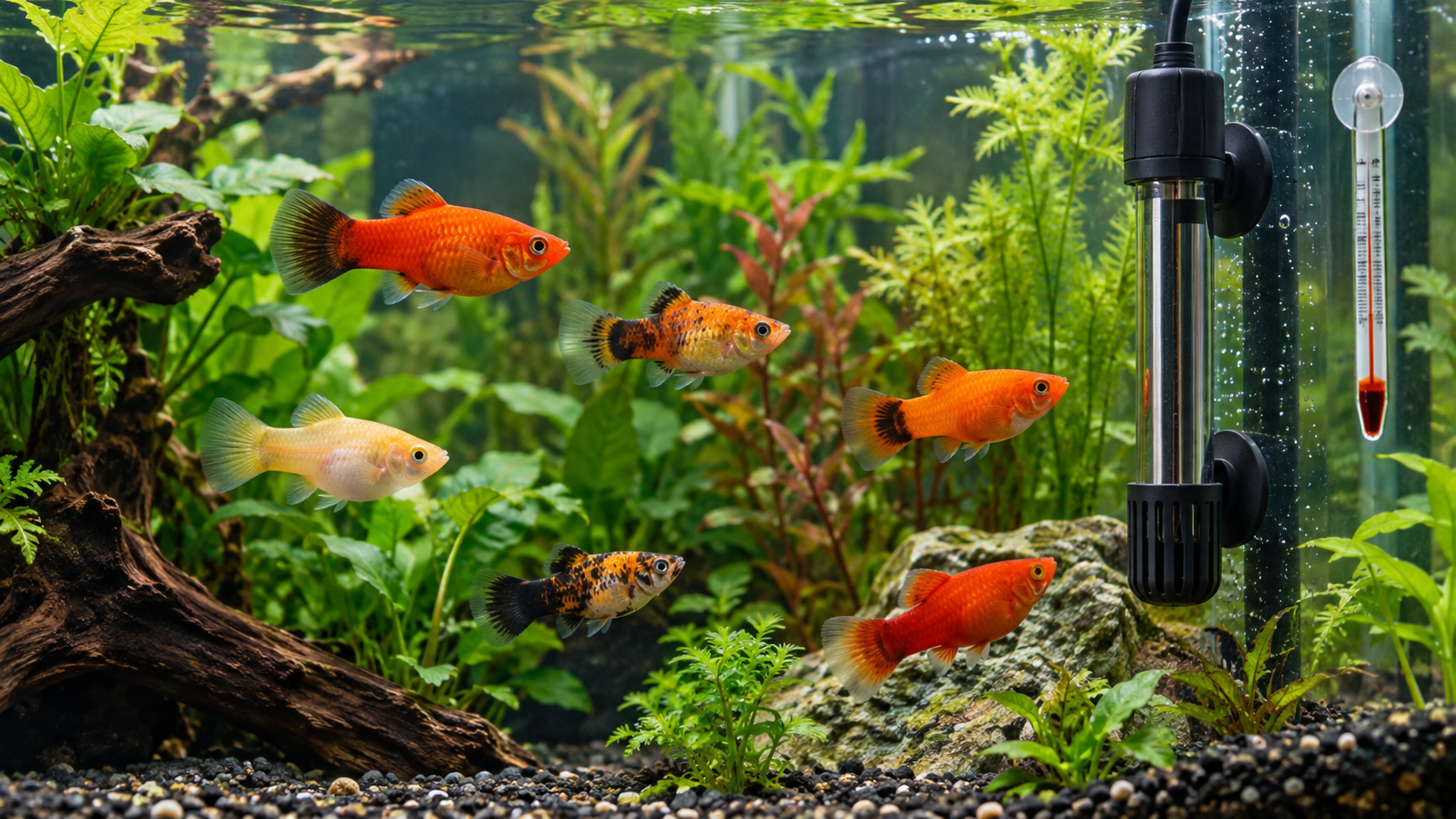
Merck describes a heater that “will typically have a programmable thermostat that you can set to control the water temperature.” The thermostat is the control. The thermometer is the check. Merck recommends that you “should also have a separate thermometer in the tank to monitor water temperature independently from the heater.” If the dial and the thermometer disagree, the thermometer shows what the fish experience.
Setup order matters. Merck says: “Do not plug in the heater until the tank is full of water.” The reason it gives is that “Most heaters are in a glass tube that may shatter if not surrounded by water, which regulates the temperature and prevents the tube from overheating.” Fill the tank, place the heater in the water, and plug it in last.
A three-reading check for platy tanks
The table turns the FishBase range into three readings. It is a guide built from the range, not a rule the sources set for home tanks. Treat the actions as general guidance.
| Thermometer reading over several days | What it suggests (general guidance) |
|---|---|
| Stays between 18°C and 25°C, including overnight | A heater may not be needed in this room. Keep checking through the seasons. |
| Drops below 18°C, especially at night | Add a heater with a thermostat, set it to hold the water in range, and confirm the result with the separate thermometer. |
| Rises above 25°C for long stretches | Move the tank away from sun and heat sources, then recheck the heater setting before changing anything else. |
Read the thermometer at the same time each day for a week, and again after any change in room temperature. A single morning reading can miss a cold night or a sunny afternoon.
Heater choices for a platy tank
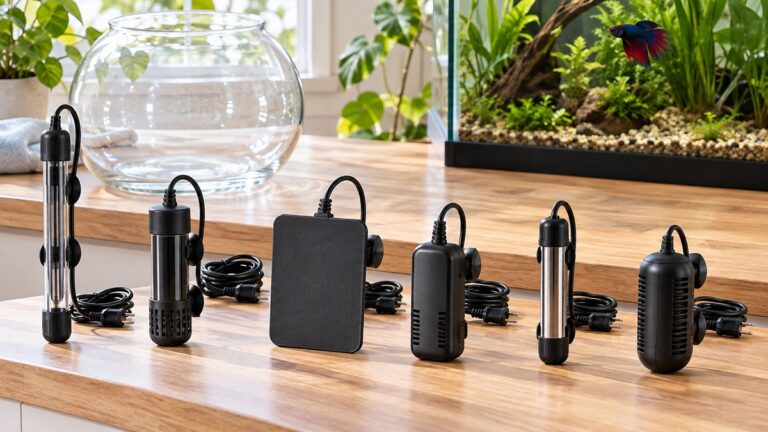
The sources do not name a heater wattage for any platy tank size, and they do not describe heater brands. Choose a heater by checking the manufacturer’s label for its rated volume, then compare that with the actual water volume of your tank.
Keep the heater where the fish cannot be trapped against it and where you can reach the thermostat dial. Placement advice in this guide is general guidance, because Merck does not give a heater placement rule.
If you keep a betta alongside platys, the betta setup has its own heater question. The guide on whether betta fish need a heater covers that side. For the heater roundup written for betta tanks, see the best aquarium heater for betta fish. Those pages cover betta needs, which differ from platy needs, so read each one for its species.
Platy housing and temperature
FishBase gives a minimum aquarium size of 60 cm for the southern platyfish. It also describes the species as one that reproduces easily in aquariums. The sources we opened do not connect platy breeding with a particular temperature, so do not assume a heater setting will change breeding results. Any breeding claim in a tank should be treated as unknown until a source addresses it.
The sources do not give compatibility rules for platys with other species, and they do not give a heater setting for a mixed tank. Check each species’ range before choosing one temperature for a tank that holds more than one kind of fish.
How we chose
This guide relies on two non-retail sources. FishBase is a species database that records natural temperature range and aquarium housing notes. The Merck Veterinary Manual section “Providing a Home for Fish” is a veterinary reference that covers heaters, thermometers, temperature stability and sunlight. We chose these because each gives statements that can be quoted and checked. We did not use retail product pages, prices or customer ratings. Where a claim lacked a source, it is labelled as general guidance or left out.
What we could not verify
Several parts of the question are not answered by the sources we opened. The FishBase page gives a habitat range, not a home aquarium target. The Merck section covers heaters and thermometers in general and does not name the southern platyfish. Neither source says how cool a room can get before a platy is harmed in a home aquarium.
What the sources do not say
The sources do not say whether platys can live without a heater in a given room. They do not give a winter minimum for a home tank. They do not give a heater wattage per gallon. Merck says that “Goldfish and certain other temperate-water or cold-water fish do fine in water that is room temperature.” It does not place platys in that group, so the sources do not settle the question either way.
Frequently asked questions
Do platys need a heater if the room stays warm?
If the room stays inside the 18°C to 25°C range that FishBase lists, a heater may not be needed. The sources do not say this is safe in every home, so check the water over several days before relying on room temperature.
What temperature range does FishBase list for platys?
FishBase lists “Tropical; 18°C – 25°C” for the southern platyfish. That is the range recorded for the species in the wild, not a setting for a home aquarium.
Should a heater go in before the tank is filled?
No. Merck says “Do not plug in the heater until the tank is full of water.” Fill the tank first, then place and plug in the heater.
Can a thermometer replace a heater?
No. A thermometer reads the temperature but does not add heat. Merck recommends a separate thermometer so that you can check the heater’s result. The sources do not describe a case where a thermometer alone keeps a tank in range.
How big should a platy tank be?
FishBase gives a “minimum aquarium size 60 cm” for the southern platyfish. That is the sources’ figure. It is a minimum, not a stocking rule, and the sources do not give a count of platys per tank.
Sources
- FishBase, Xiphophorus maculatus (southern platyfish) species summary (opened 2026-10-24)
- Merck Veterinary Manual, Providing a Home for Fish (opened 2026-10-24)