Best Digital Aquarium Heaters
As an Amazon Associate we earn from qualifying purchases.
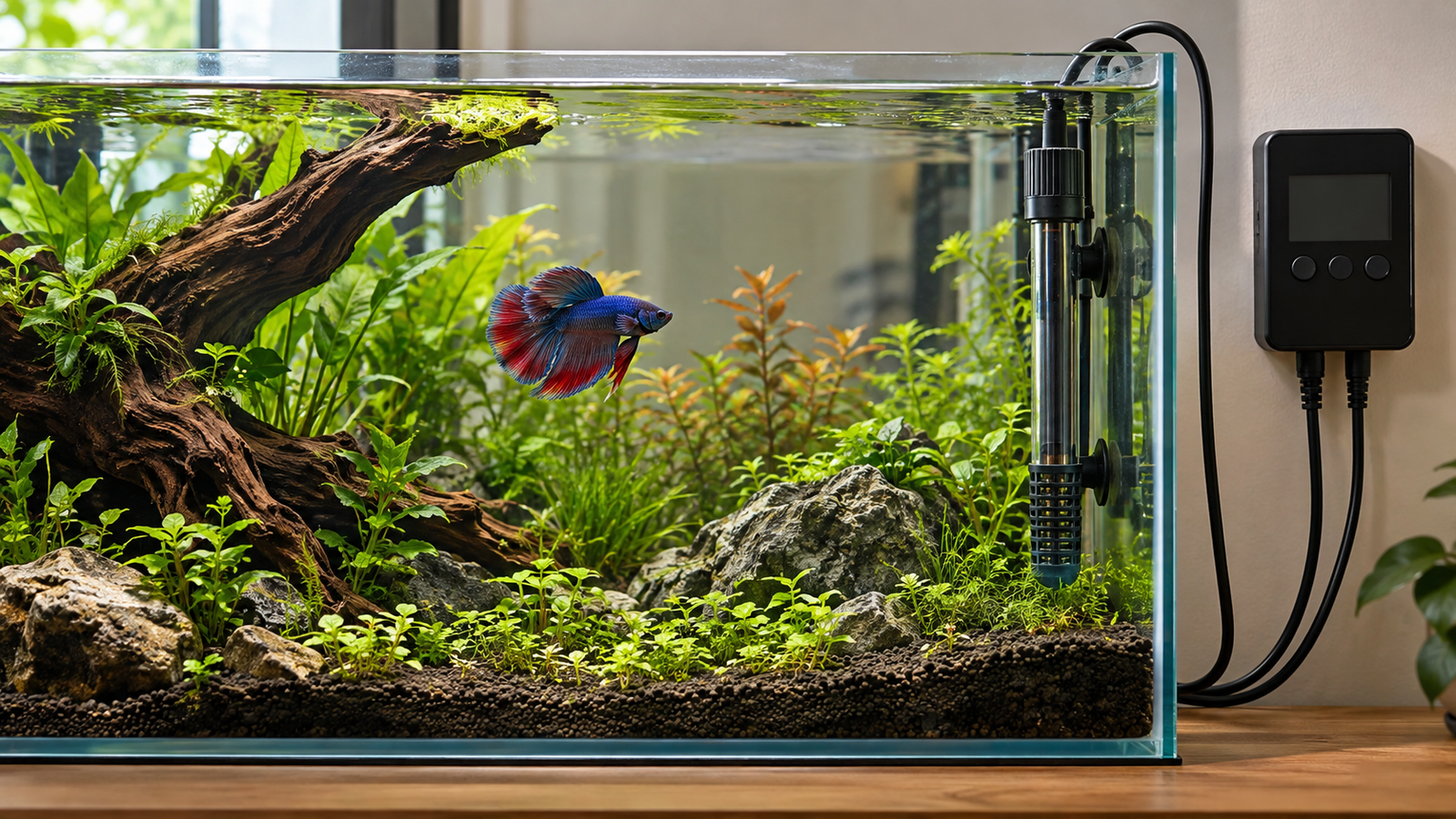
Digital aquarium heaters combine a heating element with an external or built-in controller that shows the water temperature on a small screen and lets you set a target with buttons. They are useful for a betta or a small community tank because you can read the temperature at a glance and adjust it without reaching into the water. A digital display is helpful, but it does not replace an independent thermometer, since the display shows the reading at the heater’s sensor rather than across the whole tank. Choose a digital heater whose stated tank range matches your aquarium, then verify its reading with a second instrument.
Quick answer
- Match the heater’s stated tank range to your real water volume, and do not rely on a single headline wattage.
- Choose an external controller if you want to read and set the temperature without touching the water.
- Check the set point against an independent thermometer placed at the far end of the tank from the heater.
- Confirm the heater shuts off when out of water and has an overheat protection stated in its listing.
Two related guides on this site give background for the decision. Our betta tank setup guide covers the full equipment list, and our article on whether bettas need a heater explains the temperature reasoning. The advice here assumes the tank will be heated and focuses on choosing a digital model that fits.
What a digital display actually gives you
A digital controller shows the temperature as numbers, usually in red or green LED digits, and it lets you press a button to change the set point. Compared with a dial, the display removes guesswork. You can see whether the heater is holding the target or still climbing, and you can change the setting in a few seconds. Many digital controllers also remember the set point after a power interruption, which spares you from resetting the heater after a breaker trips. The hygger 50W mini listing states that the heater has a memory function so you do not need to reset the temperature after a power outage.
The display is a convenience, not a guarantee. It shows the temperature measured by the controller or the probe, and that probe may sit close to the heating element. The NT Labs article on tropical aquarium thermometers explains that “the design of a typical aquarium heater means the heating element is directly underneath the thermostat,” which “can lead to the heater not reading the true water temperature.” A digital readout is therefore best treated as a control reading, and a separate probe placed in open water is the check that tells you whether the tank is actually at the target.
Digital controllers also differ in what they display. Some show only the water temperature, some show the set point and the live reading together, and some switch between Fahrenheit and Celsius. Confirm which display your chosen heater uses before buying, especially if you plan to compare the reading with a thermometer calibrated in the other unit.
Sizing a digital heater for the real tank
Start with the working water volume of the tank, not the nominal size on the box. A tank labeled 10 gallons may hold noticeably less water once the substrate, decor, and filter take up space. Measure the water depth and the footprint, or fill a container with a known volume and pour it into the tank. Then compare that number with the stated tank range on the heater listing.
Wattage is the second check. A higher wattage heats water faster but may also overshoot in a small tank if the controller does not cycle cleanly. A lower wattage holds a steady temperature in a small volume but may struggle in a cool room or a tank with a large lid opening. The listings in this guide each state a tank range, and the range is the most useful guide when you are choosing between models. Pick the smallest wattage whose stated range covers your tank, and be wary of a heater rated for a volume much larger than yours.
Room temperature changes the picture. A tank in a cool basement loses heat through the glass and the water surface faster than one in a warm living room. If your room drops well below the temperature you want to hold, choose a heater that stays comfortably inside its tank range even on the coldest night, and keep the lid on to reduce heat loss.
Reading the controller and the thermometer together
A digital heater works best when you read it alongside an independent thermometer. The NT Labs article recommends placing the thermometer “at the opposite end of the tank to the heater,” because that spot gives a reading that does not depend on the heater’s own sensor. Set the controller to your target, leave the heater running for several hours, then compare the two readings. A small difference is normal, since the controller and the thermometer measure in different spots. A persistent gap of several degrees is a reason to look at heater placement, filter flow, and whether the heater is fully submerged.
Watch the indicator lights too. Many digital heaters show a red light while the element is heating and a green light when the target has been reached. The hygger 50W digital listing describes red for heating and green for standby, and the AQUANEAT listing says the red light shuts off when the target is reached. The light pattern tells you the controller is cycling, which is normal, but a light that never changes can signal a stuck relay or a control problem.
Digital readings also fluctuate. A heater cycles on and off around the set point, so the number may move up and down by a degree or so over an hour. That movement is not a fault. Look for a stable daily pattern rather than reacting to every change, and set the target in the middle of the range your fish handle comfortably. For bettas, the PetSmart betta care page gives a range of about 77 to 82 degrees Fahrenheit, which leaves some room for ordinary fluctuation.
Safety features to check in the listing
Digital heaters in this guide describe several protections, and it helps to know what each one does. Overheat protection stops the element if the water exceeds a set limit. Out-of-water protection shuts the heater off when the heating section is exposed to air. Both protections matter for a betta tank, because a heater that is partly out of water during a water change can crack or overheat before anyone notices.
The hygger 50W digital listing states that it shuts off with warning codes “EE” or “ER” if the water exceeds 97 degrees Fahrenheit or if the heater is exposed to air. The HiTauing listing describes an intelligent water sensor that stops heating when the heater is out of water or rapidly heats beyond the set temperature. The hygger 10W small heater listing gives error codes HH for high temperature and E1 for out of water. Treat these protections as a backstop rather than a substitute for correct placement. A heater that keeps tripping its protection needs to be repositioned or checked.
Unplug the heater before any water change or cleaning. The hygger 50W digital listing says to unplug the heater and let it cool for 15 minutes before water changes or cleaning, and the AQUANEAT listing recommends waiting at least 10 minutes before performing aquarium maintenance or removing the heater from the water. Cooling is not optional: the glass heating tube holds heat for a while after power is removed.
Installation and cord planning
Install the heater fully submerged, with the heating section clear of substrate and decor. Most digital heaters use suction cups, and the listings describe mounting them vertically or horizontally on the tank wall. Choose the orientation that keeps the element in moving water, as discussed in our guide to heater position. Check the suction cups after installation, since a cup that loosens can let the heater tilt and touch the glass or the bottom.
Plan the cord before you fill the tank. An external controller sits on the cord, usually a few feet from the heater, so the cord must reach a dry spot where the controller can be read. The HITOP digital listing gives a 5.6-foot cable, and the AQUANEAT listing gives a 6-foot power cord. Route the cord so water runs down it and away from the outlet, and form a drip loop before the plug. Keep the controller and any plug above the water line, out of splash range, and off the floor.
Do not run the cord across the top of the tank or under the lid where it can be pinched. Keep the controller visible from the front of the aquarium so the display can be read without moving the lid. A controller hidden behind a stand is easy to forget, and an unreadable display is an unmonitored heater.
The five digital heaters in this guide
The table below summarizes the five picks. Each figure comes from the stated listing details, and a cell reads “not stated” when the listing does not provide that item. The aim is to help you match the heater to your tank volume and your preference for controls.
| Heater | Stated wattage | Stated tank range | Stated display and control | Other stated feature |
|---|---|---|---|---|
| hygger 50W Mini Digital (HG142) | 50 watts | 5 to 10 gallons | External controller, digital display, 59 to 93 °F range | Memory after power outage; cool 15 minutes before removal |
| hygger 50W Digital Controller (HG273) | 50 watts | 5 to 10 gallons | Digital controller, red and green indicator lights, 59 to 93 °F range | Overheat and out-of-water protection; error codes EE and ER |
| HiTauing 50W to 500W (AP02) | Family includes 50W, 100W, 200W, 300W, 500W; the 300W listing targets 40 to 75 gallons | Listing for 300W: 40 to 75 gallons | Two-digit LED display, Fahrenheit and Celsius switch, 63 to 94 °F | Automatic power-off when out of water |
| HITOP Mini 50W Digital (Q2) | 50W | 5 to 12 gallons | LED display shows set and live temperature, 68 to 93 °F | Thickened quartz glass; sticker thermometer included |
| AQUANEAT 100W Adjustable | 100W | 15 to 30 gallons | Dial on top; digital thermometer included; 65 to 89 °F | Red light turns off at target; 6-foot power cord |
1. hygger 50W Mini Digital Heater (HG142)
The hygger HG142 is a 50-watt mini heater with an external thermostatic controller and a digital display. Its listing describes an element about 4 inches long and 1 inch high, which fits into small tanks without taking up much room. The listing says the controller lets you cycle the set point between 59 and 93 degrees Fahrenheit, and it describes an indicator light that shows whether the heater is heating or on standby. The heater also has a memory function that keeps the set point after a power outage.
Why choose it: For a 5 to 10 gallon betta tank, the compact element and external controller keep the heater out of sight while leaving the display easy to read. The memory function means you do not need to reset the set point after a breaker trips.
Limitation: The listing gives the 5 to 10 gallon range, but it does not state the accuracy of the controller’s probe. Use an independent thermometer to confirm the reading.
Skip if: Your tank holds more than about ten gallons, since the stated range does not cover it. Skip it also if you want a heater that switches between Fahrenheit and Celsius, because the listing does not describe that feature.
2. hygger 50W Digital Heater with Overheat and Out-of-Water Protection (HG273)
The hygger HG273 is another 50-watt mini heater for 5 to 10 gallon tanks, with a digital controller that displays the real-time water temperature. The listing describes a body about 6.1 inches long and about 1.06 inches wide, explosion-proof quartz glass with silicon carbide, and insulated ends to reduce the risk of burns. It states that the heater shuts off with the warnings EE or ER if the water exceeds 97 degrees Fahrenheit or if the heater is exposed to air.
Why choose it: The stated protections address the two most common heater failures in small tanks, overheating and dry running. The indicator lights give a quick visual check: red for heating, green for standby.
Limitation: The listing says to place the heater in an area with good water circulation, but it does not define how much flow is enough. Judge the position by the thermometer reading across the tank rather than by the flow alone.
Skip if: You need a heater that holds a temperature above about 93 degrees Fahrenheit, since the listed range stops there. Skip it also if your tank is outside the 5 to 10 gallon range.
3. HiTauing Submersible Heater with Two-Digit LED Controller (AP02)
The HiTauing AP02 family spans several wattages from 50 to 500 watts, and its main listing describes a 300-watt version with an external controller showing two red LED digits. The listing states a temperature range of 63 to 94 degrees Fahrenheit and 17 to 34 degrees Celsius, and it says you can switch between the two units by pressing and holding the button. The listing describes an intelligent water sensor that stops heating when the heater is out of water or heats rapidly beyond the set point. It also mentions a one-year warranty.
Why choose it: The Fahrenheit and Celsius switch is useful if you read temperatures in both units, and the out-of-water shutoff adds a safety margin during water changes.
Limitation: The 300-watt version in the main listing is aimed at 40 to 75 gallon tanks. That is far larger than a typical betta tank, so a heater from this family is only appropriate if you pick the wattage that matches your volume. Check the exact model before purchase.
Skip if: Your tank is under about 20 gallons and you cannot find a smaller wattage in this family that matches it. Skip it also if you want a heater whose stated range is 5 to 10 gallons, since this family’s main listing does not target that size.
4. HITOP Mini Submersible Digital Heater (Q2)
The HITOP Q2 is a 50-watt mini heater with a digital controller that displays both the set temperature and the real-time water temperature. The listing describes a 5.6-foot cable between the heater and the controller, a stated adjustment range of 68 to 93 degrees Fahrenheit, and a heating indicator light on the controller. It is made from thickened quartz glass and comes with two suction cups, a bottom protective cover, and a sticker thermometer. The listing states a 12-month after-sales service.
Why choose it: The display shows both the target and the live reading, so you can see the heater working without a separate meter. The bottom protective cover is a stated feature that may reduce contact between the element and the substrate.
Limitation: The listing says the heater suits 5 to 12 gallon tanks, but it does not give an accuracy figure for the controller. Confirm the reading with a separate probe, especially in the first week.
Skip if: Your tank is over 12 gallons, or your tank is under about 5 gallons where a smaller heater would suit better. Skip it also if you need a heater that runs above 93 degrees Fahrenheit.
5. AQUANEAT 100W Adjustable Digital Thermometer Heater (G419)
The AQUANEAT G419 is a 100-watt submersible heater with an easy-to-access dial on top, a stated range of 65 to 89 degrees Fahrenheit, and a digital thermometer included in the package. The listing describes a red light that turns off when the target is reached and a body about 8.25 inches long with a 6-foot power cord. The listing says the heater suits 15 to 30 gallon tanks and both marine and freshwater aquariums.
Why choose it: The included digital thermometer gives you a separate reading to compare with the heater, which is the cross-check this guide recommends. The dial is simple to use if you prefer a single control over a menu.
Limitation: The listing describes a dial rather than a digital controller for the heater itself. The digital part is the included thermometer, so you read the heater setting by turning the dial and the water temperature on the separate display.
Skip if: Your tank is under about 15 gallons, since the listing targets 15 to 30 gallons and the wattage would be high for a small betta tank. Skip it also if you want the heater setting to be shown on the heater’s own display.
A commissioning routine for a new digital heater
Set up the heater the same way the first time you use it, and keep a short log of the readings. Fill the tank, confirm the filter is running, and place the heater fully underwater in moving water away from substrate. Plug the controller in after the heater is in position. Set the target to the middle of your fish’s comfortable range, then check the display and the independent thermometer at one, four, and twelve hours. Write down the readings. If the gap between the controller and the thermometer stays above a degree or two, reposition the heater, check the filter flow, and retest.
Repeat the routine after any water change or after moving the heater. The Merck Veterinary Manual’s guidance on fish care states that “filters, pumps, heaters, and lights should not be turned on until after the tank is filled with water,” so the order matters. Turning the heater on in an empty or half-filled tank is the most common way to damage the glass.
Cleaning around the controller and the element
Mineral deposits build up on heater glass and on suction cups over time. Wipe the glass with a soft cloth while the heater is unplugged and cool, and rinse away loose deposits in aquarium water rather than tap water with soap. Never scrape a glass element with a hard tool, because a small scratch can become a crack. Keep the external controller dry. Wipe its face with a cloth that is only slightly damp, and never submerge it.
Check the suction cups every time you clean. A cup that has hardened or cracked can let the heater slip. Replace worn cups before the heater shifts into the substrate or against the glass wall.
When a simple heater is enough
A digital display is not always necessary. An adjustable heater with a separate thermometer does the same job if you check the reading regularly, and it may be easier to audit because there is no electronics to fail. Choose a digital heater when the display solves a real problem, such as a tank you cannot reach easily, a room where the temperature changes a lot, or a need to see the set point and live reading side by side. For a shelf-top betta tank that you check every day, a simple thermostat plus a good thermometer is often just as useful.
Whichever type you choose, the most important questions are the same. Does the stated tank range match your water volume? Is the heating section fully submerged in moving water? Does an independent thermometer agree with the controller? Answer those three questions and you are most of the way to a safe, steady tank.
Frequently asked questions
Is a digital display enough to trust the temperature?
No, not on its own. The display shows the reading at the heater’s sensor, and that sensor sits near the element. Compare it with an independent thermometer placed at the far end of the tank, as the NT Labs article recommends, before you trust the number.
Can I use the maximum tank range as a guarantee of performance?
No. The stated range is a manufacturer’s boundary. Room temperature, lid coverage, filter flow, and how deep the heater sits all change how the heater performs. Treat the range as the outer limit for a sensible choice, and confirm the result with a thermometer.
Should I run the heater during a water change?
Unplug it first. The listings in this guide recommend cooling the heater for 10 to 15 minutes before removing it from the water or performing maintenance. Turn the heater back on only after it is fully submerged and the water is at the normal level.
Why does the display show a different number from my thermometer?
The two instruments measure in different places, and a heater’s sensor may read warmer water near the element. Heaters can also drift out of calibration over time, according to the NT Labs article. A consistent gap of more than a degree or two means you should check the position and consider a replacement.
What temperature should I set for a betta?
The PetSmart betta care page gives a range of about 77 to 82 degrees Fahrenheit, or 23 to 27 degrees Celsius. Set the controller to a value inside that range and keep it steady rather than adjusting it frequently.
What should I do if the heater shows an error code?
Unplug the heater, let it cool, and check the position. Make sure the heating section is fully submerged and the water is at the normal level. If the code returns after the heater is back in the water and cool, stop using it and contact the seller under the warranty or service terms in the listing.
Bottom line
Digital aquarium heaters give you a readable display and a convenient control, and the best of them state a clear tank range, clear protections, and a safe installation method. Choose one whose stated range matches your real water volume, confirm the heater shuts off when out of water, and check its reading against a separate thermometer. The display makes the heater easier to live with, but the thermometer tells you whether the tank is truly at the target.
For more on betta heating, read the Best Aquarium Heater for Betta Fish: 6 Safe Picks and the Best Betta Water Heater for 5-Gallon Tanks. Both cover sizing and control choices in more detail.
How we chose
We built this guide from five heaters in the site’s product file for small and medium aquariums, covering wattages from 50 to 100 watts in the main picks. Each pick is included because its listing states a wattage, a tank range, or a control method that matches one placement situation. We left out models whose listings gave no tank range, and we did not infer a range from the wattage. The comparison table reports only what the listings state, and it marks missing details as not stated.
What we could not verify
The three sources opened for this guide describe placement principles, a betta temperature range, and the value of an independent thermometer. They do not measure flow rates, heating times, or temperature uniformity for any of the five heaters, and no test data was available for their accuracy in a particular tank. Listing claims about thermostat tolerance and protection features come from the sellers and were not tested here. Check the manual that ships with the heater, and confirm the stated protections with the seller before relying on them.
Sources
- PetSmart Learning Center, “How To Care for Your Betta Fish,” https://www.petsmart.com/learning-center/fish-care/how-to-care-for-your-betta-fish/A0188.html (opened October 27, 2026).
- NT Labs, “Do I need a thermometer when there is a heater in my tropical aquarium?,” https://www.nt-labs.com/knowledge-hub/do-i-need-a-thermometer-when-there-is-a-heater-in-my-tropical-aquarium/ (opened October 27, 2026).
- Merck Veterinary Manual, “Providing a Home for Fish,” https://www.merckvetmanual.com/all-other-pets/fish/providing-a-home-for-fish (opened October 27, 2026).