Best Electric Aquarium Cleaners
As an Amazon Associate we earn from qualifying purchases.
The best electric aquarium cleaner for most home aquariums is the one whose power, reach and controls match your tank rather than the one with the biggest motor. Only two of the products reviewed here are truly electric: the UPETTOOLS 28W gravel cleaner and the Suness 36W multi-function cleaner. The other three are included as non-electric alternatives, because a manual or faucet-driven system is often the better choice for a small betta tank. Read the table and the skip notes before buying, since a stronger motor also means faster water removal and more equipment to keep dry.
Quick answer
- Best electric pick for reach: UPETTOOLS 28W, with a telescoping tube that the listing says extends from 23.6 to 37.7 inches.
- Best electric pick for adjustable power: Suness 36W, with three power steps of 19W, 27W and 36W and a timed shutoff.
- Best non-electric option for a faucet-side tank: enomol, which uses tap-water pressure and a 30-foot hose.
- Best choice for a small, carefully controlled tank: Laifoo or Tetra, both manual siphons that need no plug or switch.
Before you choose, read our guide to aquarium water test kits, which explains how to decide whether water needs changing at all, and our guide to betta tank decor, because hardscape and plants decide where a powered cleaner can safely reach.
Electric aquarium cleaners compared with practical fallbacks
An electric cleaner uses a motor to move water through a tube or through a filter cup. That gives it a clear advantage when the aquarium is deep, when you want to avoid lifting a full bucket, or when you want the cleaner to return filtered water to the tank. It also brings extra responsibilities: a cord or adapter, a switch that must stay dry, and a motor that must be kept clear of debris. The table below separates the powered models from the manual and faucet-driven fallbacks so you can compare the mechanism first and the accessories second.
| Product | Drive method | Stated specifications | Best fit |
|---|---|---|---|
| UPETTOOLS 28W | Corded electric, 110 V | 28 W motor; 1,700 L/h in one bullet and 2,000 L/h in the specification field; telescoping tube from 23.6 to 37.7 inches | deep aquariums where powered suction saves real effort |
| Suness 36W | Corded electric with push-button control | Power steps of 19 W, 27 W and 36 W; 1.5 m outlet hose; 15 cm adjustable telescoping tube; timed shutoff | buyers who want selectable power and a timer |
| enomol 30 ft | Faucet-powered water changer, no motor | 30-foot hose; 16.5-inch cleaning tube with a built-in screen; four adapter sizes | a medium or large tank near a compatible faucet |
| Laifoo 5ft-S | Squeeze-bulb manual siphon | 5-foot clear hose; hard gravel tube with a detachable screen; hose clip | a small tank where hand control matters |
| Tetra Water Cleaner | Priming-bulb manual siphon | Listed for aquariums up to 55 gallons; 5.5 × 3.38 × 13.75 inches | simple gravel cleaning into a bucket |
The table deliberately keeps unlike measurements in separate columns. Wattage is electrical input, hose length is reach, and a tank-size rating is a seller statement. None of these numbers is a cleaning score. A fair comparison therefore starts with the mechanism, then checks reach, then checks whether you can control the flow, and only then compares accessory counts.
Product picks in detail
1. UPETTOOLS 28W: the longest reach among the electric options
The UPETTOOLS gravel cleaner is a submersible corded unit rated at 110 volts and 28 watts. Its listing describes six functions: water changing, sand washing, debris removal, water filtration, water showering and flow control. The adjustable valve is the feature that matters most in a small tank, because it lets you reduce suction for gentle cleaning. The telescoping tube is stated to extend from 23.6 to 37.7 inches and to suit water depths from 13.7 to 47.2 inches. That range points toward deeper aquariums rather than a shallow desktop setup.
Position the discharge securely before you connect power, and keep every electrical connection away from splashes. The listing also states a three-year warranty against manufacturing defects. A warranty does not change how carefully the unit should be routed or stored, and it does not guarantee a particular delivered flow.
Limitation: the two maximum-flow figures conflict, and neither one shows the rate you will get through gravel under real lift.
Skip if: your aquarium is shallower than the stated working range, you cannot route a 110-volt cord safely, or gentle manual suction would be easier for you to control.
2. Suness 36W: the best electric option for adjustable power
The Suness cleaner is an eight-function electric unit. Its listing describes automatic water changing, gravel and sand cleaning, filtration and circulation through a filter cup, a turtle shower, adjustable power, timed shutoff and an algae removal head. The most distinctive specification is the three-step power selection: 19 watts, 27 watts or 36 watts. Starting at the lowest step gives you a documented way to avoid beginning at maximum power in a small tank.
The package includes a 1.5-meter outlet hose, two extension sections, a filter cup with sponge and biofiltration balls, and several interchangeable heads. More attachments add versatility, but they also add joints to assemble, rinse, dry and store. The listing explicitly says the external switch is not waterproof, so the controls need a dry location away from the tank. The listing also includes a 15 cm adjustable telescoping tube and a one-year warranty.
Limitation: the listing does not give a comparable flow rate, and its filter cup describes filtration and circulation, which does not replace biological filtration or a water change.
Skip if: you do not have a reliably dry place for the switch and adapter, or the number of heads would complicate maintenance more than it helps.
3. enomol 30-foot system: the non-electric option for a faucet-side tank
enomol is included as a deliberate non-electric comparison. It uses tap-water pressure to start draining and then reverses for refilling, with two valves and a long hose. The package includes a 3/4-inch garden-hose-thread adapter and three threaded faucet adapters in 15/16-inch, 55/64-inch and 13/16-inch sizes. The cleaning tube is 16.5 inches long and has a built-in screen. For a medium or large aquarium across the room from a sink, this can remove the need to carry buckets without placing a motor in the water.
Faucet fit is the deciding factor. Pull-out, sensor-operated and unthreaded faucets may not accept the adapters. The 30-foot hose also needs a route that will not kink, trip anyone or pull on the tank. Refill water still needs conditioning and a suitable temperature, so the convenience does not replace water preparation.
Limitation: the product details do not state water use at the faucet, delivered suction or hose diameter, and compatibility depends on your plumbing.
Skip if: none of the included adapters fits your faucet, the hose would have to cross a busy walkway, or you need close control in a very small aquarium.
4. Laifoo 5ft-S: the best manual option for close control
Laifoo uses a squeeze bulb rather than a motor. The package includes a five-foot clear hose, a hard gravel tube with a detachable filter screen inside, a hose clip, the siphon ball and instructions. Once the bulb primes the hose, gravity keeps water moving to a container placed below the aquarium. The clear hose makes it easy to see debris, and the hard tube stays in position while you work.
A manual siphon lets you stop quickly by lifting the intake or pinching the hose. Its simplicity is an advantage around a betta, plants and delicate decor. It still needs supervision: secure the outlet, keep the intake in view, and avoid drawing fish, fins, roots or light substrate into the tube. Never start a siphon by mouth. The listing states a three-month warranty.
Limitation: gravity requires the receiving container to sit below the tank, and the five-foot hose limits reach.
Skip if: lifting a full bucket is unsafe for you, or the aquarium cannot drain downhill into a stable container.
5. Tetra Water Cleaner: a familiar branded bulb siphon
The Tetra Water Cleaner is a gravel siphon with a priming bulb and a bucket clip. Its listing states compatibility with aquariums up to 55 gallons and gives product dimensions of 5.5 by 3.38 by 13.75 inches. The 55-gallon rating is a seller statement, not a flow measurement, but it is a useful screening number for buyers with larger tanks. The listing does not state a hose length, so check that the bucket can sit where you need it before you buy.
The listing says the cleaner makes monthly water changes easy by replacing 30 percent of the water in 30 minutes every 30 days. Treat that as packaging language, not a universal schedule. Water-change needs depend on volume, stocking, feeding, filtration and measured water quality. In a five-gallon betta tank, mark the planned removal level before you start, because a small vertical drop is a meaningful share of the total water.
Limitation: no hose length or standardized flow value appears in the product details, so reach and speed are hard to compare with the other options.
Skip if: you need a long run to a sink, or bucket handling is physically difficult for you.
Why flow numbers need care
The UPETTOOLS listing gives two maximum-flow figures. The specification field says 2,000 liters per hour, while one of the bullet points says 1,700 liters per hour. Dividing the lower figure by 60 gives about 28.3 liters per minute. In a five-gallon aquarium of roughly 18.9 liters, that headline rate would move the water in well under a minute, which is far faster than a careful betta cleaning should go. The conflict between the two figures is itself useful information: do not treat any maximum rate as a delivered rate. Restrictions, lift height, substrate and valve position all change what actually comes out of the hose.
Suness does not state a comparable liters-per-hour figure. It states wattage steps instead. Those steps tell you how the motor can be set, not how fast water will move in your tank. The enomol and Laifoo listings state hose or tube dimensions but no flow, and Tetra states neither a hose length nor a flow. For that reason, no product in this article is ranked on flow alone.
Electric, faucet-driven and gravity cleaners are different tools
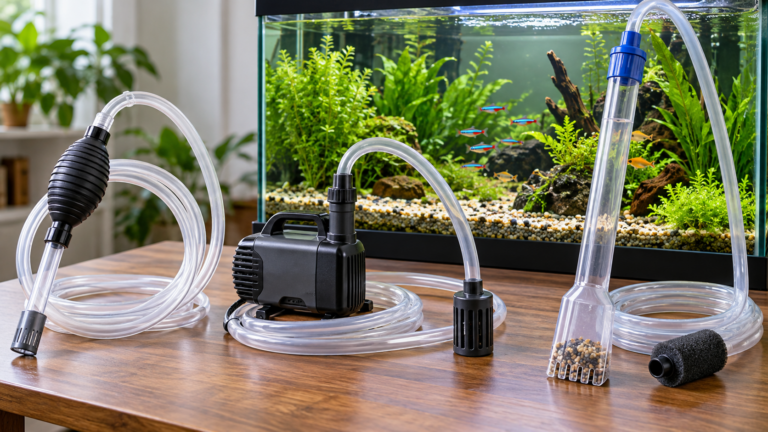
An electric cleaner depends on a motor and a power supply. A faucet-driven changer depends on household water pressure and a compatible thread. A bulb siphon depends on gravity once the hose is primed. Each mechanism creates different installation questions. Electric units need a protected outlet and dry controls. Faucet systems need the right adapter and a hose route that will not kink or trip anyone. Gravity siphons need a receiving container placed lower than the aquarium. Product titles often group all three under words such as automatic or vacuum, so identify the energy source before comparing accessories and feature lists.
Why a small betta tank changes the recommendation
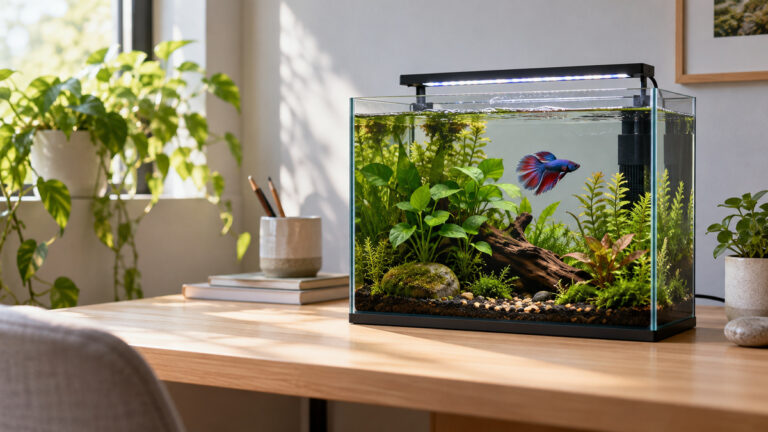
A powered unit can move a large fraction of a five-gallon aquarium before you have finished cleaning one patch of gravel. Substrate can tumble, plants can loosen, and a heater or filter intake can become exposed as the water line drops. A narrow manual tube is slower, but it is easier to pause and easier to watch. If you still choose an electric model for a betta tank, start at the lowest available power setting, plan the removal volume before you begin, and keep the intake well away from the fish. Stable temperature, adequate filtration and steady water quality matter more than how quickly the tank is cleaned.
Separate debris pickup from water replacement
Some powered cleaners include a filtration or recirculation mode. Water passes through a filter cup and returns to the tank. That can capture visible particles without lowering the water line very much. It is not the same as replacing water. Recirculating water through a small cartridge does not remove dissolved waste from the aquarium, and it does not replace the job of adding fresh, properly conditioned water. The Merck Veterinary Manual states that poor water quality is the most common cause of environmental disease in fish, so decisions about water replacement should follow measured water quality rather than how clear the water looks.
Plan a safe electrical zone
Before you fill or drain anything, decide which parts may be submerged and which must stay dry. The Suness listing warns that its external independent switch is not waterproof and should be kept away from water. Treat that as an installation rule. Keep plugs, adapters and switches outside the splash zone, form a drip loop in the cord, and use a grounded outlet protected by a ground-fault circuit interrupter where that is appropriate for your home. Disconnect power before you reach into the aquarium or change an attachment. Never lift a device by its cord. If a casing, seal, plug or cable is damaged, retire the unit instead of improvising a repair.
Control the endpoint before you start
Mark the desired water line with removable tape, measure the bucket capacity you will use, and decide where the discharge will go. Powered flow makes these small preparations more important. The outlet should not hang over a sink edge where it can jump, and the bucket should be stable enough that a shifting hose cannot tip it. A timer is a backup convenience, not permission to leave a running cleaner unattended. Stop early if substrate enters the hose continuously, if the water line drops faster than planned, or if the fish cannot find a calm area.
Clean gravel in sections
Push the tube into one small section of gravel, let debris rise, and then move on before too much substrate travels up the hose. Avoid churning the whole bed until the tank turns cloudy. In planted areas, hover above the surface or work around roots rather than pushing the tube through them. Sand needs more care: start higher above the bed and reduce suction, because fine grains lift easily. Cleaning a different third of the bed on each maintenance day is a practical way to keep the tank more stable than stripping every surface in one session.
Preserve biological filtration
Visible dirt is not the only material in an aquarium. Surfaces and filter media host microorganisms that help process fish waste. An electric cleaner’s filter cup is a temporary debris collector, not proof that the tank has enough biological capacity. Do not replace or sterilize every filter medium and scour all substrate in the same session. The EPA’s ammonia summary describes ammonia as a common toxicant derived from wastes and notes that unionized ammonia is very toxic to aquatic animals, particularly fish. If you detect ammonia or nitrite, address water quality promptly and consult an experienced fish keeper or aquatic veterinarian if a fish appears unwell.
Use listing claims conservatively
Every seller uses the strongest language available. UPETTOOLS describes six functions and precise control of suction strength. Suness describes eight functions and a filtration cup that filters 99 percent of impurities. Those phrases are marketing claims. They are not an independent test. Wattage tells you about electrical input, not about cleaning results. Hose length tells you about reach, not suction. A tank-size rating is neither a safety certificate nor a maintenance schedule. A useful buying decision can accept missing data and still choose by mechanism, fit, control and maintenance burden.
Account for displacement and usable volume
A nominal five-gallon aquarium does not hold five gallons of free water. Substrate, rock, wood, equipment and the air gap below the rim all displace water. Calculations based on label capacity are therefore rough upper-bound illustrations. For a more practical number, measure how many conditioned gallons you need to refill from your marked water line. That observed amount tells you how big the bucket should be and how long the cleaner should run, which is more useful at home than a theoretical tank-volume figure.
Post-cleaning checks
After refilling with conditioned water at a suitable temperature, confirm that the heater and filter are submerged as their manuals require before restoring power. Check hose paths and fittings for leaks, remove wet towels from electrical areas, and confirm that the equipment runs normally. Watch the fish from a short distance rather than pressing against the glass. Recheck temperature with an independent thermometer and follow your normal water-testing routine. Rinse the cleaner parts as directed, clear trapped gravel, and dry components before storage so the next session starts with intact equipment.
Who should avoid an electric cleaner
Avoid an electric cleaner if storage, assembly and cord management take more effort than a short manual siphon. Avoid it if the aquarium is too shallow for the intake, if you have no dry place for the controls, or if limited grip strength makes a powered wand hard to stabilize. Do not buy one only because the word automatic appears in the title. Electric cleaners still need active steering, outlet management, cleaning and inspection. For many single small tanks, the simplest device is the one you will use carefully and consistently.
How we chose
We limited the ranked picks to products in our verified product data that clearly describe a gravel or water-changing mechanism. Only the UPETTOOLS and Suness products are electric in that data, so we did not relabel unrelated products as electric. We added three real-brand alternatives that use faucet pressure or manual gravity, because those are the realistic options for many small aquariums. Selection criteria were a clear mechanism, enough product detail to identify a use case, compatibility information, controllability and a concrete reason a buyer might decline the product. We calculated only one derived figure, the UPETTOOLS flow conversion, because the other products do not state a comparable flow.
What we could not verify
The product details we used do not establish delivered suction under gravel, noise at a standard distance, motor life, timer accuracy, electrical certification, replacement-part supply or performance with every substrate type. The UPETTOOLS flow figures conflict. The Suness data gives wattage steps but no flow. We cannot confirm whether a faucet adapter fits a particular home fixture, and we cannot confirm that seller statements about debris removal reflect an independent protocol. Product availability and included parts can change, so check the exact model and its current manual before ordering.
FAQ
Is an electric aquarium cleaner better than a siphon?
It can reduce priming effort and offers features such as filter cups and attachments. It is not inherently better. In a small aquarium, a manual siphon is often easier to control.
Can an electric cleaner replace water changes?
No. Pulling debris through a small filter cup is different from removing old water and adding conditioned replacement water. Use water tests to decide how much to replace.
Can fish stay in the tank during cleaning?
Many keepers clean with fish present, but keep the intake visible, leave a calm refuge, and stop if a fish approaches the tube or shows distress.
Can an electric cleaner remove all algae?
No single tool removes every growth. An algae attachment can clear some visible algae, but lighting, nutrients and routine maintenance also affect how quickly it returns.
What power setting should I use?
Begin at the lowest setting that moves debris and increase only if pickup is poor. For the Suness, the 19 W step is the natural starting point for a small tank. Maximum power is not a target.
Should I clean all the gravel at once?
Section-by-section cleaning is more controlled and keeps the tank more stable. Avoid cleaning substrate, decor and biological filter media all in one session.
Bottom line
Buy an electric aquarium cleaner when powered suction solves a real reach or lifting problem and you can keep the controls dry. For a small betta tank, a manual siphon usually gives you the safer degree of control. Use the UPETTOOLS if you need long reach, the Suness if you want selectable power and a timer, and a manual or faucet-driven option if the motor would be more than the tank needs.
For related reading, see our aquarium water test kit guide, which helps you decide when a water change is needed, and our betta tank decor guide, which shows how hardscape limits where a cleaner can safely reach.
Sources
- Merck Veterinary Manual, “Providing a Home for Fish,” https://www.merckvetmanual.com/all-other-pets/fish/providing-a-home-for-fish (opened October 27, 2026). Paraphrased: poor water quality is the most common cause of environmental-related disease in fish; most city water is treated with chlorine or chloramine.
- Merck Veterinary Manual, “Routine Health Care of Fish,” https://www.merckvetmanual.com/all-other-pets/fish/routine-health-care-of-fish (opened October 27, 2026). Paraphrased: new water should be dechlorinated before it is added; a pressurized water and vacuum system can remove solid waste from gravel during a water change.
- U.S. EPA, “Sources, Stressors & Responses: Ammonia,” https://www.epa.gov/caddis-vol2/caddis-volume-2-sources-stressors-and-responses-ammonia (opened October 27, 2026). Paraphrased: ammonia is a common toxicant derived from wastes, fertilizers and natural processes; unionized ammonia is very toxic to fish.