Can You Use Seachem Prime and Stability Together
As an Amazon Associate we earn from qualifying purchases. Details
Quick answer: Seachem’s own FAQ says Prime can be used with any Seachem product except Cupramine, and that Prime does not directly interact with other Seachem products. It does not mention Stability by name, so the answer for this pair is a yes on the FAQ’s general terms, with two things to keep in mind. Keep each product on its own label dose, and leave a gap between the two doses rather than adding them in the same minute. Stability is a bacteria product for setting up a new tank, and the FAQ does not describe its effect on Stability’s bacteria.
Sources: Seachem’s knowledge-base FAQ “Can I use Seachem Prime together with ____?”, read on 2026-10-17. Stability’s dosing comes from retailer pages that reproduce the maker’s directions, read on 2026-10-17, not from Seachem’s own site, so check the bottle label before you dose.
What the person typing this wants
The person typing this is usually setting up a new tank, or about to add a bacteria product to a tank that already has a conditioner routine. They want a clear answer and a sensible order of steps.
What each product does
- Prime. Seachem describes Prime as a conditioner that treats the chlorine and chloramine in the new water you add. Its dosing page gives a standard water-change dose of 1 capful (5 mL) for 200 L (about 50 US gallons) of new water, and 0.1 mL per gallon for smaller changes.
- Stability. Stability is a bacteria product used to start or support the biofilter. Retailer pages that reproduce the maker’s directions give a new-tank dose of 1 capful (5 mL) per 40 L (10 US gallons) on day one, then 1 capful per 80 L (20 US gallons) daily for 7 days. They say to shake the bottle and switch off any UV or ozone unit while dosing.
What Seachem’s own FAQ says
- Other Seachem products: Prime can be used with any Seachem product except Cupramine. The FAQ says Prime will not directly interact with other Seachem products.
- Cupramine: Prime is the exception. The FAQ says to treat the water with Prime 48 hours before dosing Cupramine, so that Prime is fully used up.
- Wait times: A standard dose of Prime is used up after 24 hours, meaning it is no longer reactive. It breaks down completely after 48 hours.
- Several reducing products: The FAQ says that if you need to use three or more reducing agents at the same time, it may be best to wait an hour or so between products.
The FAQ does not mention Stability. Read the Stability label and the Prime label, and ask Seachem if you need a combined schedule.
A cautious routine
The routine below is our suggestion, built on the FAQ’s wording. Seachem does not state it as a schedule for this pair.
- Dose Prime into new water at each water change, using the dosing table’s standard rate for the volume you add.
- Dose Stability as its label says. For a new tank, that is the day-one dose, then the daily dose for 7 days, with the UV or ozone unit off.
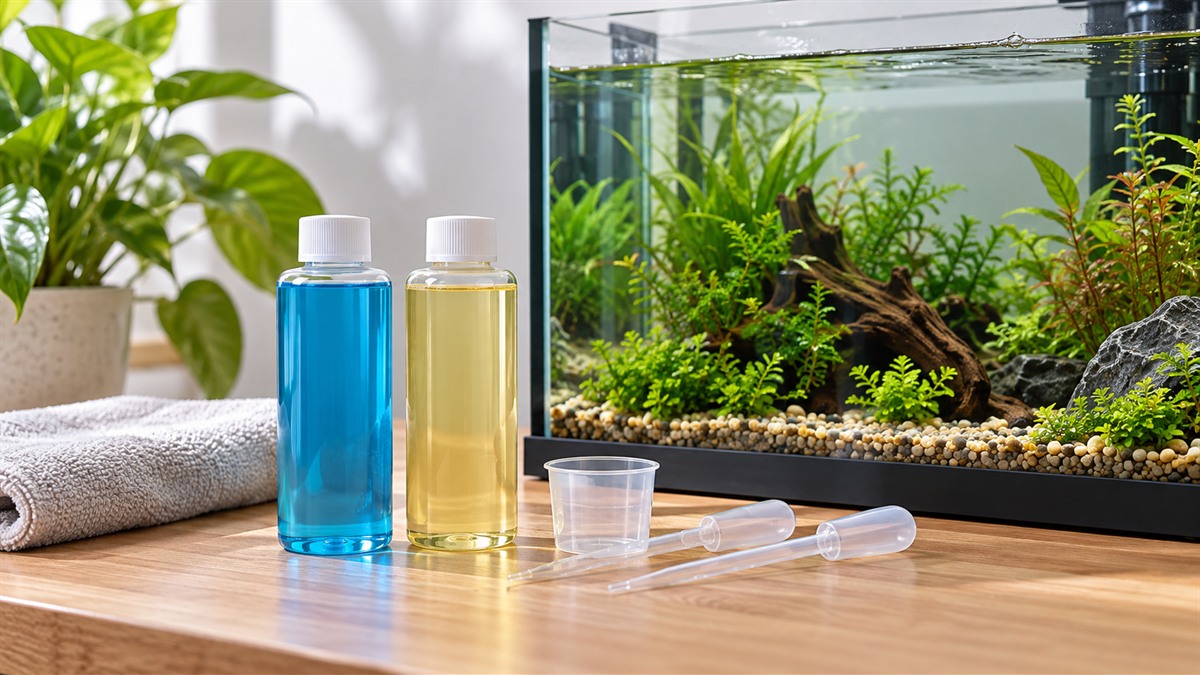
- Keep the two bottles separate and measure each dose on its own, so you know what went in.
- Leave a gap between them. The FAQ does not set a gap for Stability. A gap of at least 24 hours, which is the point where Prime is no longer reactive, is the cautious choice if you want no overlap.
- Keep a short log of water changes and doses, with dates.
An example with numbers
For example, suppose you add Prime at 9 a.m. and Stability at 5 p.m. the same day. That is an 8-hour gap. Seachem’s FAQ says Prime is not used up until 24 hours, so an 8-hour gap falls inside the window where Prime may still be active. The FAQ does not say that Stability will react with it, but the cautious routine above would move the Stability dose to the next day.
Now the Stability arithmetic. For a 10 gallon tank on day one of a new setup, the retailer directions give 1 capful, because they give 1 capful for each 10 US gallons. A tank of 2.5 gallons would need one quarter of that, which is less than one capful. Put in the liters the same way: the day-one rate is 1 capful per 40 liters, and the daily rate after that is 1 capful per 80 liters. For a tank of 5 gallons, that is half a capful on day one. For a tank of 20 gallons, the daily rate is one capful, because the directions set it at one capful per 20 gallons. Measure the fraction with a tool that reads small volumes, not a cap. The directions do not say how to dose a fraction of a capful, so check with the maker.
Seachem Prime – 250 ml (B0002568S6)
Specs (from the listing title, checked 2026-10-17): Seachem Prime, 250 ml (1.7 fl. oz.). Dose from Seachem’s dosing page: 1 capful (5 mL) for 200 L (about 50 US gallons) of new water. Other listing details were not visible in our read.
Pros: A clear dose from the maker; Seachem’s own FAQ covers combined use. Cons: The FAQ does not cover Stability by name, and the bottle size is small for frequent water changes on a large volume.
Best for: Regular water changes on a betta tank. Skip if: You do not change water.
View on Amazon (affiliate link)
Seachem Stability (B0002APIJG)
Specs (from retailer pages that reproduce the maker’s directions, read 2026-10-17): for freshwater and marine tanks; new-tank dose 1 capful (5 mL) per 40 L (10 US gallons) on day one, then 1 capful per 80 L (20 US gallons) daily for 7 days; shake well; turn off UV or ozone units. Size and weight were not confirmed in our read.
Pros: The directions give a day-by-day dose for a new tank. Cons: It is a setup product, not a substitute for a cycle or a test kit.
Best for: A new tank that needs a bacteria start. Skip if: Your tank is already established and you are not setting up a new one.
View on Amazon (affiliate link)
When this combination is a poor idea
If a fish is sick, do not add either product as a treatment without advice. A sick betta needs an experienced fish keeper or an aquatic vet, not a combined dosing plan from a product page.
Related guides
- Can I add Stress Coat with fish in tank
- When to add water conditioner to fish tank
- API Stress Coat aquarium water conditioner
- Stress coat vs tap water conditioner
Frequently asked questions
Can I add Prime and Stability on the same day?
Seachem’s FAQ says Prime can be used with any Seachem product except Cupramine, and that it does not directly interact with other Seachem products. The FAQ does not mention Stability. If you dose both on the same day, leave a gap between them, and if you need three or more reducing agents at the same time, the FAQ says it may be best to wait an hour or so between them.
How long should I wait after Prime before adding another product?
Seachem’s FAQ says a standard dose of Prime is used up after 24 hours and breaks down completely after 48 hours. For Cupramine, it advises 48 hours.
Do I need Stability for an established tank?
The Stability directions describe a new-tank dose. The directions we read do not describe a routine for an established tank, so check the bottle label.
Does Prime affect Stability’s bacteria?
Seachem’s FAQ does not describe that effect for Stability specifically. Follow both labels, and ask Seachem if you need a combined schedule.