Best Aquarium Heater Controllers
As an Amazon Associate we earn from qualifying purchases.
A heater with a separate controller lets you set the water temperature and read it on a display, which matters for a betta, a tropical community or a small turtle tank that must hold a steady temperature. This guide compares five heater controllers and explains how to choose one by tank size, wattage and the control features each listing describes.
Quick answer
- Smallest tank: hygger 50 W mini heater with an external thermostatic controller, listed for 5 to 10 gallons.
- Small tank with a digital read-out: HITOP 50 W mini heater with a digital controller, listed for 5 to 12 gallons.
- Medium tank: NICREW 100 W heater with a temperature controller, listed for 10 to 20 gallons.
- Largest listed tank: HiTauing 300 W heater with an LED display, for tanks at the upper end of the range.
- Mid-size tank with a dial: AQUANEAT 100 W adjustable heater, listed for 15 to 30 gallons.
Start with the tank volume, not the wattage
Wattage is the number most people look at first, but it only makes sense against the volume of water. A heater that is too small struggles to hold temperature in a cold room, and a heater that is too large can overshoot and stress the fish. Each listing in this guide gives a gallon range, and the range is the figure to match against your tank. If your tank sits between two ranges, choose the heater with the higher wattage in the lower range, and check that its controller reads the temperature you need.
Do not rely on the tank’s label size alone. Many tanks are sold by total capacity, while the usable water is less once gravel, decorations and the filter are in place. Measure the water depth and width, work out the volume you actually fill, and use that figure to choose the heater.
Comparison
| Heater | Wattage stated | Tank range stated | Control and display stated | Item weight |
|---|---|---|---|---|
| hygger mini submersible heater | 50 W | 5 to 10 gallons | External thermostatic controller; black body | 9.6 oz |
| HITOP mini submersible heater | 50 W | 5 to 12 gallons | Digital controller with LED temperature display; 5.6 ft cable | 8.4 oz |
| NICREW 100 W heater | 100 W | 10 to 20 gallons | External controller with power-off memory; dual sensor | 13.7 oz |
| HiTauing 300 W heater | 300 W | Not stated in the listing | LED digital display; 8.2 ft cord | 1.39 lb |
| AQUANEAT 100 W heater | 100 W | 15 to 30 gallons | Dial on top; range 65 to 89 °F; 6 ft cord | 8.1 oz |
The table gives the figures each listing states. Where a listing gives no tank range, the cell says so rather than estimating one.
The 50 W mini heater for a small betta tank
The hygger heater is a 50 W submersible heater with a black body, listed as 4 inches long and about 1 inch high in the heating element. Its external thermostatic controller lets you set the temperature by turning a dial, and the listing describes low-water shutdown and overheat protection. The compact body is meant to sit out of sight behind decorations, which suits a betta tank where the fish prefers a quiet corner.
The listing gives a 5 to 10 gallon range. A betta tank of five gallons is at the bottom of that range, so the heater will run at a moderate level. For a larger tank, the same heater may need more time to bring the water up to temperature.
Skip if: your tank is above 10 gallons, because the listing gives a range up to 10 gallons.
Limitation: the listing does not state a temperature range for the controller in the data reviewed.
A digital read-out on a small heater
The HITOP heater is also 50 W, but its listing describes a digital controller with an LED display that shows both the set temperature and the water temperature. The cable is listed at 5.6 feet, which gives room to place the controller outside the tank. The listing gives a 5 to 12 gallon range, so it covers a slightly larger tank than the hygger.
A display is useful when you want to check the water without a separate thermometer. Read the temperature at the same time each day for the first week, so you can see how the heater holds the setting in your room.
Skip if: you want a heater with a dial rather than a digital display.
Limitation: the listing describes the product as suitable for seawater and freshwater, so check the label for the intended use before buying for a betta tank.
A 100 W heater with a controller for a medium tank
The NICREW heater is listed at 100 W for a tank of 10 to 20 gallons. Its external controller has a power-off memory, so the set temperature is kept after a power cut. The listing describes a dual temperature sensor for more accurate readings, and an overheat protection that switches the heater off above 98 °F (36 °C). These features suit a medium tank where a sudden spike would affect many fish.
The heater weighs 13.7 ounces and measures 12.09 by 4.49 by 2.13 inches in its package, so it needs space in a tank of this size. Leave room for the body and check that it does not touch the glass or the substrate.
Skip if: your tank is below 10 gallons, because the listing sets the lower limit at 10 gallons.
Limitation: the listing gives an overheat cut-off but not the minimum temperature the controller can hold.
A 300 W heater for a large tank
The HiTauing heater is listed at 300 W, which is the highest wattage in this group. Its LED display and five safety protections are described in the listing, and it has an 8.2 foot power cord. The body is 13 by 6 by 2 inches and weighs 1.39 pounds. The listing does not state a tank range, so the wattage is the only size guide.
A 300 W heater is far more than a betta tank needs. It suits a large tank, but a heater this powerful should be used with a controller that cuts power when the set point is reached, and a tank that holds a steady temperature. Do not use it in a small tank without checking the water temperature frequently.
Skip if: you keep a betta or a small community tank, because this heater is far above what a small tank needs.
Limitation: the listing gives no tank range, so the wattage and your tank volume must be matched by you.
A dial heater for a 15 to 30 gallon tank
The AQUANEAT heater is listed at 100 W for a 15 to 30 gallon tank. Its dial on the top adjusts the temperature from 65 to 89 °F, and a red light goes off when the target is reached. The listing says the heater maintains a consistent temperature, and it has a 6 foot power cord. It is a simple choice for an owner who prefers a dial to a digital display.
Skip if: you want a digital read-out, because this heater uses a dial and an indicator light.
Limitation: the listing gives a temperature range but does not state the accuracy of the dial.
How to choose and set up a heater controller
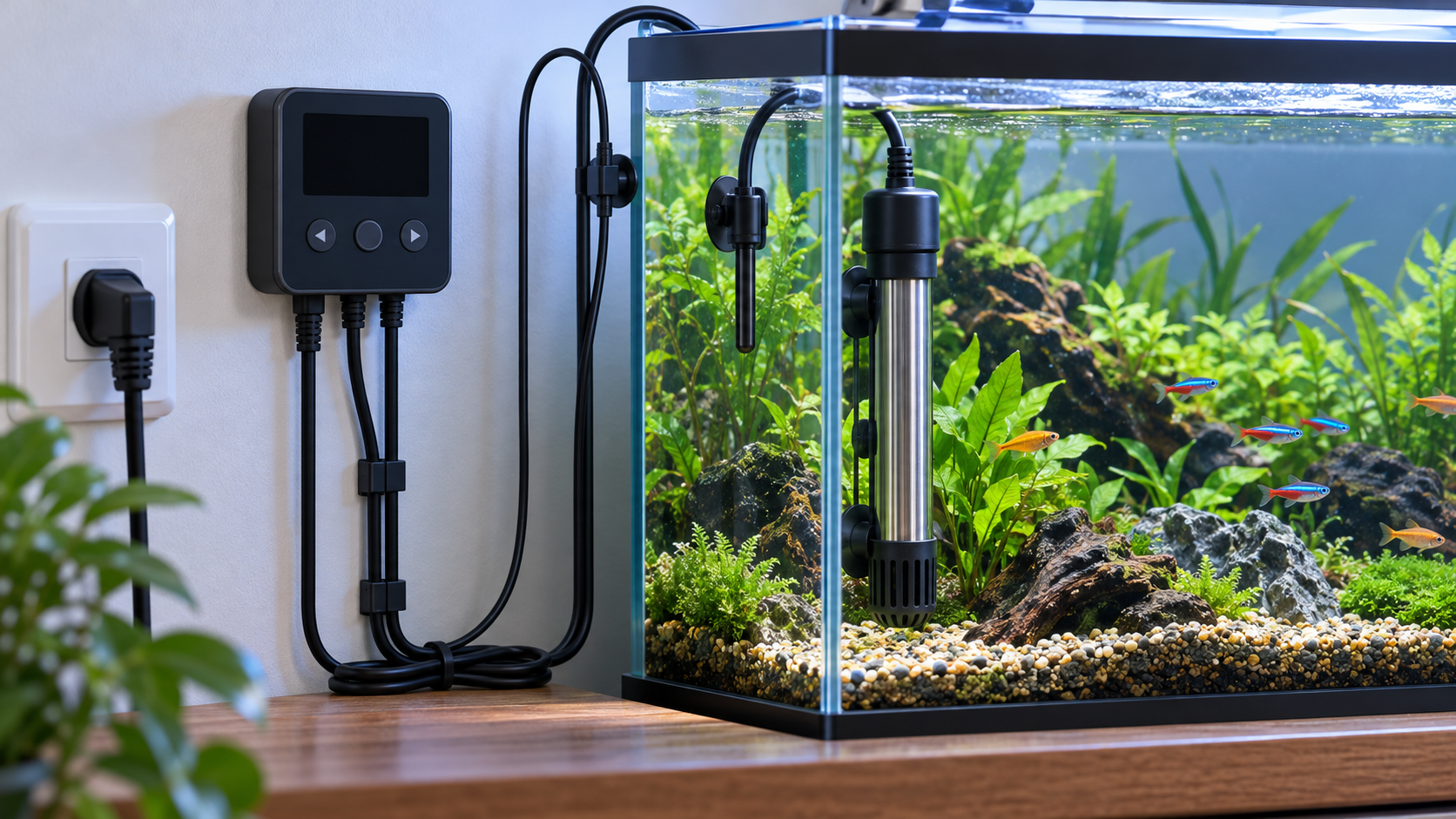
Place the heater in a spot with good water flow, and keep it away from the outlet of the filter. Hang or position the controller outside the water, where you can read the display, and keep the cable clear of the tank rim. Set the temperature a degree or two at a time and wait for the water to settle before changing it again. Check the reading with a separate thermometer for the first week.
Plan for the room temperature as well. A heater works against the room. In a cool room it will run more often, and in a warm room it may not reach the set point. Choose a wattage with a margin for the coldest part of the year where you live.
Unplug the heater before any water change, and let it cool before you move it. Never run a heater out of water, even for a moment. Most heaters in this group have overheat or low-water protection in the listing, but the protection is a backup, not a reason to skip the checks.
Why a stable temperature matters for a betta
Fishkeeping Advice recommends keeping a betta tank between 75 and 80 degrees Fahrenheit, and it notes that water below 74 degrees is too cold for a betta’s health. A heater is the most reliable way to hold that range in an indoor tank, because room temperature changes through the day. The same guide says a heater also evens out sudden swings, which matter as much as the exact number on the dial.
Tankarium makes the point directly: if the water temperature gets too hot or too cold, a betta can go into temperature shock. Sunlight on the tank causes fast changes in water temperature, so a heater does not solve the problem on its own. Keep the tank out of direct sun, away from windows and vents, and let the heater do the steady work.
A heater dial is not a thermometer
The NT Labs guide explains why a separate thermometer is worth having. In a typical aquarium heater, the heating element sits directly under the thermostat, so the heater can read the water next to its own element rather than the water across the tank. The result can be a reading that does not match the true water temperature. An independent thermometer gives a second reading that does not depend on the heater.
Place the thermometer at the end of the tank away from the heater, so it reads the average water temperature rather than the water around the heater. Read both the heater and the thermometer at the same time each day for the first week. If the two readings stay apart by the same amount, adjust the set point on the heater or the controller to close the gap. If the gap grows or changes from day to day, replace the heater.
Placement, the room and the cable
Put the heater where water flows past it, but not directly in the outflow of the filter, which can stop the heater from warming the water evenly. Keep the element fully under the water, and never run the heater out of water. Leave the cable free of the tank rim so it does not pull the heater, and use a drip loop so that water runs away from the outlet.
The room affects how often the heater runs. In a cool room, a heater works longer to hold the set point, and in a warm room it may switch off for long periods. Choose the wattage with the coldest room in mind, and check the temperature on a cold night as well as a warm afternoon.
Common mistakes with heater controllers
- Choosing by wattage alone, without checking the gallon range on the listing.
- Setting the temperature in one step, rather than adjusting by a degree or two and waiting for the water to settle.
- Trusting the dial without a separate thermometer for the first week.
- Placing the heater in the filter outflow, so the heated water is blown away from the heater.
- Leaving the tank in direct sunlight, which can push the temperature up faster than the heater can hold it down.
A simple first-week routine
On the first day, set the heater to the temperature you want and let it run for a few hours before you judge it. Read the thermometer at the same time each morning and evening, and write both readings down. On the third and seventh days, check whether the readings have settled. If the water is still moving away from the target after a week, check the placement, the room and the thermometer before you change the heater.
Types of heater and what to look for
Fishkeeping Advice states that submersible heaters are the most common type of aquarium heater, and it describes them as the usual choice for a tank that is kept indoors. It also says that aquarium heaters are the most reliable way to hold a stable temperature in a betta tank. A submersible heater sits in the water, which is why its element must stay fully covered at all times.
The same guide describes a feature to look for: overheat protection and water shortage protection. A heater with these features stops heating if the water becomes too warm or if the heater is not fully under the water. Both protections are worth checking on the listing before you buy, because a heater that runs dry can be damaged quickly. Choose a model that states both protections, and keep the level of the water above the heater’s marked limit.
How we chose
We used the five heater controllers in the site’s verified product set. We kept products whose listings describe a heater with a controller or a digital display. We recorded the wattage, tank range, control type and item weight each listing states. We did not rank the heaters by reviews, ratings or sales, because this site does not use those figures.
What we could not verify
- The listings do not give tested accuracy for the temperature controllers, so the readings cannot be compared against each other.
- Not every listing gives a tank range, and the HiTauing listing gives none.
- No listing states the heater’s life expectancy, so long-term reliability cannot be compared.
- Whether a heater suits a particular room depends on the room temperature, which the listings do not cover.
FAQ
What temperature should a betta tank be?
Many betta keepers aim for a steady, warm temperature rather than a fixed number. Choose a heater that can hold the set point you pick, and check the reading regularly so that a sudden change is noticed early.
Can I use a heater without a controller?
A heater without a controller may work, but it gives less control. A heater with a controller lets you set the temperature and read it, which is why this guide focuses on controller models.
How do I know the heater is working?
Check the temperature with a separate thermometer. A heater that is working should keep the water near the set point. If the reading drops or climbs well past the set point, check the heater and the controller.
Should I use a heater in a saltwater tank?
Some listings describe use in saltwater as well as freshwater. Check the label for the intended use, and follow the manufacturer’s instructions for the tank type.
Bottom line
For a small betta tank, the hygger 50 W heater suits the size and the controller. For a small tank with a digital read-out, the HITOP heater is the choice. For a medium tank, the NICREW 100 W heater fits the 10 to 20 gallon range. For a 15 to 30 gallon tank with a dial, the AQUANEAT heater is the simplest option.
For related guides on heating a betta tank, see Best Aquarium Heater for Betta Fish: 6 Safe Picks and Best Betta Water Heater for 5-Gallon Tanks.
Sources
- Fishkeeping Advice, do betta fish need a heater — opened October 27, 2026. Cited for the 75 to 80 degrees Fahrenheit target, the 74 degree lower limit, and the point about stable temperature.
- Tankarium, benefits of aquarium lighting for betta fish — opened October 27, 2026. Cited for the statement that a betta can go into temperature shock when water becomes too hot or too cold.
- NT Labs, do I need a thermometer when there is a heater — opened October 27, 2026. Cited for the point that a heater’s thermostat sits above its element and can misread the water.