Can Gouramis Live With Bettas? What to Know
As an Amazon Associate, this site earns from qualifying purchases. This guide contains no product links.
The person typing “can gouramis live with bettas” wants a yes or no, along with the reason. The sources checked for this guide do not answer that question for these two species. They describe gouramis as labyrinth fish, explain that established fish can attack newcomers, and describe ways to reduce that aggression when fish are added. Those points help a keeper judge the risk, but they do not show that the pairing is safe. This guide sets out what the sources support and what needs a specialist’s advice.
Quick answer
- The sources checked do not say whether gouramis and bettas can live together. They do not name betta as a species in the gourami discussion.
- The UF/IFAS publication says “Labyrinth fish, also known as anabantoids, include gouramis and paradisefish,” so gouramis belong to the same broad group of air-breathing fish.
- Merck says that “When new fish are added to the aquarium, the current residents sometimes respond aggressively, chasing or attacking the new fish.”
- Before adding either fish to a shared tank, check the space, the temperament of each fish, and the plan for separating them if fighting starts. Speak with an experienced fish keeper or an aquatic vet.
What gouramis are
Gouramis are freshwater fish from Asia. The UF/IFAS publication on freshwater ornamental fish notes that “Gouramies are native to south and southeast Asia.” It places them in the labyrinth fish group. The same publication explains the name: “Labyrinth fish are named for the ‘labyrinth organ’ (modified gill) which is used like a lung to breathe atmospheric air.”
The group is wide. The publication says the family includes “about 134 species in 14 genera,” and that “Most species are relatively small (< 150 mm or 6 in) with the exception of the kissing gourami (about 300 mm or 12 in).” Size is one reason species differ in what they need. A small gourami and a large one do not carry the same risk to a tank mate.
The publication also describes breeding habits that matter in a community tank: “Many labyrinth fish are bubble nest builders, with the male maintaining the nest as well as guarding and caring for the eggs and fry.” Guarding a nest can make a male more territorial. That link is general guidance, not a finding from the sources, which do not say how often nest guarding causes trouble with other species.
What the sources say about aggression
The main concern in a shared tank is aggression. The Merck chapter on providing a home for fish explains the pattern: “When new fish are added to the aquarium, the current residents sometimes respond aggressively, chasing or attacking the new fish.” The chapter adds that “This is particularly true when space and territory in the aquarium are at a premium.”
The same chapter explains why the problem matters beyond the bite. “Aggressive behavior is stressful for all fish in the tank, so it is helpful to reduce aggression” is the point the chapter makes. Stress affects every fish in the tank, not only the target. A tank where one fish chases another all day is not a healthy setup, even if no fish is hurt.
Merck also notes that aggression is common in other groups. It says aggressiveness toward new fish “is common among freshwater cichlids and other larger (more than 3 inches [7.6 cm]) freshwater species.” The sources do not put gouramis or bettas in that list, so the guide does not claim either species falls into it.
Territory is the central idea. The Merck home chapter says decorations “allow fish to have their own territory.” When a tank has few hiding places and one open zone, the fish compete for the same space. Adding more decoration and more distinct zones is one way to lower competition, though the sources do not say it will stop a determined fish.
| Factor | What the sources support | What the sources do not say |
|---|---|---|
| Tank size | Space and territory at a premium raise aggression, per Merck | A minimum volume for a gourami and betta pair |
| Decor | Decorations help fish have their own territory, per Merck | How much cover each species needs |
| Adding fish | Residents may attack newcomers, per Merck | Whether the pairing works in any given tank |
| Breeding behavior | Many labyrinth fish guard nests, per UF/IFAS | How often nest guarding causes problems with other species |
How to add fish with less fighting
If a keeper decides to try a shared tank, the Merck chapter gives three methods for adding new fish. The first is to float the bag: “be sure to ‘float’ the bag with the new fish in it to allow the temperature of the water in the bag to equalize with the temperature of the water in the tank.” The chapter warns that “Adding the fish directly, without a gradual equalization of temperature, can cause shock and stress.”
The second step is to rearrange the decor while the bag floats. The chapter says this “helps break up established territorial markers, which may reduce territorial aggression.” The third method is to release the new fish in low light. The chapter says “A third technique is to release the new fish in the dark,” and it explains that most fish rest once the lights go out.
Feeding during the introduction is another method. The chapter notes that feeding the fish in the tank at the same time as the new fish are released “is often enough to distract the aggressive fish from bothering the new fish.” These methods help with a first introduction. They do not guarantee that two fish will live together for the long term.
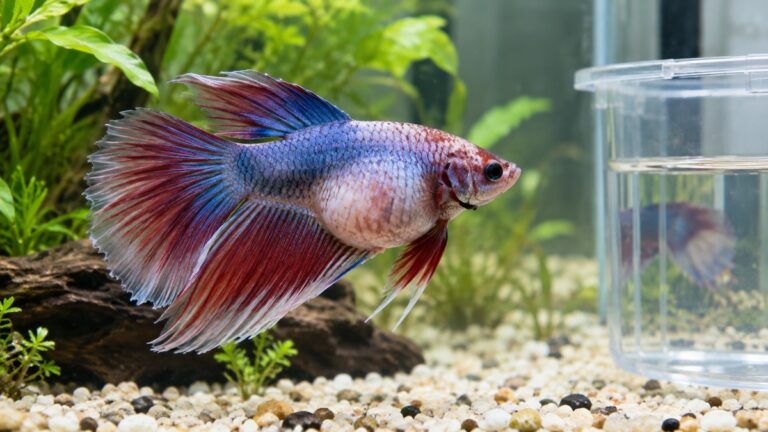
If the fighting does not stop, the chapter names the next step. It says “If the aggression persists, the fish can be separated with a clear plastic tank divider.” If that is not practical, it says “it may be necessary to remove either the aggressive fish or the new additions.” Plan that step before the purchase, because a second tank or a divider may be needed.
For a betta-specific comparison, the guide on tank mates for a male betta covers the same question from the betta side. The guide on betta tank mates in a 20 gallon tank covers a larger setup. Both are general guides, not a verdict on gouramis.
What to watch for in the first weeks
Watch the new fish and the residents closely in the first days. The Merck selection chapter describes healthy fish: “Fish should be swimming normally and steadily around the aquarium.” A fish that is chased constantly, hides for long periods, or stops eating needs action. The sources say “Diseased fish often swim erratically (circling or drifting around the tank) or appear listless,” so a stressed fish can look similar to a sick one.
Check for torn fins and marks on the body. Merck says healthy fish have fins that are “intact, not bloody or ragged.” Chasing that leaves marks on fins is a sign the pairing is not working. Remove the fish that is being hurt, or the aggressor, before the damage progresses.
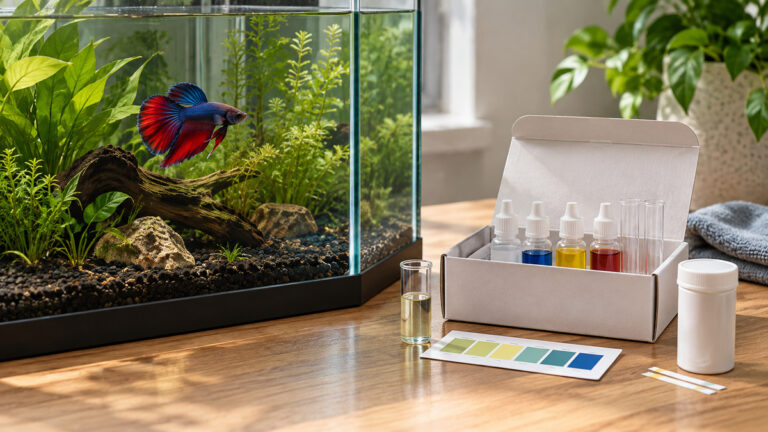
Keep the water tested. The Merck chapter says “Poor water quality is the most common cause of environmental-related diseases in fish,” and stress from a crowded or fighting tank makes water problems more damaging. A water test is a sensible step after any change to the fish in a tank.
General guidance outside the sources: a betta and a gourami in one tank are often a poor match, because both can be territorial and both are kept in small tanks. The sources checked do not say this, so treat it as a caution rather than a rule. The safest default is separate tanks unless a specialist advises otherwise.
How we chose
The sources in this guide were chosen because they are a university extension publication and a veterinary reference, not sellers. They were opened with curl on 2026-10-24 and read as text. The question has no product angle, so no product is recommended. The sections follow the order the sources use: what gouramis are, what they do, how aggression works, how to add fish, and what to watch for.
What we could not verify
The question about gouramis and bettas is not settled by the sources checked. The gaps below mark what this guide cannot say.
What the sources do not say
- The sources do not say whether gouramis and bettas can live together.
- They do not name betta fish in the gourami discussion.
- They do not give a minimum tank size or a stocking level for this pairing.
- They do not say which gourami species are more or less likely to fight with bettas.
Frequently asked questions
Are gouramis and bettas related?
The UF/IFAS publication places gouramis in the labyrinth fish group, which uses a labyrinth organ to breathe air. Bettas are often described as members of the same wider group, but the sources checked do not name betta fish, so that link is general knowledge rather than a sourced finding. It does not show that the two species are compatible.
Will a gourami attack a betta?
The sources do not say. Merck describes aggression from residents toward new fish in general, and notes that it is more likely when space is limited. Watch the fish closely in the first days.
How big should the tank be for both?
The sources checked do not give a size for this pairing. Merck says space and territory limit fights, so a larger tank with more hiding places is the safer direction. Ask a specialist about a specific size.
Can a clear divider solve the problem?
Merck says “If the aggression persists, the fish can be separated with a clear plastic tank divider.” A divider can reduce contact, but it is a management step, not a cure, and it is not described for every tank.
Should a fighting fish be removed?
Merck says that if other options fail, “it may be necessary to remove either the aggressive fish or the new additions.” Removal is a decision for the keeper, and the health of the fish is the first concern. Ask an aquatic vet if the fish show injuries.
Sources
- UF/IFAS Extension, “Freshwater Ornamental Fish Commonly Cultured in Florida,” https://edis.ifas.ufl.edu/publication/FA054 (opened 2026-10-24)
- Merck Veterinary Manual, “Providing a Home for Fish,” https://www.merckvetmanual.com/all-other-pets/fish/providing-a-home-for-fish (opened 2026-10-24)
- Merck Veterinary Manual, “Selection of Fish,” https://www.merckvetmanual.com/all-other-pets/fish/selection-of-fish (opened 2026-10-24)
- Merck Veterinary Manual, “Disorders and Diseases of Fish,” https://www.merckvetmanual.com/all-other-pets/fish/disorders-and-diseases-of-fish (opened 2026-10-24)