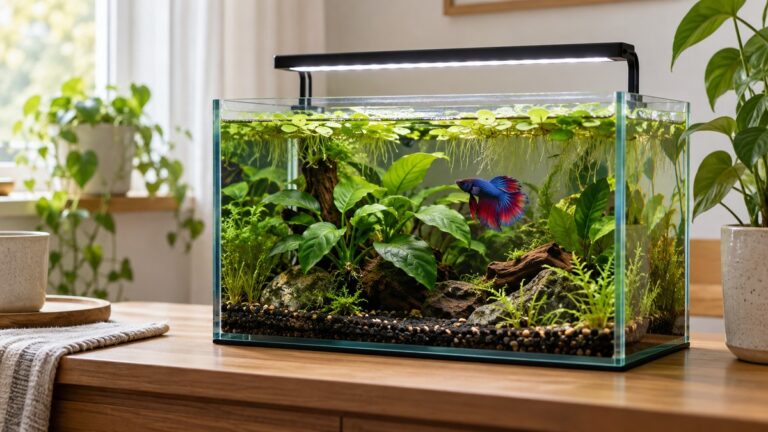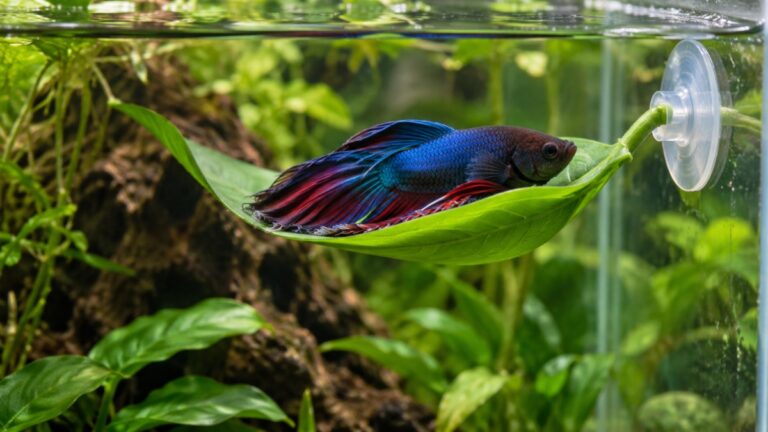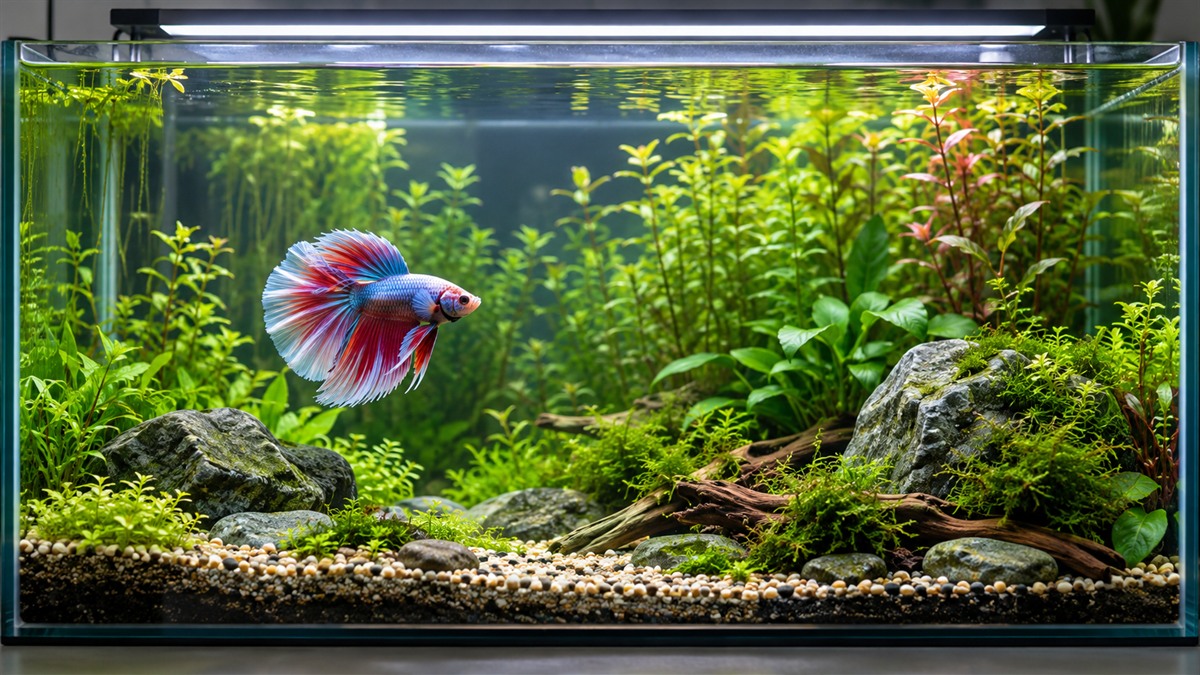
Best Real Plants for Betta Fish Tank: Three Kits That Support Growth
As an Amazon Associate we earn from qualifying purchases. Details
Real plants for a betta fish tank need light, stable water and a tank that gives them room. This guide compares the three kits in the data that meet this site’s minimum of 5 gallons for a single betta and whose listings say they support plant growth. None of these kits sells live plants. You choose and buy the plants separately, and the kit gives them a place to grow. Each card shows the listing’s stated volume, light, filter and included parts, along with its pros and cons. Read each card before you choose, because the three kits differ more in their light and filter than in their size.
Quick answer
Choose a tank of 5 gallons or more with a filter you can run gently, then pick the kit whose light and included parts suit the plants you plan to add. The Vimvins 5-gallon glass kit is the simplest starting point. The YHDSYN 6-gallon kit gives the most water and the most light modes. The HYUVCX 5.3-gallon kit is the tallest and includes a planting basket. None of the three includes a heater, so buy one before any betta or live plant goes in. Smaller kits in the data fall below the site’s minimum, so this guide does not recommend them.
What real plants need in a betta tank
A live plant has needs that a decor piece does not have. Four things matter most, and each listing answers them differently.
- Light. A live plant needs light to grow. The three kits describe LEDs that support plant growth, but none gives an intensity figure, so you cannot compare their output by a number. Compare them by the number of light modes, the brightness control and the color options.
- Tank volume. The site rule is a tank of 5 gallons or more for a single betta. Plants take up floor space and root room, so a larger volume gives them more room. The stated volume may be total capacity, not usable water, so leave room for gravel and roots.
- Heat and filter. A betta needs a stable temperature and a gentle filter. A plant needs stable water too, and sudden changes stress both plants and fish. The Vimvins and HYUVCX listings do not describe adjustable flow, and the YHDSYN listing names an adjustable pump, so check the flow on arrival.
- Oxygen and bacteria. Nitrifying bacteria need oxygen and alkalinity to work. UF/IFAS notes that when oxygen falls, these bacteria can stop functioning, and ammonia and nitrite levels rise. That guidance comes from aquaculture systems, but the same logic applies to a home tank.
- Plant choice. None of the three kits describes a live plant’s care, and the HYUVCX listing includes an aquatic plant without saying whether it is live. Pick plants by their own seller’s care line, and keep the betta’s tank rule in mind.
A betta does not need live plants to live well. A planted tank adds cover and a natural look, and live plants also take up nutrients from the water. Treat the plants as a bonus after the tank, heater, filter and light are right.
Quick comparison
The table lists the figures each listing states. “Not listed” means the listing does not name that part.
| Kit | Stated volume | Light | Included parts | Heater included |
|---|---|---|---|---|
| Vimvins 5-gallon glass | 5 gallons | Dimmable LED with 3 modes | Filter, light, custom lid | Not listed |
| YHDSYN 6-gallon | 6 gallons | 3-color LED with 9 brightness levels | Air pump, filter, light | Not listed |
| HYUVCX 5.3-gallon | 5.3 gallons | 3-color full-spectrum LED | Filter, light, planting basket, net, shells, pebbles, coral | Not listed |
The table shows a clear split. The Vimvins kit is glass, with a lid and the simplest parts list. The YHDSYN kit has the most water and the most light control, and it names an air pump. The HYUVCX kit is the tallest and the only one with a planting basket and a full set of decor items. None of the three lists a heater, so the heater cost is part of every choice.
The picks
Each card shows the listing’s specs, pros and cons. The cards are the only place this guide describes each kit.
1. Vimvins 5 Gallon Glass Small Fish Tank with Filter Light and Lid, Betta Aquarium Starter Kits (Best simple 5-gallon glass kit)
Specs from the listing (checked 2026-10-11):
- Tank Volume: 5 gallons
- Material: Glass
- Included Components: Filter, Light
- Special Feature: Self Cleaning
Pros
- The bullets say the dimmable LED lights simulate a natural light cycle and aim to promote the growth of aquatic plants.
- The kit includes a glass tank, a filter, an LED light and a custom lid in one box.
Cons
- No heater is listed, so you must buy one before a betta or a live plant goes in.
- The listing describes the light's aim but gives no intensity figure to compare it with other lights.
Best for: Owners who want a 5-gallon glass kit where the light is part of the setup from the start.
Skip if: You need a heater in the box.
View on Amazon (affiliate link)
2. 6 Gallon Betta Fish Tank, 7 in 1 Aquarium Starter Kits, Fish Tank (Best for the most water and light modes)
Specs from the listing (checked 2026-10-11):
- Tank Volume: 6 gallons
- Included Components: 6 Gallon Fish Tank, Air Pump, Filter, Light
- Item Highlight: LED Light, 4-Layers Hanging Filter, Betta Fish Tank with Adjustable Pump, Square Material, Filter Cotton, Hollow Balls
- Product Dimensions: 19.5"L x 8.4"W x 8.4"H
Pros
- The listing describes three light modes that mimic natural sunlight to support fish and plant growth.
- It offers nine brightness levels, and the listing's highlights name an adjustable pump and a four-layer hanging filter.
Cons
- The listing gives 6 gallons as the stated volume, and the usable water volume is not stated.
- No heater is listed, so plan to buy one before a betta goes in.
Best for: Owners who want the largest volume in this group and a light with several modes.
Skip if: You need a glass tank, or a heater included in the box.
View on Amazon (affiliate link)
3. 5.3 Gallon Fish Tank, Betta Fish Tank, Starter Kit, Aquarium for Beginner (Best tall kit with a planting basket)
Specs from the listing (checked 2026-10-11):
- Tank Volume: 5.3 gallons
- Product Dimensions: 8.27"L x 8.27"W x 18.74"H
- Included Components: bare tank*1, LED full spectrum 3 color light*1, 3 modes filter*1, hydropics basket*1, fishing net*1, aquatic plant*1, shell*6, packet of pebbles*1, coral*1
- Item Highlight: LED Full Spectrum 3 Color Light, 3 Modes Filter, Hydroponic Basket, Fishing Net, Shells, Aquatic Plant, Coral, Pebbles
Pros
- The bullets describe a semi-open top with a hydroponic planting basket, which the listing says lets you combine fish with hydroponic plants.
- The LED is a full-spectrum light offered in three colors, according to the listing.
Cons
- The kit includes an aquatic plant, but the listing does not say whether it is live or artificial.
- No heater is listed, and the listing does not describe a filter flow that can be set.
Best for: Owners who want a tall tank with a planting basket and a light in one kit.
Skip if: You need a stated filter flow or a heater in the box.
View on Amazon (affiliate link)
How to choose
Choose by rule, and check the listing before you order.
- Choose the Vimvins kit if you want a 5-gallon glass tank with a light, a filter and a lid in one box. The bullets say the dimmable LEDs aim to promote the growth of aquatic plants.
- Choose the YHDSYN kit if you want the most water in this group and the most light control. The listing describes three light modes and nine brightness levels, and it names an adjustable pump.
- Choose the HYUVCX kit if you want a tall tank with a planting basket and decor included. Confirm the filter flow first, because the listing does not describe a flow setting.
- Skip any kit below 5 gallons on this site’s rule, even if its light looks suitable. The data includes smaller kits, such as a 3-gallon tank with a full-spectrum clip-on lamp that the listing says suits aquatic plant growth. Its volume is below the minimum, so it is not a pick.
- Skip all three if you cannot add a heater. A betta tank without a heater is not a safe default for this site.
The rule for all three is the same. Confirm the tank size, check the light and the filter, and add a heater before any live plant or betta goes in.
Worked example: a light schedule for live plants
Multiply the hours by the days in a week. Ten times 7 equals 70 hours of light each week. Keep that total in mind when you set the timer, and treat it as a starting point rather than a plant target.
Now compare a shorter day. Six hours a day gives 6 times 7 equals 42 hours a week. The difference between the two schedules is 28 hours, and it is the amount of light the plants receive each week under each choice. Neither number is a plant requirement, because the listings do not give one. Watch the plants and the fish, and adjust the schedule in small steps.
A plant that gets too much light can grow algae on the glass and leaves, and a plant that gets too little may fade. Change the schedule slowly, and let about a week pass between changes so you can see the effect.
Setting up for live plants
The steps below are general guidance for any planted tank, not a claim from a listing. Follow the manufacturer’s instructions for each part.
- Rinse the tank, the substrate and any decor with clean water. Do not use soap.
- Install the heater and the filter before you add the plants, and set the flow to a gentle level for the betta.
- Plant live plants in the substrate, or anchor them as their care line describes. Keep the taller plants toward the back.
- Start the light on a short schedule, and increase it slowly over several weeks as the plants show they need more.
- Run water tests through the first six to eight weeks, because a new tank needs that time for its biofilter to build up.
- Add the betta after the water readings are stable, and watch the plants and the fish for the first two weeks.
Test the equipment before the plants arrive
Run the light and the filter outside the tank for a few minutes before you add any plant or fish. Watch for buzzing, heat at the housing or a loose plug. Dry every part before it goes back into the water, and keep electrical connections above the waterline.
Check the seal on the tank and the fit of the lid. A lid that does not sit flat lets water evaporate and lets a curious fish jump out. The listings describe lids and covers, but they give no test for how well each one seals, so check it yourself.
Plan where the plants will go before you unpack them. Measure the floor and the back wall, mark the spots for the taller plants, and keep a clear lane for your betta to swim. Live plants often arrive wet and packed tightly, so give them a rinse and trim any damaged leaves before planting.
Mistakes to avoid
- Buying a kit by its light alone. Light matters, but the filter, the volume and the heater decide whether the setup is safe for a betta. Compare the whole kit.
- Adding plants before the heater is running. A betta needs a stable temperature. A plant added before the heater is running can be stressed by the first changes in water.
- Running the light all day. A betta and a plant both need a dark period. Set a timer and keep the schedule steady.
- Assuming the kit’s plant is live. The HYUVCX listing includes an aquatic plant, but it does not say whether the plant is live or artificial. Ask the seller before you assume it will grow.
- Skipping the water test. Plants do not remove the need to test. Test the water in the first weeks and after you add the betta.
FAQ
Which kit is best for live plants?
The best kit is the one whose volume, light and parts suit your plan. The Vimvins kit is the simplest. The YHDSYN kit gives more light control and more water. The HYUVCX kit gives a planting basket and a tall tank. Check each listing’s light and filter before you choose.
Do I need a light for a real plant in a betta tank?
Most live plants need light to grow. The three kits describe lights that support plant growth, but none gives an intensity figure. Check the light needs of each plant you buy, and match the light schedule to them.
Can I buy plants from one of these listings?
No. None of the three kits sells live plants. Buy plants from a seller that describes its plants’ care needs, and keep the tank’s size and light in mind when you choose.
How long should the light run each day?
The data gives no single figure. Start with a short schedule, such as 6 to 8 hours, and increase it slowly. Watch the plants and the fish, and adjust in small steps.
Does a live plant replace a filter?
No. A plant can help with water quality, but it does not replace a filter. Keep the filter running at a gentle flow, and keep the heater on a stable setting.
How do I know the water is stable enough for plants?
Test the water. The UF/IFAS guidance on nitrifying bacteria says they need oxygen and alkalinity to work, and that ammonia and nitrite can rise when oxygen is short. Check your readings before you add the betta or a delicate plant.
Which tank is the easiest starting point?
The 5-gallon glass kit is the simplest starting point because it includes a filter, a light and a lid. Add a heater, and choose plants that suit a betta’s tank. The other two kits give more water or more decor, but they also need more room on a desk or stand.
Bottom line
Real plants need light, stable water and a tank that can hold them, and a betta needs a heated, filtered tank of 5 gallons or more. Among the kits in this guide, the Vimvins kit is the simplest, the YHDSYN kit has the most water and light control, and the HYUVCX kit has the most decor and a planting basket. Buy the live plants from a seller that describes their care, add a heater, and test the water before the betta goes in.
Related reading: best live plants for betta fish tank compares live options, best light spectrum for aquarium plants explains light choice, and best aquarium heater for betta fish covers the heater you will need.
Source notes: the nitrifying bacteria and oxygen points come from UF/IFAS, written for aquaculture systems. Treat them as context for a home tank, not as a direct rule.
Sources
- UF/IFAS: Ammonia in Aquatic Systems: nitrifying bacteria need oxygen and alkalinity, and a new biofilter takes six to eight weeks to build up.
- Wikipedia: Siamese fighting fish: bettas set up territories even when housed alone and enjoy a decorated tank.